

Geoffrin Clock "the Timetable" Louis XVI Style, Maison Denière, Paris, 19th Century
Artist: Deniére Paris
Geoffrin-style clock, "The Timetable," Louis XVI style, Maison Denière, Paris, 19th century.
Materials: Cast, chased, gilded, and patinated bronze; Paris porcelain plaques; clockwork elements; glass; enamel.
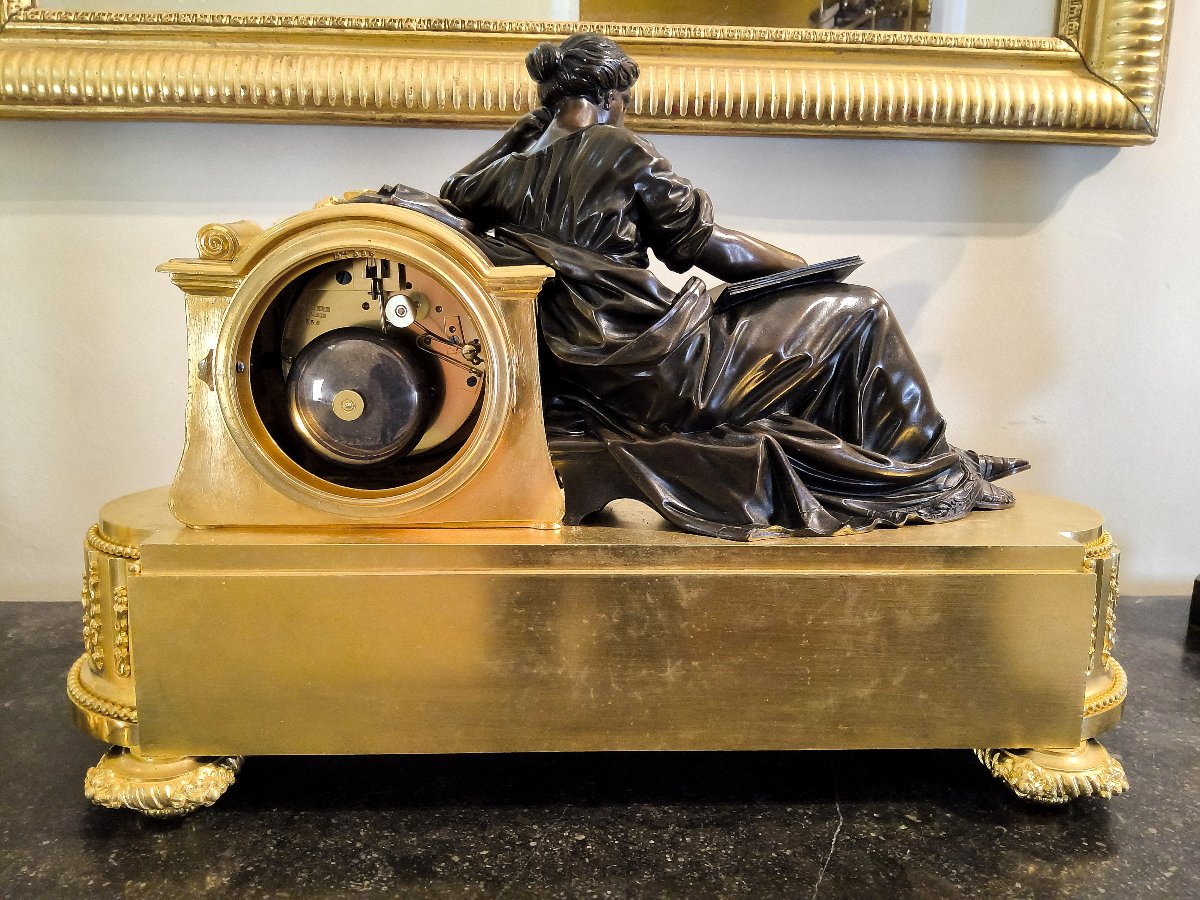
Condition report: Superb original mercury gilding in two matte and glossy tones. Magnificent, rich, and lustrous brown patina on the antique motif. Minor signs of age and use (typical of antique pieces). One small, flat, round glass panel for the movement access lens is missing from the back.
Dimensions: Height 33 cm, Length 47 cm, Depth 18 cm. Provenance: Val de Loire property. Private collection.
Denière in Paris: The Denière firm, founded in 1804 by Jean-François Denière (1774–1866) and taken over in 1844 by his son, Guillaume Denière (1815–1903), specialized in bronze furniture pieces, such as candelabra, firelighters, torches, clocks, and centerpieces. Building on its success, the Denière firm also collaborated with talented contemporary artists to produce their works. As bronze supplier to royal houses, Denière provided the bronzes for the coronation carriage of Charles X, made several deliveries for the Crown furniture during the July Monarchy, and produced numerous bronze furnishings for the Tuileries Palace during the Second Empire. Awarded a medal of honor at the 1855 Universal Exhibition, it received further recognition at the 1862 Universal Exhibition. His contributions to the Universal Expositions were always eagerly anticipated and recognized, on par with those of the Barbedienne firm.
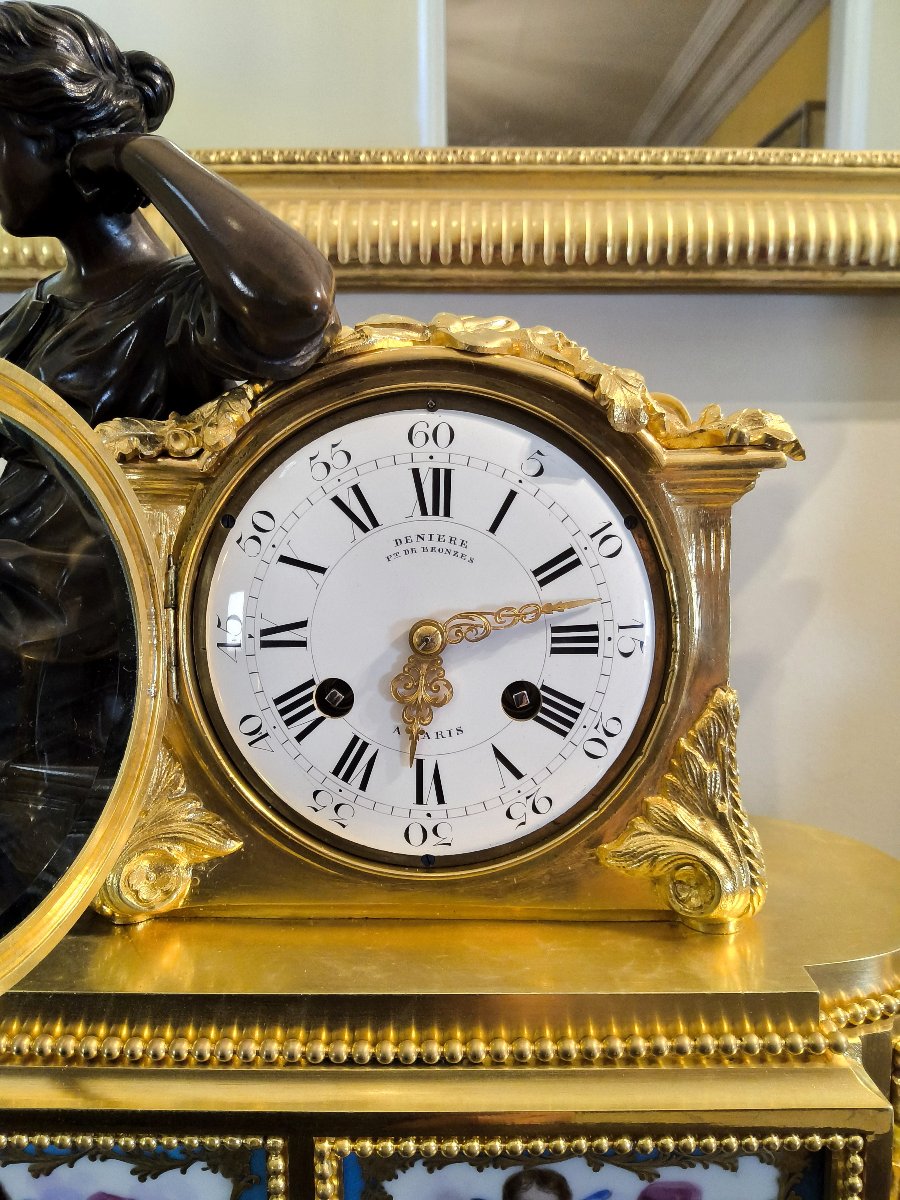
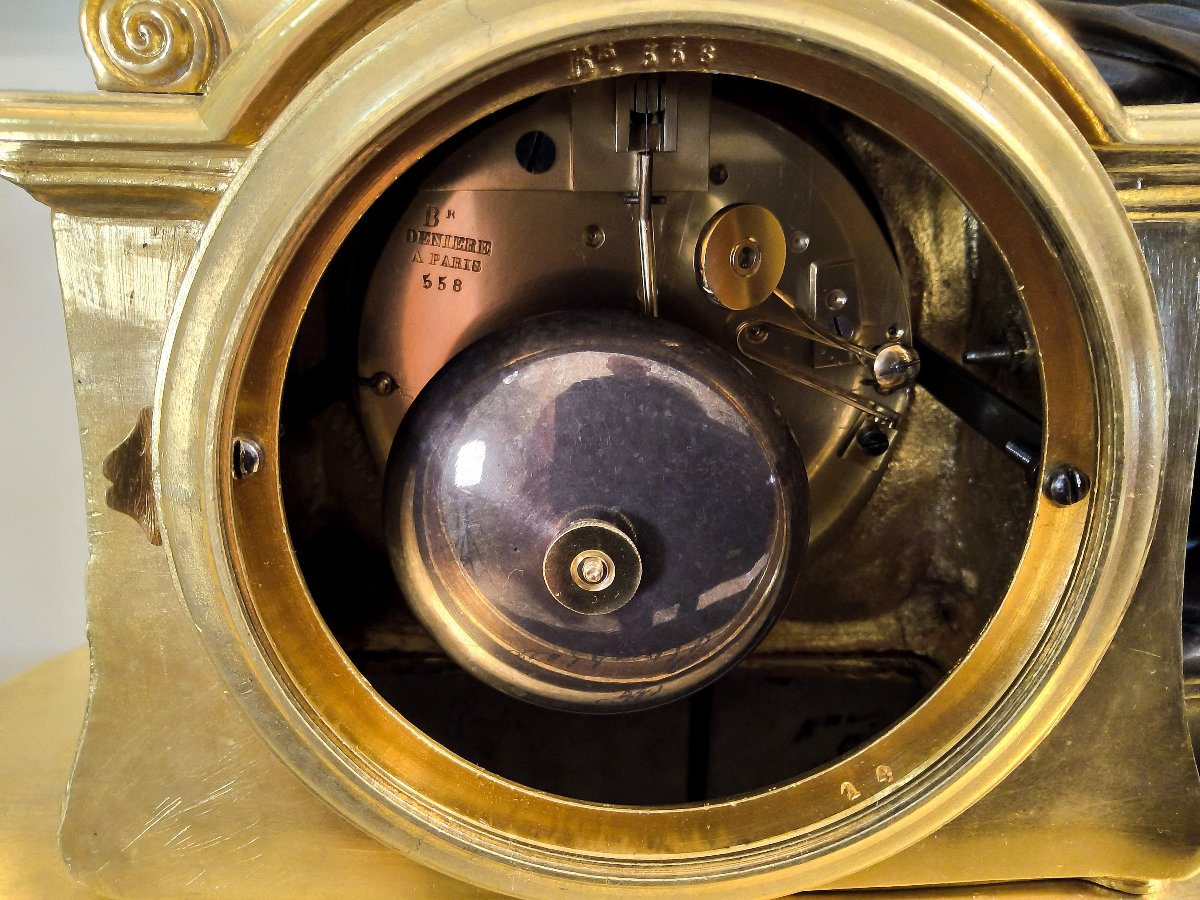
Signed Denière Paris on the enamel dial and clockwork plate. A rare Denière model in this composition.
High-quality movement by the watchmaker Pons in Paris. Gold medal 1827 on the movement (Tardy), one of the greatest watchmakers of the early 19th century. Supplier Juvenaux Paris. Fully serviced. Perfect working order. Strikes the half-hour and hour.
Composed of approximately forty different pieces (40 pcs) excluding clockworks.
Exceptional engraving.
Clock design:
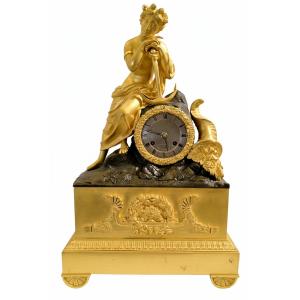
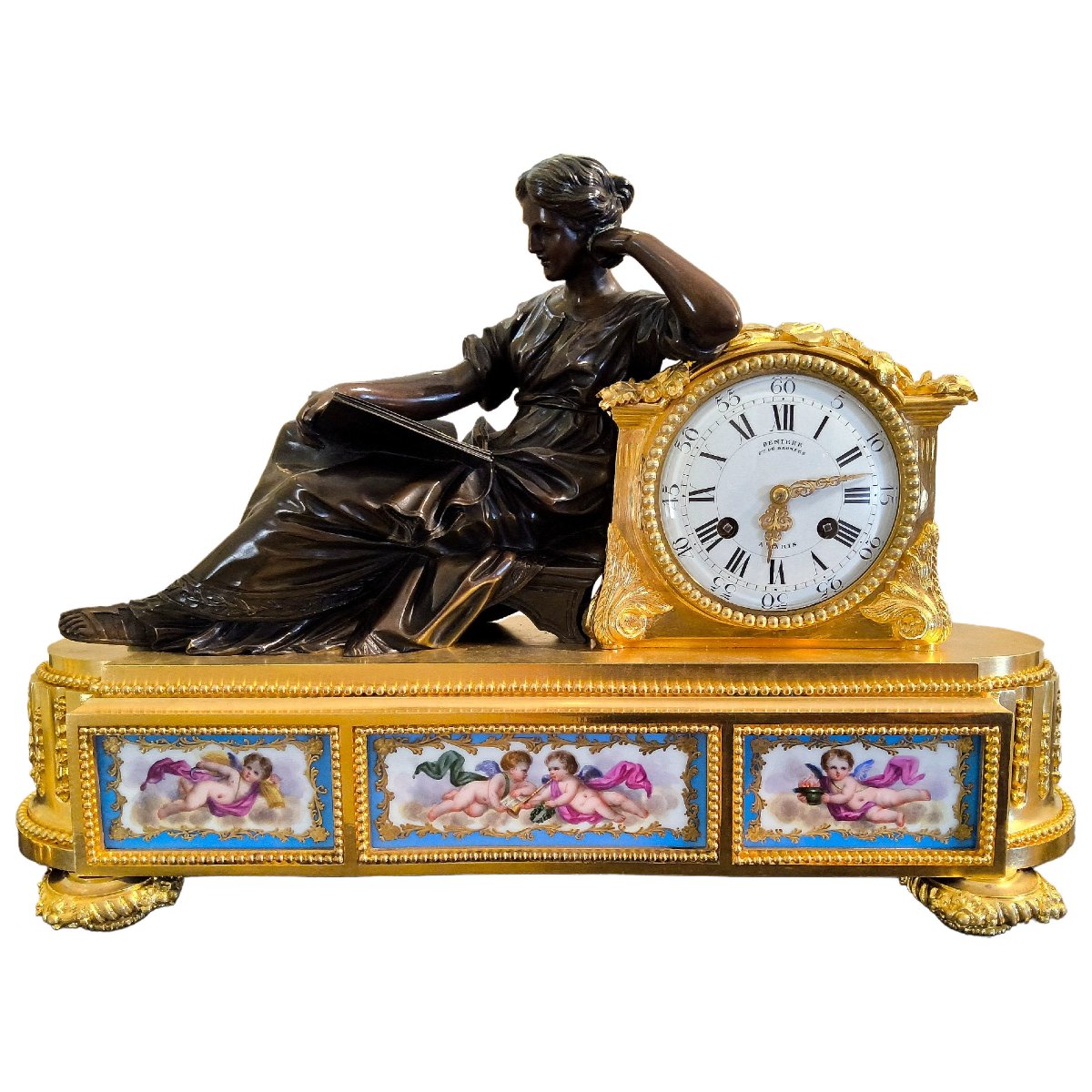
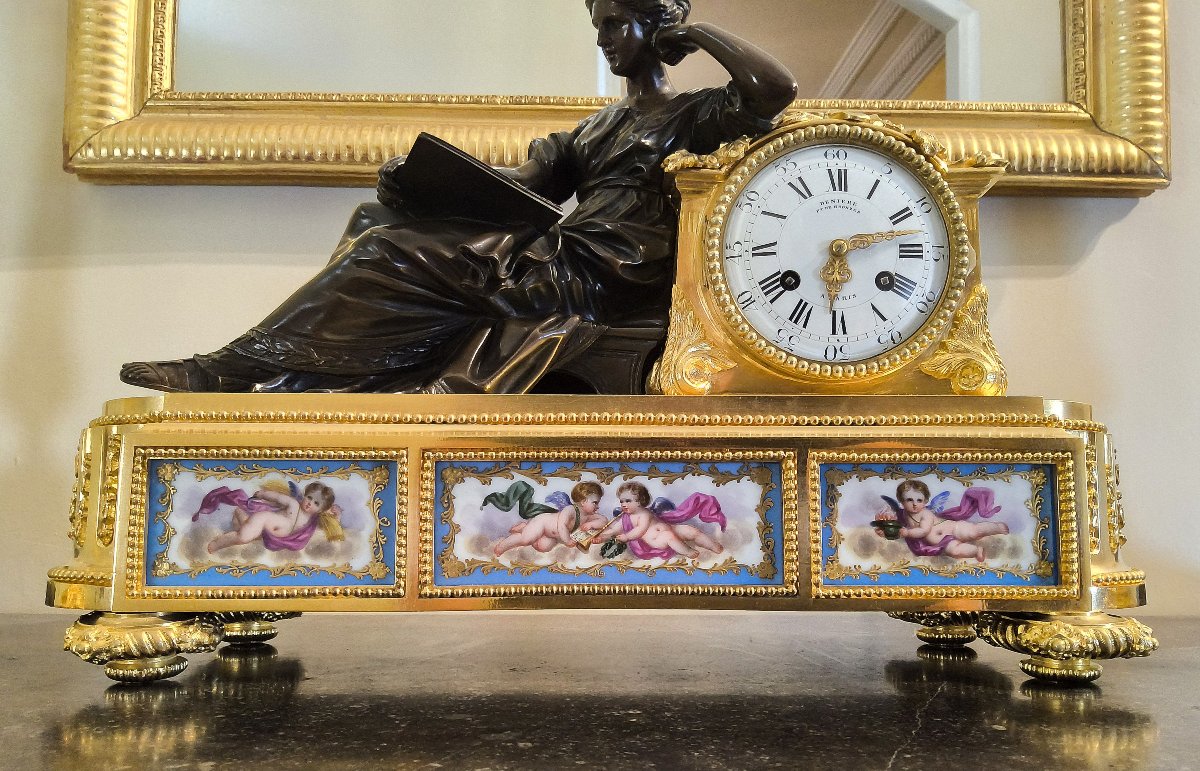
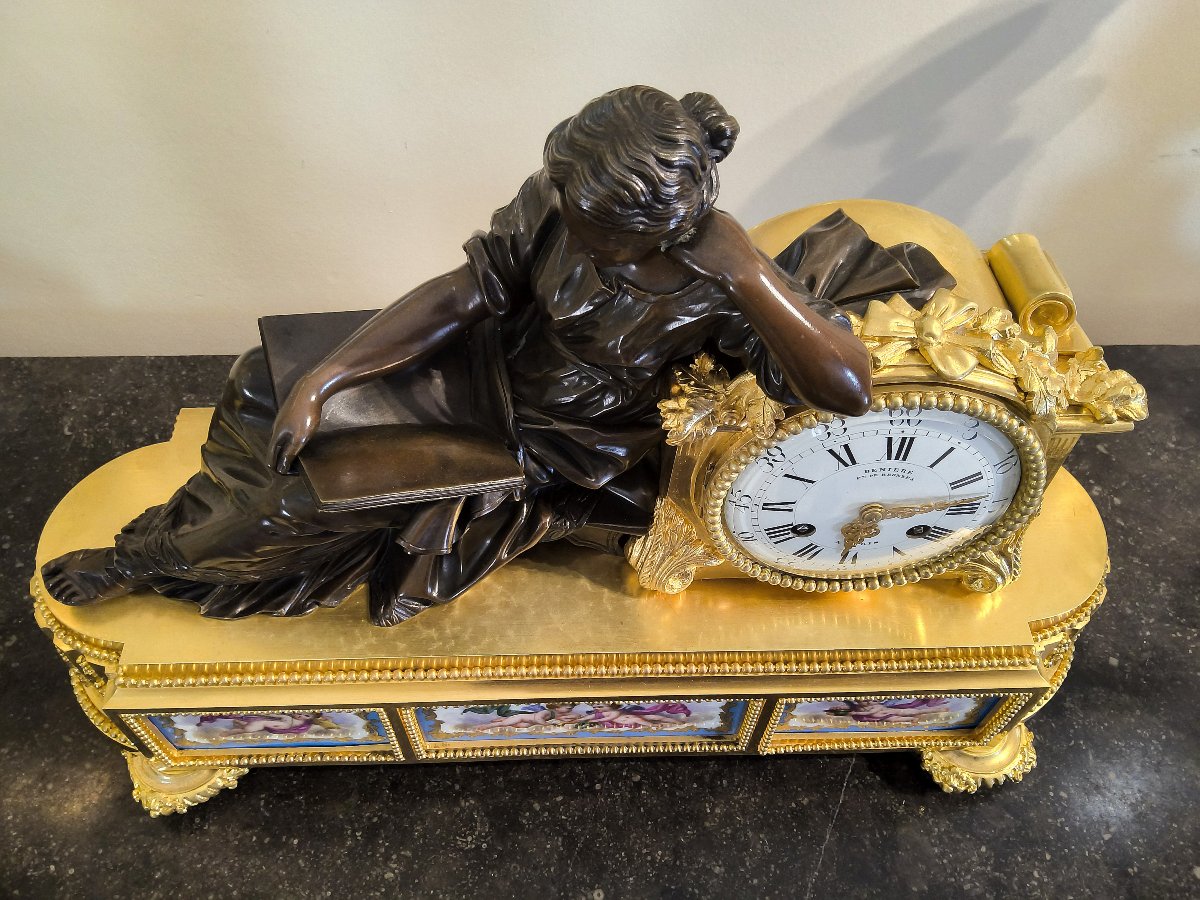
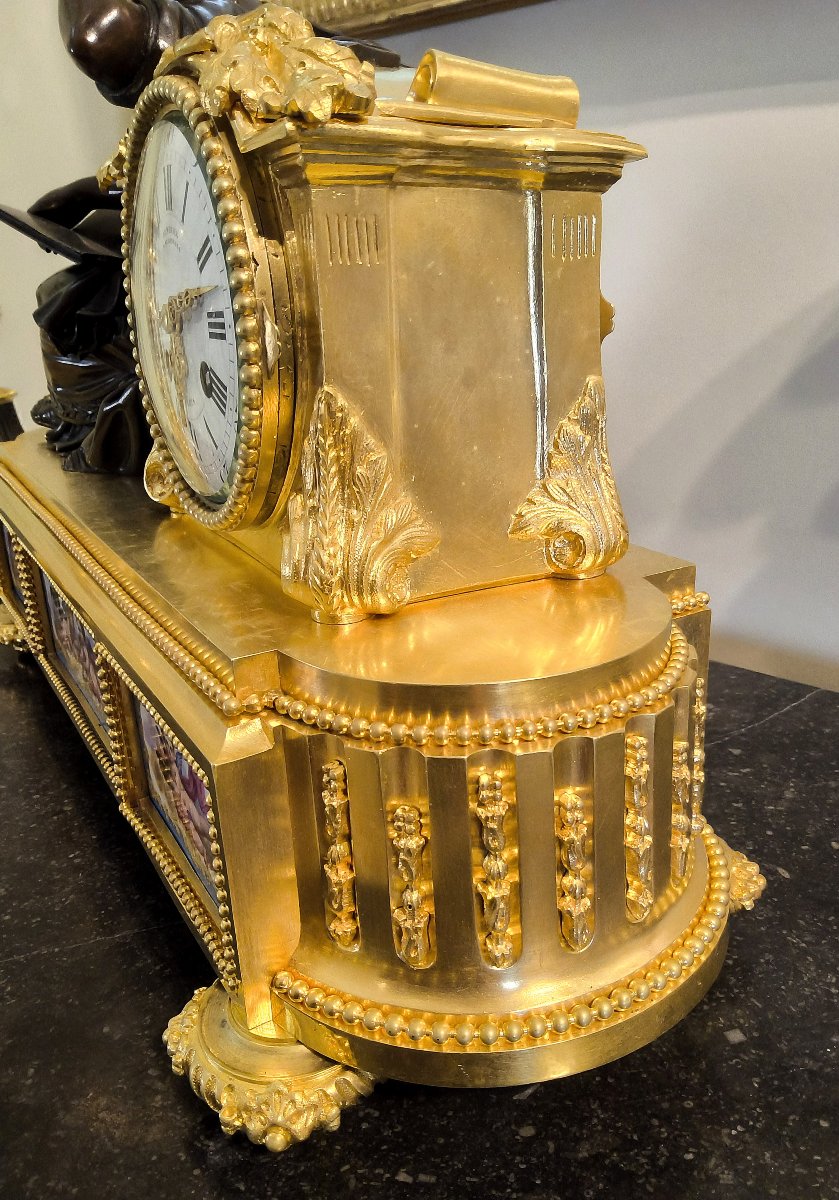
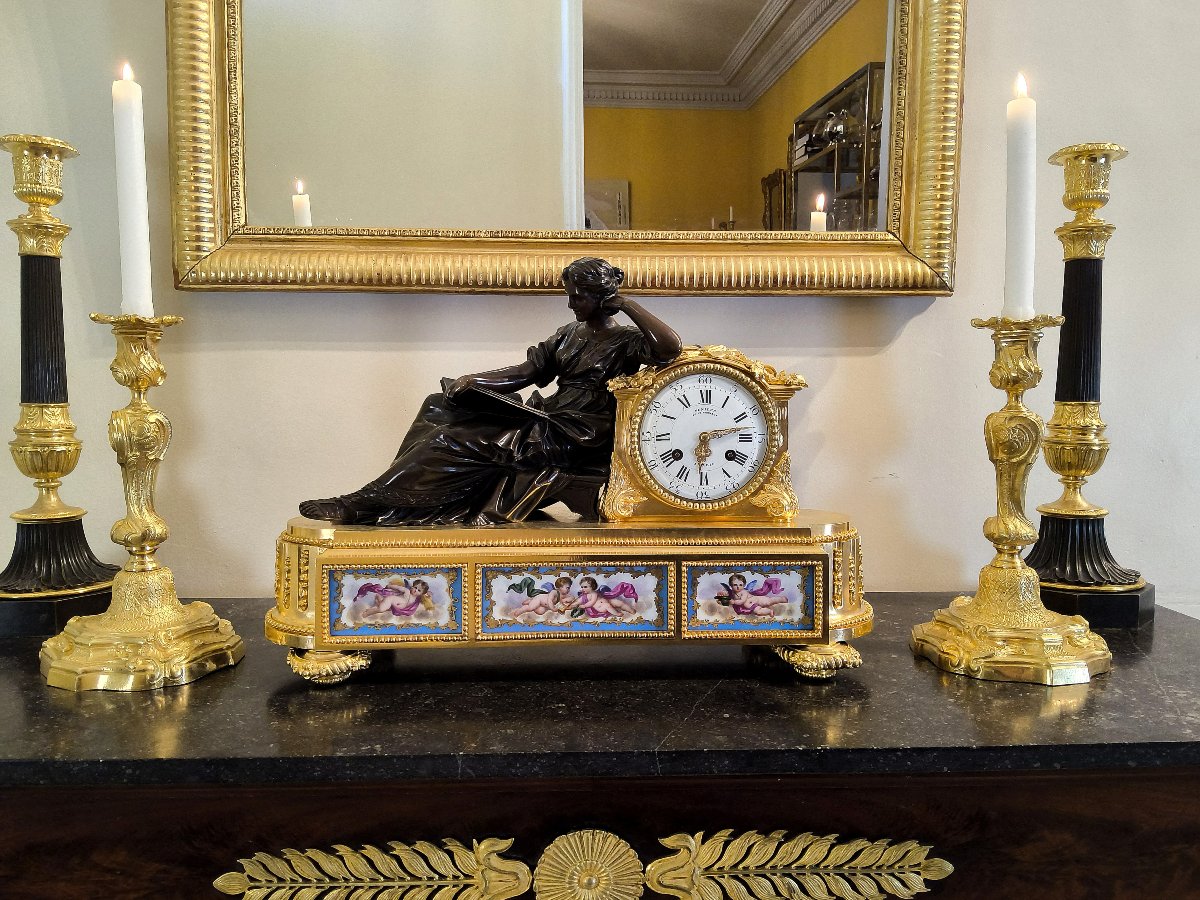
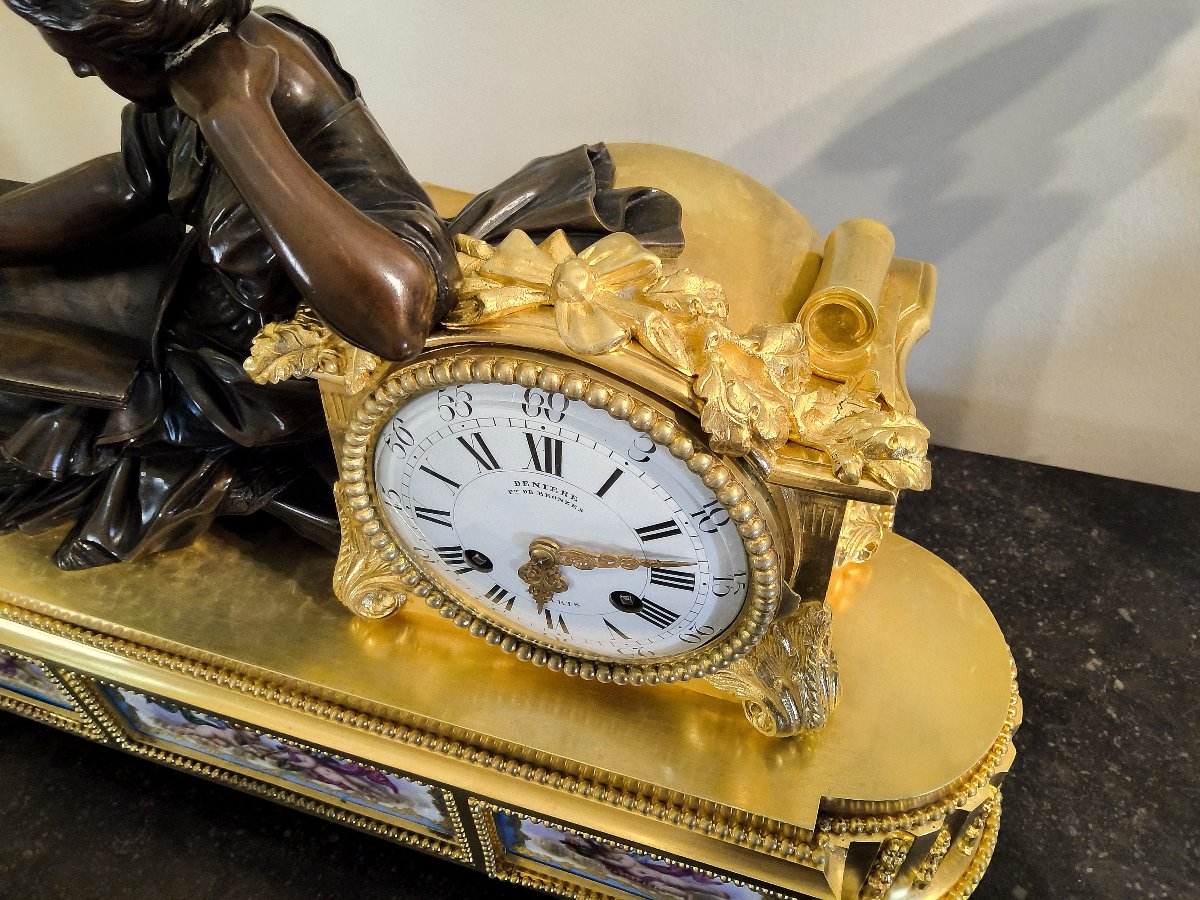
The clock depicts a young woman seated reading on a stool, leaning on a bollard. She is dressed in a draped antique gown and her hair is styled in a chignon. The female figure here symbolizes "Time Management." The clock is decorated with stylized acanthus leaves in the lower corners, while the upper part features a foliage motif, a ribbon, and a rolled parchment (a symbol of knowledge). The clock's movement is integrated into the clock, which is round with a domed glass bezel and beaded decoration. The enamel dial, in superb condition, displays Roman numerals for the hours and Arabic numerals for the minutes, along with a minute track.
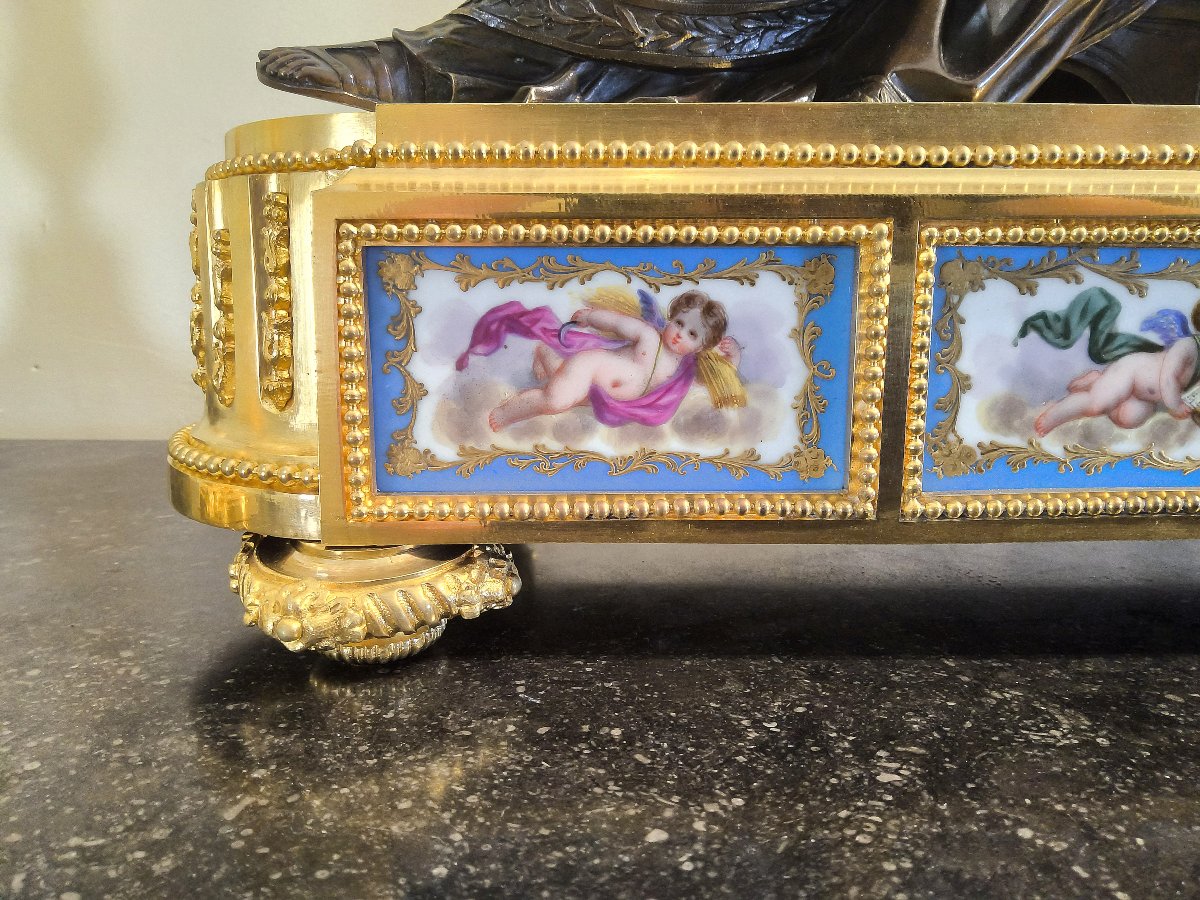
The entire piece rests on an exceptionally wide rectangular base (47 cm) with numerous moldings, including a flat surface, a cavetto molding, and beading. The sides are shaped like truncated half-columns with fluting and staggered antique-style moldings, and feature rich rounded moldings and beaded lines.
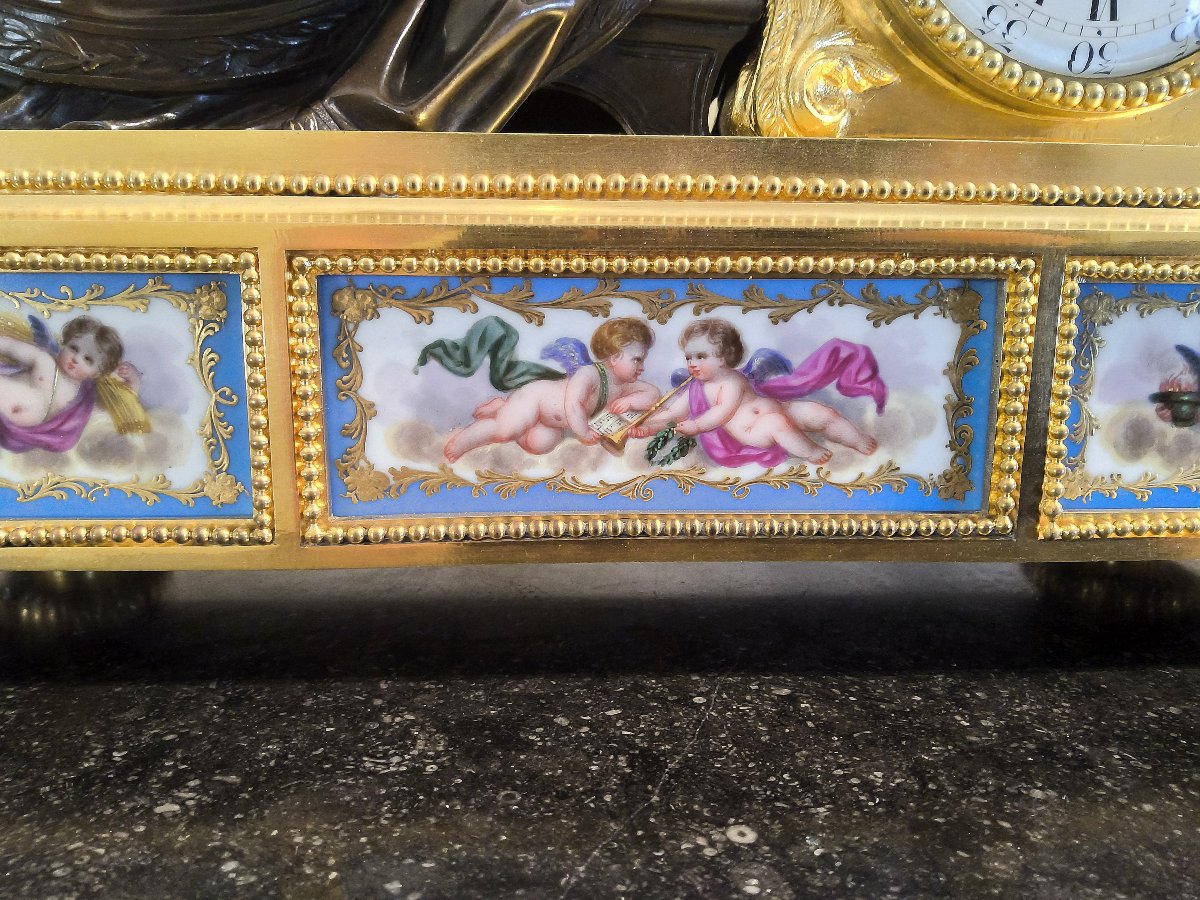
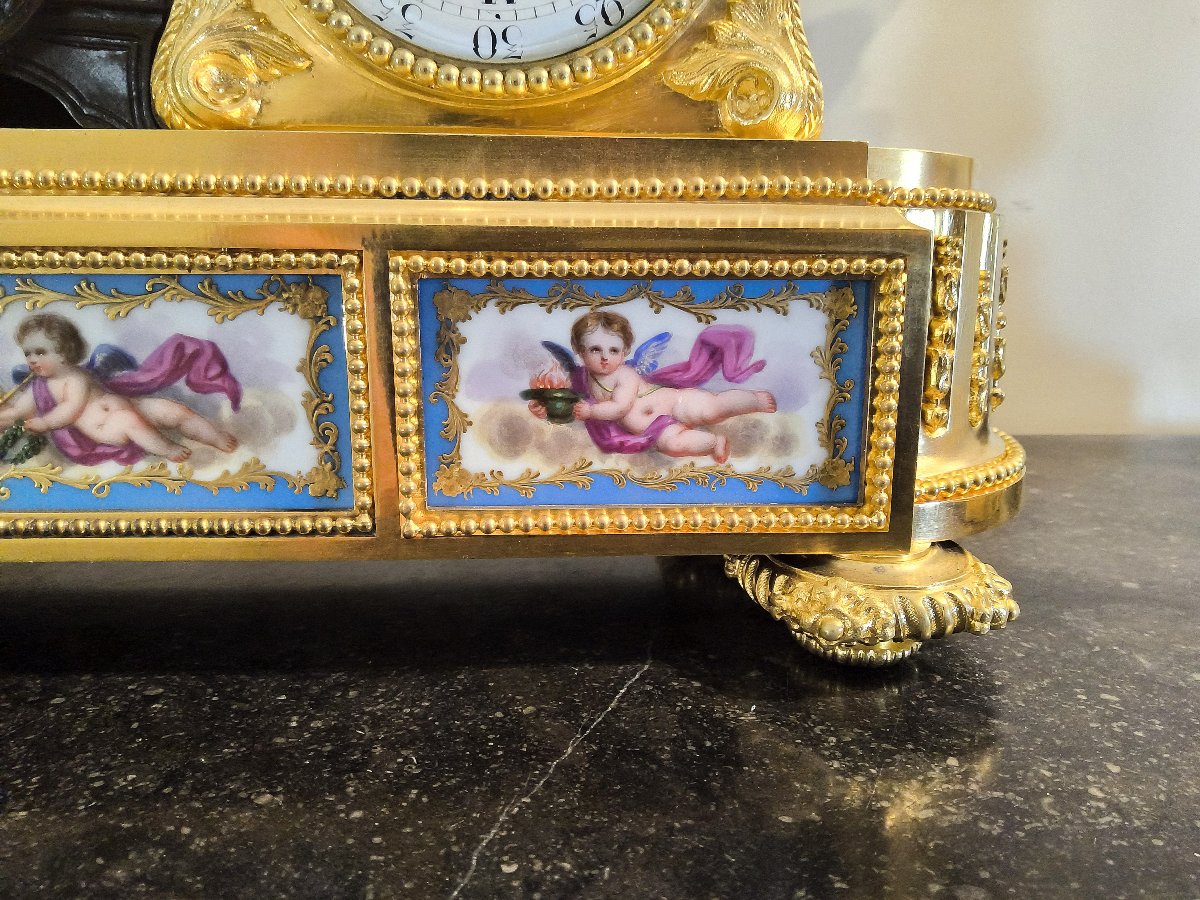
Like a triptych of paintings, the façade is adorned with three porcelain plaques from Paris, each decorated with winged cherubs arranged and carried on clouds (fine hand-painted), draped in the antique style.
One can distinguish a pair of musical cherubs in the central section, representing the Arts; a harvesting cherub on the left, a rich allegorical figure primarily linked to the cycles of nature and life, and the seasons; and on the right, a cherub with a fire pot. Fire is also the symbol of Enlightenment, of truth that dispels the darkness of ignorance. The cherub protects or presents this flame as a spiritual and intellectual guide.
These very fine plaques feature a beautiful sky-blue decoration and a gilded frieze framed with scrolls and floral motifs, enriched by a border of pearls and flat moldings. The whole piece rests on four elegant, flat, round feet adorned with rich moldings, fluting, and acanthus leaves.
Worldwide delivery. Secure packaging. Fast shipping. Responsive communication. Additional photos available upon request.
History:The original model of this clock, created by Laurent Guiard in 1754, is among the most influential designs of the second half of the 18th century and was featured in some of the most important collections of the period, notably that of the Marquis de Marigny, brother of Madame de Pompadour. Laurent Guiard (1723-1788) was a student of Edme Bouchardon and achieved brief renown in January 1754 for an equestrian statue of Louis XV. In September of the same year, he went to Rome to further his studies before becoming chief sculptor to the Duke of Parma.This model, both popular and timeless, owes its name to Marie Thérèse Rodet Geoffrin (June 26, 1699 – October 6, 1777), a Frenchwoman of modest origins who rose to a position of considerable influence in French society and held a prestigious salon. The first clock of this model was made for her, probably cast by the founder Edme Roy (master in 1745) after a design by Laurent Guiard (1723-1788) and fitted with a Musson movement. This model was known in the 18th century as "L'Emploi du Temps" (The Timekeeper).An identical example, with a Le Roy movement and resting on an ebony base, is kept at Waddesdon Manor. It is reproduced in G. de Bellaigue's *The James A. de Rothschild Collection at Waddesdon Manor*, Fribourg, 1974, vol. I, no. 17, pp. 104-107. Another example, with a Berthoud movement, also on an ebony base and adorned with a patinated bronze figure, is in the Wallace Collection, illustrated in P. Hughes, *The Wallace Collection, Catalogue of Furniture*, London, 1996, Vol. I, no. 1. 99 (F267), pp. 440-443.The success of the model designed for Madame Geoffrin (1699-1777) by the sculptor Laurent Guiard (1723-1788) and the founder Edme Roy (master in 1745) remained strong throughout the second half of the 18th century. Thanks to the intermediaries of the marchands-merciers (merchants and haberdashers), Julien Le Roy was the watchmaker who supplied most of the movements for this model: his signature can be found, in particular, on examples belonging to the Duke of Burgundy, the Count du Luc, Horace Walpole, the Duke of La Vrillière, the Marquis of Vintimille, the Duchess of Mazarin, and the Count of Besenval (C. Baulez, op. cit., p. 38).Today, a similar model by Julien Le Roy is preserved at Waddesdon Manor (G. de Bellaigue, *The James A. de Rothschild Collection at Waddesdon Manor*, Fribourg, 1974, Vol. I, no. 17, pp. 104–107).Bibliography:H. Ottomeyer and P. Pröschel, *Vergoldete Bronzen*, Munich, 1986, illus. pp. 160–161, the model illustrated fig. 3.3.1.C. Baulez, “La pendule à la Geoffrin, un modèle à succès,” *L'estampille l'objet d'art*, no. 224; April 1989, pp. 34–37.P. Kjellberg, *Encyclopédie de la pendule française du Moyen Age au XXe siècle*, Paris, 1997, the model illustrated p. 263 BOther illustrious collectors owned this clock in the 18th century, notably Horace Walpole at Strawberry Hill, the Duke of La Vrillière, and, above all, the Duke of Choiseul, chief minister to Louis XV and one of the greatest connoisseurs of his time, who even had it depicted on the gold snuffbox dated 1770-1771 in his octagonal drawing room, a snuffbox now in the Louvre Museum but considered the masterpiece of its kind.A similar model, with a marble base, is illustrated in G. de Bellaigue, The James A. de Rothschild Collection at Waddesdon Manor, Fribourg, 1974, vol. I, no. 17, pp. 104-107. Another example, with an ebony base, is illustrated in P. Hughes, The Wallace Collection, Catalogue of Furniture, London, 1996, vol. I, no. 99 (F267), pp. 440–443. A Geoffrin clock was also sold at Christie's Paris by the Dalva brothers on November 23, 2021, lot 18.Model reference: OSMOND Robert (1711–1789). After. Large Louis XVI style clock, "à l'étude," "à l'emploi du temps," or "à la Geoffrin" (because the first example was given by Diderot in 1768 to the writer Madame Geoffrin), in white marble, patinated brown bronze, and gilt, surmounted by a "Reclining Young Girl Reading a Book." Model after Robert OsmondModel in the Mobilier National collection, inventory reference GML 6349Jean-Marc Nattier, Portrait of Madame Goeffrin, oil on canvas, 1738, Fuji Art Museum, Tokyo.
Materials: Cast, chased, gilded, and patinated bronze; Paris porcelain plaques; clockwork elements; glass; enamel.
Condition report: Superb original mercury gilding in two matte and glossy tones. Magnificent, rich, and lustrous brown patina on the antique motif. Minor signs of age and use (typical of antique pieces). One small, flat, round glass panel for the movement access lens is missing from the back.
Dimensions: Height 33 cm, Length 47 cm, Depth 18 cm. Provenance: Val de Loire property. Private collection.
Denière in Paris: The Denière firm, founded in 1804 by Jean-François Denière (1774–1866) and taken over in 1844 by his son, Guillaume Denière (1815–1903), specialized in bronze furniture pieces, such as candelabra, firelighters, torches, clocks, and centerpieces. Building on its success, the Denière firm also collaborated with talented contemporary artists to produce their works. As bronze supplier to royal houses, Denière provided the bronzes for the coronation carriage of Charles X, made several deliveries for the Crown furniture during the July Monarchy, and produced numerous bronze furnishings for the Tuileries Palace during the Second Empire. Awarded a medal of honor at the 1855 Universal Exhibition, it received further recognition at the 1862 Universal Exhibition. His contributions to the Universal Expositions were always eagerly anticipated and recognized, on par with those of the Barbedienne firm.
Signed Denière Paris on the enamel dial and clockwork plate. A rare Denière model in this composition.
High-quality movement by the watchmaker Pons in Paris. Gold medal 1827 on the movement (Tardy), one of the greatest watchmakers of the early 19th century. Supplier Juvenaux Paris. Fully serviced. Perfect working order. Strikes the half-hour and hour.
Composed of approximately forty different pieces (40 pcs) excluding clockworks.
Exceptional engraving.
Clock design:
The clock depicts a young woman seated reading on a stool, leaning on a bollard. She is dressed in a draped antique gown and her hair is styled in a chignon. The female figure here symbolizes "Time Management." The clock is decorated with stylized acanthus leaves in the lower corners, while the upper part features a foliage motif, a ribbon, and a rolled parchment (a symbol of knowledge). The clock's movement is integrated into the clock, which is round with a domed glass bezel and beaded decoration. The enamel dial, in superb condition, displays Roman numerals for the hours and Arabic numerals for the minutes, along with a minute track.
The entire piece rests on an exceptionally wide rectangular base (47 cm) with numerous moldings, including a flat surface, a cavetto molding, and beading. The sides are shaped like truncated half-columns with fluting and staggered antique-style moldings, and feature rich rounded moldings and beaded lines.
Like a triptych of paintings, the façade is adorned with three porcelain plaques from Paris, each decorated with winged cherubs arranged and carried on clouds (fine hand-painted), draped in the antique style.
One can distinguish a pair of musical cherubs in the central section, representing the Arts; a harvesting cherub on the left, a rich allegorical figure primarily linked to the cycles of nature and life, and the seasons; and on the right, a cherub with a fire pot. Fire is also the symbol of Enlightenment, of truth that dispels the darkness of ignorance. The cherub protects or presents this flame as a spiritual and intellectual guide.
These very fine plaques feature a beautiful sky-blue decoration and a gilded frieze framed with scrolls and floral motifs, enriched by a border of pearls and flat moldings. The whole piece rests on four elegant, flat, round feet adorned with rich moldings, fluting, and acanthus leaves.
Worldwide delivery. Secure packaging. Fast shipping. Responsive communication. Additional photos available upon request.
History:The original model of this clock, created by Laurent Guiard in 1754, is among the most influential designs of the second half of the 18th century and was featured in some of the most important collections of the period, notably that of the Marquis de Marigny, brother of Madame de Pompadour. Laurent Guiard (1723-1788) was a student of Edme Bouchardon and achieved brief renown in January 1754 for an equestrian statue of Louis XV. In September of the same year, he went to Rome to further his studies before becoming chief sculptor to the Duke of Parma.This model, both popular and timeless, owes its name to Marie Thérèse Rodet Geoffrin (June 26, 1699 – October 6, 1777), a Frenchwoman of modest origins who rose to a position of considerable influence in French society and held a prestigious salon. The first clock of this model was made for her, probably cast by the founder Edme Roy (master in 1745) after a design by Laurent Guiard (1723-1788) and fitted with a Musson movement. This model was known in the 18th century as "L'Emploi du Temps" (The Timekeeper).An identical example, with a Le Roy movement and resting on an ebony base, is kept at Waddesdon Manor. It is reproduced in G. de Bellaigue's *The James A. de Rothschild Collection at Waddesdon Manor*, Fribourg, 1974, vol. I, no. 17, pp. 104-107. Another example, with a Berthoud movement, also on an ebony base and adorned with a patinated bronze figure, is in the Wallace Collection, illustrated in P. Hughes, *The Wallace Collection, Catalogue of Furniture*, London, 1996, Vol. I, no. 1. 99 (F267), pp. 440-443.The success of the model designed for Madame Geoffrin (1699-1777) by the sculptor Laurent Guiard (1723-1788) and the founder Edme Roy (master in 1745) remained strong throughout the second half of the 18th century. Thanks to the intermediaries of the marchands-merciers (merchants and haberdashers), Julien Le Roy was the watchmaker who supplied most of the movements for this model: his signature can be found, in particular, on examples belonging to the Duke of Burgundy, the Count du Luc, Horace Walpole, the Duke of La Vrillière, the Marquis of Vintimille, the Duchess of Mazarin, and the Count of Besenval (C. Baulez, op. cit., p. 38).Today, a similar model by Julien Le Roy is preserved at Waddesdon Manor (G. de Bellaigue, *The James A. de Rothschild Collection at Waddesdon Manor*, Fribourg, 1974, Vol. I, no. 17, pp. 104–107).Bibliography:H. Ottomeyer and P. Pröschel, *Vergoldete Bronzen*, Munich, 1986, illus. pp. 160–161, the model illustrated fig. 3.3.1.C. Baulez, “La pendule à la Geoffrin, un modèle à succès,” *L'estampille l'objet d'art*, no. 224; April 1989, pp. 34–37.P. Kjellberg, *Encyclopédie de la pendule française du Moyen Age au XXe siècle*, Paris, 1997, the model illustrated p. 263 BOther illustrious collectors owned this clock in the 18th century, notably Horace Walpole at Strawberry Hill, the Duke of La Vrillière, and, above all, the Duke of Choiseul, chief minister to Louis XV and one of the greatest connoisseurs of his time, who even had it depicted on the gold snuffbox dated 1770-1771 in his octagonal drawing room, a snuffbox now in the Louvre Museum but considered the masterpiece of its kind.A similar model, with a marble base, is illustrated in G. de Bellaigue, The James A. de Rothschild Collection at Waddesdon Manor, Fribourg, 1974, vol. I, no. 17, pp. 104-107. Another example, with an ebony base, is illustrated in P. Hughes, The Wallace Collection, Catalogue of Furniture, London, 1996, vol. I, no. 99 (F267), pp. 440–443. A Geoffrin clock was also sold at Christie's Paris by the Dalva brothers on November 23, 2021, lot 18.Model reference: OSMOND Robert (1711–1789). After. Large Louis XVI style clock, "à l'étude," "à l'emploi du temps," or "à la Geoffrin" (because the first example was given by Diderot in 1768 to the writer Madame Geoffrin), in white marble, patinated brown bronze, and gilt, surmounted by a "Reclining Young Girl Reading a Book." Model after Robert OsmondModel in the Mobilier National collection, inventory reference GML 6349Jean-Marc Nattier, Portrait of Madame Goeffrin, oil on canvas, 1738, Fuji Art Museum, Tokyo.
2 800 €
Period: 19th century
Style: Louis 16th, Directory
Condition: Excellent condition
Material: Bronze
Length: 47 cm
Height: 33 cm
Depth: 18 cm
Reference (ID): 1780526
Availability: In stock
Print