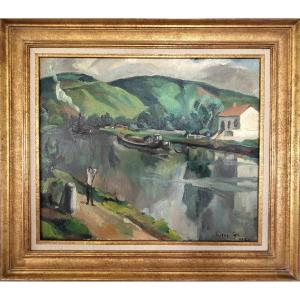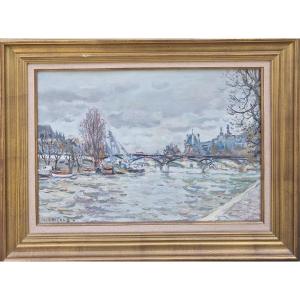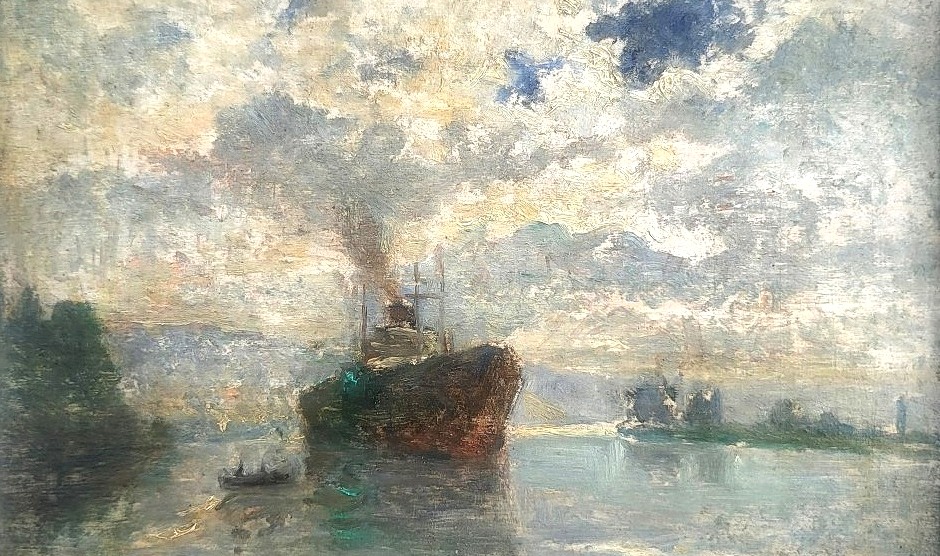
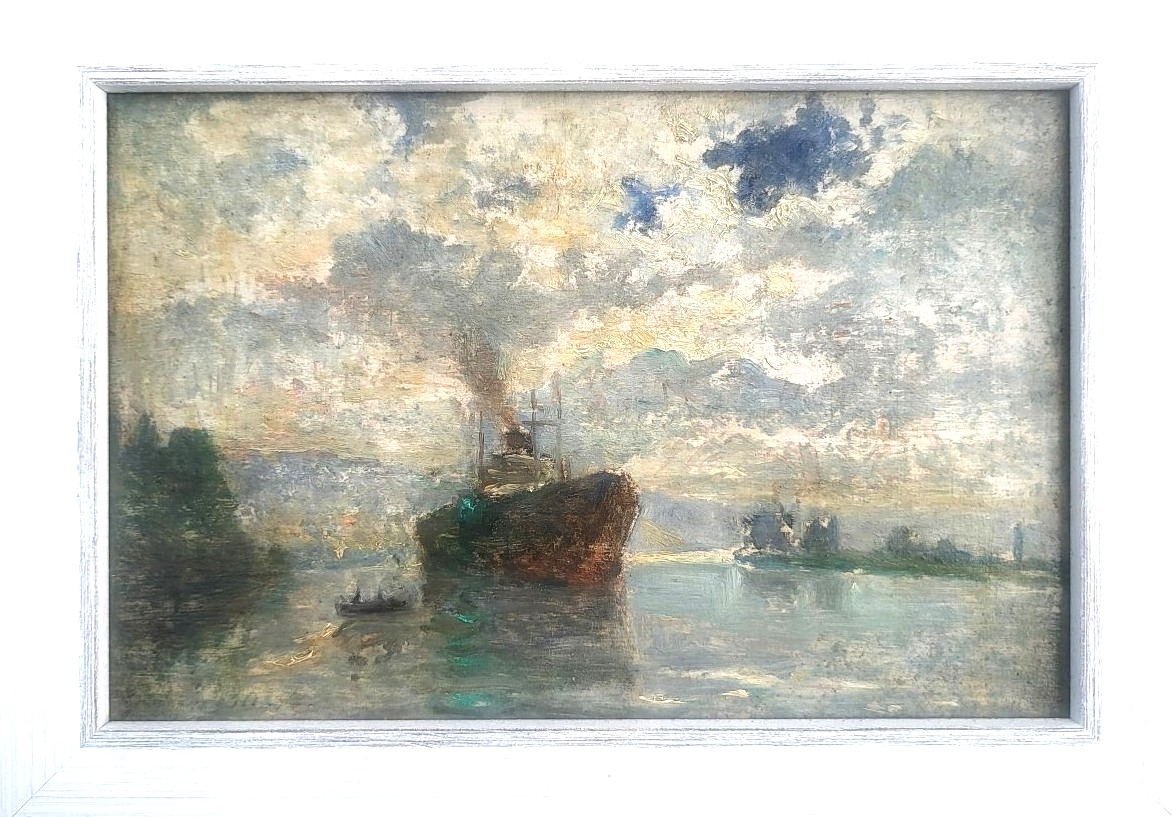
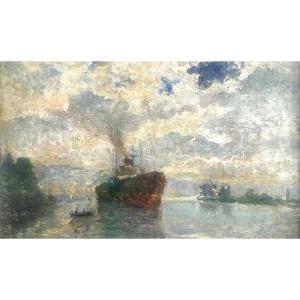


The Driver Change At Villequier
Oil on panel, 18.5 x 27
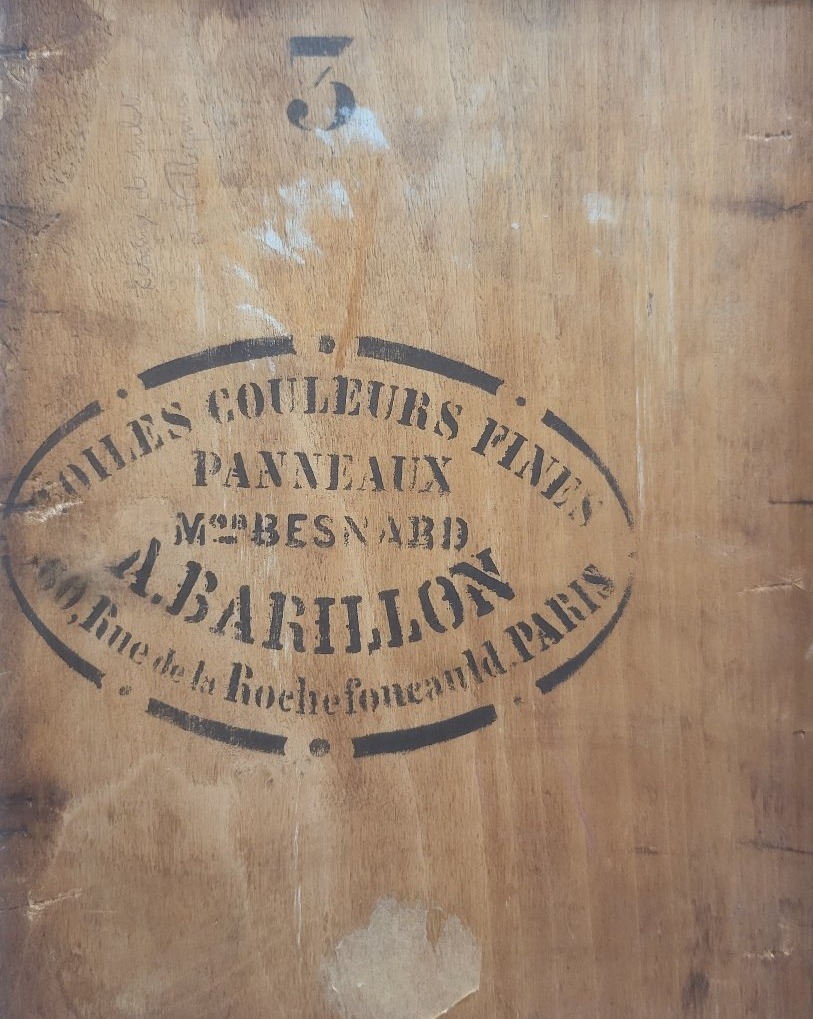
(Besnard art supply panel, A. Barillon)
Signed lower left (signature partially erased)
Very Good Condition
Sold framed
The Artist :
Georges Jules Ernest Binet, born in Le Havre on April 30, 1865, and died in Toulon on July 9, 1949, was a French painter.
Son of Jean Léon Adolphe Binet (1827–1905) and Désirée Flore Deveaux (1837–1913), Georges Binet married Madeleine Dan (1877–1967) in 1906, with whom he had his only son, Jean Georges Charles Maurice Binet.
Georges Binet’s reputation was built on his work as a landscape painter.
An artist originally from Normandy, he depicted the bustling banks of the Seine in the early 20th century.
Born in Le Havre, Georges Binet first took painting lessons with Charles Lhullier of Le Havre, then moved to Paris where he attended the studios of Louis-Joseph-Raphaël Collin and Fernand Cormon.
After this academic training, the painter turned to the Impressionist style.
Eugène Boudin, Camille Pissarro, and Claude Monet particularly influenced him in capturing the fleeting aspects of the Seine estuary.
In the early years of the 20th century, Binet returned to the Pays de Caux.
He then spent the winter in Le Havre, living at 27 Rue Saint Roch.In the summer, he settled in Villequier, on the banks of the Seine.
There, Binet painted portraits, composed still lifes, and also produced some decorative works; for example, in collaboration with Guillaume Le Vasseur, he created a stained-glass window for a family of shipowners at the Manoir des Rocques, on the road to Caudebec-en-Caux.
In 1941, Georges Binet left Normandy for Provence and settled in Toulon. His Normandy landscapes and views of the beaches of the Pays de Caux, rendered in the Impressionist style, proved to be the most popular among art lovers.
These compositions are characterized by beautiful, light, and shifting patches of color, with barely sketched architecture.
He exhibited at the Salon des Artistes Français from 1889 to 1939, notably in 1903 with *Pasture near Caudebec-en-Caux*, and at the 1906 Colonial Exhibition in Marseille. He exhibited at the Legrip Gallery in Rouen in 1930[4].
He collaborated on the creation of the Madagascar panorama and then, with Fernand Cormon, on the creation of the two main decorative panels at the Orsay train station in Paris.
He is the creator of the panorama of the city of Le Havre adorning one of the salons of the former Le Havre City Hall, built in 1857 by architect Charles Brunet-Debaine and destroyed by bombing in 1944.
Some of his other works are listed by the Ministry of Culture.
MuséoSeine in Caudebec-en-Caux is dedicating an exhibition to him during the 2020 Normandy Impressionist Festival.
The Work:
A scene that breathes, light and silence.
Few people know this, but this tugboat on the banks of the Seine was immortalized by Georges Binet, an artist born in Le Havre, who devoted many years to capturing the soul of Villequier.
In this work, the Impressionist vision is revealed through the subtlety of colors that shift with the light and delicate reflections on the water, creating an atmosphere that invites contemplation.
Capable of transforming any space with elegance, sensitivity, and artistic depth.
Period: 20th century
Style: Other Style
Condition: Excellent condition
Material: Oil painting on wood
Length: 27
Width: 18,5
Reference (ID): 1777389
Availability: In stock