


Taza Rapier For Town Wear, End Of The Reign Of Louis XIV (17th Cent.)
Artist: Hyacinthe Fourbisseur à Avignon Lame De Solingen
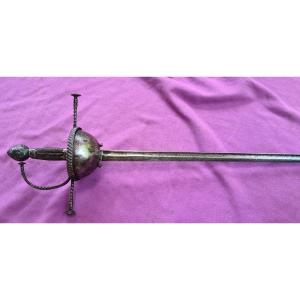
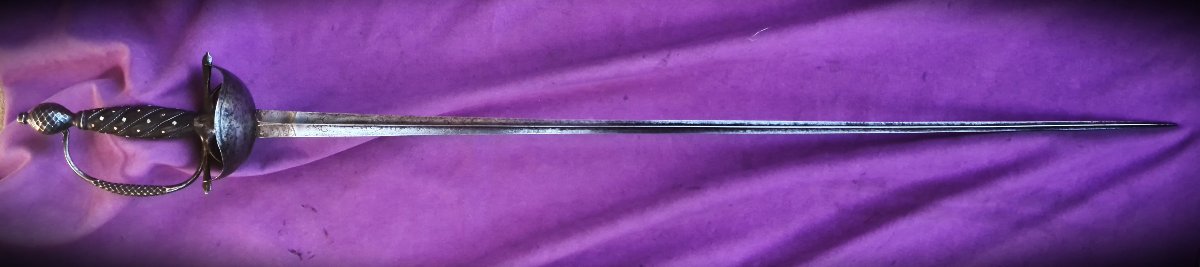
This taza rapier is French, although the decorative work on its grip suggests a strong Italian influence. It can be dated to the very end of Louis XIV’s reign, that is, between 1690 and 1710, due to the distinctive shape of its mount and the unusual spelling of the mark “Sohlinge”for Solingen.
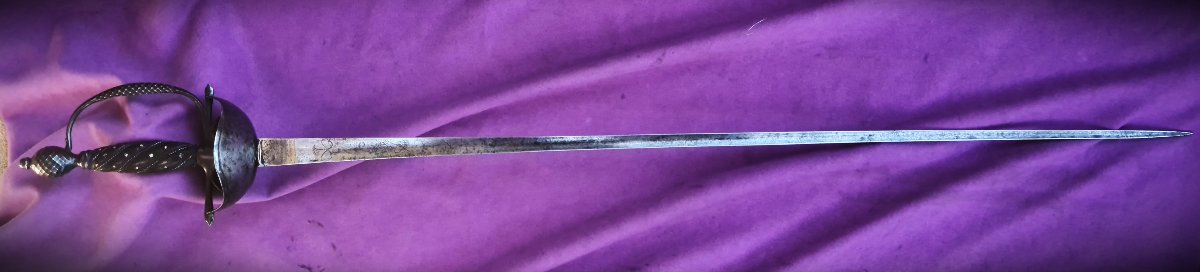
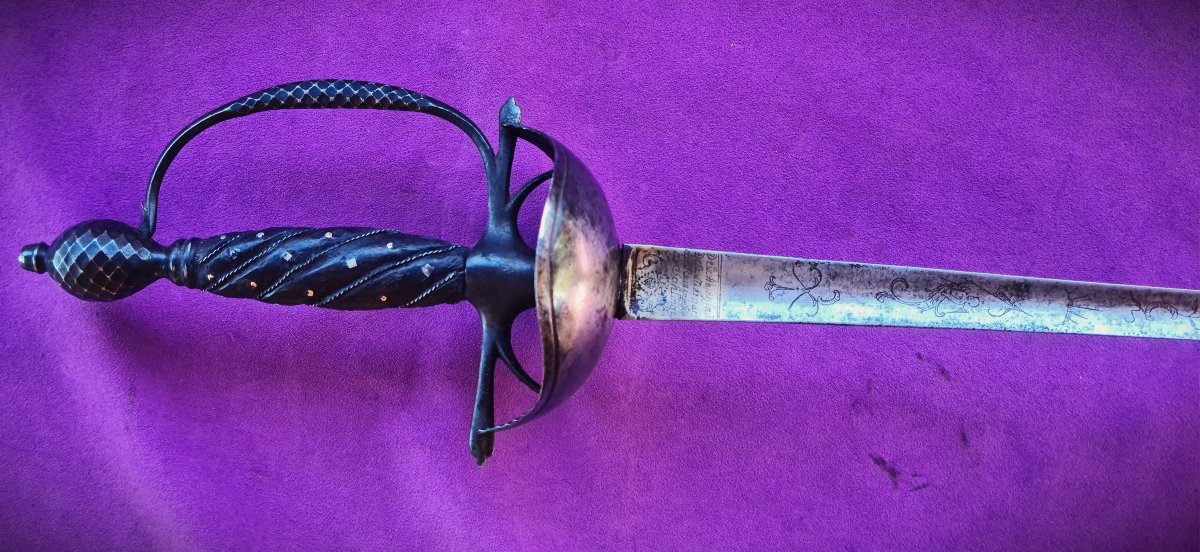
It is a transitional weapon between the last Spanish-style taza rapiers and the first so-called “musketeer” swords, whose blade style it has already adopted The guard features wide, fully functional finger rings (= arms) known as “donkey steps.” While these "donkey steps" would gradually decrease in size throughout the 18th century to become purely decorative from the 1750s–1760s onward, here we are looking at a rapier whose natural grip is achieved with afinger into the "arms". The only difference from a classic rapier is the blade, whose length corresponds to a sword intended for city wear and whose three-hollow profile fis in accorance with the new fashion of the 1680s–1700s.
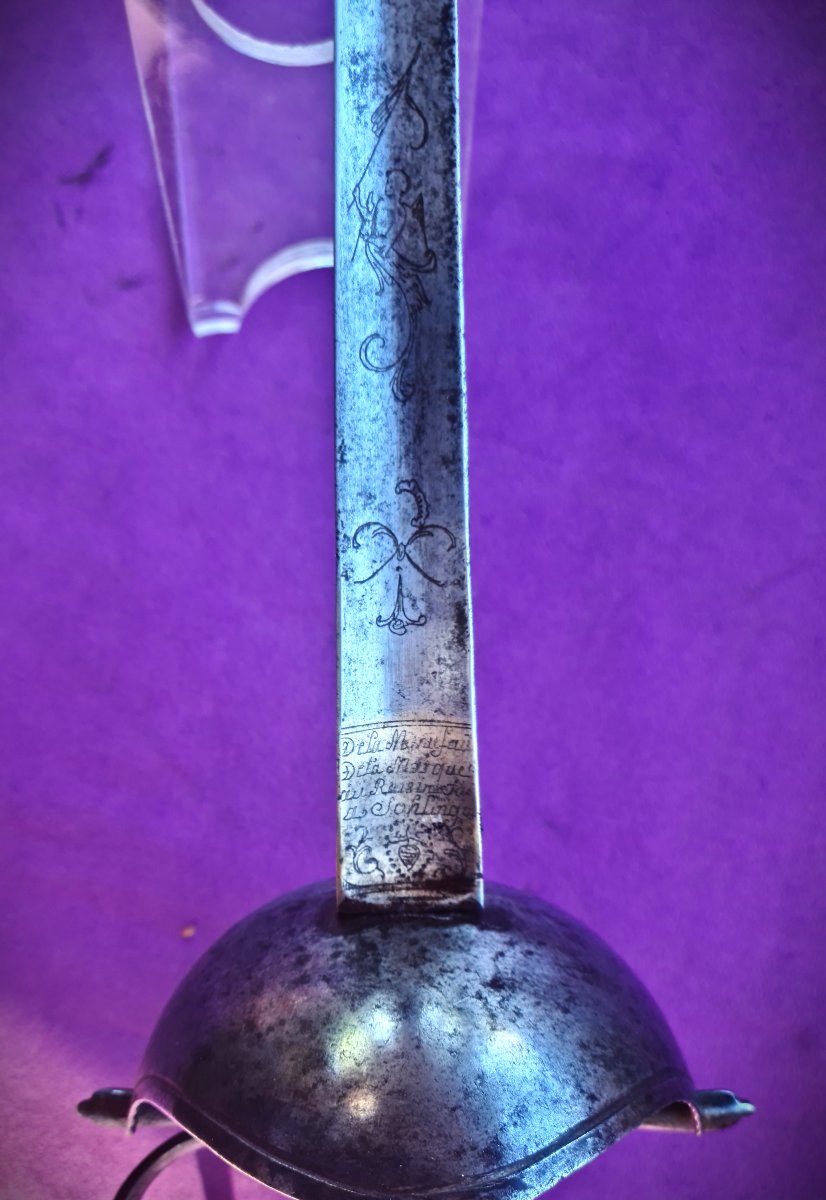
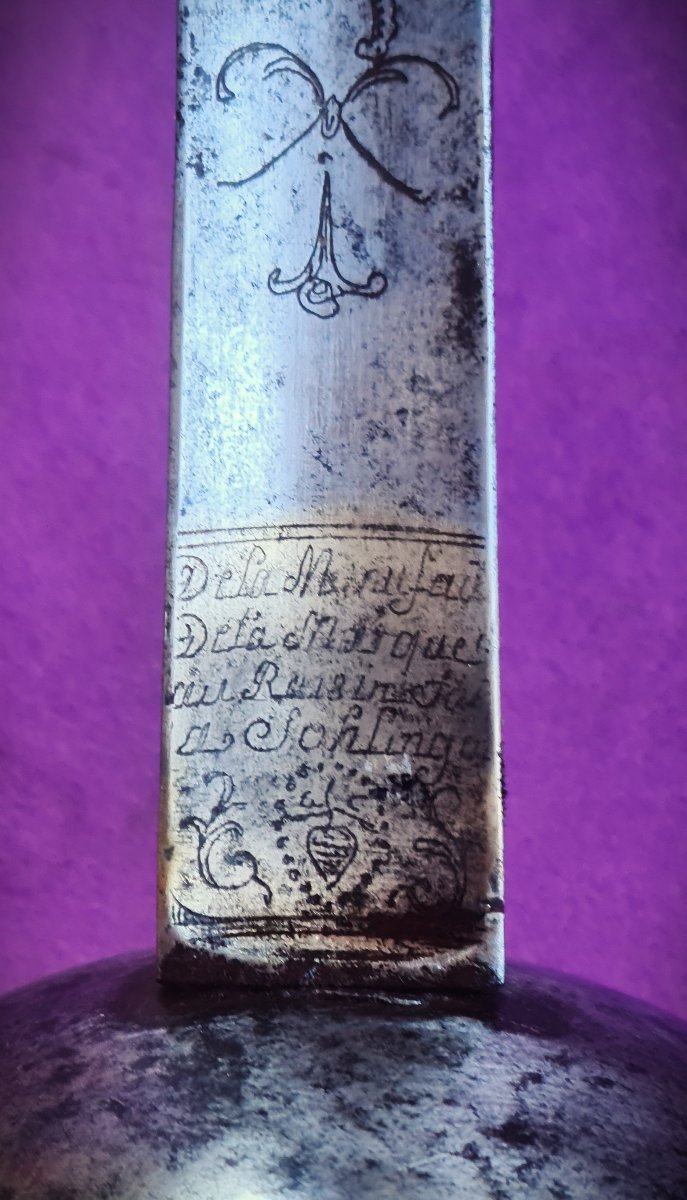
The marking “De la Manufacture de la marque du raisinà Sohlinge” indicates manufacture prior to the mid-18th century, since starting the 1750s, the modern spelling “Solingen” wa sadopted in place of “Sohlingen,” which, even earlier,as on this sword, was sometimes written “Sohlinge.” An inscription similar to that on our sword is recorded on a French sword from 1697, which confirms the dating. The famous “Grape Mark in Solingen”would, however, continue to manufacture and export throughout the 18thcentury.
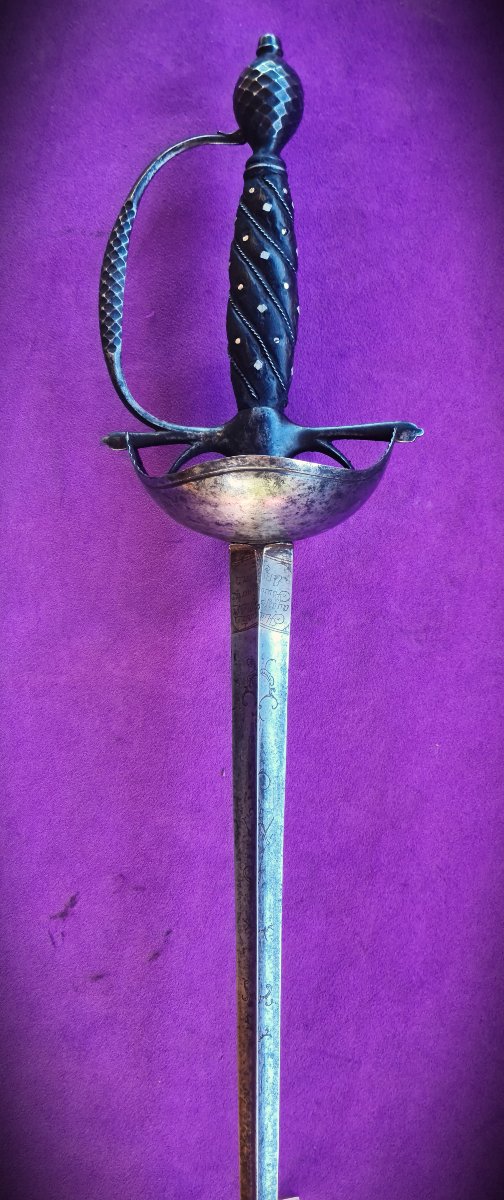
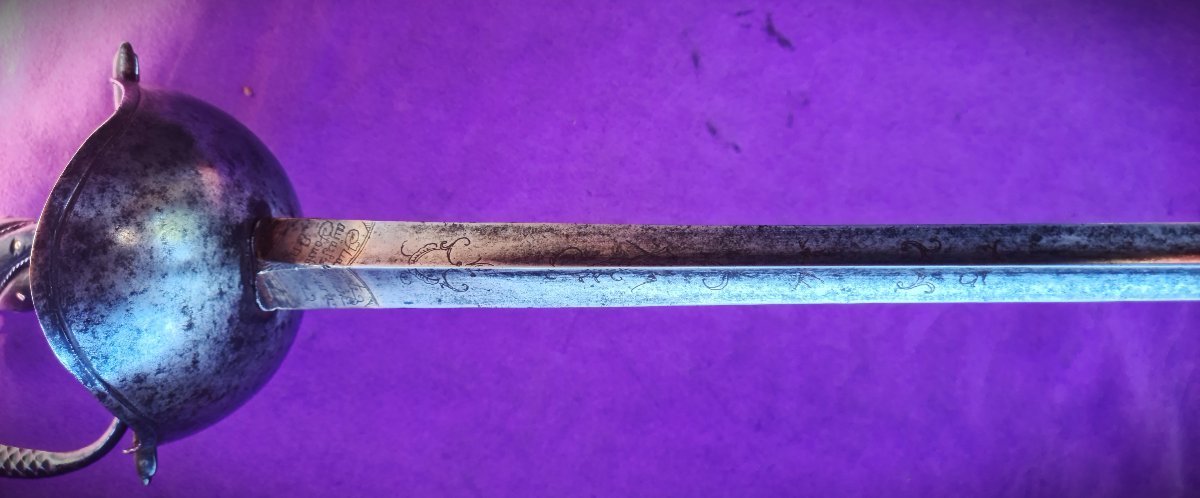
BLADE: It has a triangular cross-section with three hollow sides.
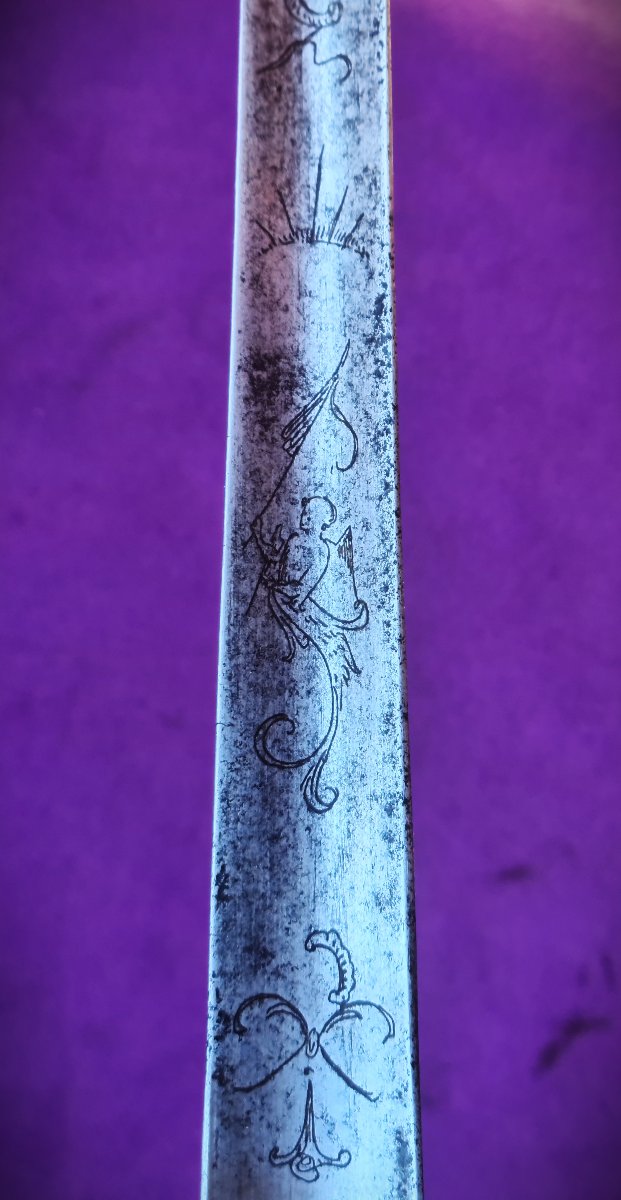
On the inner side, there is an engraved design of a trophy, an angel (or a Stryge?) floating in the air and holding a flag, a half-sun with rays (perhaps related to the Maison du Roi?? )and plant motifs. At the shoulder is the inscription “De la Manufactde la Marque au Raisin fait à Sohlinge”; this inscription is highlightedin gold.
On both outer faces, we find the same decorative elements: a trophy, an angel or stryge holding a flag, a half radiant sun, and plant motifs, more worn than on the inner side. On the shoulder, the armorer’s signature: “Hyacynthe au Jas Fbg Mail fourbisseur à Avignon" (the "Jas" is adistrict of Avignon, Fbg = Faubourg. There was indeed a Rue du Mail (mail street) in the past, but the Faubourg du Mail is no longer known)
Blade length = 82 cm from the quillons to the tip, 78.5cm from the outer edge of the taza to the tip. Width at the shoulder = 2.3 cm, thicknessat the shoulder= 8 mm
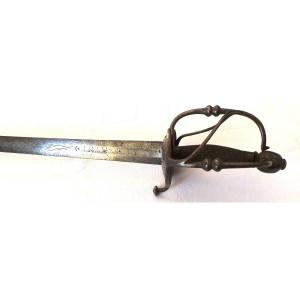
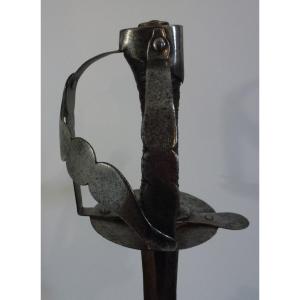
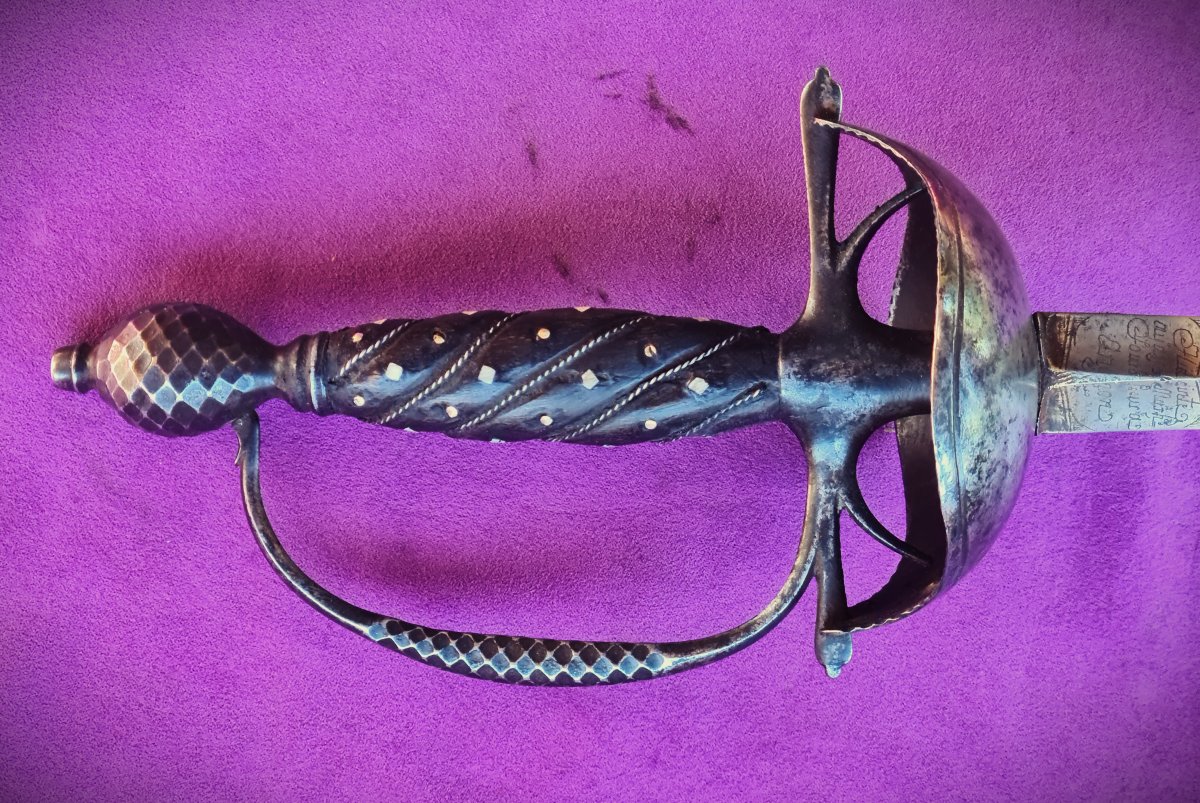
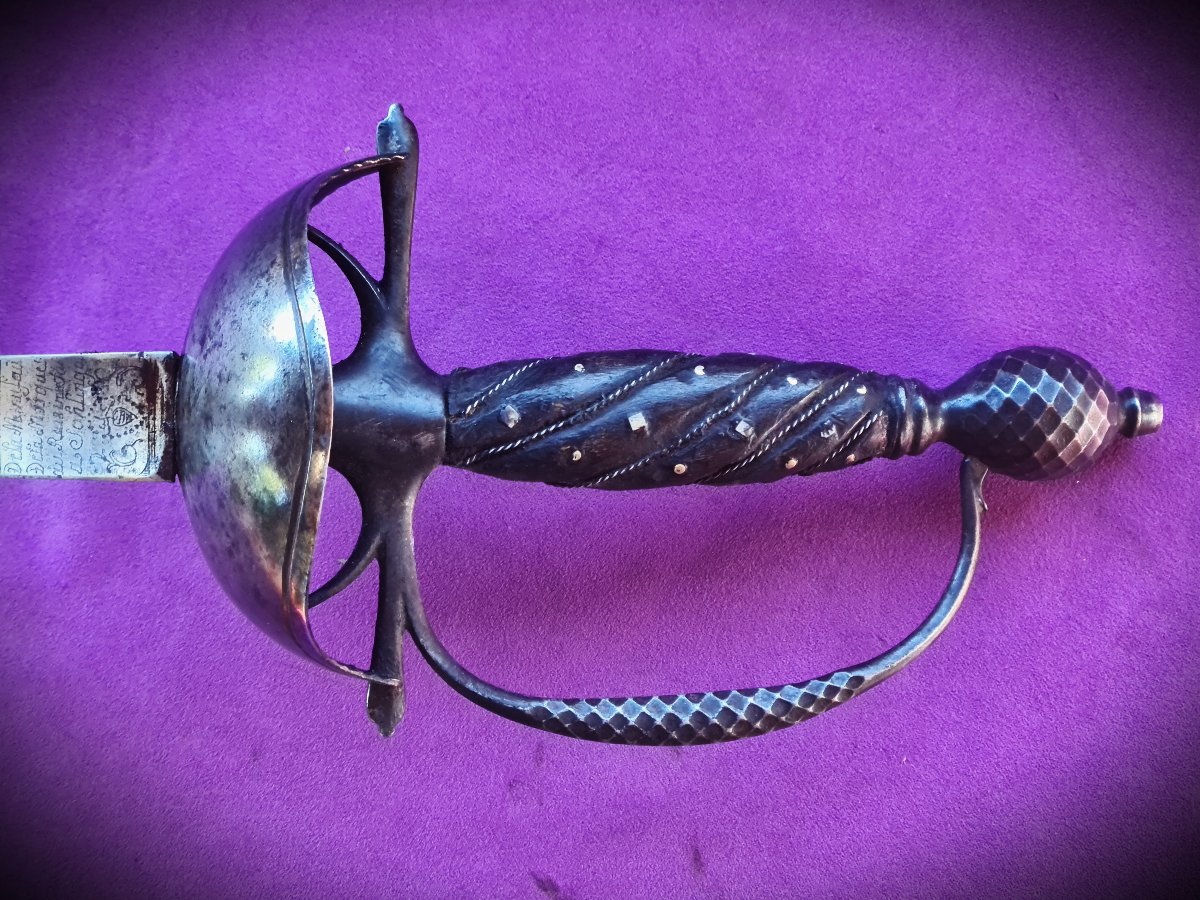
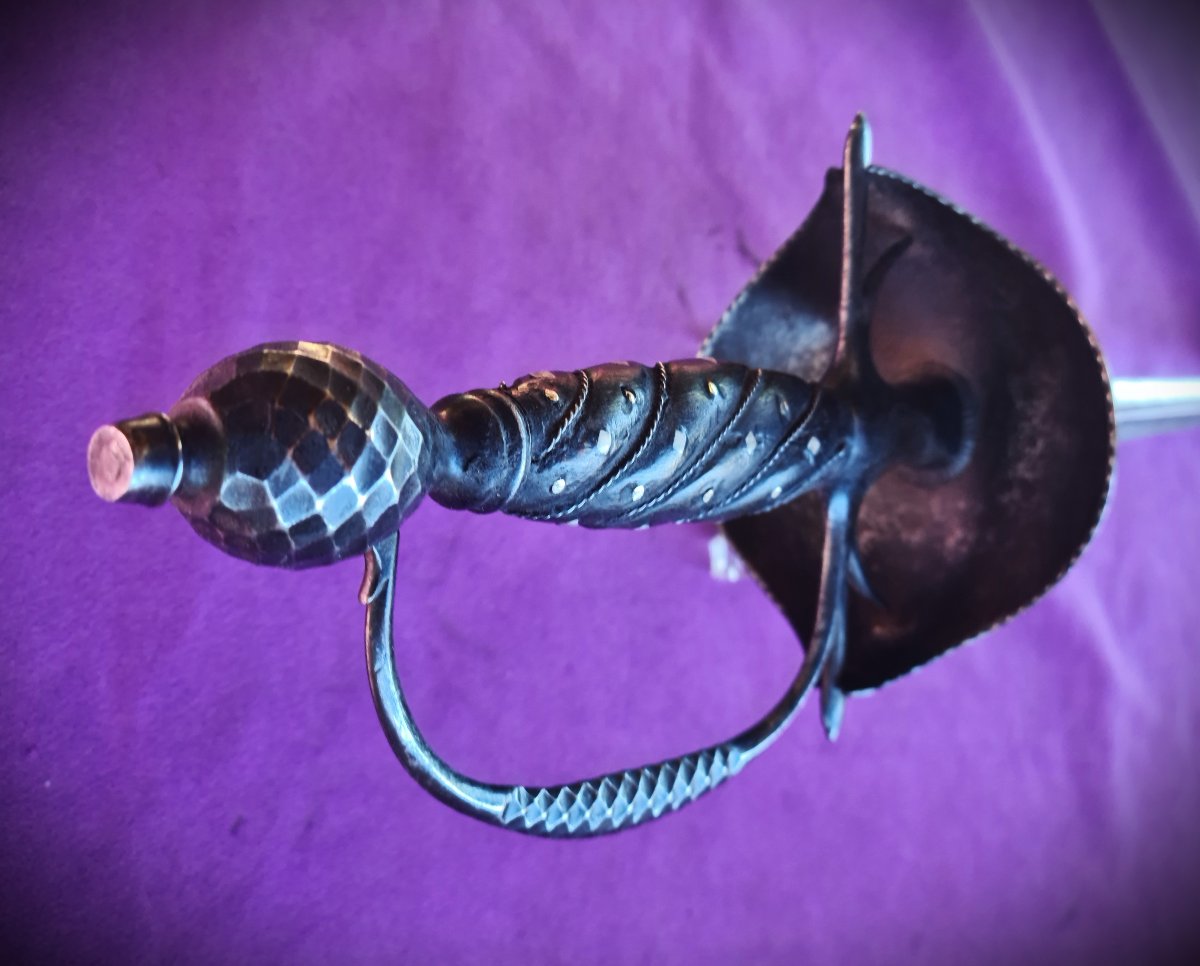
GUARD: protection is provided by a cup forged in a single piece, whose edges curve upward to meet the quillons. The quillons are straight and relatively short. The knuckle bow features a multi-faceted decoration. It connects to the pommel, to which it is attached by a hook.
POMMEL: it is ovoid, decorated with multiple facets, and topped by a small button to which the blade tang is riveted.
GRIP: it ismade of twisted dark wood, featuring diamond-shaped bone inlays and brass nails. In the recesses of the grip, twisted iron wire binding.
In resume, this is a sword of an uncommon design, a transitional model between the last taza rapiers and the firs tmusketeer swords, or the city swords of the 18th century.
REF: B-2638 /F
Shipping fee contribution = France €30, Europe €40
It is a transitional weapon between the last Spanish-style taza rapiers and the first so-called “musketeer” swords, whose blade style it has already adopted The guard features wide, fully functional finger rings (= arms) known as “donkey steps.” While these "donkey steps" would gradually decrease in size throughout the 18th century to become purely decorative from the 1750s–1760s onward, here we are looking at a rapier whose natural grip is achieved with afinger into the "arms". The only difference from a classic rapier is the blade, whose length corresponds to a sword intended for city wear and whose three-hollow profile fis in accorance with the new fashion of the 1680s–1700s.
The marking “De la Manufacture de la marque du raisinà Sohlinge” indicates manufacture prior to the mid-18th century, since starting the 1750s, the modern spelling “Solingen” wa sadopted in place of “Sohlingen,” which, even earlier,as on this sword, was sometimes written “Sohlinge.” An inscription similar to that on our sword is recorded on a French sword from 1697, which confirms the dating. The famous “Grape Mark in Solingen”would, however, continue to manufacture and export throughout the 18thcentury.
BLADE: It has a triangular cross-section with three hollow sides.
On the inner side, there is an engraved design of a trophy, an angel (or a Stryge?) floating in the air and holding a flag, a half-sun with rays (perhaps related to the Maison du Roi?? )and plant motifs. At the shoulder is the inscription “De la Manufactde la Marque au Raisin fait à Sohlinge”; this inscription is highlightedin gold.
On both outer faces, we find the same decorative elements: a trophy, an angel or stryge holding a flag, a half radiant sun, and plant motifs, more worn than on the inner side. On the shoulder, the armorer’s signature: “Hyacynthe au Jas Fbg Mail fourbisseur à Avignon" (the "Jas" is adistrict of Avignon, Fbg = Faubourg. There was indeed a Rue du Mail (mail street) in the past, but the Faubourg du Mail is no longer known)
Blade length = 82 cm from the quillons to the tip, 78.5cm from the outer edge of the taza to the tip. Width at the shoulder = 2.3 cm, thicknessat the shoulder= 8 mm
GUARD: protection is provided by a cup forged in a single piece, whose edges curve upward to meet the quillons. The quillons are straight and relatively short. The knuckle bow features a multi-faceted decoration. It connects to the pommel, to which it is attached by a hook.
POMMEL: it is ovoid, decorated with multiple facets, and topped by a small button to which the blade tang is riveted.
GRIP: it ismade of twisted dark wood, featuring diamond-shaped bone inlays and brass nails. In the recesses of the grip, twisted iron wire binding.
In resume, this is a sword of an uncommon design, a transitional model between the last taza rapiers and the firs tmusketeer swords, or the city swords of the 18th century.
REF: B-2638 /F
Shipping fee contribution = France €30, Europe €40
1 300 €
Period: 17th century
Style: Louis 14th, Regency
Condition: Excellent condition
Material: Other
Length: 97 cm
Width: aux quillons 11.2 cm
Reference (ID): 1777106
Availability: In stock
Print