Java - Buddhist Mother Goddess In Terracotta - Majapahit Period - 13/16th Century.
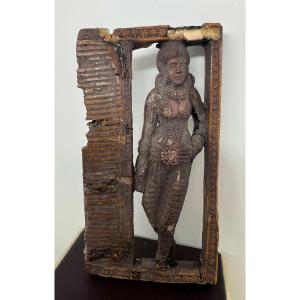
Standing on a multi-level circular pedestal adorned with lotus petals, this voluptuous female figure is modeled with serene dignity and symbolic richness. The face is serene, with almond-shaped eyes beneath a continuous brow, a slight smile and full, round features often associated with fertility. Hair is neatly parted and tied with a cord, revealing large kundala (circular earrings). She wears a thick necklace with alarge floral pendant, kangkana (bracelets) and a prominent kuchabhanda (chest ornament) that extends across the torso. A smooth paridhana (sarong) wraps the lower body and falls to the feet. On his head is a concave vessel, probably once used as an oil lamp, offering stand or architectural element. Figures of this type could be linked to fertility cults in ancient Java and could evoke Prithivi, the mother goddess of the earth, a symbol of abundance and nourishment in Hindu-Buddhist cosmology.
The object's antiquity has been rigorouslyconfirmed by a thermoluminescence (TL) test. The analytical results demonstratescientifically that the last firing of the terracotta corresponds perfectly to the chronologyof the Majapahit Period (13th to 16th century), certifying the authenticity of the set.
Terracotta objects from the Majapahit Empire include figurines, architectural elements such as tiles, bricks and columns, as well as everyday objects such as water jars, stoves, vases and piggy banks. These works offer valuable insights into the daily life, dress, beliefs and social structures of the period.Majapahit terracotta figurines depict a wide variety of subjects, from deities, dancers and mythical creatures to animals and common folk, reflecting both the religious and secular dimensions of the empire's artistic output.
The Majapahit empire, which flourished in East Java, Indonesia, from the late 13th to the early 16th century, was one of the most influential Hindu-Buddhist kingdoms in Southeast Asia, renowned for its cultural refinement and immense political power. During the reign of King Hayam Wuruk (1350-1389), Trowulan, the capital of Majapahit, became a dynamic center of religious devotion and artistic production.Among the most striking legacies of the Majapahit period is the abundant use of terracotta, employed for both utilitarian and symbolic purposes.
Origin: Indonesia, East Java, Trowulan region.
Era: Majapahit Empire (1297-1527).
Dimensions: Height: 70 cm; Diameter: 32 cm.
Conditions: Very good condition, stable and restored.
Provenance : Acquired in the Trowulan region at the end of the 20th century by Paolo Bertuzzi, then passed down through descent. Paolo Bertuzzi (1943-2022) was a fashion designer from Bologna, Italy.He was the son of Enrichetta Bertuzzi, founder of Hettabretz, a renowned Italian fashion house whose clients included the Rothschild family, Audrey Hepburn and Elizabeth Taylor.Paolo Bertuzzi then took over the family business and created exclusive pieces, some of which were exhibited at the Costumes Institute of the Metropolitan Museum in New York, USA. He was also a passionate collector of antiques for over 60 years. His collection includes both ancient and contemporary works of art. He also edited two important books on Asian art: Goa Made - An Archaeological Discovery and Majapahit - Masterpieces from a Forgotten Kingdom, both documenting major excavation projects carried out in collaboration with the Indonesian and Italian governments.
Literary comparison: Compare with a related Javanese terracotta figurine depicting Hariti, 4th-15th century, held at the Metropolitan Museum of Art, object number: 2009.321. Compare with a related Javanese bronze figurine of a standing woman in the Metropolitan Museum of Art, object number 1987.142.192. See also Pratapaditya Pal, Icons ofPiety, Images of Whimsy: Asian Terracottas from the Walter- Grounds Collection, Los Angeles 1987, nos. 79 and 82, for two other related figurines.
22 000 €
Period: Before 16th century
Style: Asian art
Condition: Fully restored in our whorkshop
Material: Terracotta
Diameter: 32 cm
Height: 70 cm
Reference (ID): 1769392
Availability: In stock
Print