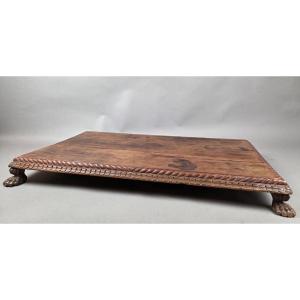
Tibet - Folding Ritual Table (portable Altar) - 19th Century.
This folding table, carved and painted from wood, belongs to the tradition of Tibetan ritual furniture designed for portable religious use. Conceived for easy transport, it features an ingenious structure that allows it to fold completely, transforming the object into a compact and protected volume, while offering a stable and unobstructed surface when unfolded. The decoration, executed in relief and enhanced with polychrome pigments now largely patinated, is dominated by an iconographic register deeply rooted in Tibetan Buddhist vocabulary. The main front is adorned with confronting dragons, protective figures associated with cosmic power, the mastery of natural forces, and the safeguarding of sacred space. These creatures move amidst stylized clouds and auspicious motifs, symbols of good fortune and the flow of spiritual energy. The strictly symmetrical frontal composition is characteristic of objects intended to structure a ritual space facing the practitioner. The sides and folding elements feature a more understated yet coherent painted decoration, ensuring symbolic continuity even when the object is closed. The upper surface, intentionally devoid of figurative ornamentation, shows long-standing and even wear, consistent with the repeated placement of ritual objects: votive statuettes, butter lamps, sacred texts, or dry offerings. The overall patina, deep and homogeneous, testifies to prolonged use. The abrasions, chips, and wear are not indicative of secular domestic use but are consistent with repeated ritual handling and frequent relocation. The piece retains a high degree of legibility in its forms and decoration, without any visible intrusive restorations. Typologically, this object is similar to folding ritual tables used as portable altars by itinerant monks, traveling lamas, or in the context of private devotional practices, particularly during temporary rituals outside the fixed monastic setting. This type of furniture, less common than fixed altars, remains relatively rare on the market and in Western collections. Origin: Tibet (Himalayan cultural area). Period: 19th century. Dimensions: Open: L: 72 cm; W: 29 cm; H: 29 cm – Closed: L: 72 cm; W: 29 cm; H: 10 cm. Provenance: Belgian private collection.
900 €
Period: 19th century
Style: Asian art
Condition: Excellent condition
Material: Painted wood
Length: 72 cm
Width: 29 cm
Height: 29 / 10 cm
Reference (ID): 1685536
Availability: In stock
Print