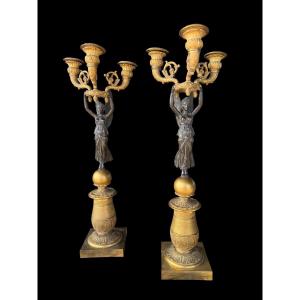


Candelabra With Winged Victories, France, Empire Period, Early 19th Century
Winged Victory Candelabra, France, Empire period, early 19th century.
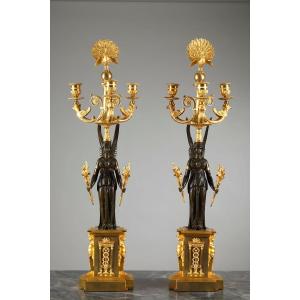
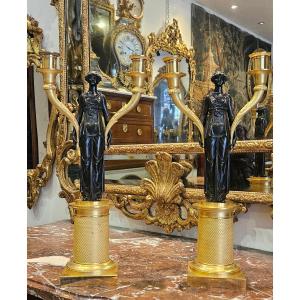
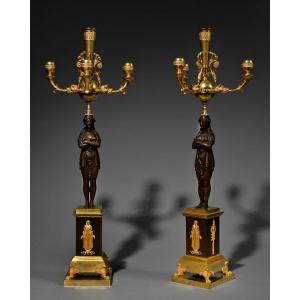
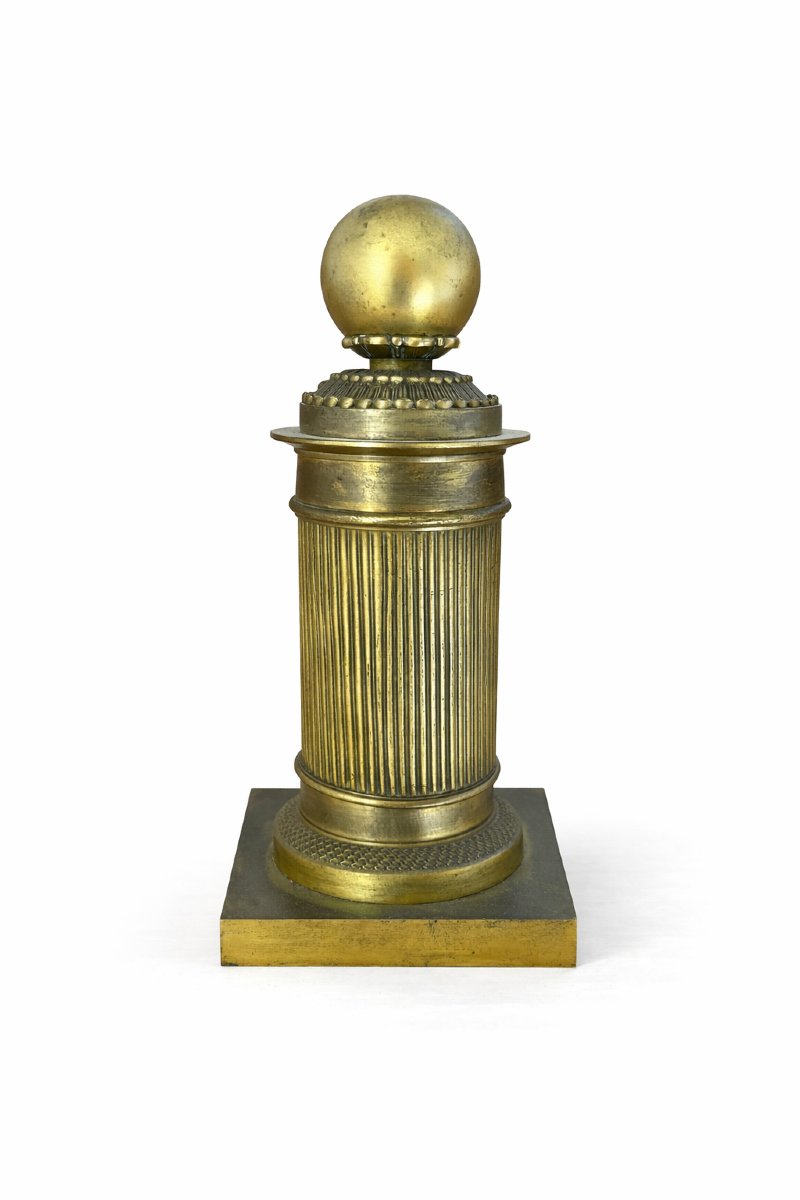
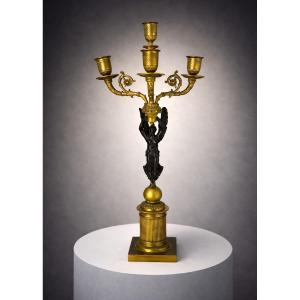
Patinated and gilt bronze. Description: This Empire period candelabra brilliantly illustrates the revival of classical vocabulary in French decorative arts at the beginning of the 19th century. The piece consists of a central shaft supported by a winged figure in patinated bronze, resting on a gilt sphere itself placed on a fluted cylindrical pedestal with a quadrangular base. The alternation of gilt bronze and bronze with a brown patina gives the whole a refined contrast, characteristic of the most ambitious productions of the First Empire. The winged female figure, draped in the classical style, with raised arms supporting the light, evokes a Victory or a winged Genius, an emblematic motif of the imperial repertoire inspired by ancient Rome. The modeling is precise: delicate treatment of the face, flowing draperies, and finely structured wings. The upper section features five finely chased candle arms: candle holders with beaded friezes and geometric motifs, elegant foliate scrolls, and guilloché-decorated candle cups. The raised central arm reinforces the verticality and majesty of the composition. The fluted base, directly inspired by classical architecture, affirms the neoclassical rigor characteristic of the Empire style. Stylistic Attribution: Through the quality of the chasing, the purity of the lines, and the skillful combination of gilt and patinated bronze, this candelabra reflects the taste of the great Parisian workshops such as Pierre-Philippe Thomire (1751–1843) or the workshops associated with Claude Galle (1759–1815). These bronze casters supplied the Imperial Court and aristocratic residences under Napoleon I. Lacking a visible stamp, the piece is attributed to a very high-quality Parisian workshop, operating within the sphere of influence of these great masters. Historical Context: Under the Empire, gilt bronze became an essential marker of decorative prestige. Inspired by antique models rediscovered in Pompeii and Herculaneum, furniture and lighting adopted an architectural, symmetrical, and symbolic language. The figure of Winged Victory embodies military glory, spiritual elevation, and imperial grandeur. Candelabra of this type were intended for state rooms, consoles, or monumental fireplaces. Characteristic Stylistic Elements: Contrast between gilt bronze and patinated bronze; Fluted pedestal with a square base; Winged allegorical figure; Finely chiseled foliate arms; Emphasized symmetry and verticality. Significance: This candelabra testifies to the pinnacle reached by Parisian bronze art under the First Empire. It illustrates the perfect synthesis of sculpture, architecture, and ornamentation, characteristic of creations inspired by the workshops of Thomire and Galle.
Patinated and gilt bronze. Description: This Empire period candelabra brilliantly illustrates the revival of classical vocabulary in French decorative arts at the beginning of the 19th century. The piece consists of a central shaft supported by a winged figure in patinated bronze, resting on a gilt sphere itself placed on a fluted cylindrical pedestal with a quadrangular base. The alternation of gilt bronze and bronze with a brown patina gives the whole a refined contrast, characteristic of the most ambitious productions of the First Empire. The winged female figure, draped in the classical style, with raised arms supporting the light, evokes a Victory or a winged Genius, an emblematic motif of the imperial repertoire inspired by ancient Rome. The modeling is precise: delicate treatment of the face, flowing draperies, and finely structured wings. The upper section features five finely chased candle arms: candle holders with beaded friezes and geometric motifs, elegant foliate scrolls, and guilloché-decorated candle cups. The raised central arm reinforces the verticality and majesty of the composition. The fluted base, directly inspired by classical architecture, affirms the neoclassical rigor characteristic of the Empire style. Stylistic Attribution: Through the quality of the chasing, the purity of the lines, and the skillful combination of gilt and patinated bronze, this candelabra reflects the taste of the great Parisian workshops such as Pierre-Philippe Thomire (1751–1843) or the workshops associated with Claude Galle (1759–1815). These bronze casters supplied the Imperial Court and aristocratic residences under Napoleon I. Lacking a visible stamp, the piece is attributed to a very high-quality Parisian workshop, operating within the sphere of influence of these great masters. Historical Context: Under the Empire, gilt bronze became an essential marker of decorative prestige. Inspired by antique models rediscovered in Pompeii and Herculaneum, furniture and lighting adopted an architectural, symmetrical, and symbolic language. The figure of Winged Victory embodies military glory, spiritual elevation, and imperial grandeur. Candelabra of this type were intended for state rooms, consoles, or monumental fireplaces. Characteristic Stylistic Elements: Contrast between gilt bronze and patinated bronze; Fluted pedestal with a square base; Winged allegorical figure; Finely chiseled foliate arms; Emphasized symmetry and verticality. Significance: This candelabra testifies to the pinnacle reached by Parisian bronze art under the First Empire. It illustrates the perfect synthesis of sculpture, architecture, and ornamentation, characteristic of creations inspired by the workshops of Thomire and Galle.
1 650 €
Period: 19th century
Style: Consulat, Empire
Condition: Perfect condition
Material: Bronze
Width: 10cm
Height: 55 cm
Reference (ID): 1706086
Availability: In stock
Print