

Peasants In The Fields
Artist: - Ch .l Epplatenier
Charles L'Éplattenier (1874–1946) Peasants in the Fields Signed and Dated
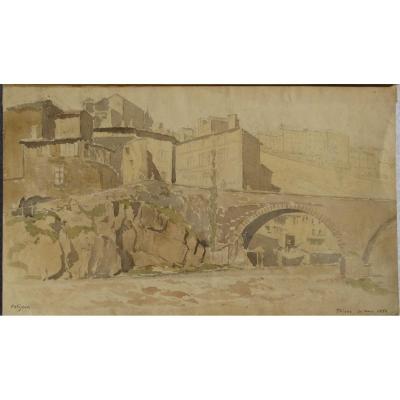
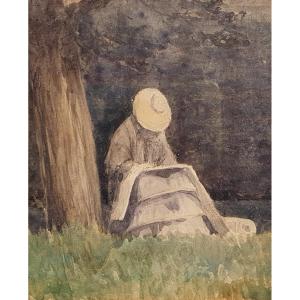
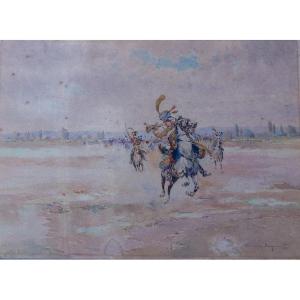
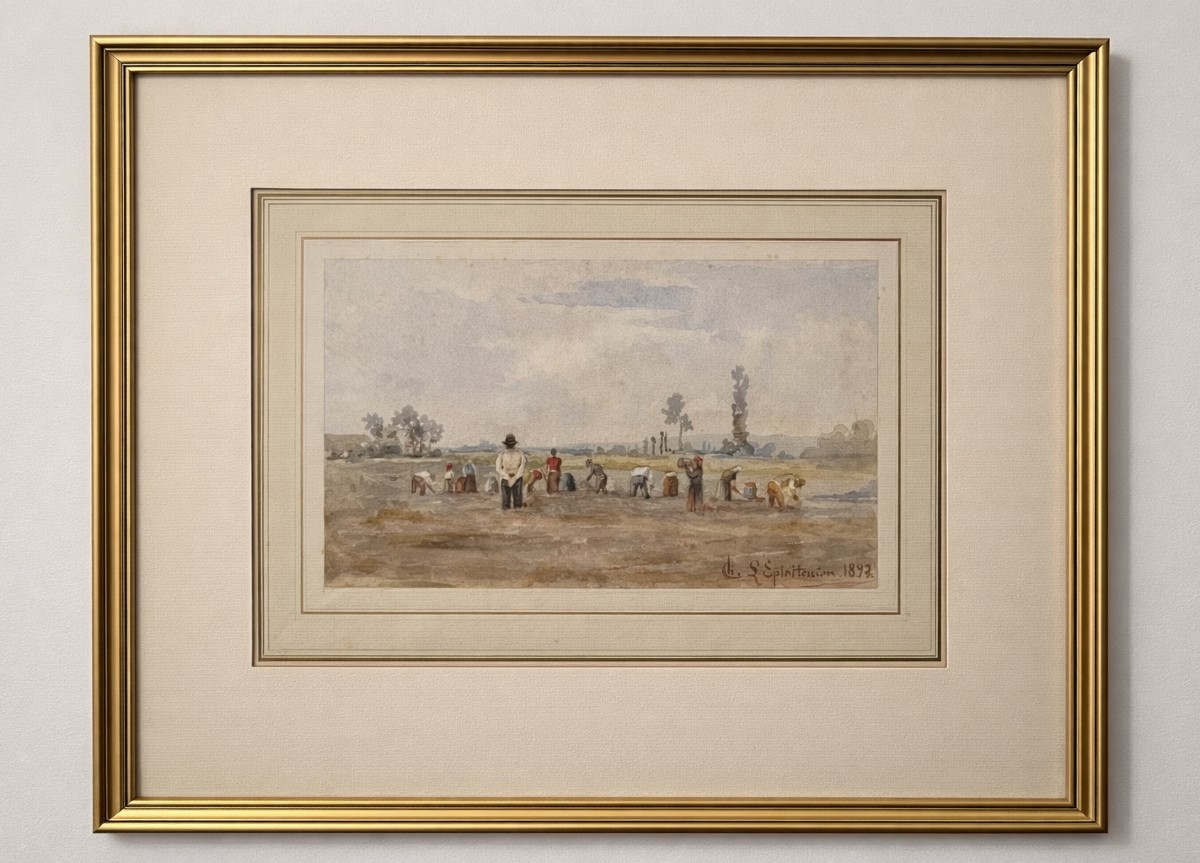
Watercolor Drawing A beautiful watercolor drawing depicting a scene of agricultural work, enlivened by a group of peasants busy in the fields. The figures, set deep within the landscape, are rendered with great restraint and keen observation, emphasizing the atmosphere and rhythm of collective labor rather than anecdotal detail. The horizontal composition, the soft, earthy palette, and the slightly blurred treatment of forms lend the whole a poetic and meditative tone, characteristic of Charles L'Éplattenier's naturalist sensibility. The open landscape, punctuated by a few slender trees, situates the scene in a rural Jura setting, dear to the artist. The work is signed and dated in the lower right corner, guaranteeing its authenticity. Charles L'Éplattenier was a major figure in Swiss art at the turn of the 20th century. A painter, decorator, and educator, he directed the La Chaux-de-Fonds School of Art, founded in 1870, and played a pivotal role in the training of numerous artists, including Charles-Édouard Jeanneret, the future Le Corbusier. A proponent of the Style Sapin (Fir Tree Style), he developed an artistic language deeply inspired by nature and regional traditions. This drawing testifies to his enduring interest in the rural world and in a sincere and humane representation of labor, at the crossroads of social observation and aesthetic exploration. The work is presented in an antique frame. Charles L'Éplattenier, born in 1874 in Neuchâtel and died in 1946, was a major Swiss artist of the turn of the 19th and 20th centuries. A painter, decorator, sculptor, and educator, he was a central figure of Art Nouveau in French-speaking Switzerland. Professor and later director of the La Chaux-de-Fonds School of Art, founded in 1870, he transformed art education by developing an approach based on the observation of nature and the integration of applied arts. Creator of the Style Sapin, a movement inspired by the flora and landscapes of the Jura region, he exerted a decisive influence on several generations of artists. He was notably the teacher and mentor of Charles-Édouard Jeanneret, the future Le Corbusier, whom he encouraged to pursue architecture. His work, deeply rooted in nature and the rural world, is distinguished by a profound poetic sensibility and a quest for harmony between art, craft, and the environment.
Watercolor Drawing A beautiful watercolor drawing depicting a scene of agricultural work, enlivened by a group of peasants busy in the fields. The figures, set deep within the landscape, are rendered with great restraint and keen observation, emphasizing the atmosphere and rhythm of collective labor rather than anecdotal detail. The horizontal composition, the soft, earthy palette, and the slightly blurred treatment of forms lend the whole a poetic and meditative tone, characteristic of Charles L'Éplattenier's naturalist sensibility. The open landscape, punctuated by a few slender trees, situates the scene in a rural Jura setting, dear to the artist. The work is signed and dated in the lower right corner, guaranteeing its authenticity. Charles L'Éplattenier was a major figure in Swiss art at the turn of the 20th century. A painter, decorator, and educator, he directed the La Chaux-de-Fonds School of Art, founded in 1870, and played a pivotal role in the training of numerous artists, including Charles-Édouard Jeanneret, the future Le Corbusier. A proponent of the Style Sapin (Fir Tree Style), he developed an artistic language deeply inspired by nature and regional traditions. This drawing testifies to his enduring interest in the rural world and in a sincere and humane representation of labor, at the crossroads of social observation and aesthetic exploration. The work is presented in an antique frame. Charles L'Éplattenier, born in 1874 in Neuchâtel and died in 1946, was a major Swiss artist of the turn of the 19th and 20th centuries. A painter, decorator, sculptor, and educator, he was a central figure of Art Nouveau in French-speaking Switzerland. Professor and later director of the La Chaux-de-Fonds School of Art, founded in 1870, he transformed art education by developing an approach based on the observation of nature and the integration of applied arts. Creator of the Style Sapin, a movement inspired by the flora and landscapes of the Jura region, he exerted a decisive influence on several generations of artists. He was notably the teacher and mentor of Charles-Édouard Jeanneret, the future Le Corbusier, whom he encouraged to pursue architecture. His work, deeply rooted in nature and the rural world, is distinguished by a profound poetic sensibility and a quest for harmony between art, craft, and the environment.
1 290 €
Period: 19th century
Style: Napoleon 3rd
Condition: Good condition
Material: Water color
Length: 37cm(ht)
Width: 27cm(ht)
Height: 23cm
Depth: 14cm
Reference (ID): 1704002
Availability: In stock
Print