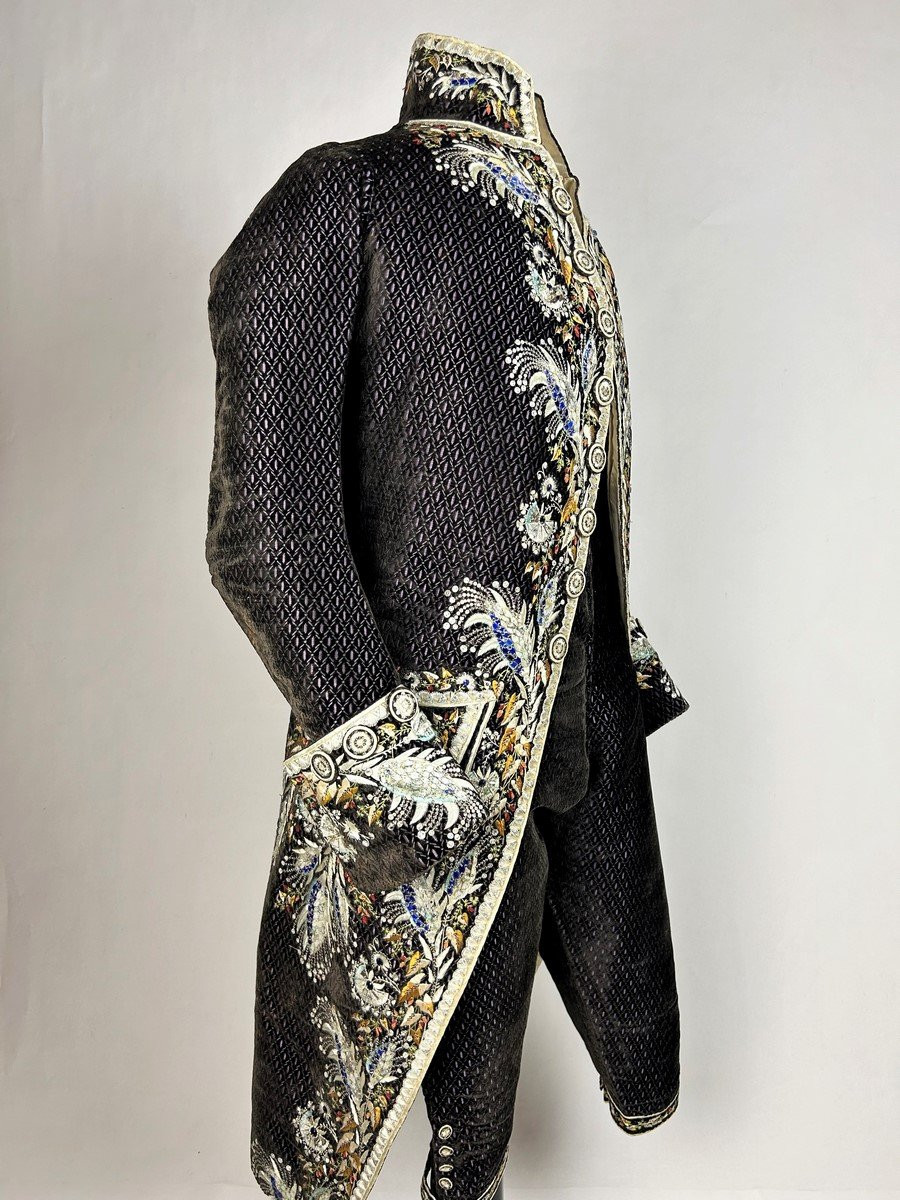
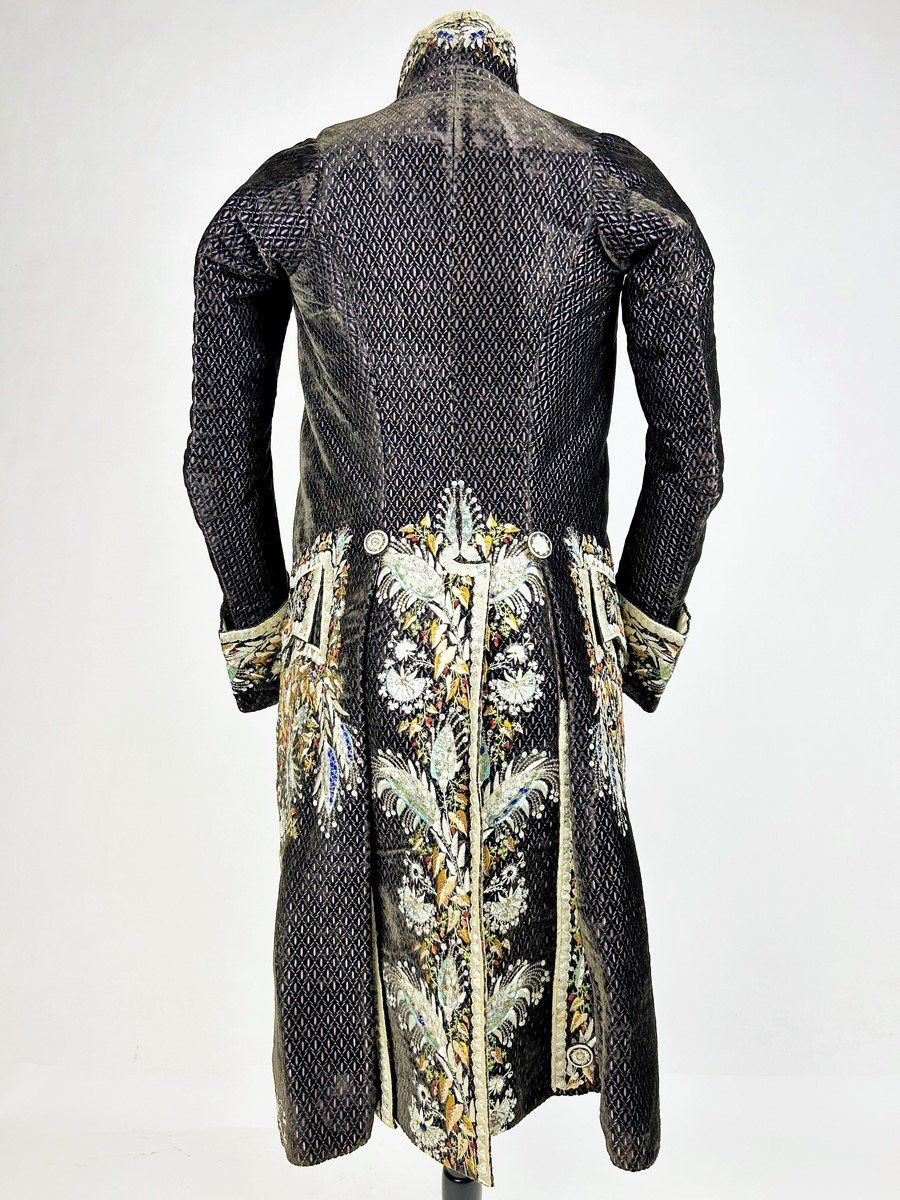
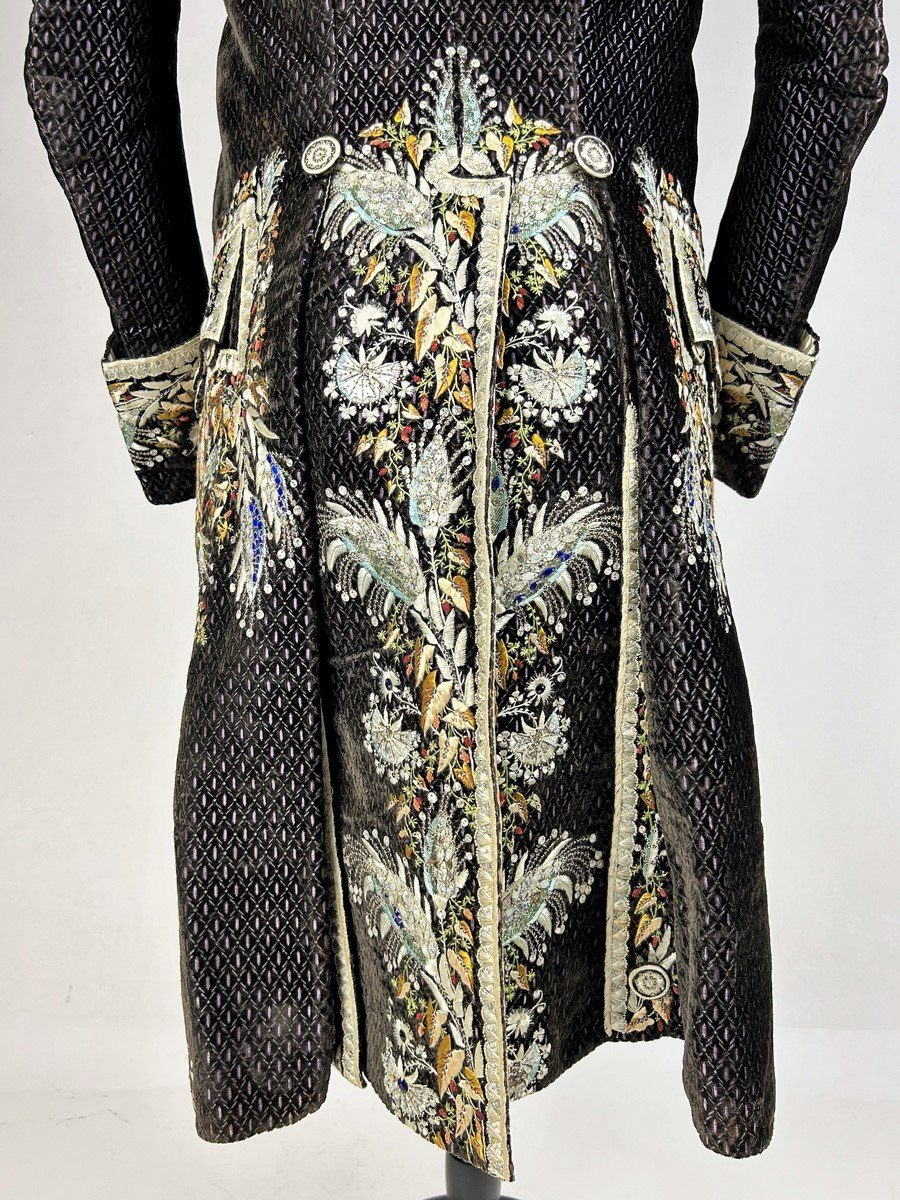


Court Coat And Breeches Of The Marquis d'Aligre – First Empire Or Restoration Period, Circa 1810
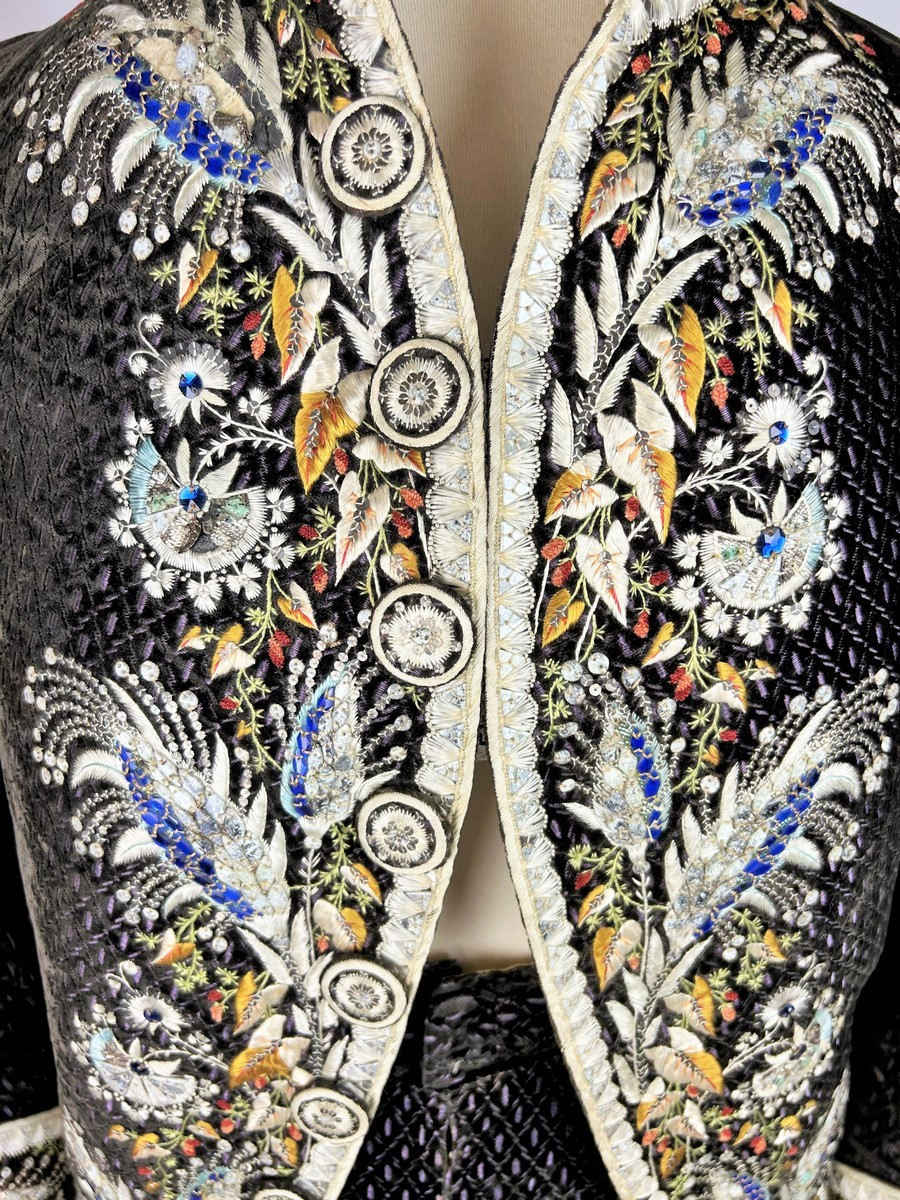
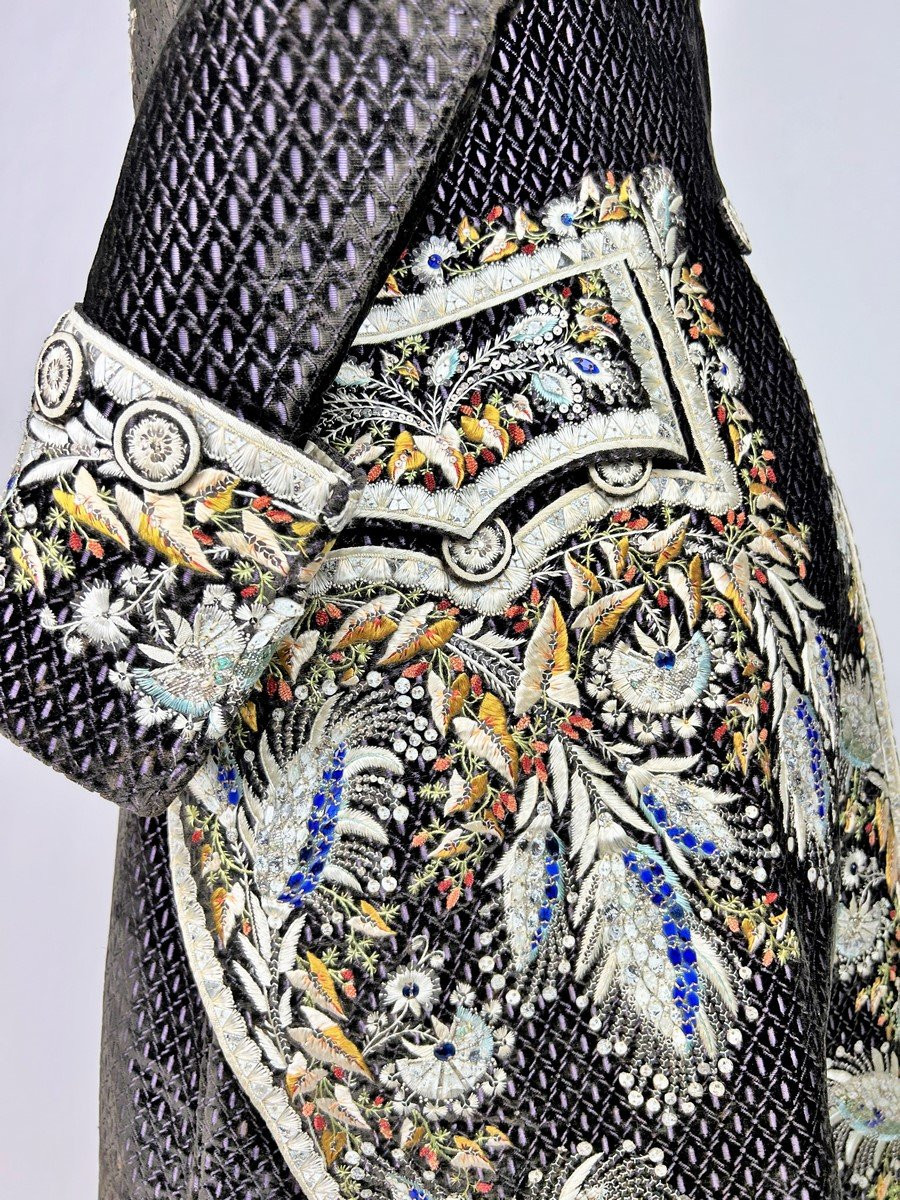
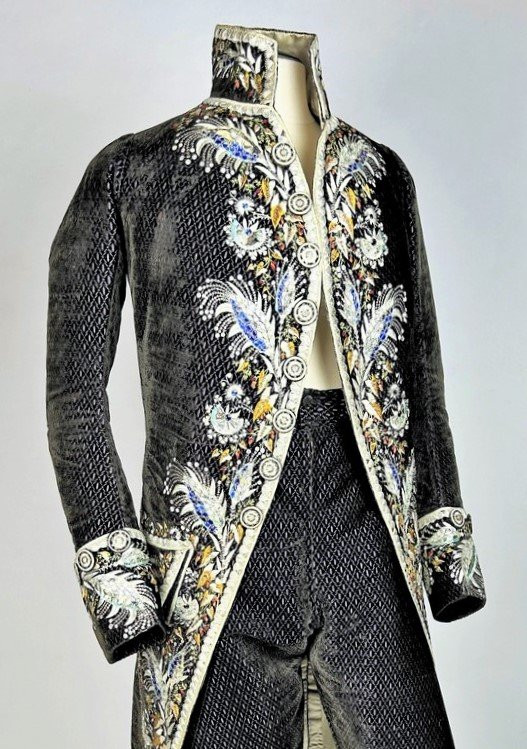
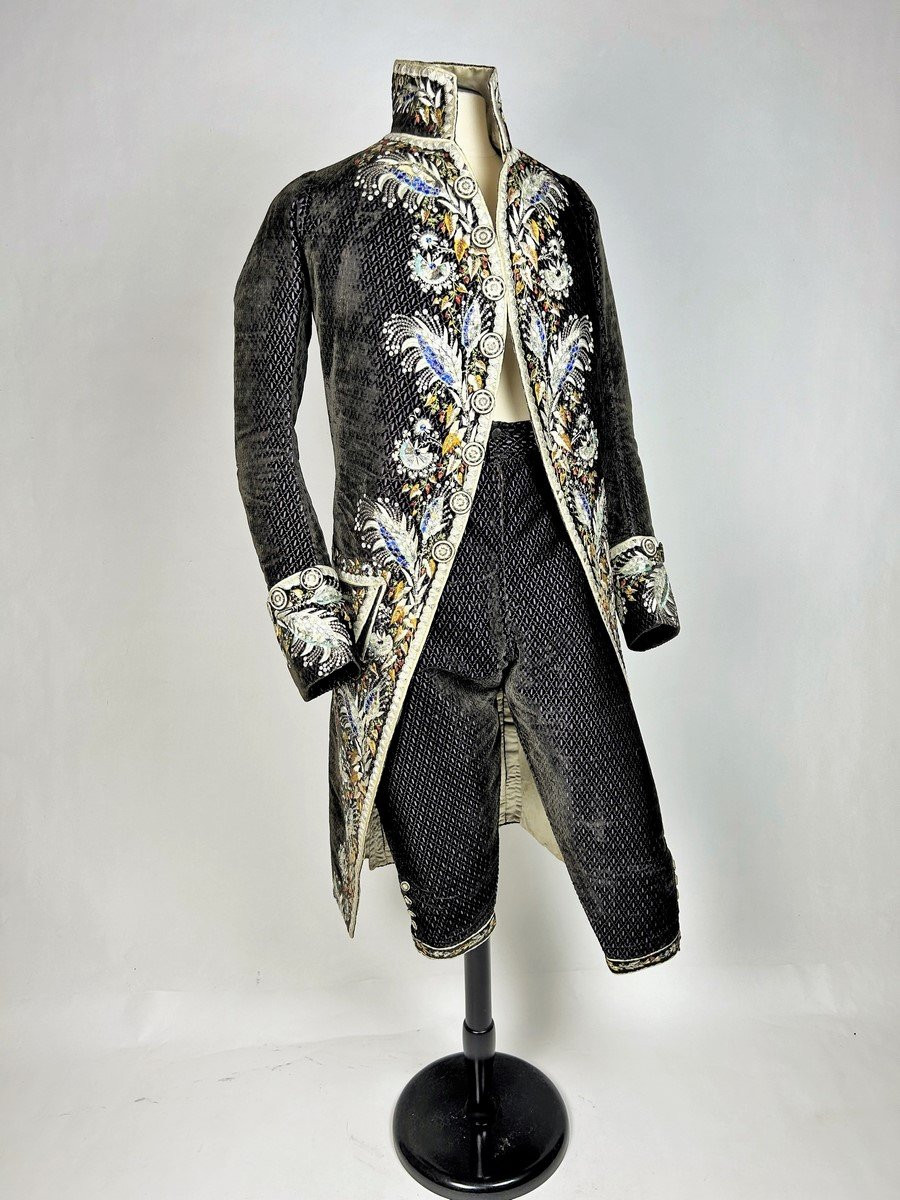
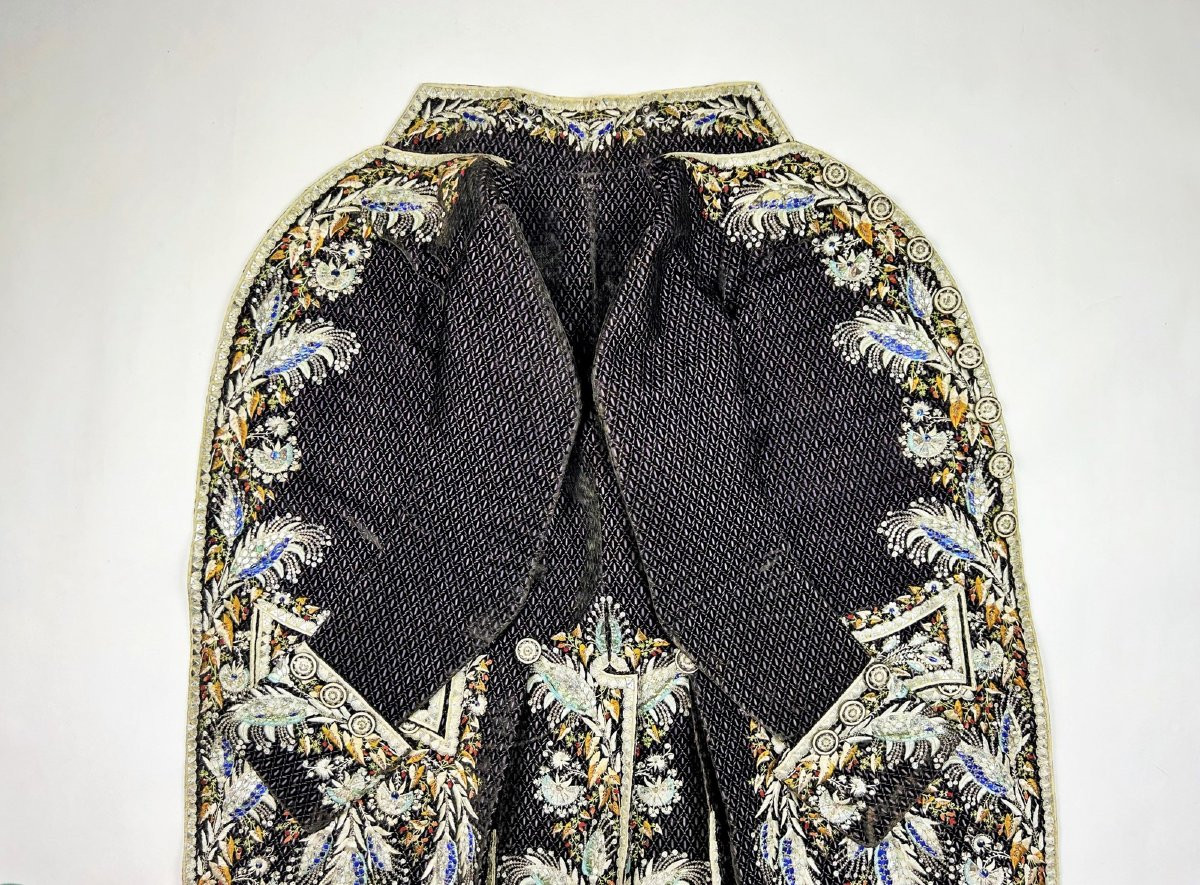
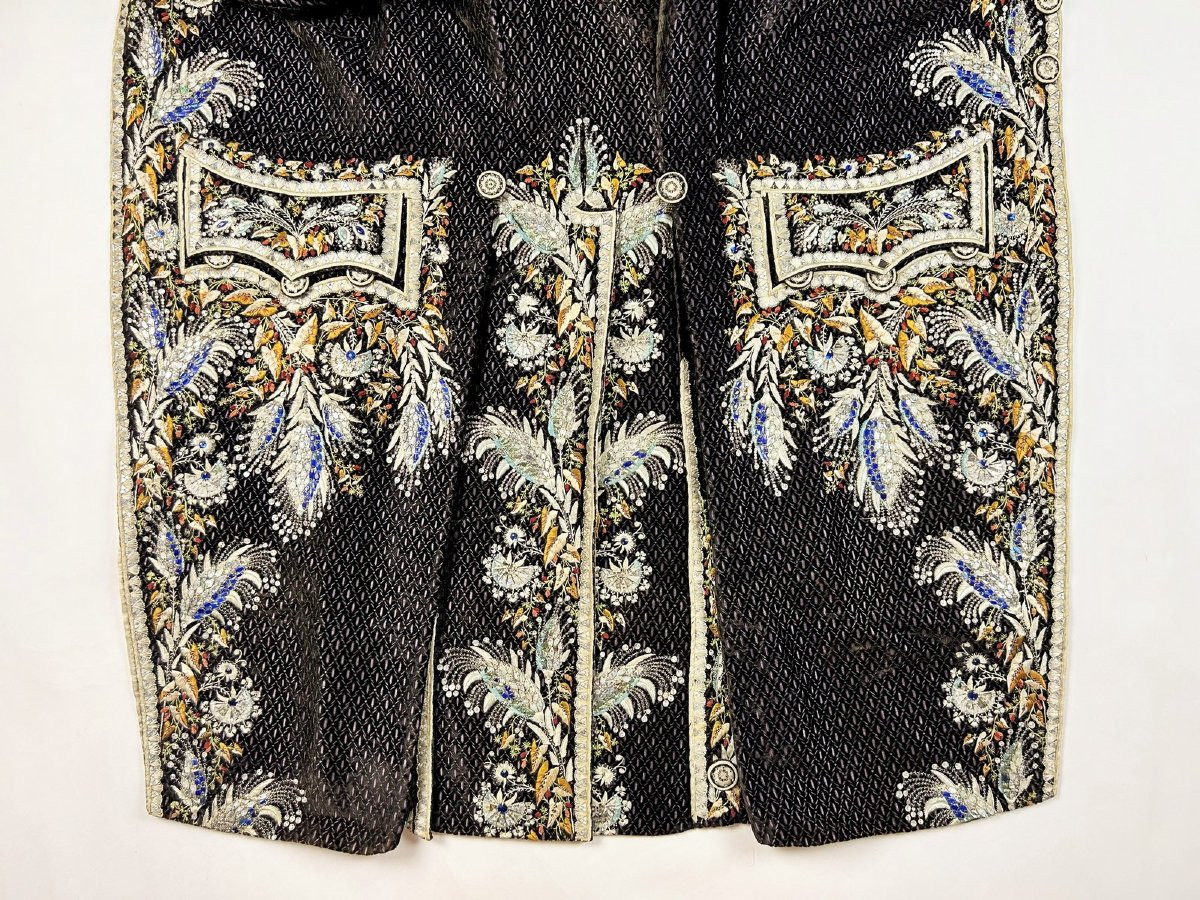
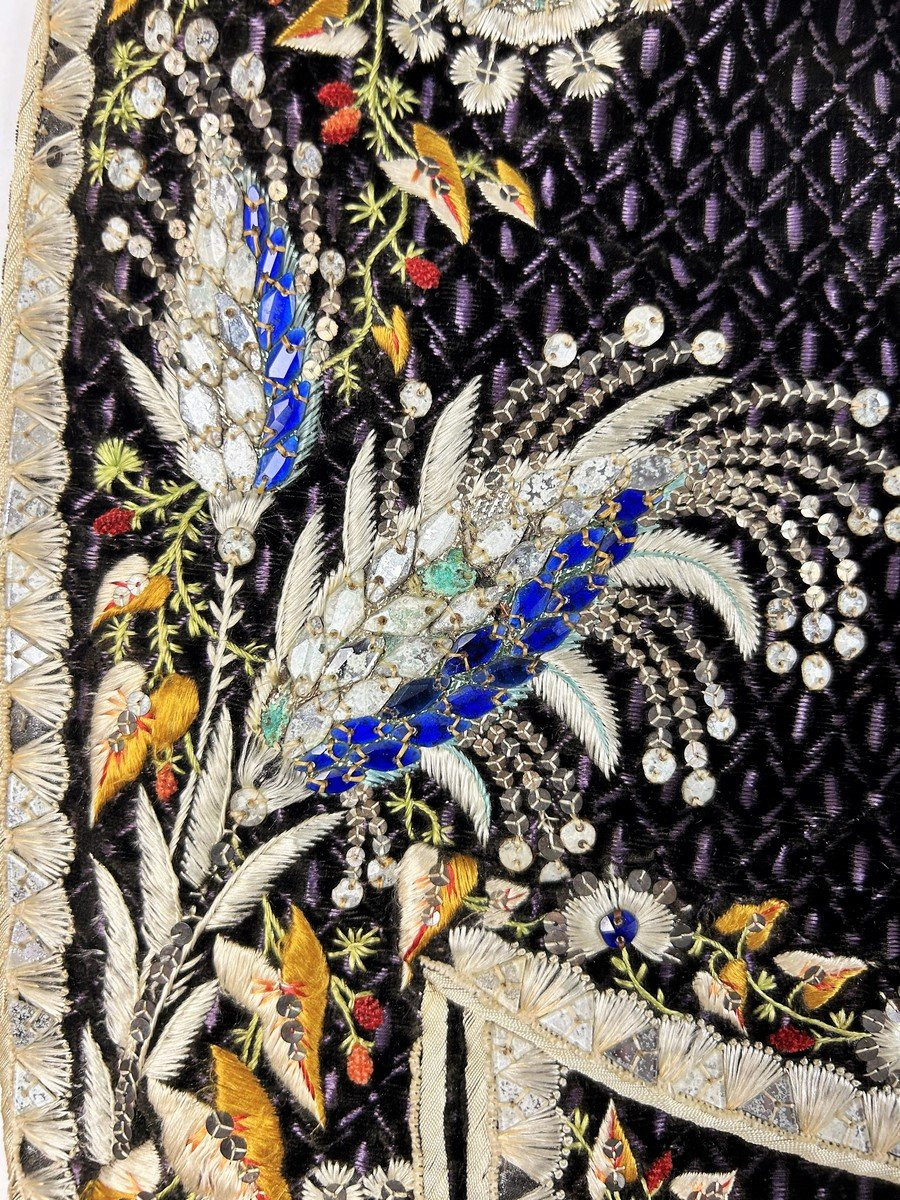
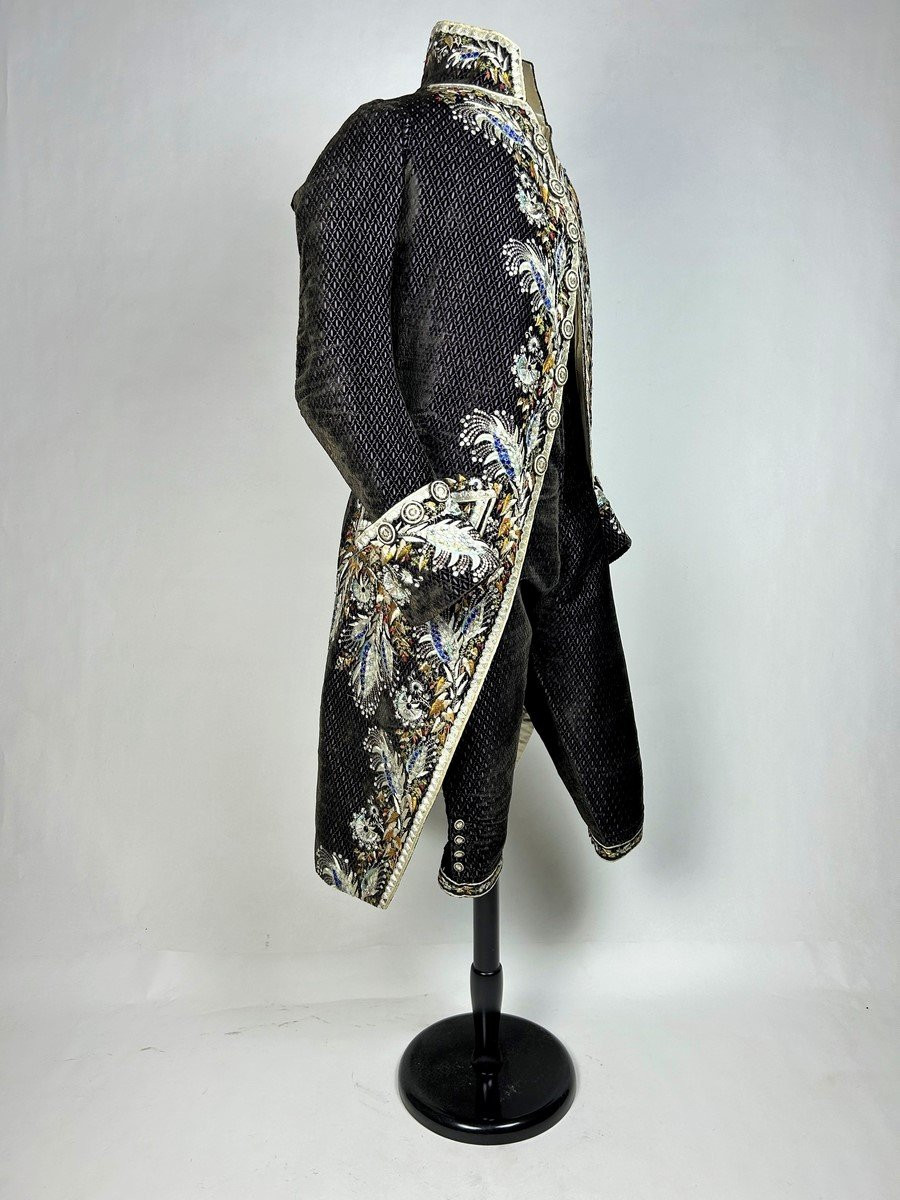
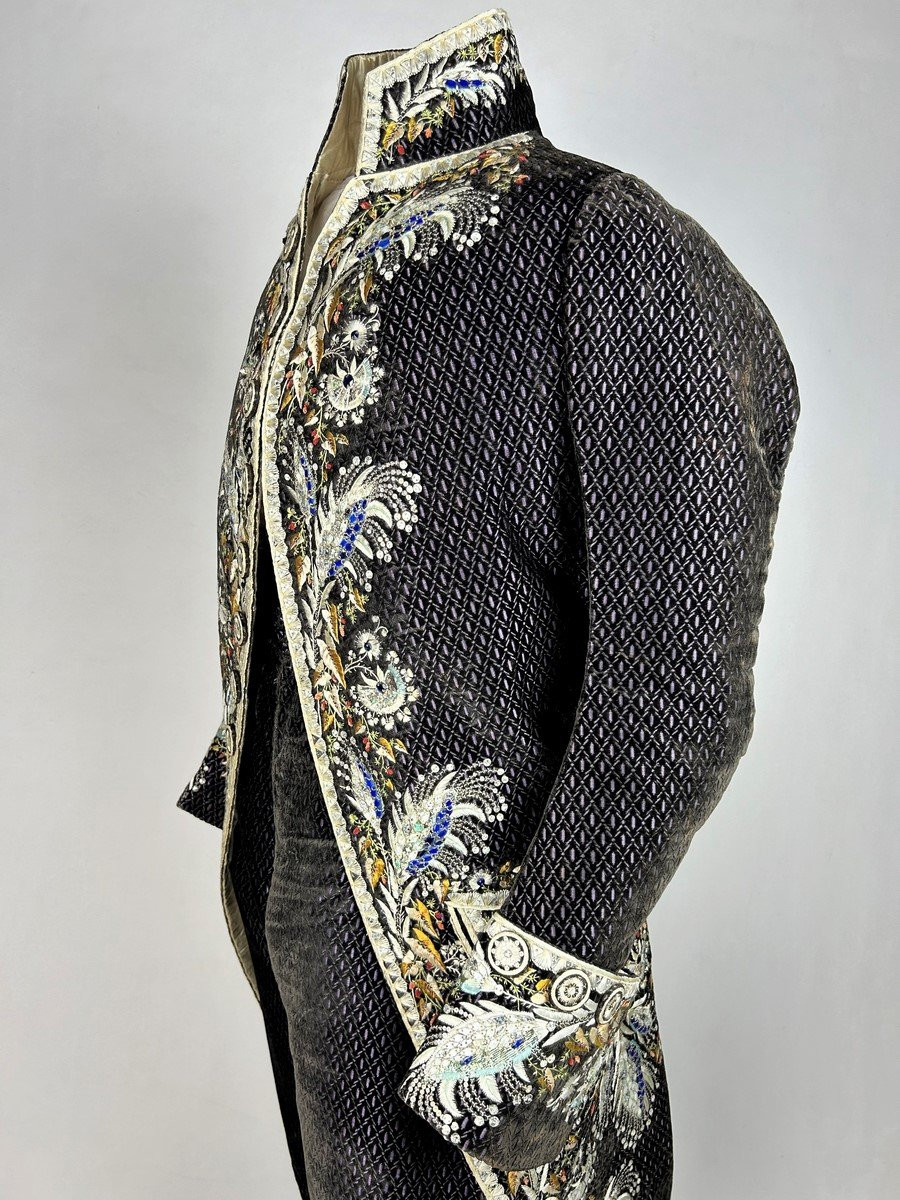
Circa 1810-1820, France. Court coat and breeches of the Marquis d'Aligre in embroidered velvet, dating from the First French Empire or the First Restoration. Coat with a stand-up collar and breeches in miniature black and purple figured velvet, magnificently embroidered. Polychrome silk embroidery in satin stitch and French knot, with silver and blue glass beads, sequins, lozenges, and shuttles, depicting stylized bouquets of flowers and foliage on the front, pockets, tails, and collar. Hook and eye closure under the collar, complete with its twenty-four embroidered buttons on the facing. Matching breeches with a front flap, trimmed with watch pockets and garter tabs embroidered in the same style. Satin lining for the coat, with quilting at the shoulders and back. It seems unlikely that a matching velvet waistcoat existed with this coat, but rather a coordinating waistcoat in a different color. Condition: very good to excellent. The fabrics are fresh and sturdy, unaltered. The velvet is stable with a few crease marks. The satin lining is in good condition except for some tears and missing pieces under the armpits. A few sequins are missing. The breeches are in good condition, complete with buttons, with slight soiling in the ecru linen lining. A complete photo file is available upon request. Measurements: Large size for the period. Coat: length 122 cm, shoulders 38 cm, collar height 8 cm, chest 111 cm, waist 108 cm, sleeves 75 cm. Breeches: length 80 cm, waist 95 cm, hip circumference 118 cm. Provenance: Etienne d'Aligre (1770-1847), 6th Marquis d'Aligre, Chamberlain to Caroline Bonaparte, Queen of Naples (1808 to 1815), from 1803. Tessier-Sarrou auction, Paris, March 25, 2016. Millon auction, Paris, November 24, 2023. The Marquis d'Aligre, son of a former First President of the Parliament of Paris, was one of the wealthiest peers in France during the Restoration. In his memoirs, Baron de Frénilly refers to him as a “poor man burdened with millions.” He owned numerous houses in Paris, on rue d'Anjou and rue d'Astorg, rue Roquépine, rue de Rivoli, rue Saint-Honoré, and rue de Clichy, as well as half a dozen châteaux, including Baronville (Eure). Under the Empire, he was among the largest taxpayers in Paris. During the July Monarchy, his annual income was estimated at two million francs, and at his death in 1847, he left an estate worth over forty-six million. (Excerpt from the entry by Raphaël Maraval-Hutin in the Millon catalog of November 24, 2023.) Between 1804 and 1814, the reign of Emperor Napoleon I favored the work of national manufacturers, symbolized by the Continental Blockade. The use of silk, wool, and velvet, like the muslins from India, became the protectionist hallmark of the French Empire in clothing. Like this exceptional ensemble in figured velvet, French embroidery excels in the representative trimmings of the Empire period. The designs of Augustin André Picot (1756-1822), embroiderer of the coronation garments of Napoleon I, or of Jean-François Bony (1754-1825) set the tone for a greater floral exuberance compared to that of the Ancien Régime.
38 000 €
Period: 19th century
Style: Consulat, Empire
Condition: Excellent condition
Material: Linen
Reference (ID): 1699029
Availability: In stock
Print