



Romanesque Capital Depicting Four Africans - Apulia, 13th Century
Romanesque Capital Depicting Four Africans
Apulia, 13th century
Stone
35 × 41 × 41 cm
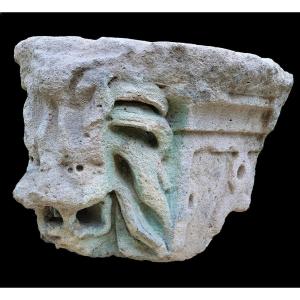
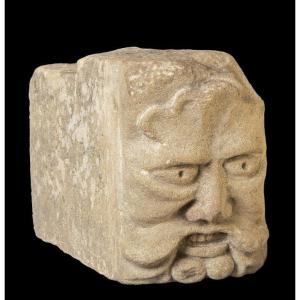
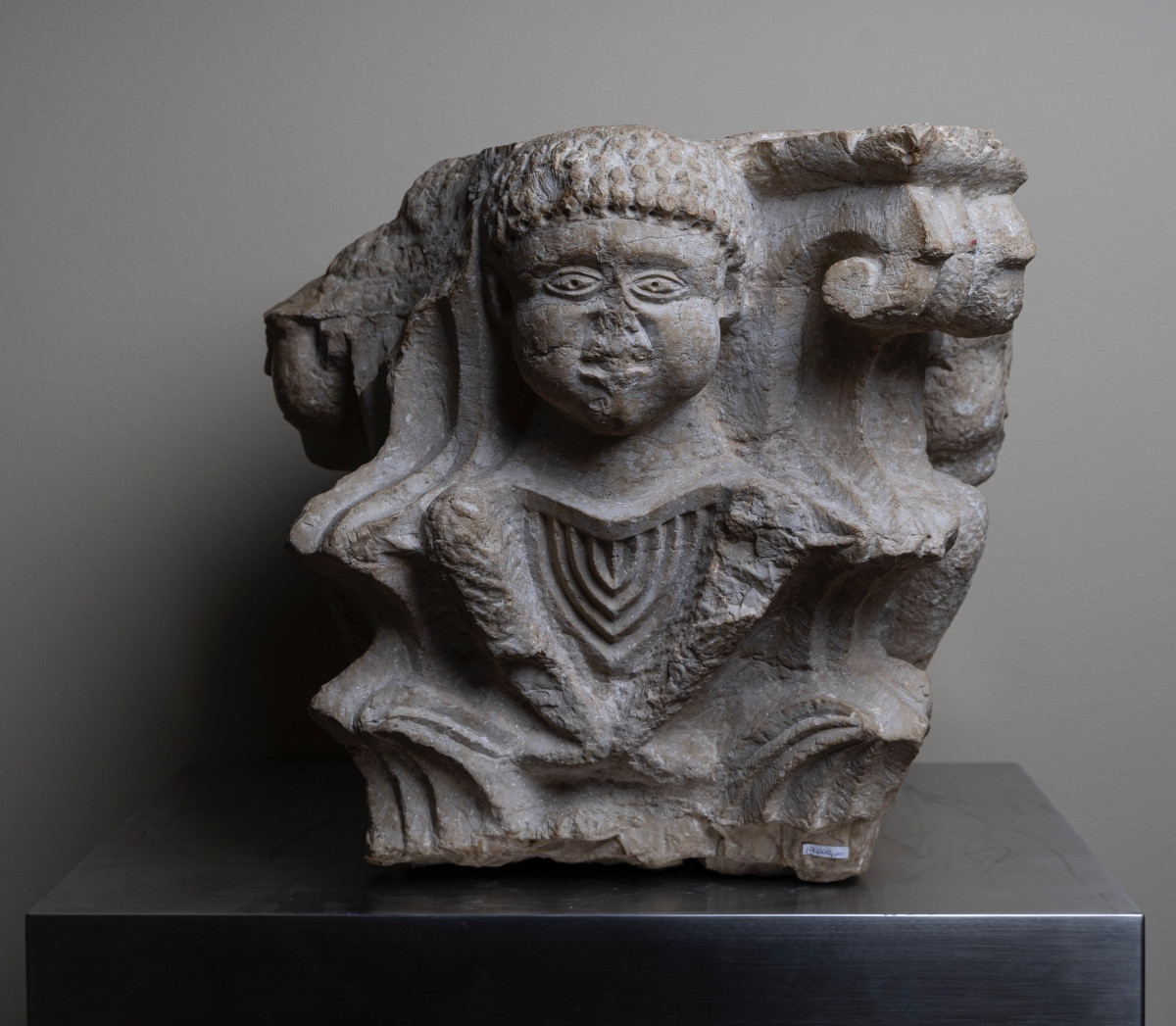
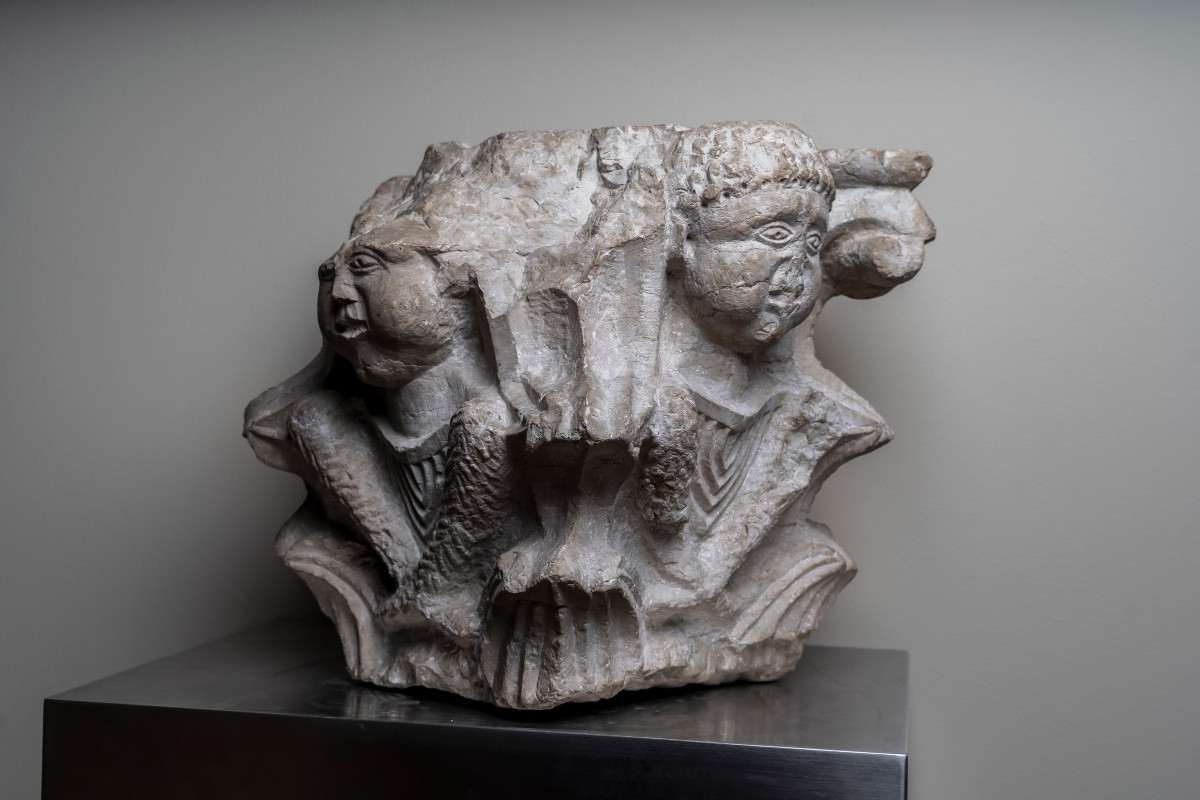
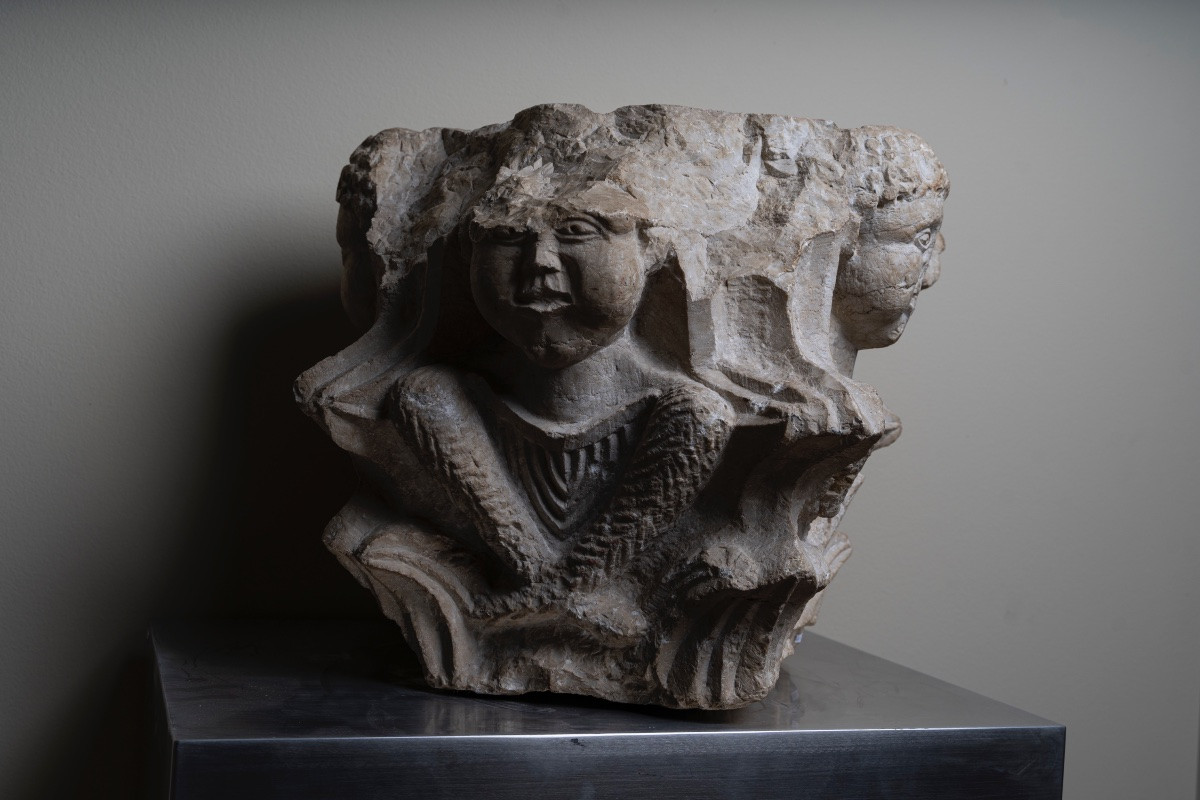
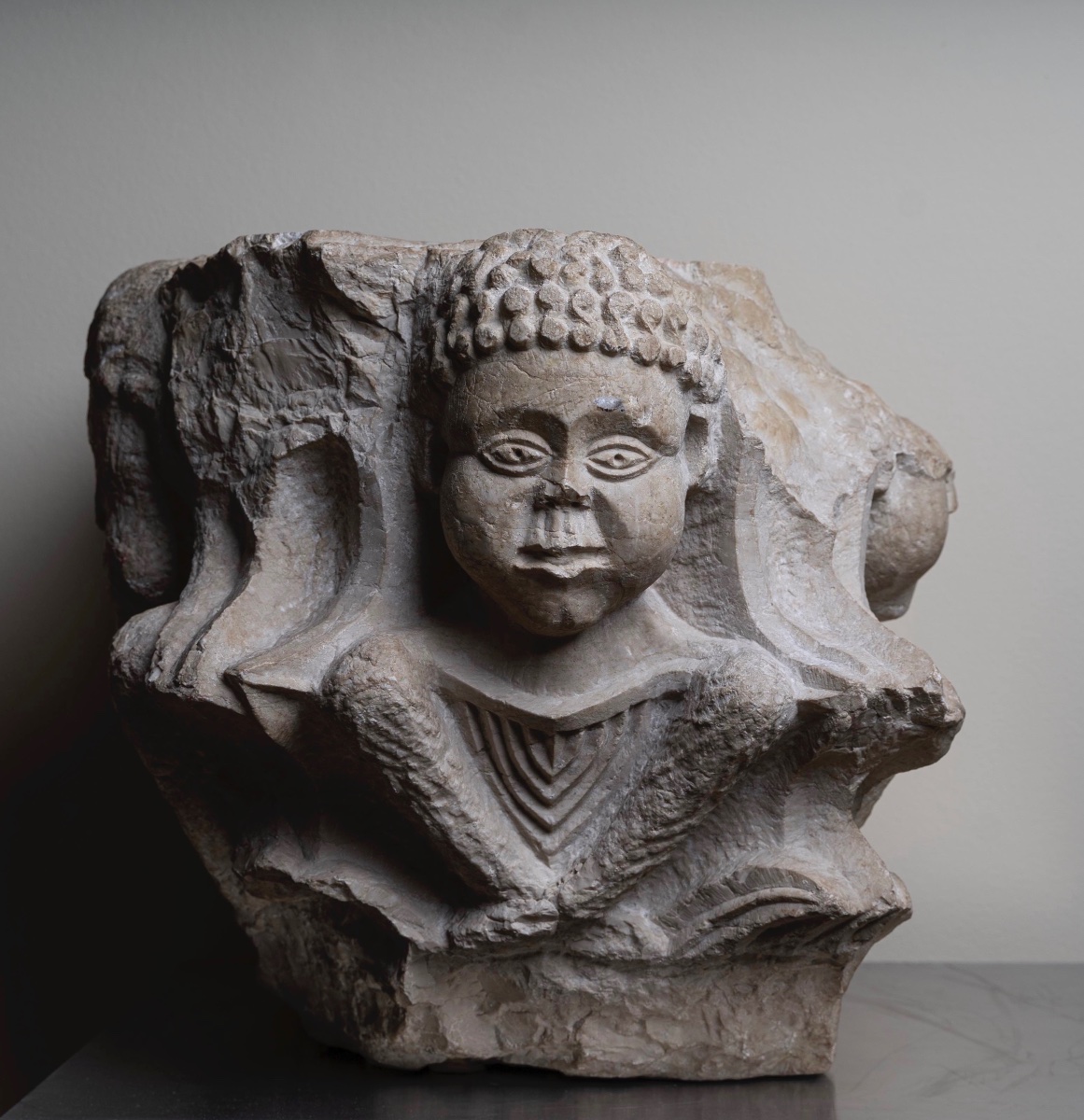
This large Romanesque capital is carved on all four sides in powerful high relief. The basket is encircled by two superimposed rows of vertical acanthus leaves rising from the astragal and filling the interstices between four human heads, one on each face. At each angle, a volute emphasizes the square format of the block and reinforces its architectural clarity.
The motif of human heads emerging from foliage derives from a long-established Late Roman decorative tradition, examples of which persisted in southern Italy, particularly in Apulia. Here, however, the subject is treated with exceptional originality and intensity. The four heads are unmistakably identified as black Africans through their carefully observed facial features: full lips, broad noses, tightly curled hair limited to the upper part of the head, and closely set eyes with pronounced, convex eyeballs. The sculptor’s close familiarity with African physiognomy is evident, most strikingly in the differentiation of hairstyles—one head with braided hair, another with small curls—details that fall well outside the conventional medieval stereotypes associated with black figures.
One of the major achievements of medieval Western art was the rediscovery of effective means for representing human racial diversity. In 12th- and 13th-century Apulia, artists had ample opportunity to observe African Saracens, and from the late 12th century onward, increasingly positive and naturalistic images of black Africans began to appear. This development was closely linked to the policies and cultural interests of the Hohenstaufen emperors, notably Henry VI and his son Frederick II. Henry’s conquest of Sicily in the 1190s brought a significant population of black Muslims under imperial rule, a reality documented in contemporary manuscript illumination.
Under Frederick II (1194–1250), whose court was a major center of intellectual and cultural exchange, black Africans appear in a wide range of artistic contexts that would later resonate in Renaissance and Baroque court culture. In the 1220s, Frederick established an Islamic colony at Lucera in Apulia that included a substantial number of Africans. At least three surviving sculptures are directly associated with this historical milieu: a capital from Troia depicting a remarkably naturalistic black figure among other ethnic types; the celebrated four-headed capital now in the Metropolitan Museum of Art, New York; and a sculpted portrait of Johannes Maurus, Frederick’s black chamberlain.
The present capital is clearly related in subject and, to some extent, in style to these works, particularly the Metropolitan Museum capital and the example from Troia. Its highly unusual iconography points to a specific and cosmopolitan cultural context, characteristic of 13th-century southern Italy under Hohenstaufen rule. More than a simple record of black presence in medieval Apulia, this sculpture bears witness to a moment of artistic openness and ethnographic curiosity that left a lasting imprint on Italian art, even after the fall of the Hohenstaufen dynasty.
Period: Before 16th century
Style: Renaissance, Louis 13th
Condition: Condition of use
Material: Stone
Width: 41
Height: 35
Depth: 41
Reference (ID): 1682854
Availability: In stock