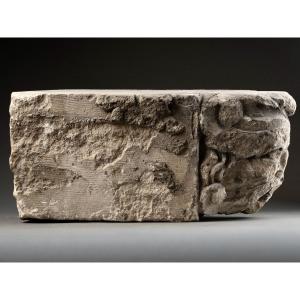


Epitaphe Germanique - Fin Du XVI Siècle
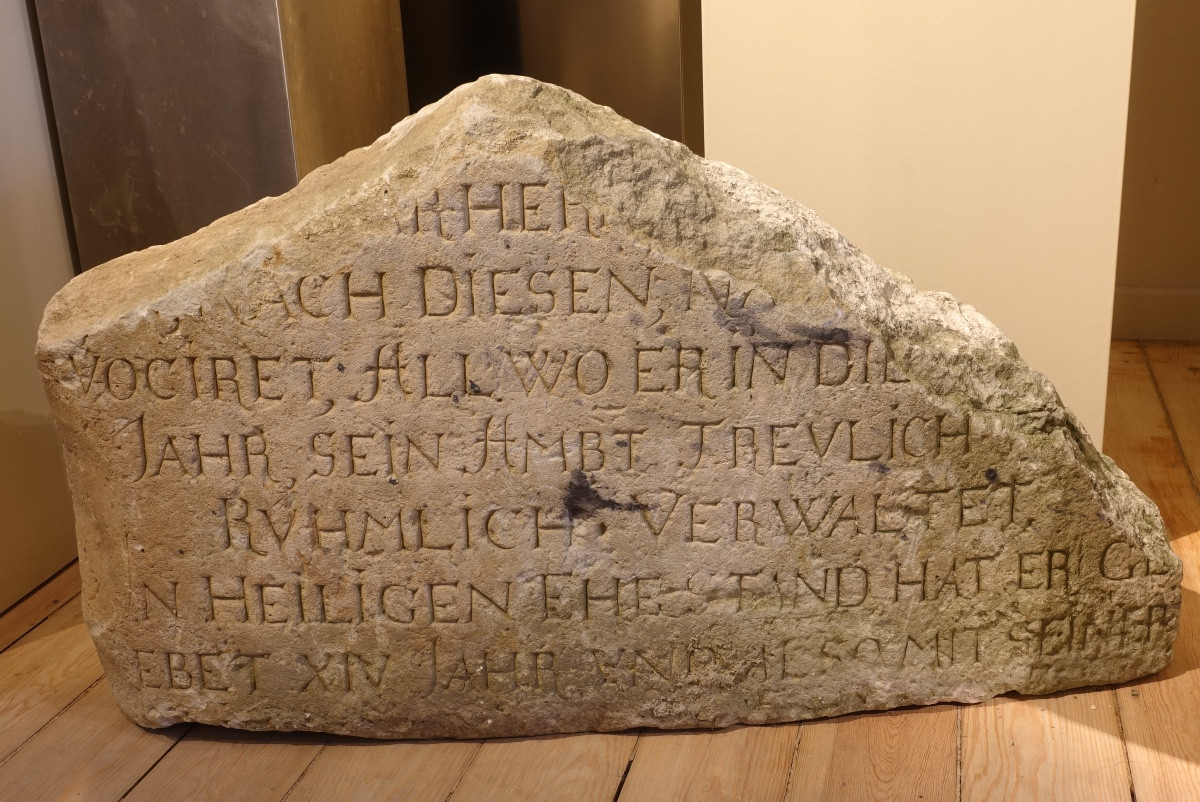
Fragment of a Germanic Funerary Epitaph
Sandy limestone · Holy Roman Empire · late 16th century
The inscription is carved in Roman humanist capitals — a significant choice in the German-speaking world of the 16th century, indicating a cultivated, humanist milieu.
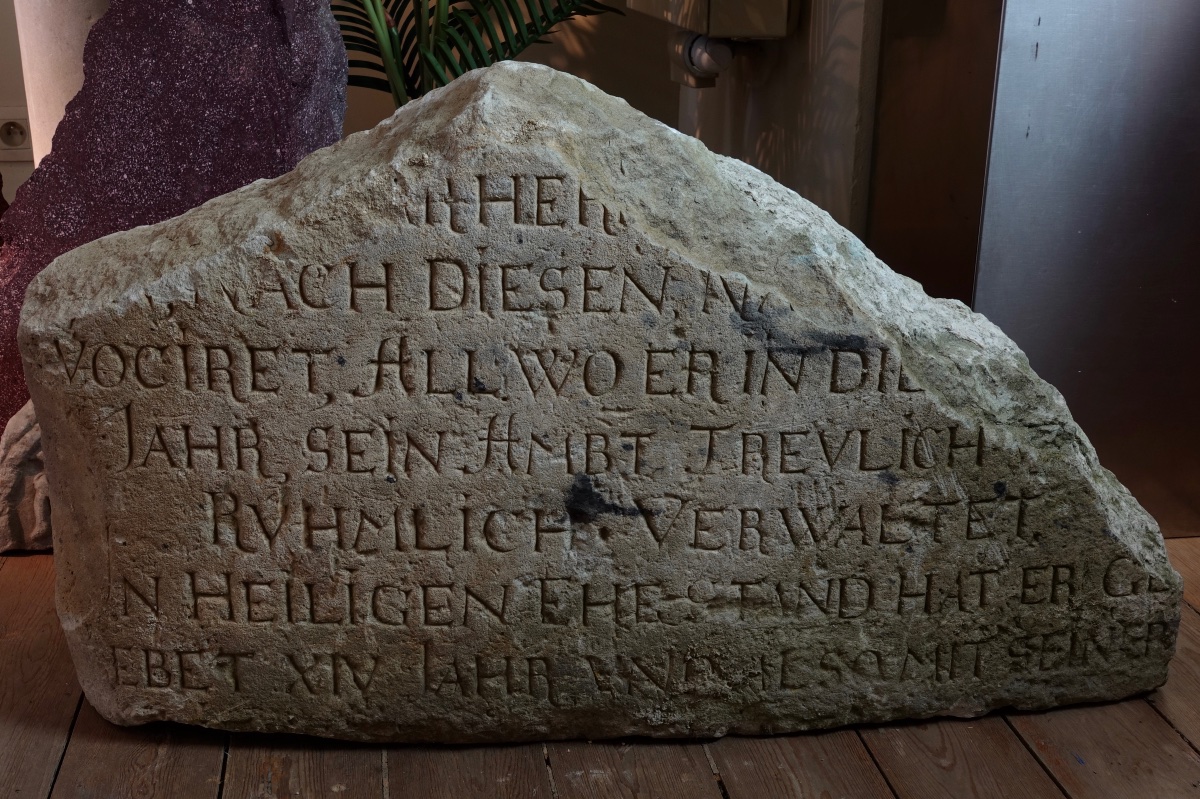
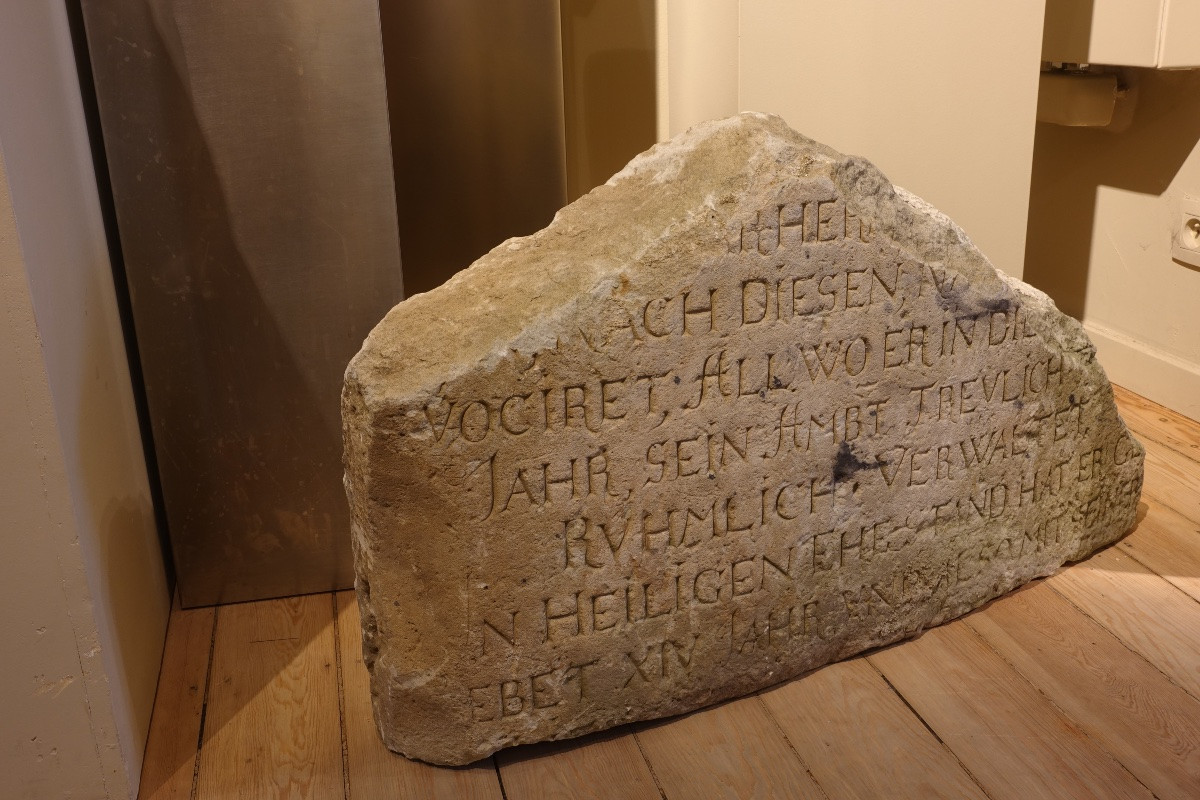
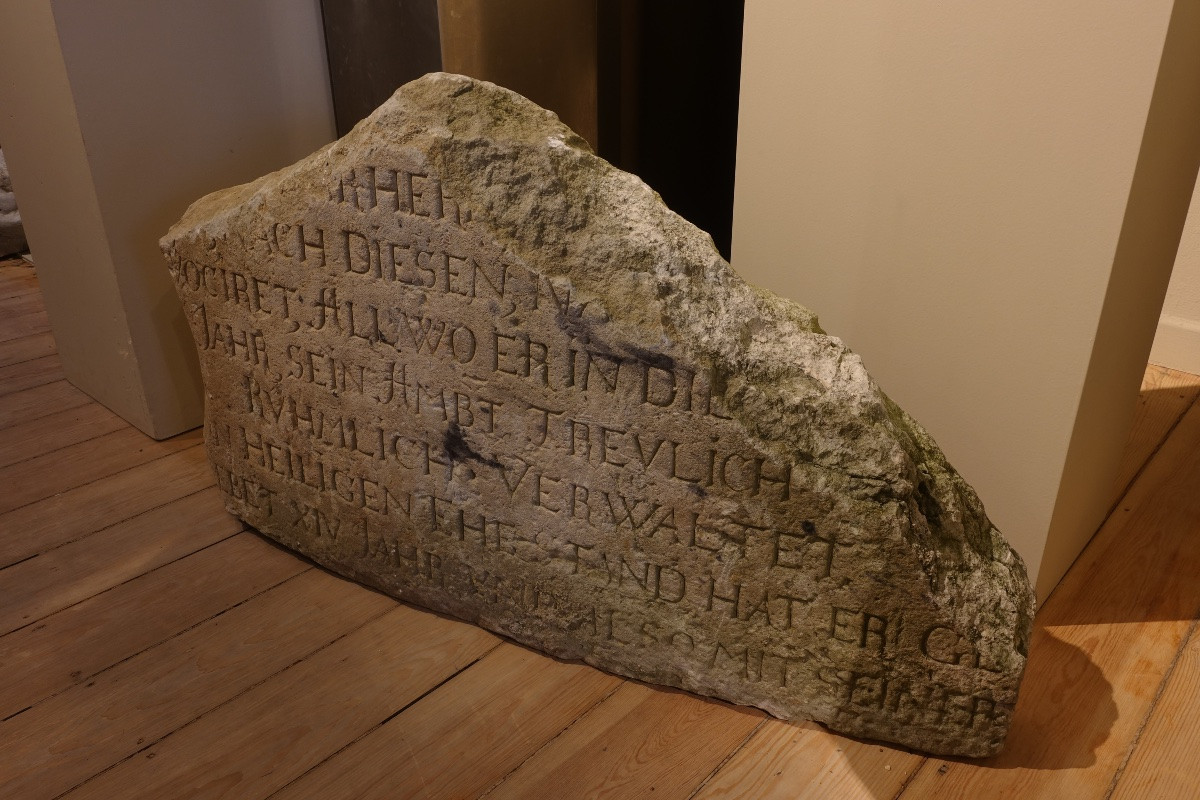
Visible text (broken edges indicated by […])…] RVHMLICH · VERWALTET […]N HEILIGEN EHE[…]TAND HAT ER G[…] EBET XIV JAHR VND ALSO MIT SEINER[…]
Reconstructed text : […] Herr [first name, surname, title…] Nach diesen [wurde er be-] vociret, allwo er in die[se…] Jahr sein Ambt treulich [und] rühmlich verwaltet. [I]n heiligen Ehe[s]tand hat er g[e-] lebet XIV Jahr, und also mit seiner […]
English translation : "[…] Mister / Reverend [name, title…], after this was called [to this office / before God], where he faithfully and honourably administered his office [for X] years. In the holy state of matrimony he lived XIV years, and thus with his [wife / family…]"
The principal face, planed and polished by the stone-cutter before carving, carries seven lines of humanist capitals with a regular module of approximately 3 to 4 cm in height. The letters are cut with a V-section incision (triangular channel), a technique characteristic of lapidary workshops in the Holy Roman Empire during the 16th century, distinct from the flat-bottomed incision more common in France. Median dots separate certain groups of words (·), a punctuation device inherited from classical Latin epigraphy and commonly adopted in German humanist epitaphs.
The script is Roman humanist capitals, directly inspired by ancient Latin inscriptions as they were rediscovered and imitated by 16th-century humanists. This choice is particularly significant in the German-speaking world, where Gothic textura remained dominant in popular inscriptions throughout the century. The adoption of upright Roman capitals signals a patron belonging to learned circles — educated Protestant clergy, urban patriciate, imperial official — in contact with Rhenish or Saxon humanist culture.
The formal characteristics (regular module, fine serifs, use of separation dots) allow this fragment to be dated to the final third of the 16th century, the period of fullest development of humanist capitals in the lapidary workshops of the Holy Roman Empire.
Several textual features allow us to define with precision the confessional and social context of this epitaph. The term AMBT (Amt, 'office, charge') denotes an official function exercised on behalf of an authority — a pastorate, magistracy, or territorial administration. Its prominence on an epitaph identifies a man who defined himself by his public service as much as by his faith.
The mention of the 'holy state of matrimony' (heiliger Ehestand) and the precise duration of XIV years of married life are characteristic of Lutheran Protestant epitaphs. Unlike the Catholic tradition, which emphasised acts of devotion and saintly intercession on funerary monuments, the Lutheran epitaph celebrates the deceased's earthly life in its civic and familial dimensions: faithfulness in office, the duration of marriage, and offspring. Marriage here is not a concession to human weakness but an honourable vocation, fully integrated into the spiritual identity of the deceased.
The Latinism VOCIRET (from Latin vocari, 'to be called, to be summoned') embedded in a German text is a further marker of erudition: it evokes simultaneously the professional vocation (the deceased was 'called' to his office) and death as divine summons, playing on both senses of the term in a learned formulation.
The combination of humanist capitals, vocabulary (Amt, Ehestand, vociret), biographical structure, and the precise mention of a duration of marriage places this fragment within the Protestant funerary epigraphy of the Holy Roman Empire, most probably in the second half of the 16th century (c. 1560–1600).
The most likely region of origin, given the lapidary style and vocabulary, is central or southern Germany (Saxony, Thuringia, Franconia, Swabia) or Alsace — areas where Rhenish humanism and Lutheran Reform combined to produce this type of monument.
The deceased was in all probability a Lutheran pastor or an Amtmann (administrative official) of an imperial city, from a cultivated background, whose epitaph was commissioned from a competent urban lapidary workshop.
Period: Before 16th century
Style: Renaissance, Louis 13th
Condition: Good condition
Material: Stone
Length: 83
Height: 46
Depth: 13
Reference (ID): 1631767
Availability: In stock