Byzantine Frieze – Egypt – 5th/6th Century
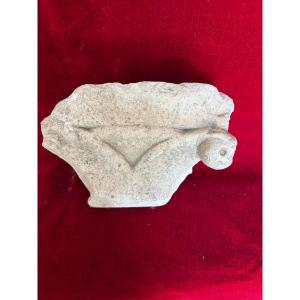
This elegant rectangular stone frieze is carved in bas-relief with abundant plant motifs. Dating from the 5th–6th century, it likely originates from a Byzantine context in Egypt, within the Late Antique and Coptic world. Associated with the Christian art of Africa and the East, it exemplifies the architectural ornamentation characteristic of this period, blending Greco-Roman influences with decorative innovations. The decoration consists of stylized acanthus scrolls that curl into continuous volutes, terminating in palmettes, and a vine with abundant grapes. These motifs, already used in the ancient Dionysian repertoire, were reinterpreted by Christians in a Eucharistic sense: the vine becomes a symbol of Christ and spiritual life. This appropriation reflects the iconographic evolution specific to the Byzantine world, where forms inherited from Roman classicism acquired new religious meanings. The frieze was intended to be part of the ornamentation of a religious building—church or chapel—and to contribute to the visual richness of the sacred space. Unlike Greco-Roman sculpture, which was careful to reserve certain motifs for specific locations, Coptic and Byzantine art tended to freely deploy its decorative vocabulary, placing themes initially linked to mosaics or sarcophagi on friezes. The vigor of the relief and the density of the motifs testify to the expertise of Egyptian workshops, capable of combining an ancient heritage with a new Christian sensibility. These friezes, often originally painted in vibrant colors, enlivened the facades and interiors of buildings, giving them both an aesthetic and theological dimension. Thus, this frieze embodies the stylistic hybridity of the period: a continuity with classical models and a Christian reinterpretation specific to the Coptic and Byzantine world. It illustrates the central role of Egypt as an artistic center in Late Antiquity.
6 500 €
Period: Before 16th century
Style: Renaissance, Louis 13th
Condition: Good condition
Material: Stone
Width: 56 cm
Height: 40 cm
Reference (ID): 1706625
Availability: In stock
Print