



Small Marble Capital - Italy - 12th Century
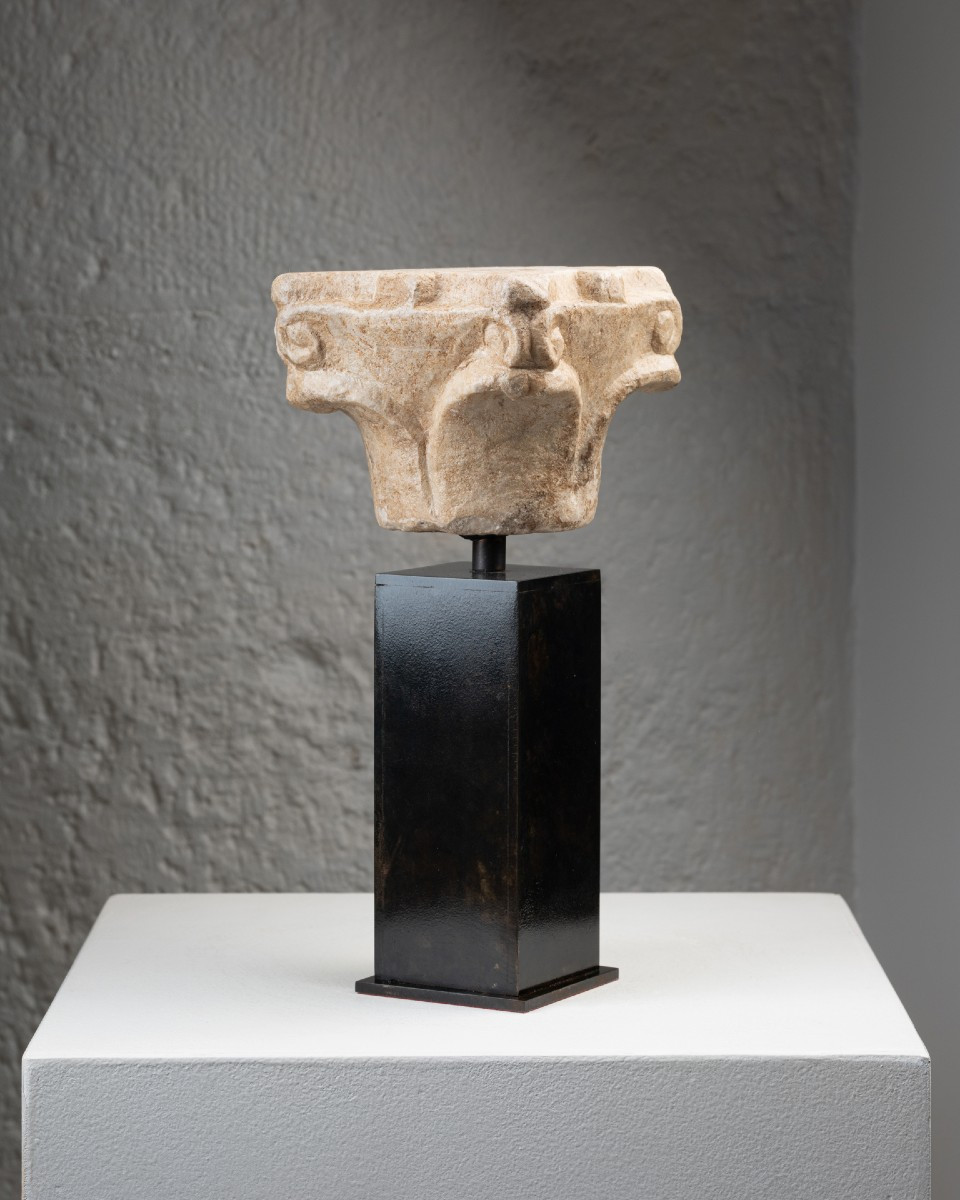
This small, lightly veined white marble capital, of Italian origin, can be placed at the hinge between the Romanesque and early Gothic periods. Carved on all sides, it features a basket decorated with stylized plant motifs, notably water leaves with rounded ends, as well as hooks and shapes evoking crosses at the corners.
These decorative elements, both sober and elegant, testify to an aesthetic characteristic of 12th-century Cistercian circles, marked by a quest for simplicity in opposition to the ornamental richness of Cluniac and Benedictine traditions. This simplification of forms is part of an older heritage: Roman artists, particularly attached to the Corinthian capital, had already tended to purify the acanthus leaf by removing its details (teeth, ribs, deep cuts) to retain only a general, smooth and unified form. This process, visible in several Roman monuments such as Agrippa's baths, was also common in small-scale productions (steles, altars, sarcophagi), particularly in late Antiquity. Easy to execute, this type of simplified decoration spread widely and was adopted, with variations, in later artistic traditions.
The organization of the capital also reveals several striking technical aspects: the presence of two holes, one at the top and the other at the base, suggests that it was intended to be fixed or integrated into a larger architectural device. The treatment of smooth leaves and the stylization of plant motifs indicate an evolution towards more refined forms, heralding Gothic developments.
This type of capital, sometimes referred to as a "water-leaf capital", is part of a tradition in which plant decoration retains a symbolic dimension. The organic forms, though simplified, evoke an orderly, controlled nature, reflecting a spiritual ideal. The lily motif, when present, can be interpreted as a symbol of purity, reinforcing the moral and religious dimension of the object.
Thus, this work is not limited to an architectural function: it participates fully in a visual language intended to accompany the spirituality of the place. Through its formal sobriety, its balance of volumes and the stylization of its motifs, this capital perfectly illustrates a phase of artistic transition, when the Romanesque heritage is gradually transformed to give rise to the more slender and structured forms of the Gothic.
Period: Before 16th century
Style: Renaissance, Louis 13th
Condition: Excellent condition
Material: Marble
Width: 12 cm
Height: 26 cm
Depth: 12 cm
Reference (ID): 1742991
Availability: In stock