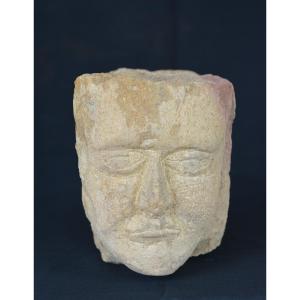
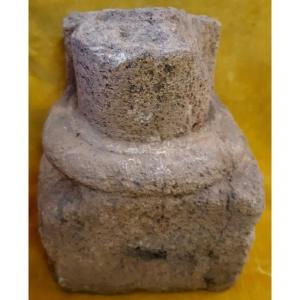
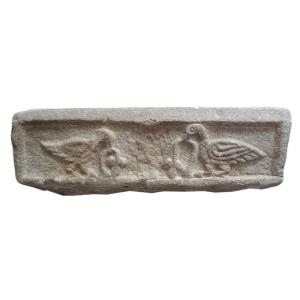
Stone Fragment – France – 14th Century
This stone fragment, sculpted in bas-relief, most likely comes from a medieval rood screen, a major architectural element of medieval churches. The work dates to around the 14th century, a period of great flourishing for monumental Gothic sculpture, and today only the lower parts of the figures remain: bare feet, ample folds of drapery, and a central vertical element resembling a tree trunk. Despite its fragmentary state, this sculpture remains a precious testament to the rich iconography and liturgical significance of rood screens. The term "rood screen" comes from the Latin liturgical formula "Jube, Domine, benedicere," pronounced by the deacon before the proclamation of the Gospel, meaning "Bless us, O Lord." The canons would ascend the rood screen so that the congregation gathered in the nave could see and hear them, beginning their reading with this solemn invocation. It is from this first word, "rood screen," that the screen takes its name. Appearing at the end of the 12th century, this architectural structure separated the nave, the space for the faithful, from the chancel reserved for the clergy, while also serving as a platform for reading the Gospel, the Epistle, or for preaching. The rood screen is a transverse enclosure, most often made of stone, pierced with doors and surmounted by a gallery accessible from the chancel. From the first third of the 13th century, particularly in northern France, sculpted decoration became fully integrated into its architecture. The arcades were then adorned with sculpted narrative cycles illustrating the life of Christ. Special emphasis was placed on the Passion, whose dramatic power resonated with medieval piety and the didactic function of imagery. The fragment under study appears to belong to such an iconographic program. The bare feet, frequently associated with the figure of Christ, as well as the bowed posture of one of the figures, suggest a scene from the Passion, possibly linked to an episode in the Garden of Gethsemane, where Christ is sometimes depicted near a tree or trunk, praying. The appearance of a second foot, belonging to another figure, suggests the presence of one of his disciples. The deep, rhythmic folds of the drapery demonstrate a concern for movement and narrative clarity, characteristic of Gothic sculpture. Clothing here becomes an expressive element, fully contributing to the dramatic tension of the scene. As with the fragment of the rood screen from Bourges Cathedral, The Kiss of Judas, iconographic recognition relies less on the faces, now lost, than on the posture of the bodies, their spatial relationship, and the architectural elements that structure the composition. Originally, these sculptures were polychrome, and tool marks still visible on the stone surface recall the sculptor's work and the materiality of the piece. The gradual disappearance of rood screens from the 17th century onward, a phenomenon sometimes described as "ambonophobia," explains the fragmentary state of these reliefs. The stones of the rood screen, considered sacred, could not be freely reused: some were recut for use in other cathedral construction projects, others were buried beneath the building, allowing for the preservation of fragments such as this one. Thus, this bas-relief is fully in keeping with the tradition of medieval sculpture, at the crossroads of architecture, liturgy, and imagery. Fragmentary yet expressive, it illustrates the medieval desire to make the sacred narrative visible and intelligible through stone, offering the faithful a truly sculpted interpretation of the Passion of Christ. A rare example of monumental Gothic art, it recalls the importance of the rood screen as a major support for religious storytelling and for mediation between the clergy and the community of the faithful.
8 000 €
Period: Before 16th century
Style: Renaissance, Louis 13th
Condition: Good condition
Material: Stone
Width: 36 cm
Height: 37 cm
Depth: 13 cm
Reference (ID): 1683748
Availability: In stock
Print