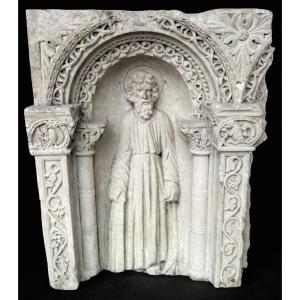
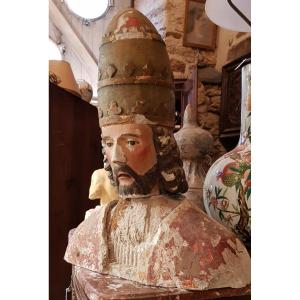
Bas-relief Depicting An Apostle – Italy, 15th Century
This Istrian stone bas-relief depicts a haloed apostle, shown full-length, sheltered beneath an architectural structure with twisted columns. The work belongs to the oeuvre of the Venetian sculptor Gherardo di Mainardo, active between 1404 and 1422, known particularly for the Relief Altarpiece with Saints Peter, Paul, and John the Baptist (1408, The Metropolitan Museum of Art) as well as for several funerary monuments commissioned by the Venetian aristocracy, including those of Dogaresse Agnese da Mosto, Petronilla de Tocco, and Orsola Venier. The apostle, represented by the closed book he holds in his left hand and the gesture of blessing with his right, stands in a stable, frontal pose, imbued with calm authority. The face, framed by a short, curly beard, is sculpted with a realistic attention to detail and psychological depth that directly recalls the central figure of the 1408 Altarpiece Relief. In both works, the powerful modeling of the face, the fleshy treatment of the hands, and the arrangement of the drapery reveal the same hand or, at least, the same artistic conception. The broad, rhythmic folds of the garment wrap in supple volumes around the body, creating an interplay of light and shadow that animates the surface of the stone. The architecture framing the saint plays an integral part in the composition: two twisted columns with foliate capitals support an entablature adorned with geometric patterns. The continuous frieze between the two columns also extends onto the left edge, suggesting that the block was intended to be inserted either in front of or to the side of the tomb. At the rear and on the right side, the presence of notches testifies to its integration into a larger architectural ensemble. This architectural device, common in Venetian sculpture at the turn of the 15th century, lends the figure a serene monumentality and places it in a symbolic sacred space, halfway between a niche and an altarpiece. Here we find the legacy of the Dalle Masegne workshop, with which Gherardo di Mainardo seems to have been closely associated, both in terms of architectural rigor and the concern for ordering figures according to a logic of symmetry and spiritual hierarchy. The funerary monuments of Dogaresse Agnese da Mosto, Petronilla de Tocco, and Orsola Venier in Venice, to which Gherardo di Mainardo is believed to have contributed, bear witness to this approach. The saints, sculpted in stone, become the eternal protectors of the noble souls they surround. The verticality of the saint in this bas-relief, his frontality, and the strength of his gaze seem to perpetuate this tradition: he stands as a guardian of virtue and memory. This work also testifies to the devotional materiality characteristic of late medieval sculpture: the polished and slightly patinated stone lends the figure an embodied, almost tangible presence. In the tradition of early Renaissance Venetian reliefs, the saint is not merely an iconographic motif, but a personification of heavenly virtues, a moral model offered for contemplation. This moral and spiritual role of the relief finds an echo in contemporary monumental tombs, where saints and virtues, placed in niches or against columns, framed the sarcophagus and symbolically celebrated the merits of the deceased. Through its balance between Gothic solemnity and all'antica construction, this work perfectly embodies the moment of transition that Venetian sculpture underwent at the beginning of the 15th century. The taste for symmetry and architectural order heralds the Renaissance, while the intense spirituality of the face and the softness of the modeling still recall Gothic fervor.
35 000 €
Period: Before 16th century
Style: Renaissance, Louis 13th
Condition: Excellent condition
Material: Stone
Width: 31 cm
Height: 60 cm
Reference (ID): 1646789
Availability: In stock
Print