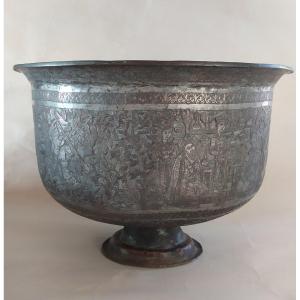
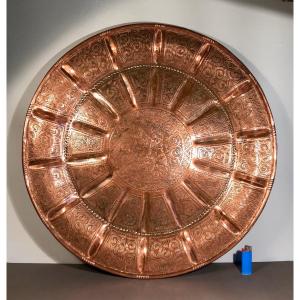
Chapati Box, Indian Bread, Red Copper, Rajasthan, India, Early 20th Century
# Chapati box, Indian flatbread, originating from India, Rajasthan, from the end of the 19th, beginning of the 20th century.
Chapati is a bread from the Indian world, traditionally made without leaven (or yeast).
Chapati is a feminine noun. In French, the usage hesitates between le and la chapati.
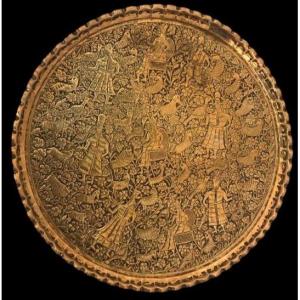
This red copper box was intended for the storage of round flatbreads, the whole is in very good condition and exceptionally beautiful.
The box is abundantly decorated with hand-engraved friezes, the handle and the closing systems are of a beautiful quality.
# These boxes also serve, thanks to their good closing system, for the conservation of betel.
If chewing betel for its stimulating properties is an integral part of many Asian cultures, the preparation techniques present regional differences and have evolved in the 20th century.
The areca nut is either minced or grated, often flavored with spices then mixed with lime (calcium oxide) and since the colonial period sometimes with tobacco.
The whole thing is usually wrapped in a piper betle leaf and improperly takes the name of betel (in some languages, but not in local dialects which differentiate betel and areca nut, although the word "chiquer" is used interchangeably for both products). The lime acts as a catalyst.
Areca contains arecoline, an alkaloid which promotes salivation.
The nut colors the saliva red and the teeth orange.
Traditionally, after about twenty minutes of chewing, the consumer spits out what remains of the quid.
Dimensions: Height: 14.5 cm - diameter: 25 cm - weight: 1621 grs
FREE SHIPPING FOR FRANCE by colissimo delivery against signature / EUROPE 25€ / WORLD 50€
For more information, you can contact me at 06 13 36 09 30 or on winsteinprovence@gmail.com
www.winsteinprovence.com
Chapati is a bread from the Indian world, traditionally made without leaven (or yeast).
Chapati is a feminine noun. In French, the usage hesitates between le and la chapati.
This red copper box was intended for the storage of round flatbreads, the whole is in very good condition and exceptionally beautiful.
The box is abundantly decorated with hand-engraved friezes, the handle and the closing systems are of a beautiful quality.
# These boxes also serve, thanks to their good closing system, for the conservation of betel.
If chewing betel for its stimulating properties is an integral part of many Asian cultures, the preparation techniques present regional differences and have evolved in the 20th century.
The areca nut is either minced or grated, often flavored with spices then mixed with lime (calcium oxide) and since the colonial period sometimes with tobacco.
The whole thing is usually wrapped in a piper betle leaf and improperly takes the name of betel (in some languages, but not in local dialects which differentiate betel and areca nut, although the word "chiquer" is used interchangeably for both products). The lime acts as a catalyst.
Areca contains arecoline, an alkaloid which promotes salivation.
The nut colors the saliva red and the teeth orange.
Traditionally, after about twenty minutes of chewing, the consumer spits out what remains of the quid.
Dimensions: Height: 14.5 cm - diameter: 25 cm - weight: 1621 grs
FREE SHIPPING FOR FRANCE by colissimo delivery against signature / EUROPE 25€ / WORLD 50€
For more information, you can contact me at 06 13 36 09 30 or on winsteinprovence@gmail.com
www.winsteinprovence.com
240 €
Period: 19th century
Style: Orientalism
Condition: Good condition
Material: Copper
Diameter: 25 cm - 10"
Height: 14,5 cm - 6"
Reference (ID): 1629546
Availability: In stock
Print