


17th Century Roman School, Santa Cecilia With Angels In Concert
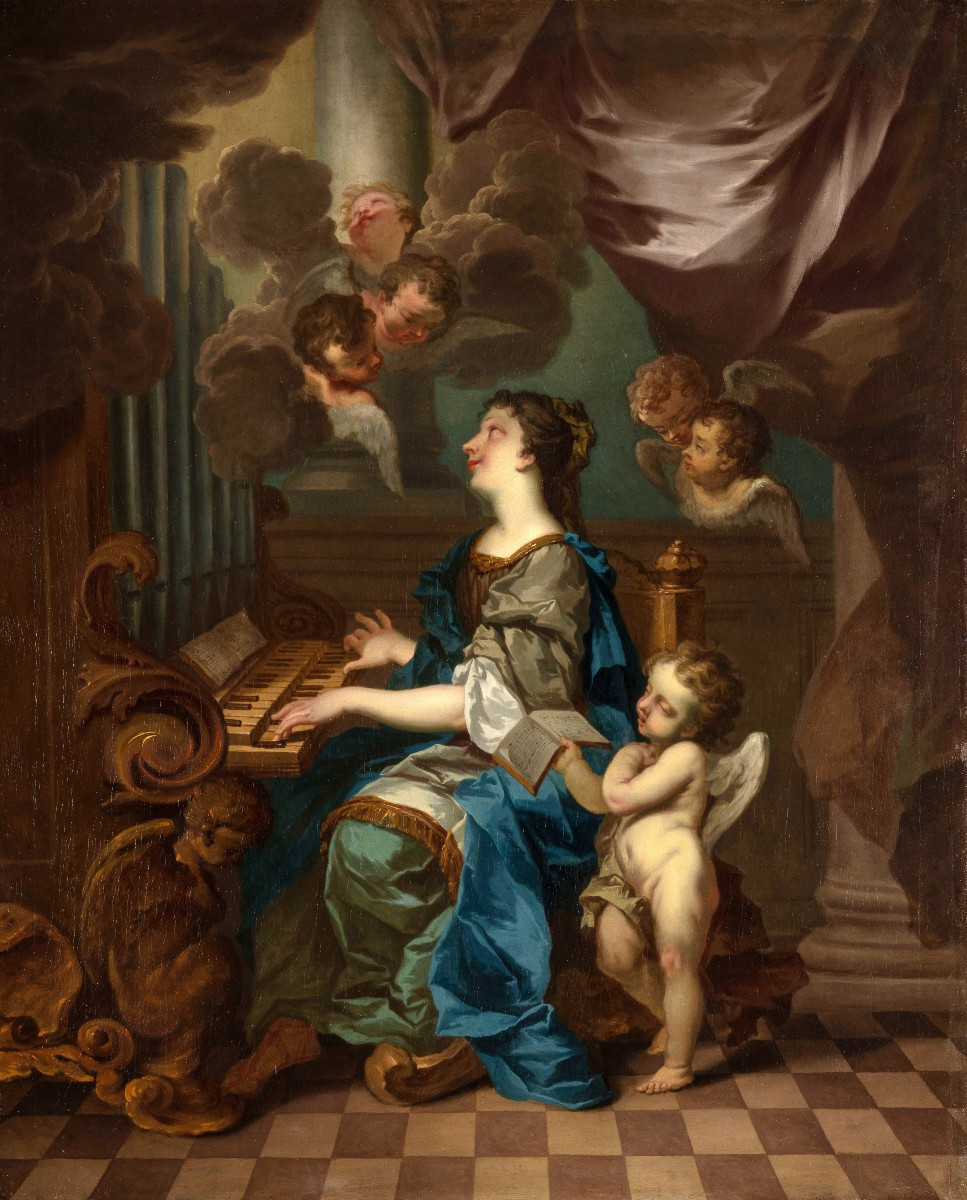
17thcentury Roman school, Santa Cecilia with angels in concert, oilpainting on canvas
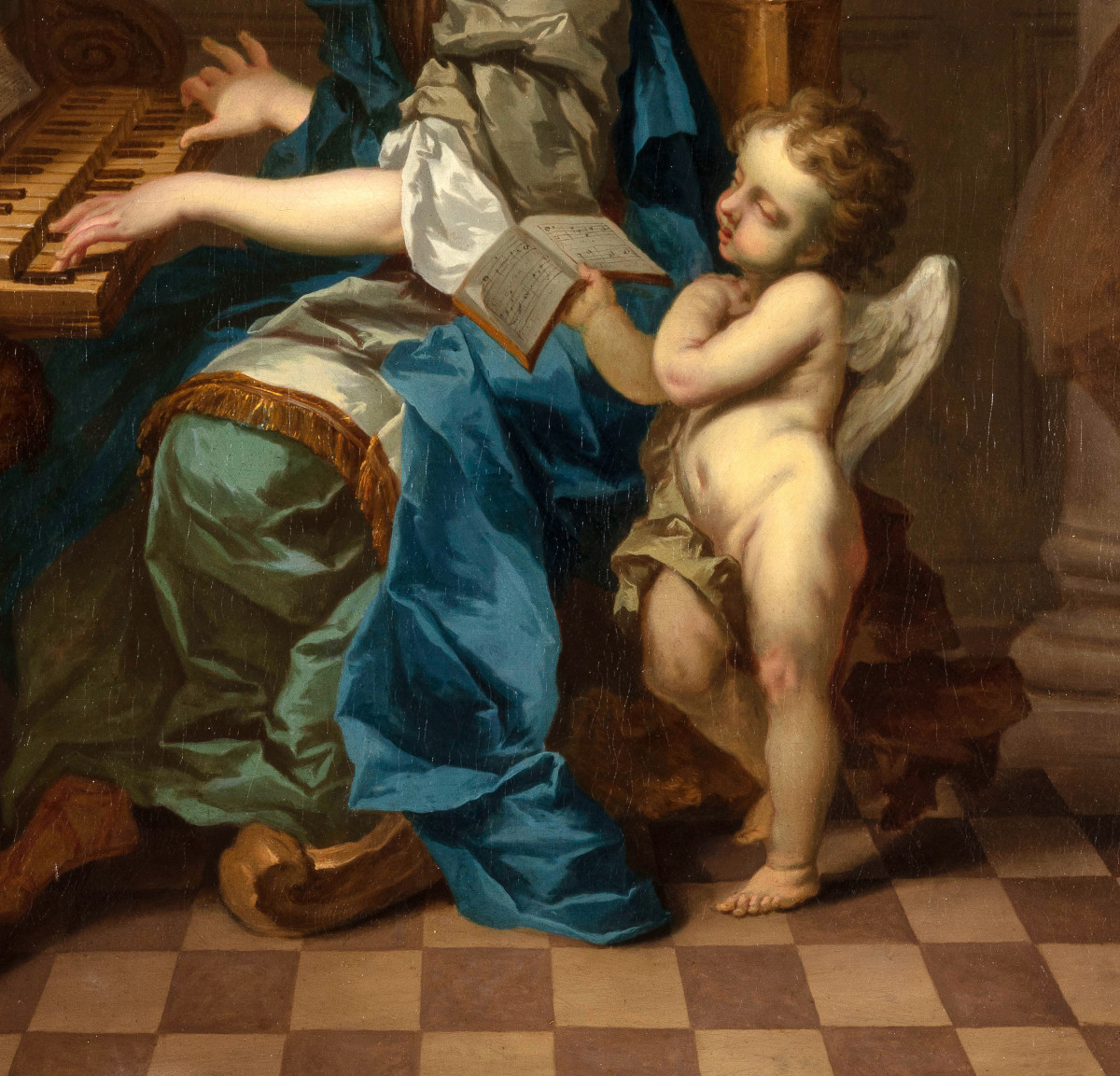
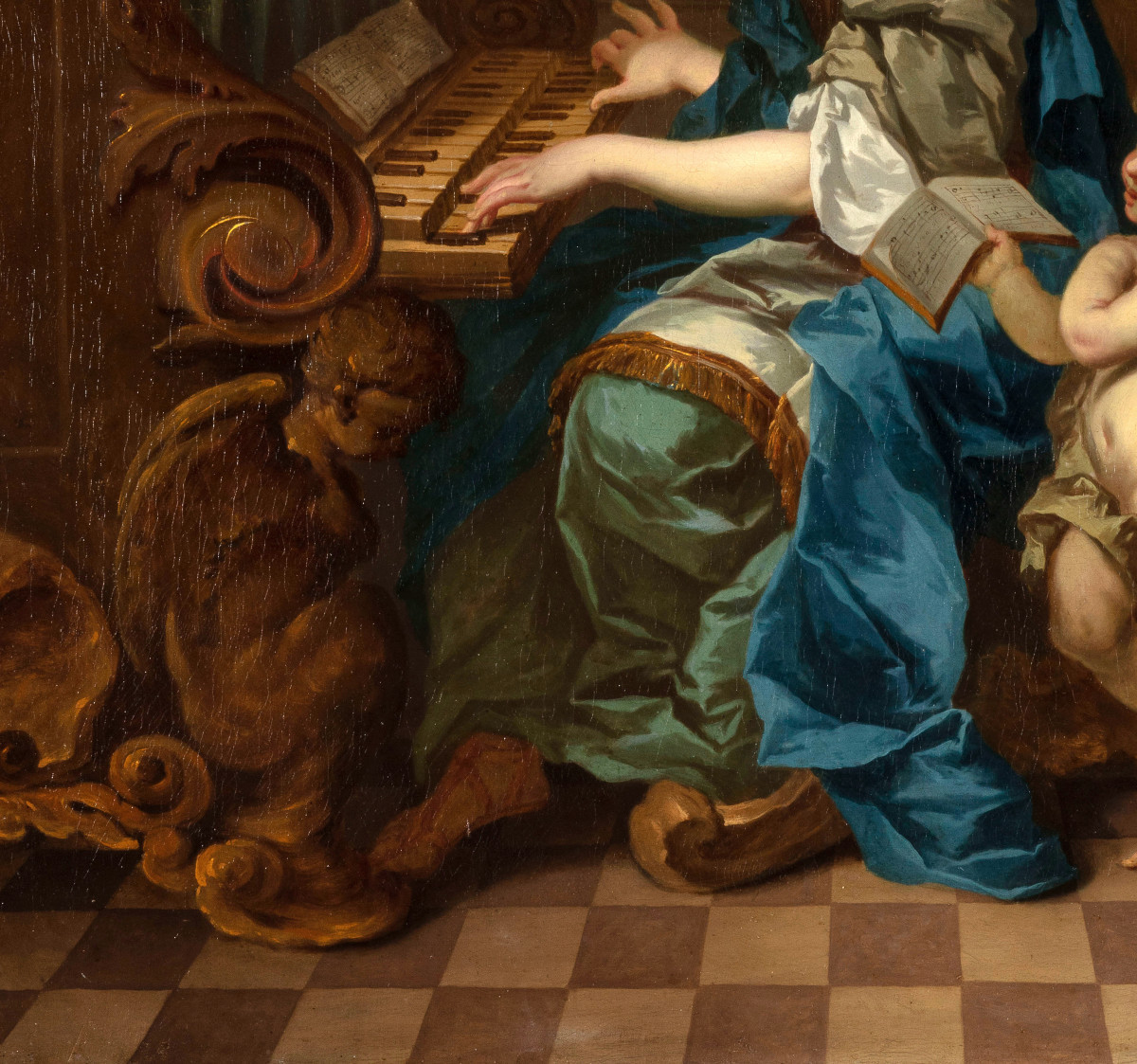
Thevaluable painting, in excellent condition, depicts Saint Cecilia playing theorgan, surrounded by cherubs and cherubim. The saint, with an absent gaze andturned towards a mystical and divine light that transpires from behind thepipes of the organ and soft clouds, is dressed in refined and precious silkdresses. Next to her a putto hands her the musical score. The structure of theorgan and the chair, in carved wood, reflect the stylistic dictates widespreadin Rome in the Baroque era. The pavement in checkered, distorted prospectively,invites the observer’s gaze to converge towards the center of the canvas, wherethe face of the saint is represented. In the background, two imposing marble columnsand a rich curtain frame the scene and serve as a fifth, increasing thecompositional solemnity.The authorof the canvas is to be found in a painter active in Rome in the seventeenthcentury of skilled technical and compositional skills. The composition, playedmainly in shades of brown, blue green and red, is harmonious and beautifulbalanced. The natural rendering of silk fabrics, as well as of the skin tones,is proof of a high pictorial skill.Iconographically, Saint Cecilia is often depictedplaying an instrument and her image is often an allegory of Music itself,included in the Liberal Arts Quadrivium. Cecilia was a Roman noblewoman, hence thesumptuous and rich clothing, lived between the second and third centuries. A.a.She was married to Valerian, also a descendant of a noble Roman family. On thenight of the wedding, Cecilia revealed to her husband her conversion toChristianity and her decision to take a vow of chastity. The husband acceptedhis wife’s wish, converted himself to Christianity and had his brother Tiburzioconverted as well.All three thus began a work of spreading the newreligion and Cecilia, excellent speaker, soon managed to convert many Romans,protected and helped by the two brothers soldiers. For their charitableactivities, their fame grew so fast that they were condemned to martyrdom bythe Roman prefect Turcio Almachio. Saint Cecilia is known to be the patronsaint of music. His approach to this art was generated by an incorrectinterpretation of the texts of the antiphonaries that were used in the massesduring the celebrations for the saint.The original text reads as follows:"Candentibus organis, Caecilia virgo in corde suo soli Dominodecantabat...", that is "Among the organs (instruments of martyrdom)glowing, the virgin Cecilia sang praises to God in her heart". The wronginterpretation is in the first sentence, transcribed as follows:"Cantantibus organis.." or "Among the organs(musicalinstruments) playing", therefore listening to heavenly music sang praisesto God in his heart. Thus begins, from the fifteenth century, theiconographic fortune of Cecilia, to whom were attributed musical abilities.Thus, the saint was given a portative organ as a symbol of her excellent skillsas a musician and since then she has been invoked by singers and composers astheir protector.Art historystudies are currently underway.
18 500 €
Period: 16th century
Style: Louis 14th, Regency
Condition: Good condition
Material: Oil painting
Width: 102,5
Height: 126
Reference (ID): 1521943
Availability: In stock
Print