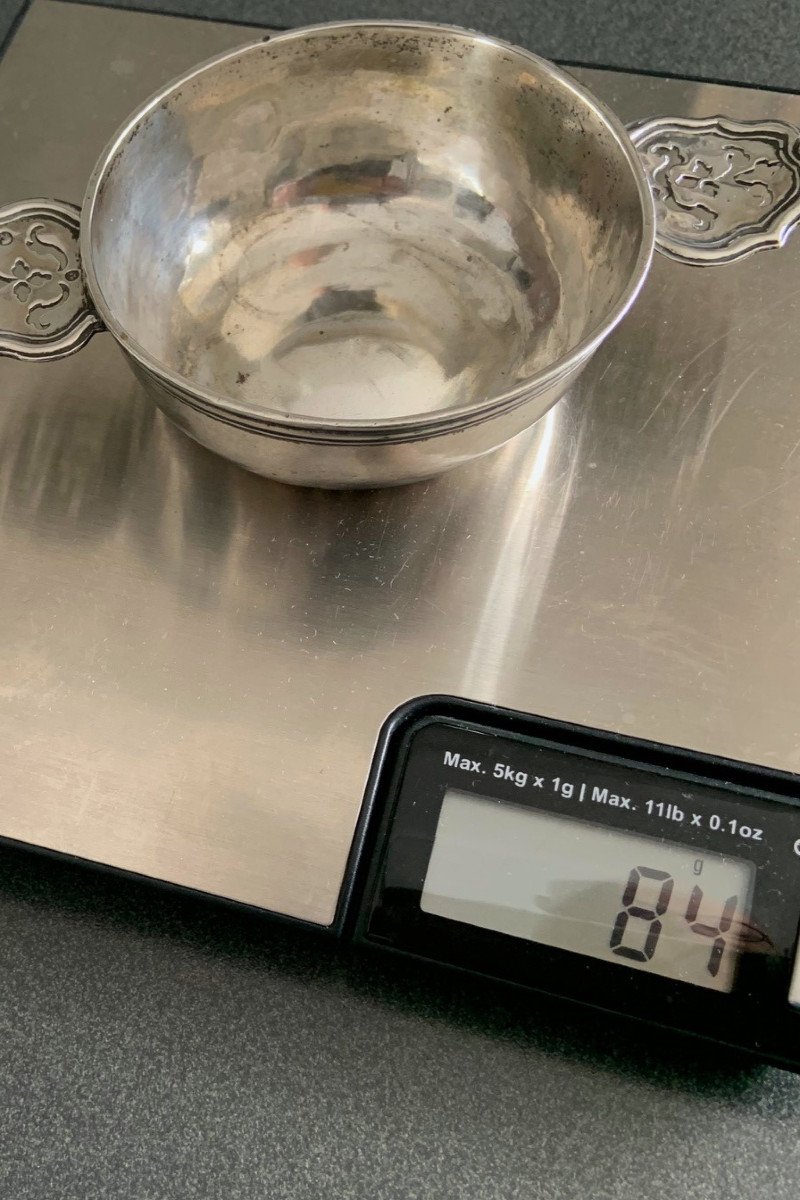


French Solid Silver Tastevin Wine Taster, Provinces 1809–1819. Coq Mark 800.
French Provincial Silver | Tastevin (Wine Taster) | Two Pierced Cartouche Handles | Silver 800 | Provinces, France 1809–1819 | Coq Mark with Numeral 2 | 84 g
A tastevin in solid silver 800, France, Provinces, period 1809–1819. Two symmetrical pierced cartouche-form handles with rocaille and quatre-foil pierced ornament, each surmounted by a small silver ball finial. Circular bowl on a flat base. No engraving or monogram.
Diameter (bowl): 8.4 cm | Width overall with handles: 14.0 cm | Height: 3.3 cm | Weight: 84 g
This is a beautiful object. It sits in the hand as it was designed to — the wide shallow bowl perfectly balanced between the two flat cartouche handles, the pierced ornament catching the light, the polished interior of the bowl gleaming as it was meant to gleam when held up to a candle with wine in it. Two hundred years have not changed what it is: an object made for pleasure, for daily use, and for the particular French conviction that drinking well is a civilised act deserving civilised tools.
It works equally today as a wine taster — the shallow form, the polished reflective interior, and the solid weight in the hand are exactly what they were in 1815. It works as a table dish for olives, salt, or small objects. It works as a jewellery tray on a dressing table. It works, simply, as a beautiful silver object that earns its place in any room it occupies. This is culture for everyday life — l'art de vivre in solid silver, at the scale of the hand.
At 84 grams, this is an exceptionally substantial example of the type — well above average weight for a tastevin of this diameter, reflecting the quality of the provincial silversmith's gauge and the seriousness with which the object was conceived.
The Form The tastevin — from the Old French tâte-vin, to taste wine — is one of the oldest functional objects in the history of French silver, its use documented from the 14th and 15th centuries and its form refined over four centuries of the French wine trade. The shallow circular bowl with its polished interior was designed to catch and scatter candlelight through the wine, enabling the négociant or sommelier to assess clarity, colour, and the presence of sediment. The two-handle format — flanking the bowl symmetrically with flat pierced cartouche ears — is characteristic of the southern French provincial tradition, distinct from the single-ring-handle format of Burgundian production. The Burgundian tastevin was a professional tool; the two-handle provincial form was equally at home on the table.
Marks French provincial silver marks, period from 1st November 1809, consistent with production circa 1809–1819:
Fineness mark: Coq (rooster) with numeral 2 in octagonal cartouche · Provinces · Silver 800/1000 (second standard) — introduced by the General Inventory of 1st November 1809 following the Decree of 11 Prairial an XI (31 May 1803).
Guarantee mark: Tête de guerrier (warrior's head) · Provinces · period 1809–1819.
Maker's mark: Struck into the handle; partially legible — identified as beginning ICH or IGH. Provincial maker, not yet fully identified.
The Coq mark, struck into the soft silver of the handle, has acquired a relief-like quality characteristic of well-preserved early 19th-century French provincial punching — the silver displaced around the punch giving the impression of a modelled rather than struck mark.
Full photographs of all marks available on request via eBay messaging.
Literature For the French hallmarking system: France (1803–1809), Decree of 11 Prairial an XI, General Inventory of 1809 — standard reference for French silver marks, p. 191: Coq with numeral 2 · Provinces · .800.
Condition Very good for age. Natural silver patina consistent with approximately 200 years of careful use. No repairs, splits, or later additions. Pierced handle ornament fully intact. Bowl retains its original reflective surface character. A handsome example of this type in genuine working condition. Additional photographs available on request via eBay messaging.
Historical Context The period 1809–1819 spans the height and collapse of the Napoleonic Empire, the Restoration of the Bourbon monarchy, and the reorganisation of French provincial life after two decades of Revolution and war. Provincial silver workshops in this period worked under the hallmarking system introduced by Napoleon's General Inventory of 1809 — one of the most precisely documented frameworks in the history of European silver regulation, making pieces from this decade among the most exactly dateable of all French antique silver.
A tastevin of this weight and quality, fully hallmarked and in original condition, is a document of provincial French material culture at a moment of extraordinary historical significance — and simultaneously an object of entirely unpretentious daily beauty, made to be used and enjoyed.
Examples comparable to this piece are held in the collections of the Musée du Vin, Paris, and the Musée du Vin de Bourgogne, Beaune.
Available for viewing by appointment at our Düsseldorf gallery.
Period: 19th century
Style: Consulat, Empire
Condition: Good condition
Material: Sterling silver
Width: 14
Diameter: 8,4
Height: 3,3
Reference (ID): 1408997
Availability: In stock