

19th Century Mantel Clock
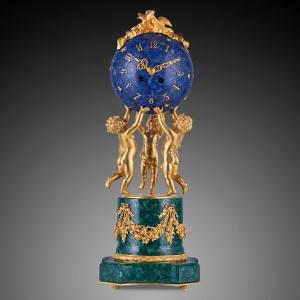
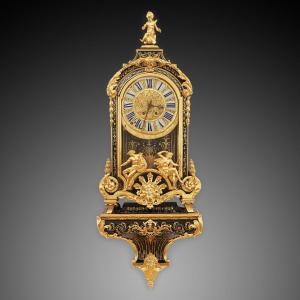
We are honored to present this magnificent mantel clock, an exceptional example of early 19th-century French craftsmanship, dating from the reigns of Louis Philippe and Charles X. This sumptuous timepiece embodies a perfect fusion of elegance, sophistication, and profound historical richness, reflecting the persistent taste for Neoclassicism and precious materials during a pivotal period of French history.
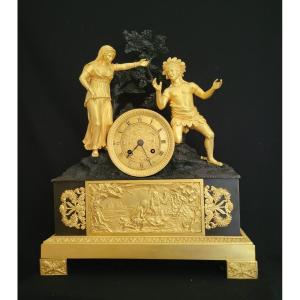
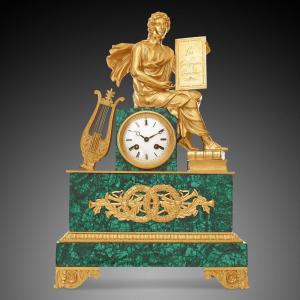
Grandeur of Empire Style and Classical Symbolism: Although produced during the reigns of Louis Philippe and Charles X, this clock is firmly rooted in the aesthetic of the Empire style, a movement that marked the zenith of French Neoclassicism. This style is characterized by its clean lines, direct references to Greco-Roman antiquity, and the sophisticated use of noble materials. The central composition features a masterful figure of a muse, most likely Clio, the Muse of History, holding an inscribed tablet. This allegorical iconography is highly representative of the decorative arts of this period, underscoring the importance of knowledge, the arts, and historical commemoration in the collective imagination.
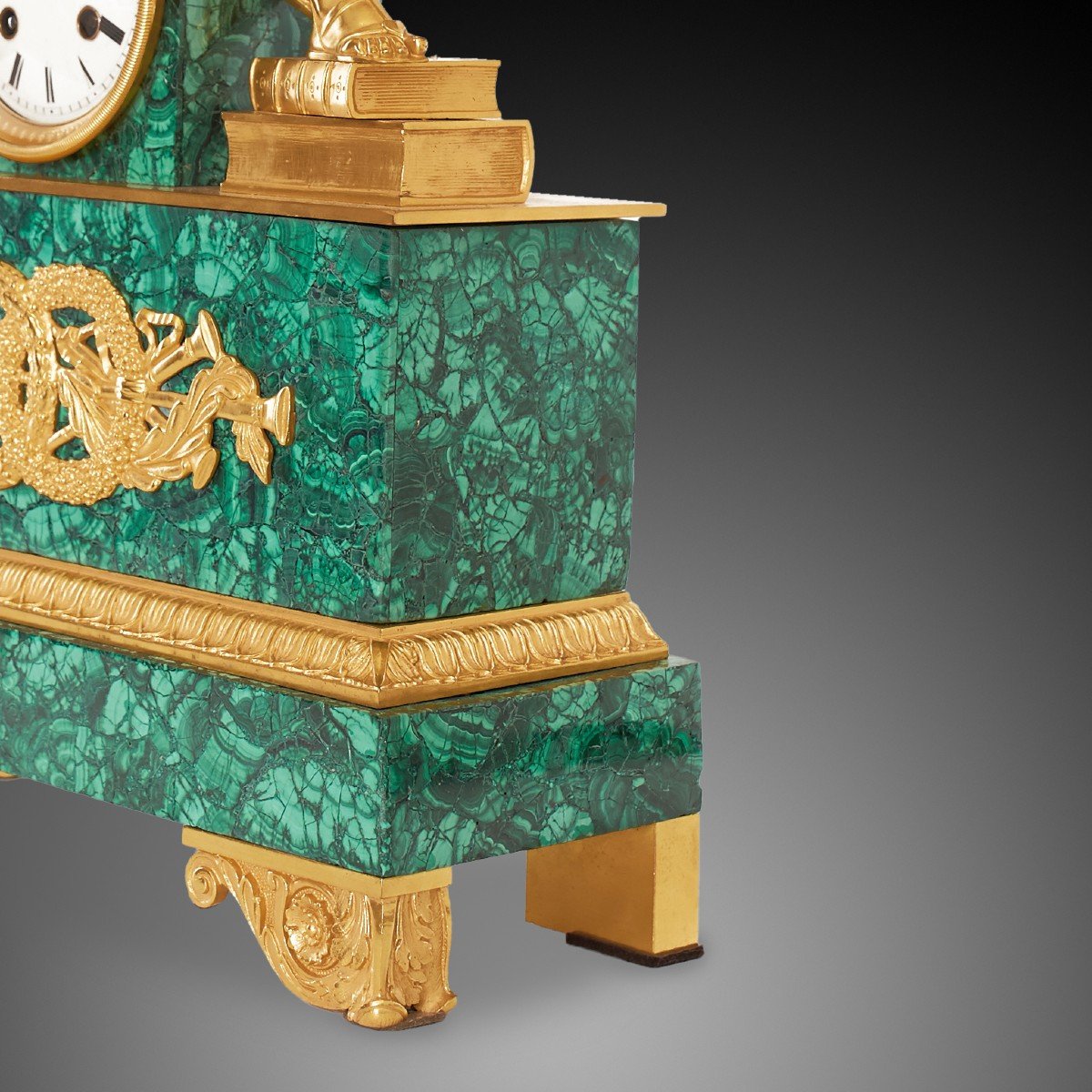
Noble Materials and Masterful Craftsmanship: The opulence of this clock is magnified by the expert employment of gilded bronze (ormolu) and malachite, two of the most prized materials of the era. The gilded bronze is used with admirable mastery to sculpt the figure of the muse, the lyre symbolizing music, and intricate ornaments, revealing the perfection of the casting and chasing. Malachite, with its concentric bands of deep, vibrant greens, provides a sumptuous and chromatically rich base, highly sought after for its exotic beauty and often distant origins (notably from the Russian Ural Mountains), which made it a sign of great luxury. The intricate details, such as the work on the lyre and other decorative elements, are finely chiseled, attesting to the exceptional skill of the period's bronze artisans.
Historical Context: The Louis Philippe and Charles X Period: This clock is situated in a pivotal period of French history. Following the fall of Napoleon I and the end of the First Empire, France experienced a period of monarchical Restoration under Louis XVIII and then Charles X, followed by the establishment of the July Monarchy under Louis Philippe. This era was marked by a notable revival of the decorative arts, where, despite political upheavals, a profound attachment to the sources of antiquity and a penchant for refined luxury persisted. The Empire style, born from Napoleon's desire for an imperial aesthetic, continued to influence furniture and objets d'art, adapting to the tastes of the burgeoning bourgeois and aristocratic elites. This mantel clock is a perfect example, combining imperial grandeur with a more nuanced elegance.
Key Features & Investment Potential:
Empire Style and Neoclassical Heritage: The clock embodies the continuity and evolution of the Empire style, with its pure Neoclassical lines and references to antiquity, making it a representative piece from a period of artistic transition.
Precious and Sumptuous Materials: The combination of high-quality gilded bronze and rare malachite offers a luxurious aesthetic and a striking visual contrast, testifying to rigorous material selection and a significant investment in craftsmanship.
Rich Iconography and Chiseled Details: The figure of the muse (Clio) and the finely chiseled motifs add an intellectual and artistic dimension, showcasing the exceptional skill of the era's artisans.
Marked Historical Period: Situated at the crossroads between the Restoration and the July Monarchy, this clock is a tangible testament to a period of renewal and consolidation in French decorative arts.
Exceptional Collector's Item: Given its condition, the quality of its materials, its emblematic design, and its historical context, this mantel clock is a highly desirable collector's piece and a choice investment for any connoisseur of French horology and decorative arts.
Period: 19th century
Style: Louis Philippe, Charles 10th
Condition: L'horloge est en excellent et parfait état de fonctionnement. de plus
Material: Brass
Width: 36 cm
Height: 53 cm
Depth: 13 cm
Reference (ID): 879895
Availability: In stock