

17th-century Italian Cup Hilt Rapier
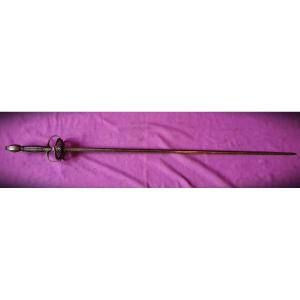
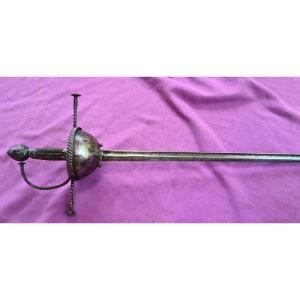
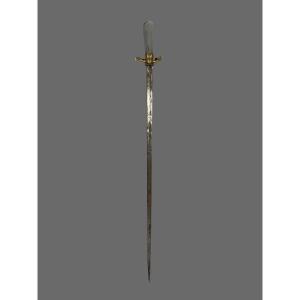
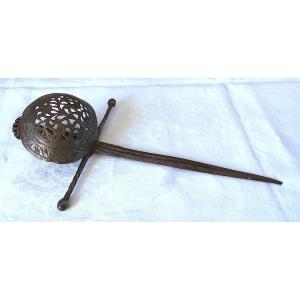
This is a beautiful Italian Taza (cup hilt) rapier dating from the second third of the 17th century.
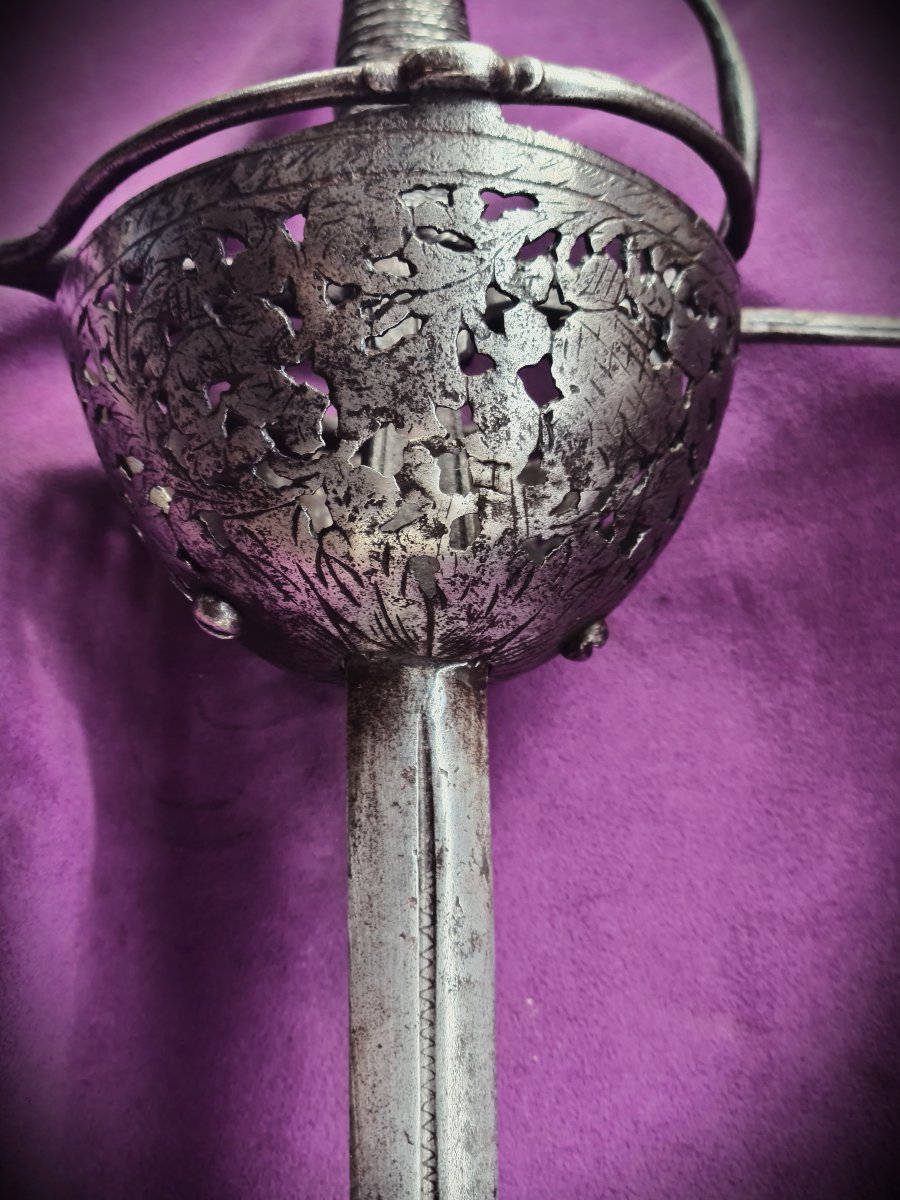
Italian rapiers differ from their Spanish "sisters" generally by deeper bowls and quillons that are often slightly narrower. The bowl’s mounting, featuring an external reinforcing bar connecting the upper quillon to the base of the knuckle bow , is characteristic.
BLADE: This is a strong blade with a lenticular cross-section, featuring a narrow central fuller on each side on the first 60 cm. On the ricasso (inside the cup) , on each side, there is a discreet mark known as the “crucigen globe,” indicating that it was made in Solingen
Blade length from the quillons to the tip = 107 cm; from the edge of the Taza to the tip = 101 cm; wideness near the bowl = 2 cm; thickness near the bowl = 0.8 cm, balance point 6 cm from the bowl.
TAZA: It is richly engraved with numerous plant motifs that intersect artistically. The bowl is secured to thearms of the crossguard by two screws
QUILLONS: They are straight, in a so-called “trumpet” shape.
KNUCKLE BOW : It is connected to the large ring that runs around the entire circumference of the bowl, and ends near the pommel
POMMEL: Shaped like a flattened bulb with chiseled plant motifs. It is topped by a small button to which the blade’s tang is riveted.
GRIP : It is covered with a wire binding of twisted wire, alternating with another twisted wire binding pattern. This type of decoration is quite rare. The braided crown-shaped ferrules known as “Turk's heads” are present and in perfect condition.
This is a fine rapier, perfectly homogen and entirely original, unrestored.
Ref. AMB-2636-G2 Shipping cost contribution via UPS France: €60 for Europe, €80
2 700 €
Period: 17th century
Style: Renaissance, Louis 13th
Condition: Excellent condition
Material: Other
Length: 119 cm
Width: aux quillons 26 cm
Reference (ID): 1854837
Availability: In stock
Print