18th-century Rosewood Casket With Cube Marquetry – Circa 1770
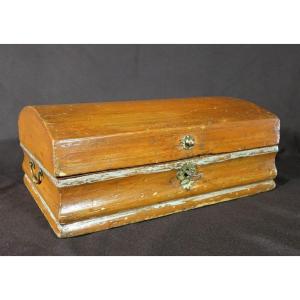
An elegant French 18th-century casket, dating to circa 1770, veneered in rosewood and palisander, with a geometric cube marquetry decoration on its lid.
Of nearly cubic proportions, this casket features four sides veneered in carefully selected and bookmatched rosewood, arranged in symmetrical patterns that highlight the natural grain and contrasting tones of the wood. Each panel is framed with straight-grain veneer, while the rounded corners are fitted with palisander moldings. These darker elements protect the edges while providing a subtle contrast with the warm pinkish tones of the rosewood.
The lid is entirely decorated with geometric marquetry known in French as cubes sans fond (endless cube marquetry), composed of three contrasting woods: rosewood, kingwood, and tobacco-stained maple. The careful arrangement of the veneers, their colors, and the direction of their grain creates a striking three-dimensional trompe-l'œil effect.
The term bois tabac (tobacco wood) was traditionally used by French cabinetmakers to describe certain stained woods, particularly maple or sycamore, treated to achieve distinctive shades. Frequently employed in 18th-century marquetry, this coloring provided the tonal contrasts necessary to emphasize geometric compositions and the illusion of depth.
The origins of perspective cube marquetry can be traced to the geometric and trompe-l'œil techniques developed by Italian craftsmen during the Renaissance.
In France, this decorative technique became particularly fashionable during the second half of the 18th century, notably through the work of the celebrated Parisian cabinetmaker Jean-François Oeben in the 1760s.
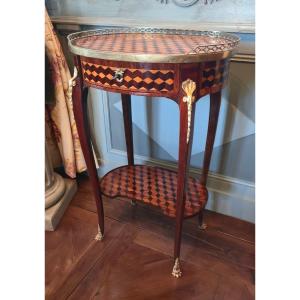
The pattern subsequently spread beyond Parisian workshops to regional cabinetmaking centers, particularly in eastern France and the Rhineland. It can be found decorating the fronts and tops of commodes, secretaries, occasional tables, and various smaller pieces of fine cabinetmaking.
The front retains its Louis XV-style gilt-bronze keyhole escutcheon, while the lid is fitted with a small gilt lifting knob. The two brass hinges and the articulated lid stay are original.
Judging by its proportions and construction, this casket was most likely originally intended as a perfume or scent casket, known in 18th-century France as a coffret à senteurs.
These refined personal accessories generally contained several glass or crystal perfume bottles, sometimes accompanied by small funnels, dishes, and containers used for storing, transferring, or preparing scented waters and fragrances.
The bottles were held in specially fitted compartments, often lined with silk or velvet to protect their delicate contents. Some examples also incorporated a mirror inside the lid.
The original interior fittings and accessories of this casket are no longer present. The interior is now lined with a later burgundy and beige striped fabric.
This piece illustrates the craftsmanship of French cabinetmakers during the second half of the 18th century, combining carefully selected veneers, symmetrical wood arrangements, and the sophisticated optical effects of geometric marquetry.
The casket has undergone some earlier veneer repairs and remains in very good condition. It has been professionally restored and French-polished, enhancing the natural colors of the woods and the intricate marquetry decoration.
Dimensions:Height: 6.5 in (16.5 cm)Width: 9.25 in (23.5 cm)Depth: 8.27 in (21 cm)
850 €
Period: 18th century
Style: Louis 15th - Transition
Condition: Good condition
Material: Wood marquetry
Reference (ID): 1852441
Availability: In stock
Print