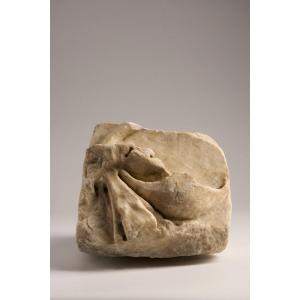




Pair Of Oxen Under The Yoke - Marble - Roman Period - 1st–2nd Century Ce
Pair of oxen under a yoke, Roman-era marble, 1st–2ndcentury CE
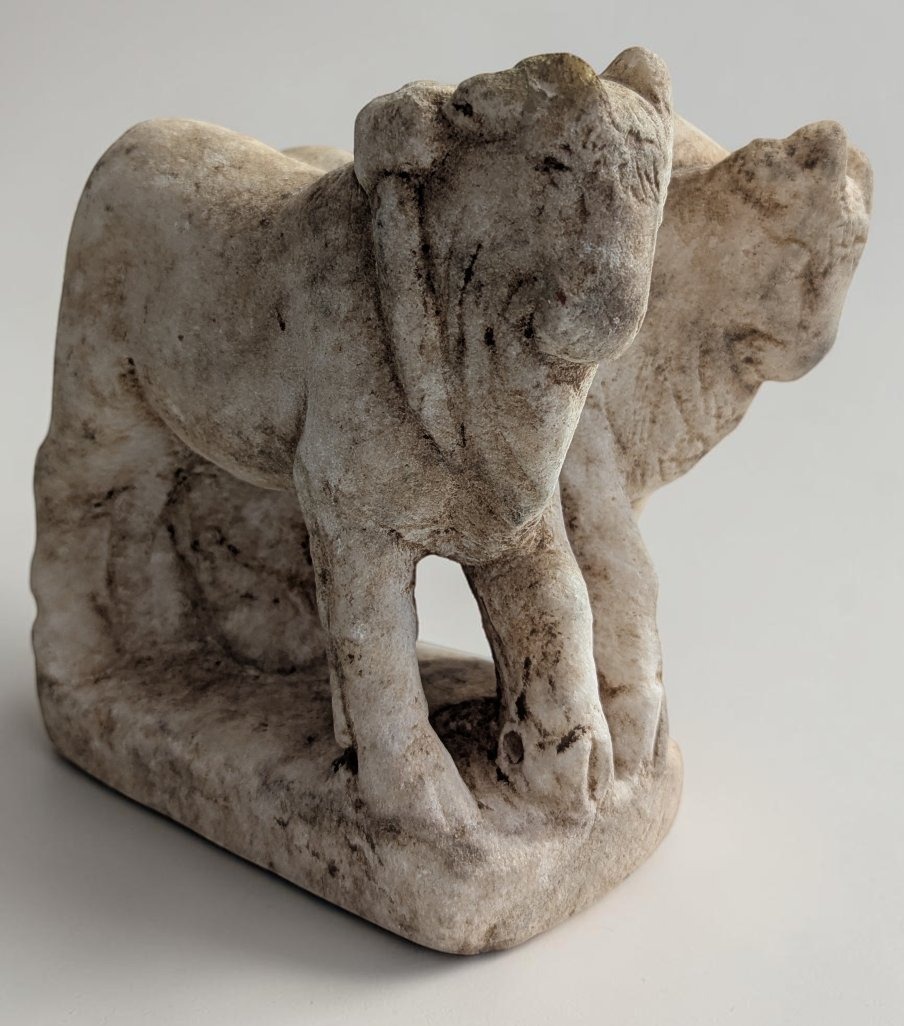
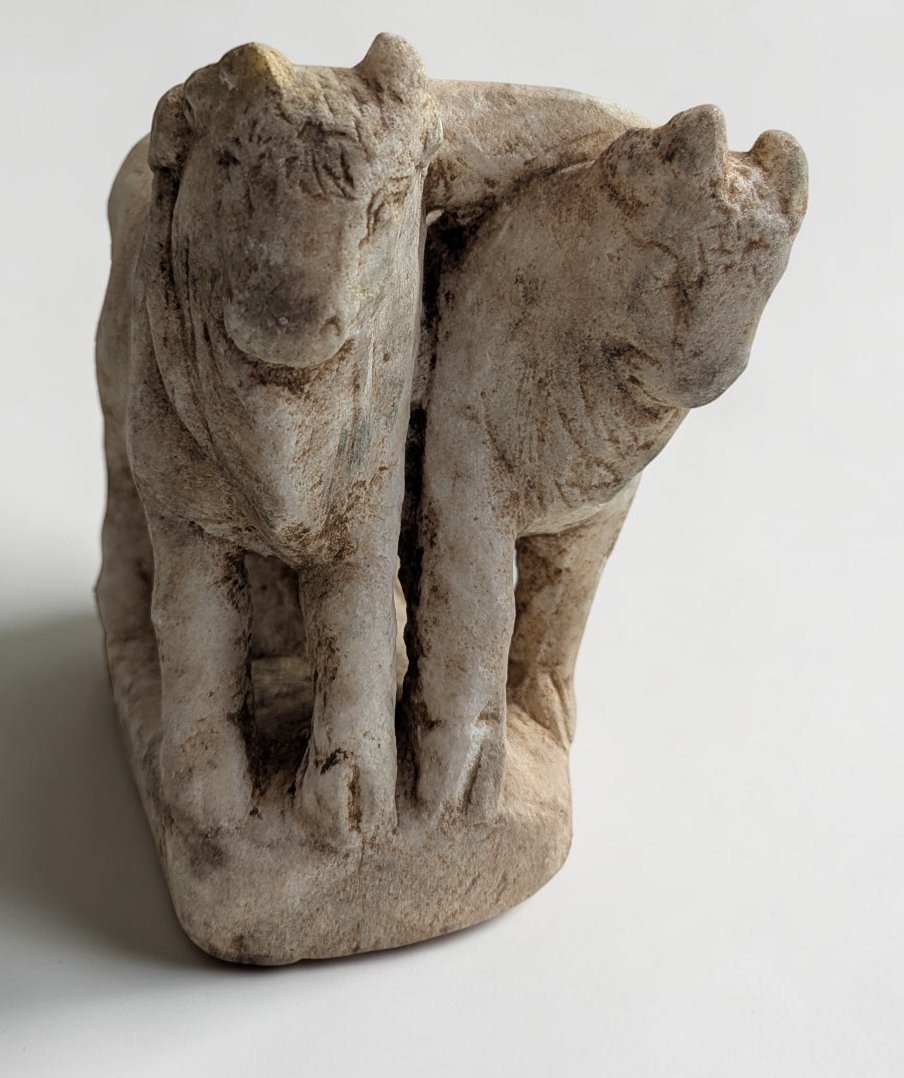
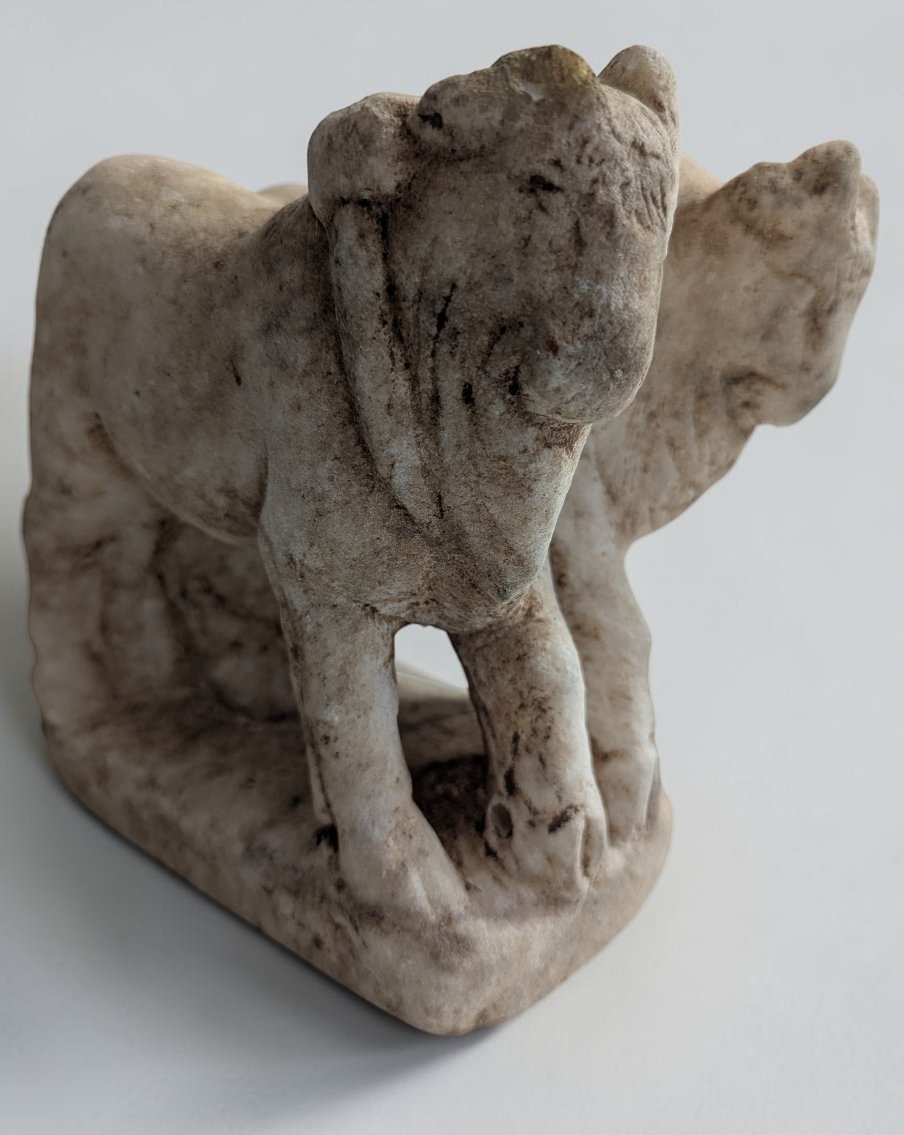
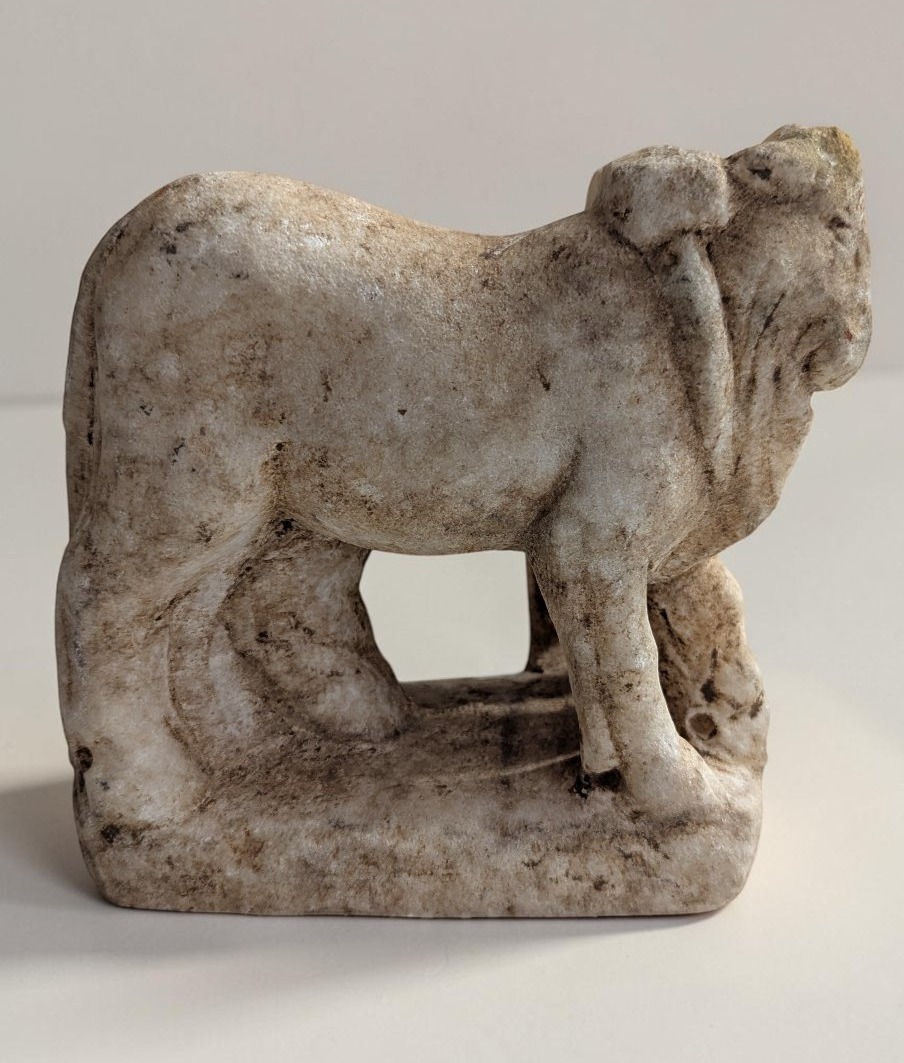
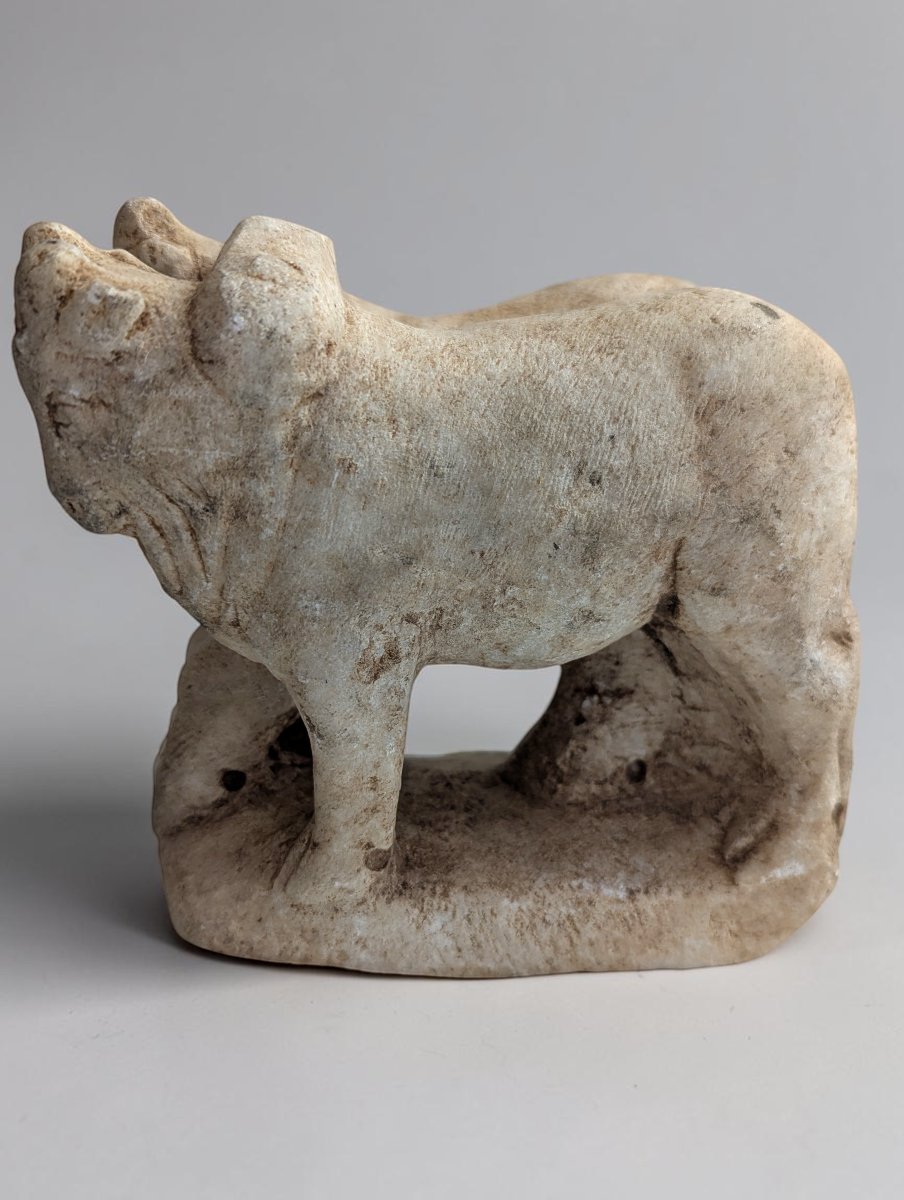
Rare white marble group sculpted in the round, depictingtwo oxen yoked together under a single yoke, standing side by side on arectangular plinth with rounded corners.
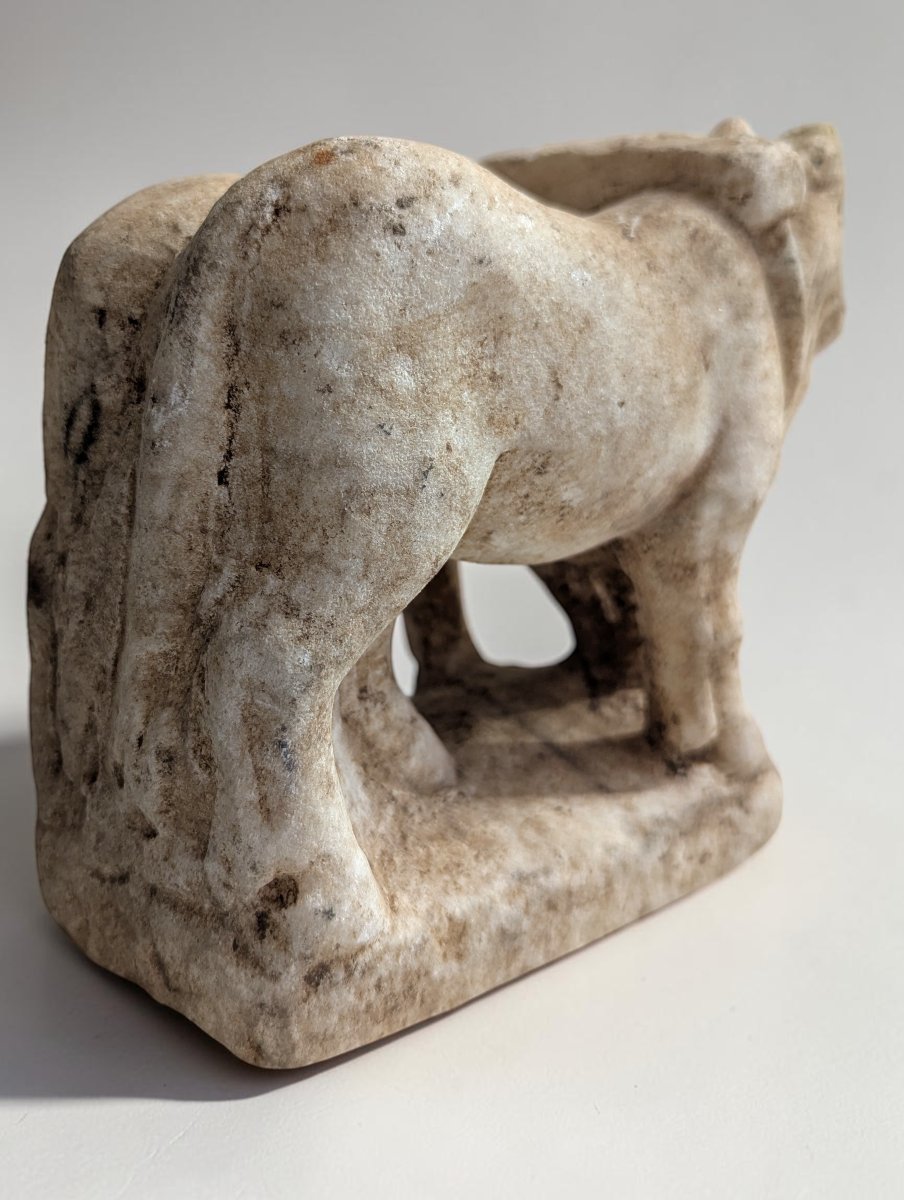
The yoke, a straight bar with a square cross-section, restsacross the necks of both oxen, just behind their short horns. The heads, withand massive muzzles, have incised almond-shaped eyes; they divergeslightly, one looking straight ahead, the other turned in a three-quarter profile. Theox on the right has a very prominent dewlap, extending from the chin to the chestin incised vertical folds. Its four limbs are outlined by openworkcarved with a drill, and its cloven hooves are indicated by an incision. Thetails hang down along the thighs.
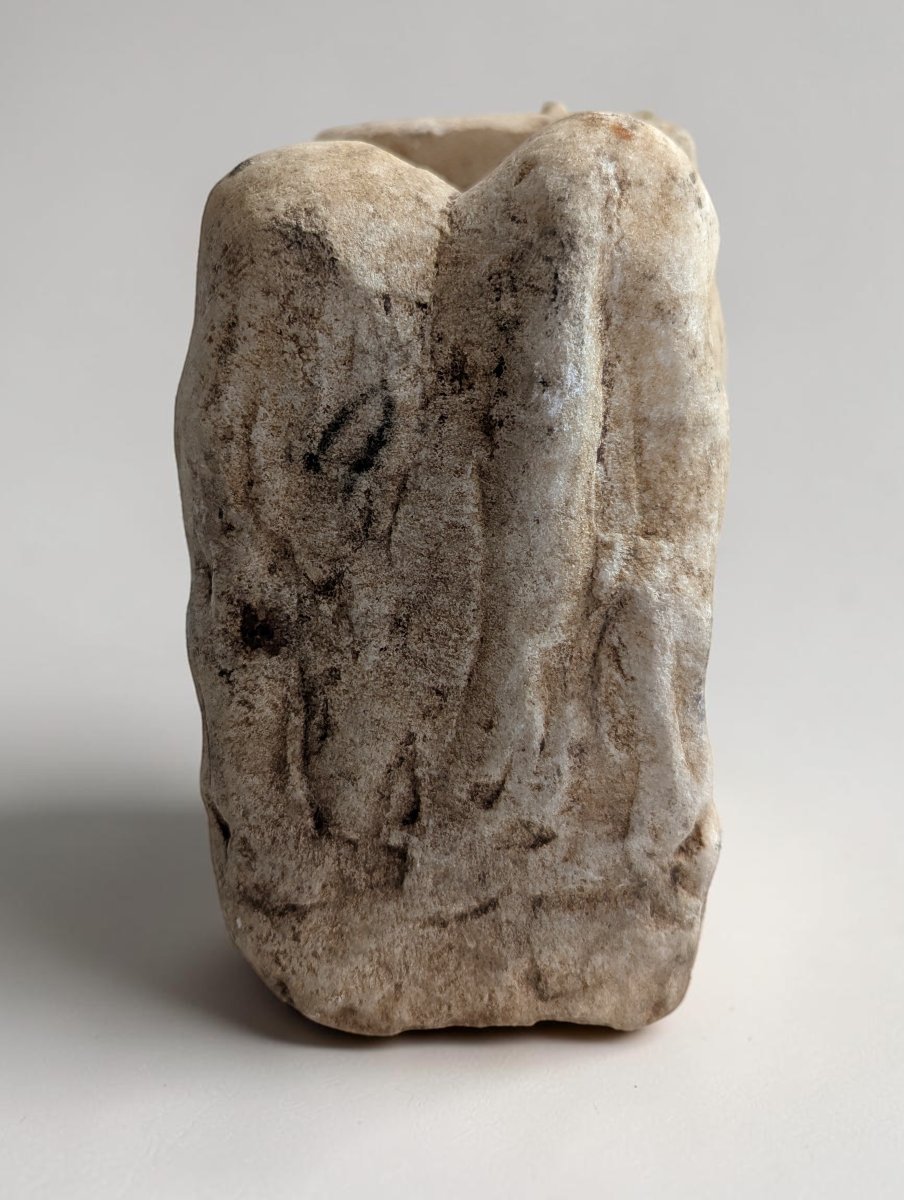
The left side, roughly hewn, shows that the groupwas intended to be viewed from the front and in three-quarter profile. It was likelyplaced against a wall in a sanctuary or a lararium. The yoke indicates draft animals andnot sacrificial victims: the Romans reserved for sacrificeanimals that had never been harnessed. It is therefore most likely an agrarian votive offering,presented for the prosperity of the harvests, presumably to Ceres. Plinythe Elder also reports that the plow ox, Ceres’s helper, wasonce so protected that killing it was punished as murder.
Beautiful patina of age, general wear on the reliefs,small chips on the horns and edges.
Roman period, 1st–2nd century CE, according to the historical reportby Alessandro Neri.
Dimensions: L. 15 cm, H. 16 cm, W. 11 cm.
Formerly in an English collection, and prior to that in aGerman collection assembled in the 1990s.The work is accompanied by the historical report by AlessandroNeri and the confirmation letter from the Art Loss Register.
Museum Comparisons
-Museo Egizio, Turin, Suppl. 18236. Bronze bull statuette, Hellenistic to Roman period. It bears striking similarities to our group: a dewlap forming several folds, a powerful neck, andshort horns. It follows the same stylistic convention for depicting bovines.
-Metropolitan Museum of Art, NewYork, X.21.84. Bronze bull statuette, 1st–2nd century CE. Sametreatment of the dewlap and the profile of the head.
-BritishMuseum, London, 1879,0710.1. Bronze group depicting the plowman of Piercebridge, 2nd–3rd century CE. A plowman and his plow drawn by a bull and a cow under the yoke: the best iconographic parallel in Roman provincial art.
-Museo Nazionale Etrusco di Villa Giulia, Rome. Plowman of Arezzo, bronze from the 4th century B.C. Italic prototype of the plowing group.
-Fitzwilliam Museum, Cambridge, GR.1.1886. Marble relief (Luna?), 1st–2ndcentury A.D., depicting an ox under the yoke.
Bibliography
Plinythe Elder, Natural History, VIII, 180.
SaintAugustine, The City of God, IV, 24 and 34 (on Bubona, deity ofcattle).
J. M. C. Toynbee, *Art in Roman Britain*, London, 1962, no. 54.
W. H. Manning, “The Piercebridge plow group,” *British Museum Quarterly*, 35, 1971, pp. 125–136.
M. J. Green, Small Cult-Objects from the Military Areas of Roman Britain, BAR 52, Oxford, 1978, p. 66.
7 500 €
Period: Before 16th century
Style: Rome and Antic Greece
Condition: Good condition
Material: Marble
Length: 15
Width: 11
Height: 16
Reference (ID): 1845482
Availability: In stock
Print