


Ceremonial Initiate's Lime Case – Rooster Head – Iatmul – Papua New Guinea
Ceremonial Initiate’s Lime Case – Rooster’s Head – Iatmul –Papua New Guinea
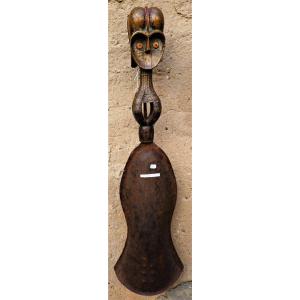
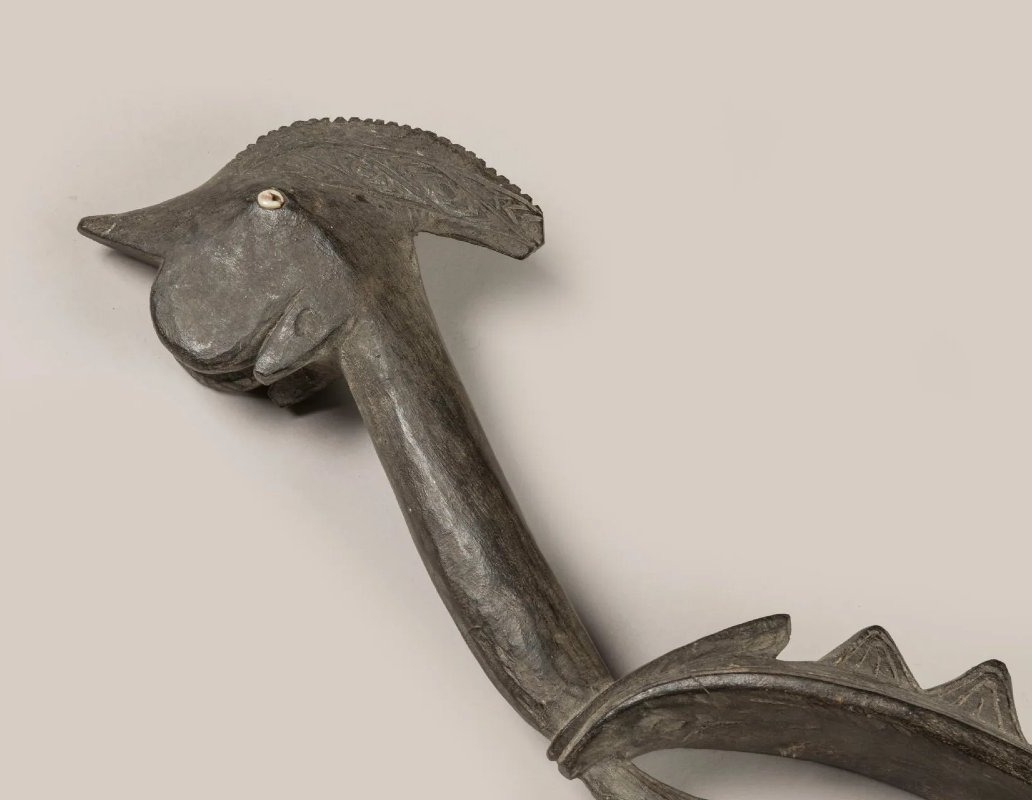
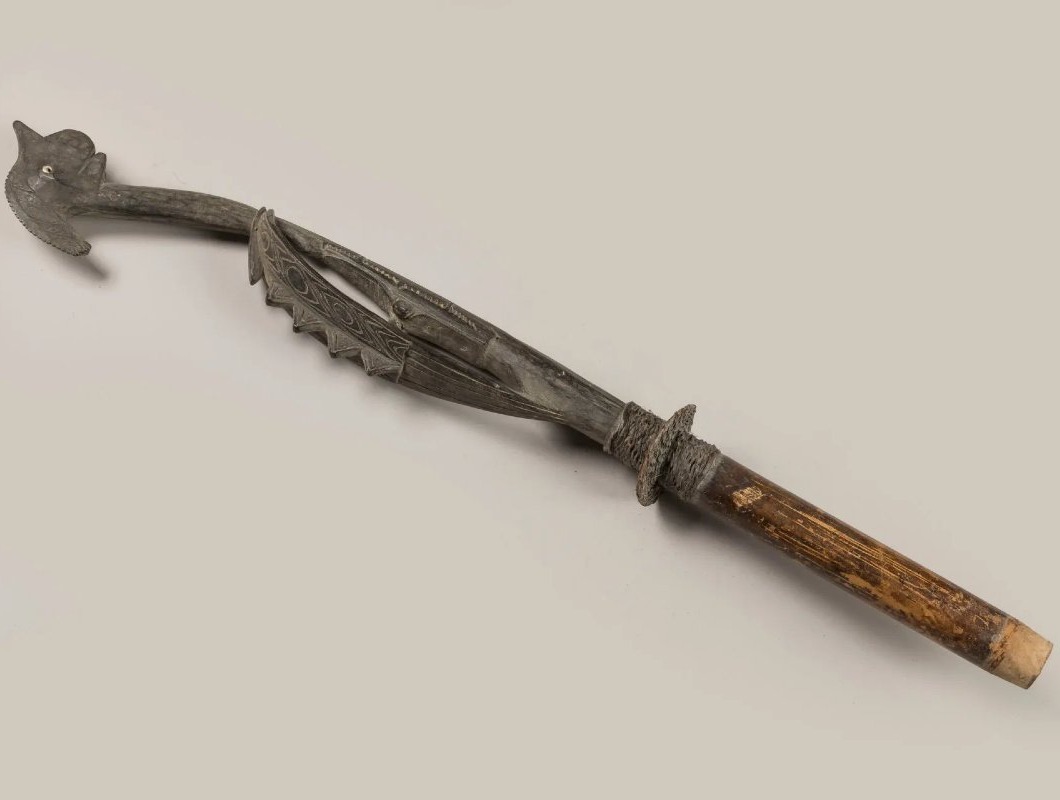
Ceremonial initiation lime container, made of bamboo, wood,woven basketwork, and seashells, decorated with a slender figure with a rooster’s head.Notable for its slender proportions and the richness ofits composition, this lime container combines a bamboo body withcarved and woven elements, embellished with seashells. At its end, aslender anthropomorphic figure, surmounted by a rooster’s head, forms asculptural ornament characteristic of Middle Sepik art.
Among the Iatmul, lime containers, called bandi naiavo, played an important role in material culture andinitiation ceremonies. They contained lime obtained fromburnt shells or coral, used along with areca nuts inbetel chewing.These objects held a significance far greater thantheir utilitarian function.
Toward the end of their period of initiatory seclusion,the young men received richlyornamented cases from their maternal uncles, which they displayed upon their public reappearance and during ceremonieson the dance floor. This gift marked their new social status and theirentry into the world of men.
The animal figure crowning the object is part of aniconographic repertoire in which birds, ancestral figures, andsupernatural beings occupy a central place. The rooster, prized in the regionfor its plumage and vigor, frequently appears in the ornamentation ofceremonial cases from the Sepik, sometimes associated with crocodile figures orancestral faces.
With its exceptional dimensions of 86 cm andthe combination of bamboo, carved wood, basketwork, and shell, thisexample attests to the sophistication of Iatmul ritual arts and tothe importance placed on the adornments that accompanied the decisive stages ofsocial life.
First half of the 20th century
86 cm long
Provenance: private collection in Nièvre.
References and comparisons:
— The Metropolitan Museum of Art, New York, CeremonialLime Container (Bandi Na Iavo), Iatmul or Chambri, late 19th–early20th century, inv. 1979.206.1457.
— Museum of Archaeology and Anthropology, University ofCambridge, Lime box, Iatmul, Palimbai, Middle Sepik, inv. 1935.17 B, bamboocase decorated with a carved figure and a bird.
— Sotheby’s, Iatmul Ceremonial Lime Container (Bandi NaIavo), catalog entry by Philippe Peltier on lime casespresented to initiates upon completion of their seclusion.
Ceremonial initiation lime container, made of bamboo, wood,woven basketwork, and seashells, decorated with a slender figure with a rooster’s head.Notable for its slender proportions and the richness ofits composition, this lime container combines a bamboo body withcarved and woven elements, embellished with seashells. At its end, aslender anthropomorphic figure, surmounted by a rooster’s head, forms asculptural ornament characteristic of Middle Sepik art.
Among the Iatmul, lime containers, called bandi naiavo, played an important role in material culture andinitiation ceremonies. They contained lime obtained fromburnt shells or coral, used along with areca nuts inbetel chewing.These objects held a significance far greater thantheir utilitarian function.
Toward the end of their period of initiatory seclusion,the young men received richlyornamented cases from their maternal uncles, which they displayed upon their public reappearance and during ceremonieson the dance floor. This gift marked their new social status and theirentry into the world of men.
The animal figure crowning the object is part of aniconographic repertoire in which birds, ancestral figures, andsupernatural beings occupy a central place. The rooster, prized in the regionfor its plumage and vigor, frequently appears in the ornamentation ofceremonial cases from the Sepik, sometimes associated with crocodile figures orancestral faces.
With its exceptional dimensions of 86 cm andthe combination of bamboo, carved wood, basketwork, and shell, thisexample attests to the sophistication of Iatmul ritual arts and tothe importance placed on the adornments that accompanied the decisive stages ofsocial life.
First half of the 20th century
86 cm long
Provenance: private collection in Nièvre.
References and comparisons:
— The Metropolitan Museum of Art, New York, CeremonialLime Container (Bandi Na Iavo), Iatmul or Chambri, late 19th–early20th century, inv. 1979.206.1457.
— Museum of Archaeology and Anthropology, University ofCambridge, Lime box, Iatmul, Palimbai, Middle Sepik, inv. 1935.17 B, bamboocase decorated with a carved figure and a bird.
— Sotheby’s, Iatmul Ceremonial Lime Container (Bandi NaIavo), catalog entry by Philippe Peltier on lime casespresented to initiates upon completion of their seclusion.
300 €
Period: 20th century
Style: Tribal Art
Condition: Good condition
Material: Solid wood
Length: 86
Reference (ID): 1835233
Availability: In stock
Print