




Spanish-flemish Firm
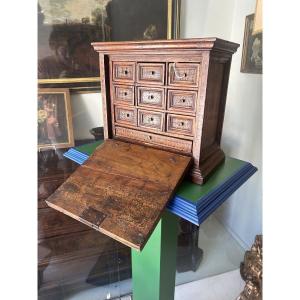
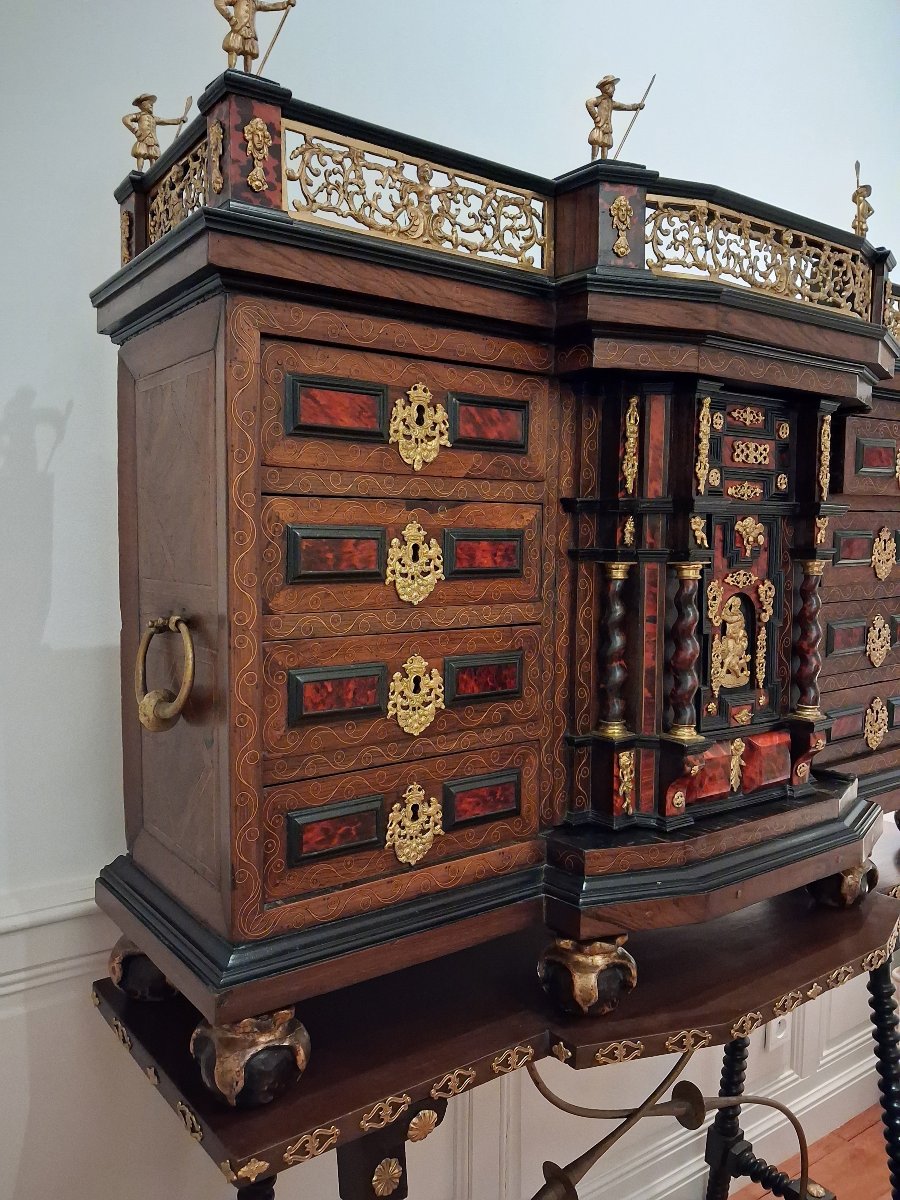
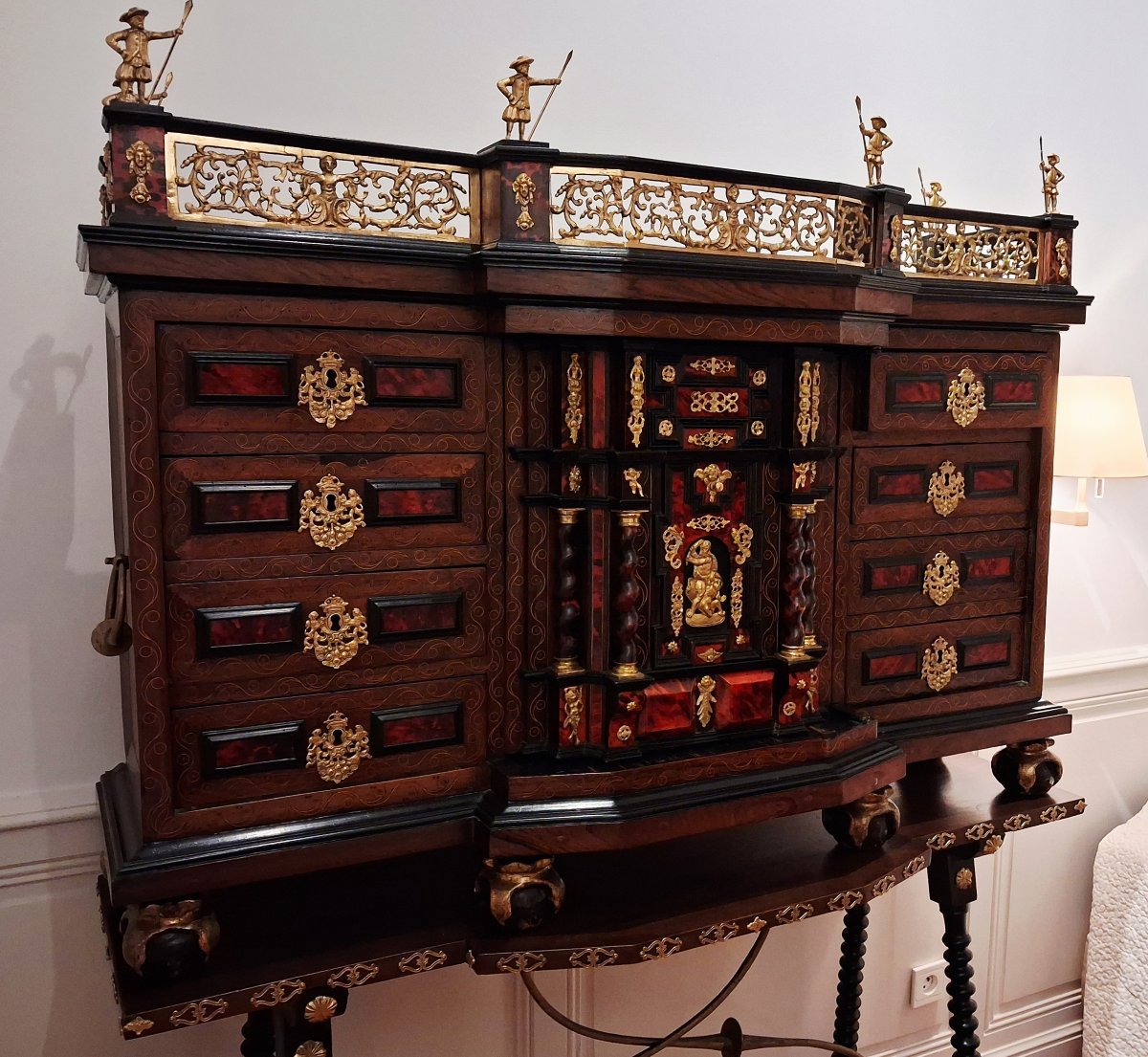
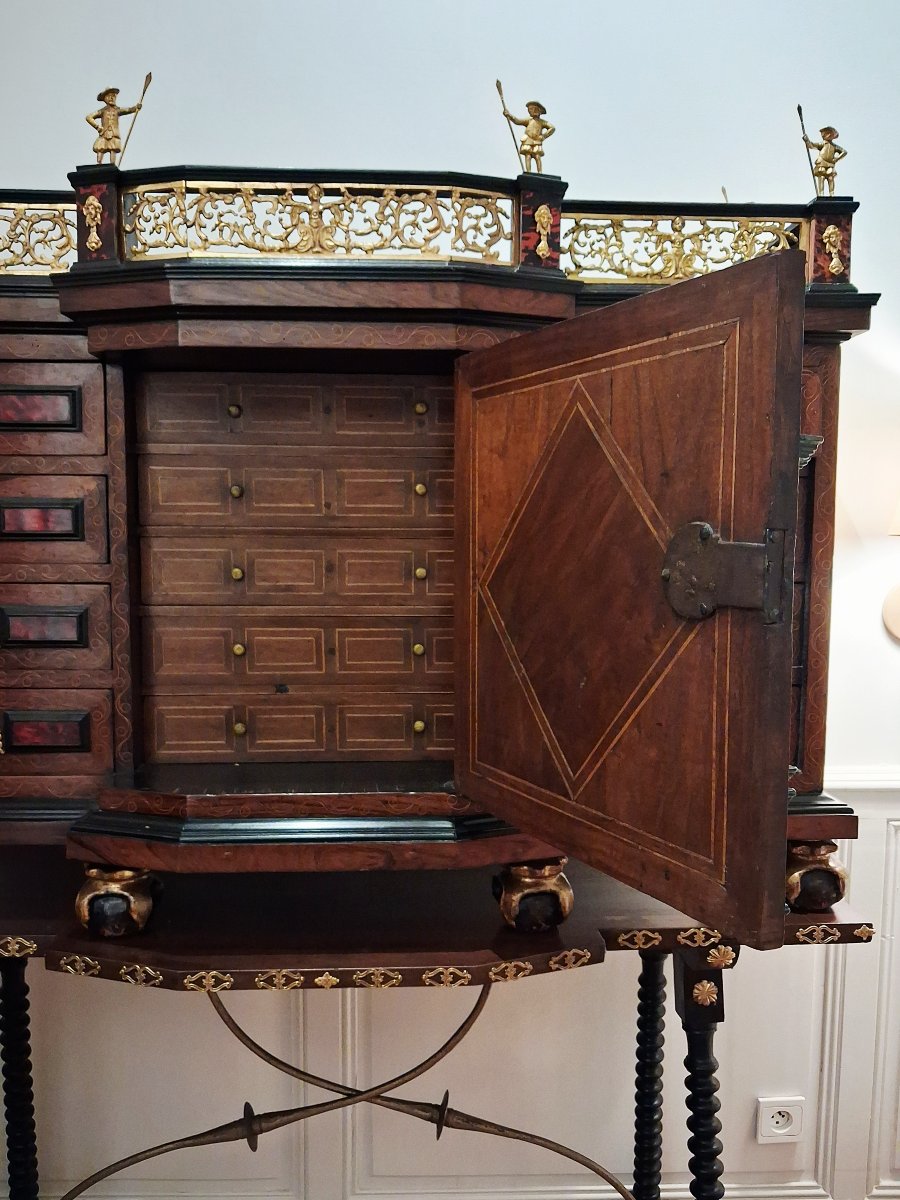
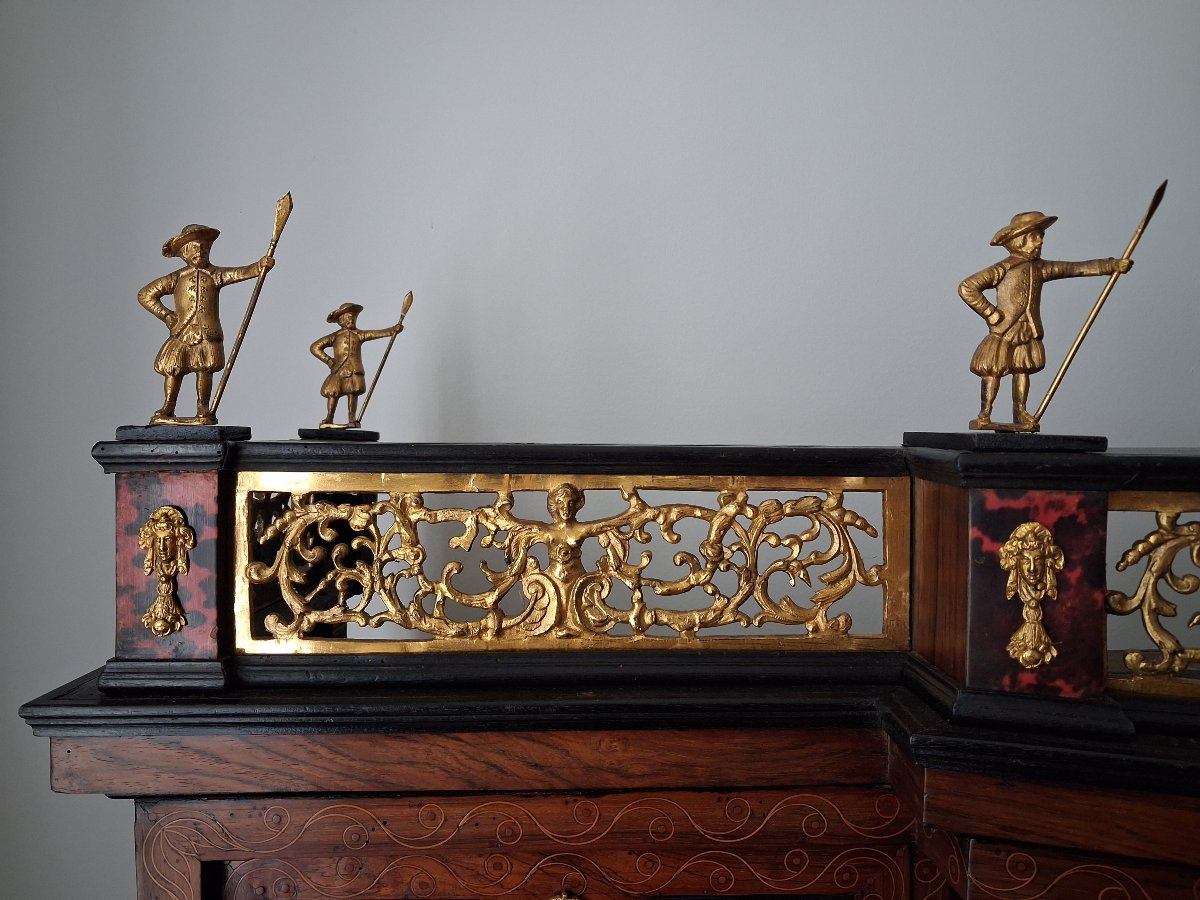
architecturally shaped, made of walnut veneer, with a central projection topped by a partially lacquered gallery, inlaid with tortoiseshell and adorned with openwork, gilded bronze fittings depicting centered figures and foliage motifs separated by pedestals supporting armed figures.
It opens to reveal two rows of four stacked drawers separated by a door that reveals five drawers.
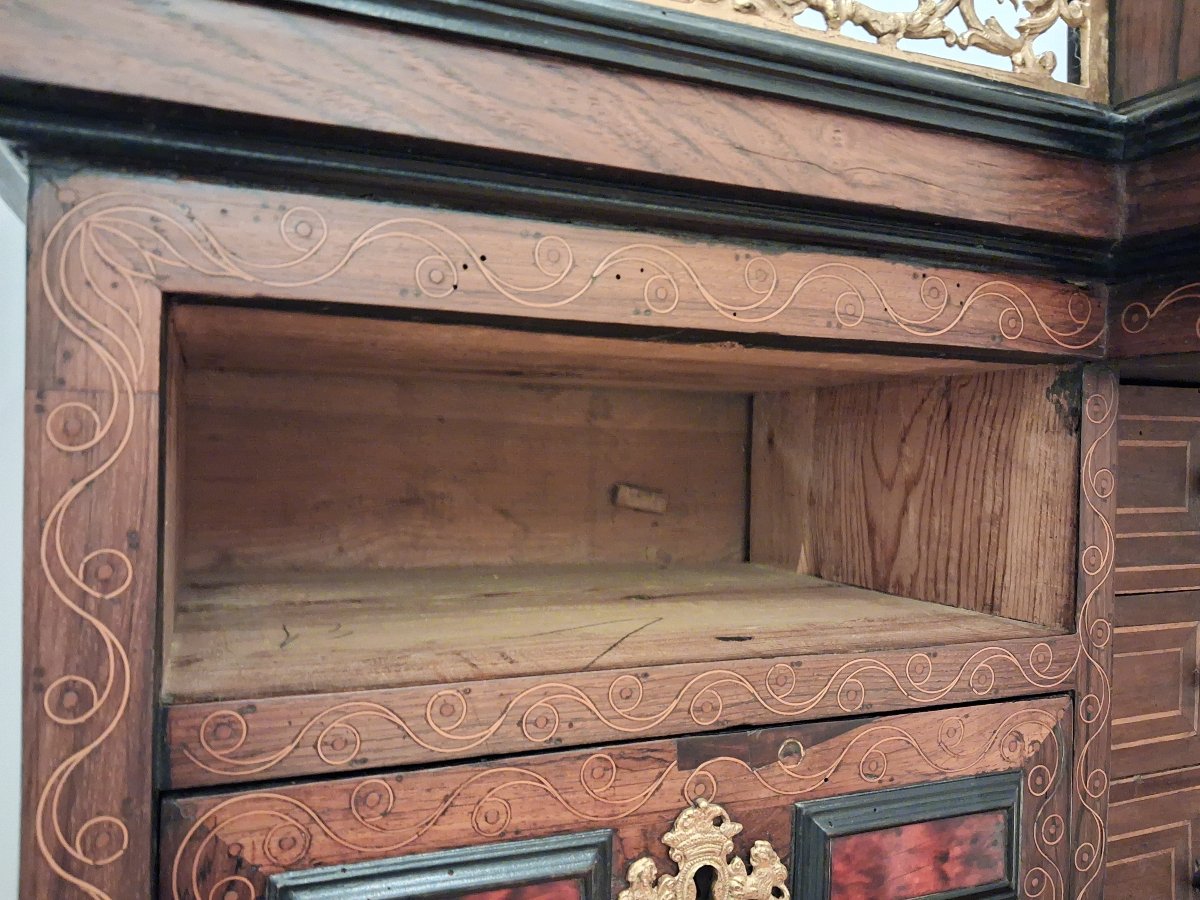
It is decorated with intarsia of stylized foliage in light wood, black-lacquered wood moldings, and panels inlaid with tortoiseshell.
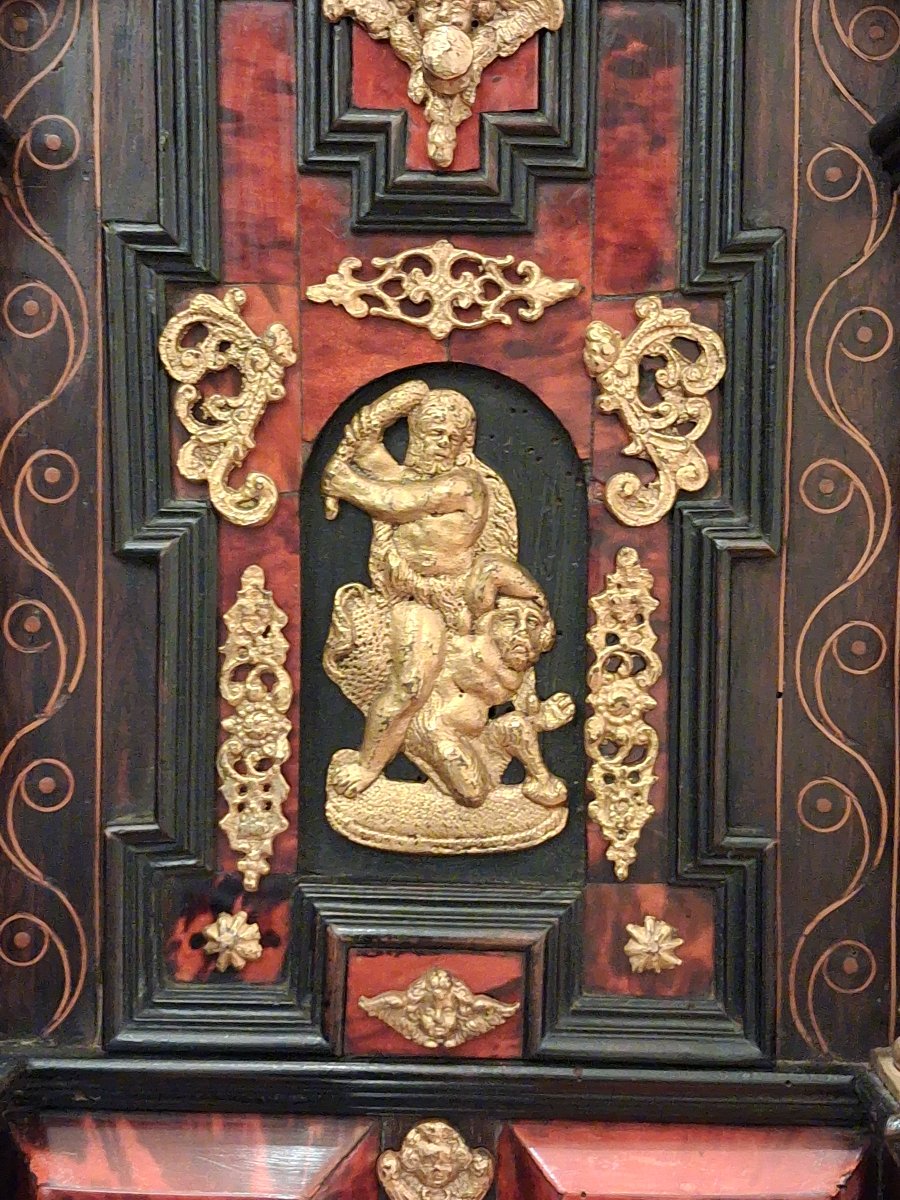
The door features a superimposition of pilasters and twisted columns adorned with ornate, gilded bronze work depicting foliage, sconces, and cherubs. In the center is an allegory of Hercules fighting the centaurs *.
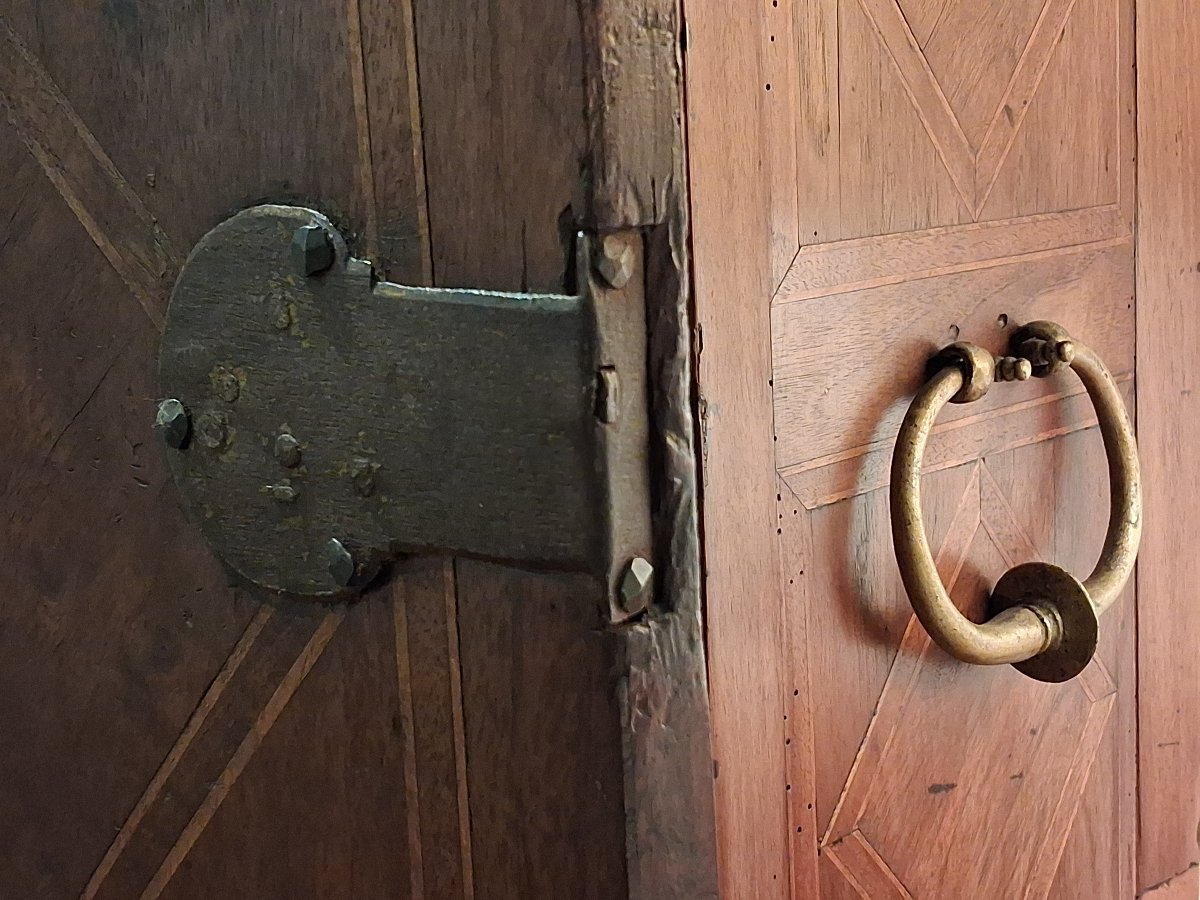
The sides are veneered in walnut with double bands of light wood forming two panels adorned with lozenges separated by a border. The handles are drop-style brass with rings and a central disc.
It rests on a base with a band and lacquered molding supported by six gilded wooden claw feet resting on lacquered spheres.
Frame, back, and sides made of spruce and walnut.
Hispano-Flemish work, 17th century.
Cabinet dimensions:
Height: 98 cm / Length: 132 cm / Depth: 42 cm
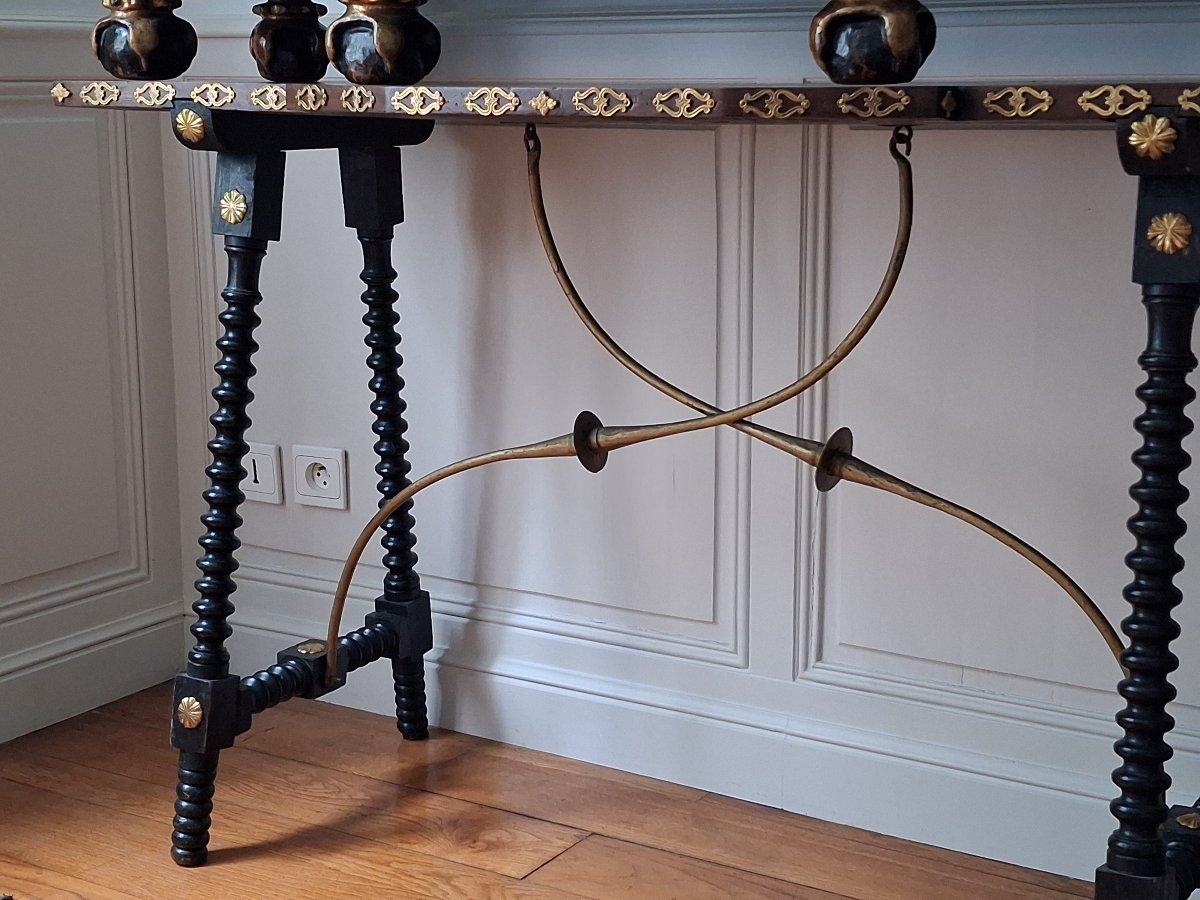
19th-century base consisting of a solid wood top and turned, black-lacquered legs joined by a wrought-iron crossbar gilded with mixtion.
Base dimensions:
Height: 81 cm / Length: 132.5 cm / Depth: 48 cm.
Very good condition.
[Minor cosmetic repairs, the most significant being a piece of veneer on one side, visible in one of the photos].
It appears that around 1570, the cabinet became a portable piece of furniture, with or without legs, always square or rectangular, featuring behind its doors or drop-down panel—depending on its size— several rows of side-by-side drawers of varying sizes, sometimes alongside compartments opening via a door.
People would then take care to store all sorts of gemstones and precious objects such as jewels, jewelry, coins, rarities, and curiosities… as well as documents, correspondence, and “valuable papers” owned by its owner.
Depending on social class, customs, and region, the cabinet evolved and became more of a ceremonial piece of furniture than a functional one, featuring various architectural designs, resting on column-style bases, pilasters, twisted columns… or tables designed for this purpose.
A multitude of materials of plant, animal, and/or mineral origin were used: precious woods “from India” or native species, bone or ivory, semi-precious stones, marbles… and, of course, tortoiseshell.
In Western Europe, regardless of the region of manufacture, size, or intended use, these pieces gave rise to a wide variety of styles and decorative motifs reflective of local traditions, resources, and influences introduced through trade.
In the 17th century, the cabinet was what the chest of drawers would become in the 18th—an iconic piece of furniture indispensable for certain uses as well as for the decoration of mansions and apartments.
* An episode from one of the Twelve Labors of Hercules : during the hunt for the Erymanthian boar, Hercules finds hospitality with the centaur Pholos…
Prologue
On his way to capture the Erymanthian boar, Hercules is hosted by the generous centaur Pholos.
To please his guest, who is exhausted from a long hunt, he offers him as much food as he needs.
Spotting a jar, Hercules asks his host to let him taste the wine inside.
Although wine was given to the centaurs by Dionysus, Pholos objects because of the danger posed by opening the jar—the scent of the wine could attract the other centaurs.
But disregarding the danger, he eventually gives in to please his friend.
Attracted by the scent of wine—their favorite drink—the other centaurs rush over to punish the one they consider an intruder and a thief…
Period: 17th century
Style: Renaissance, Louis 13th
Condition: Excellent condition
Reference (ID): 1842798
Availability: In stock