


Holland, Early 18th Century
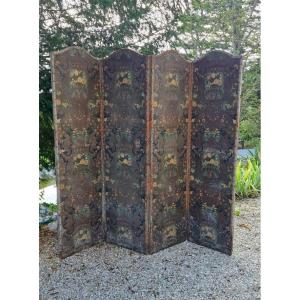
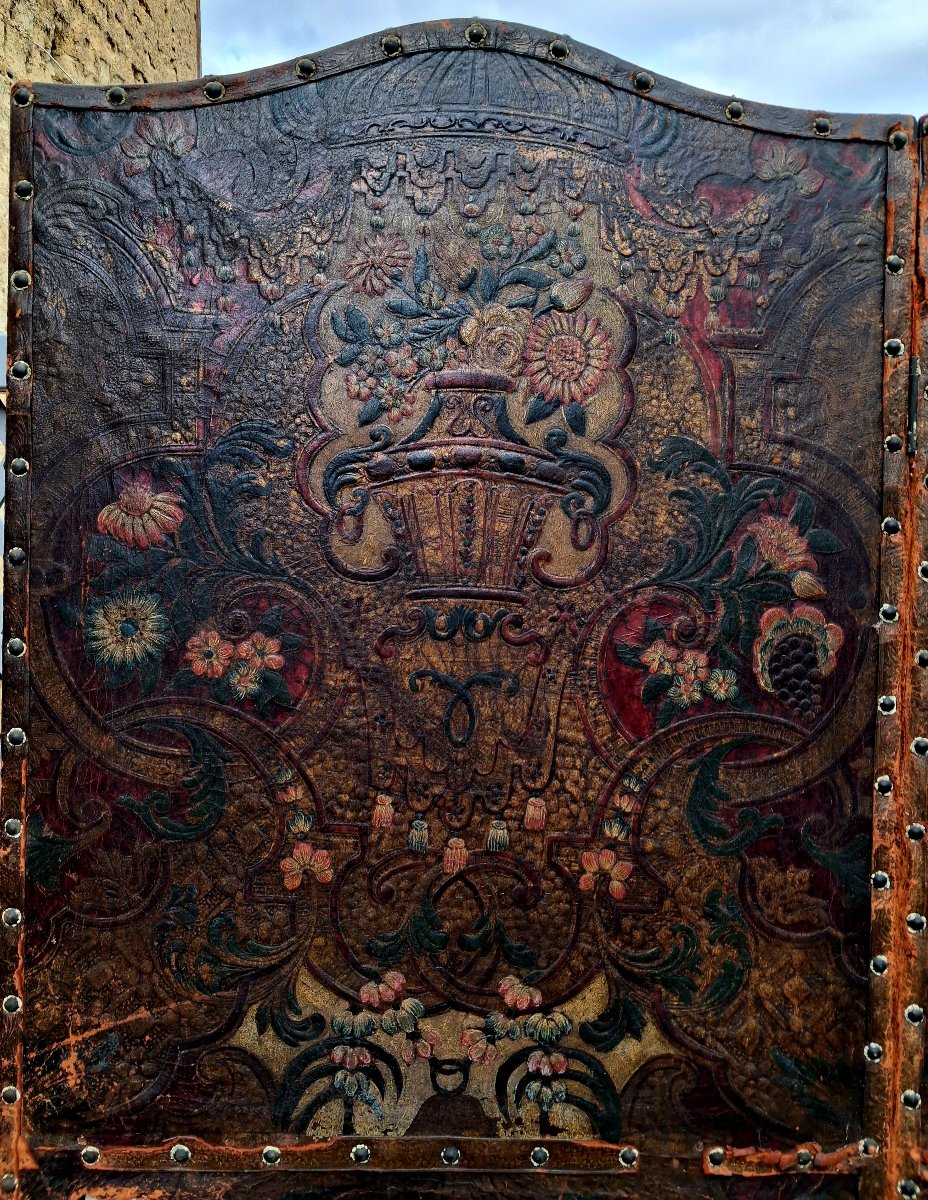
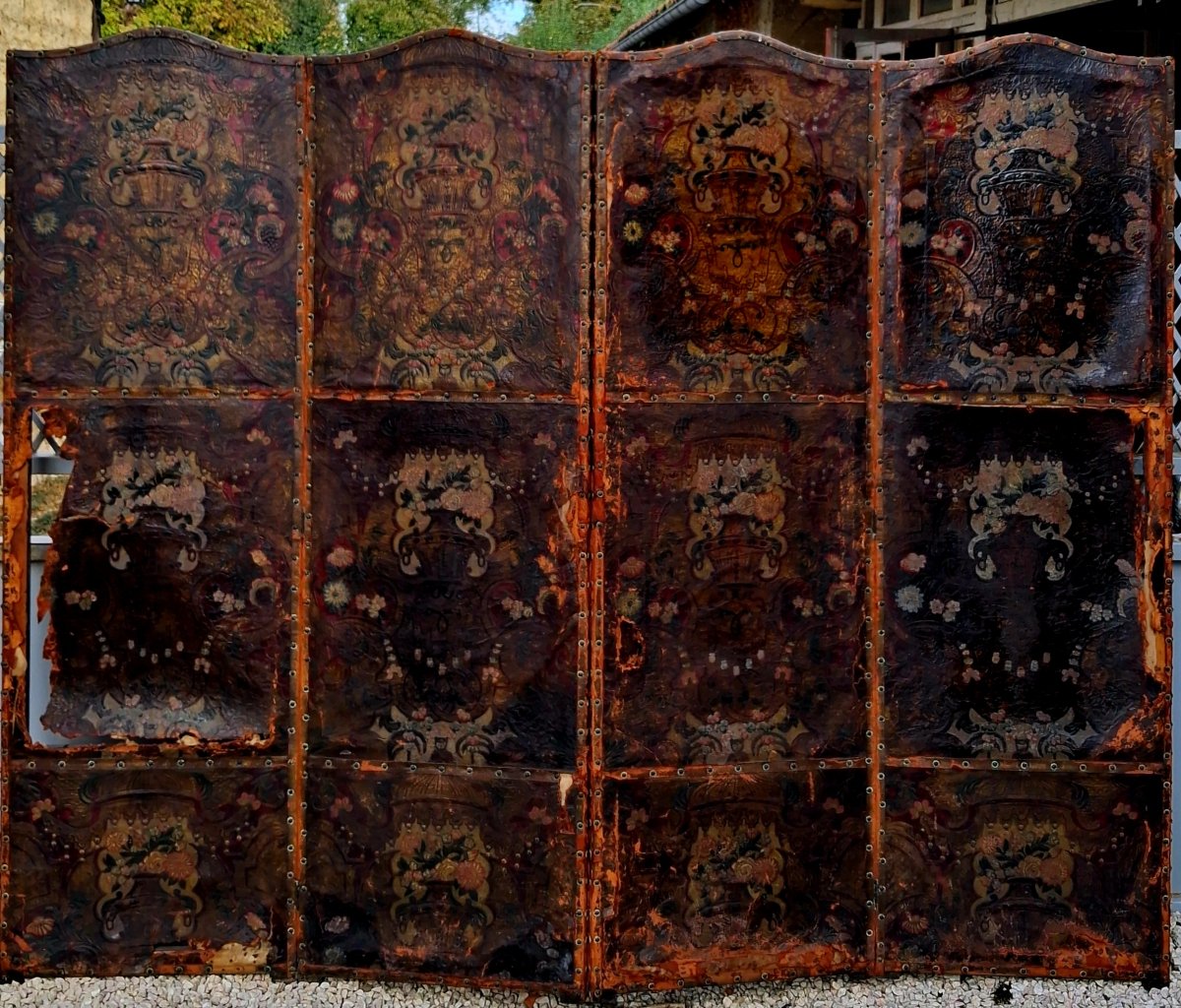
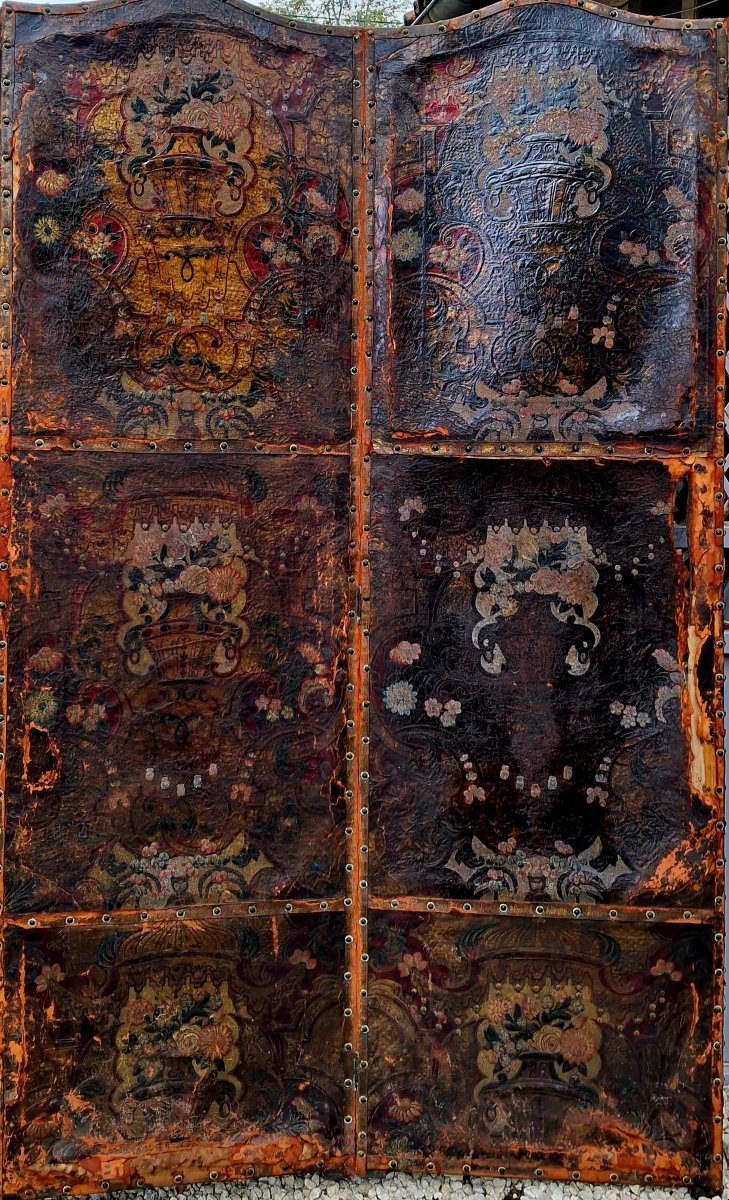
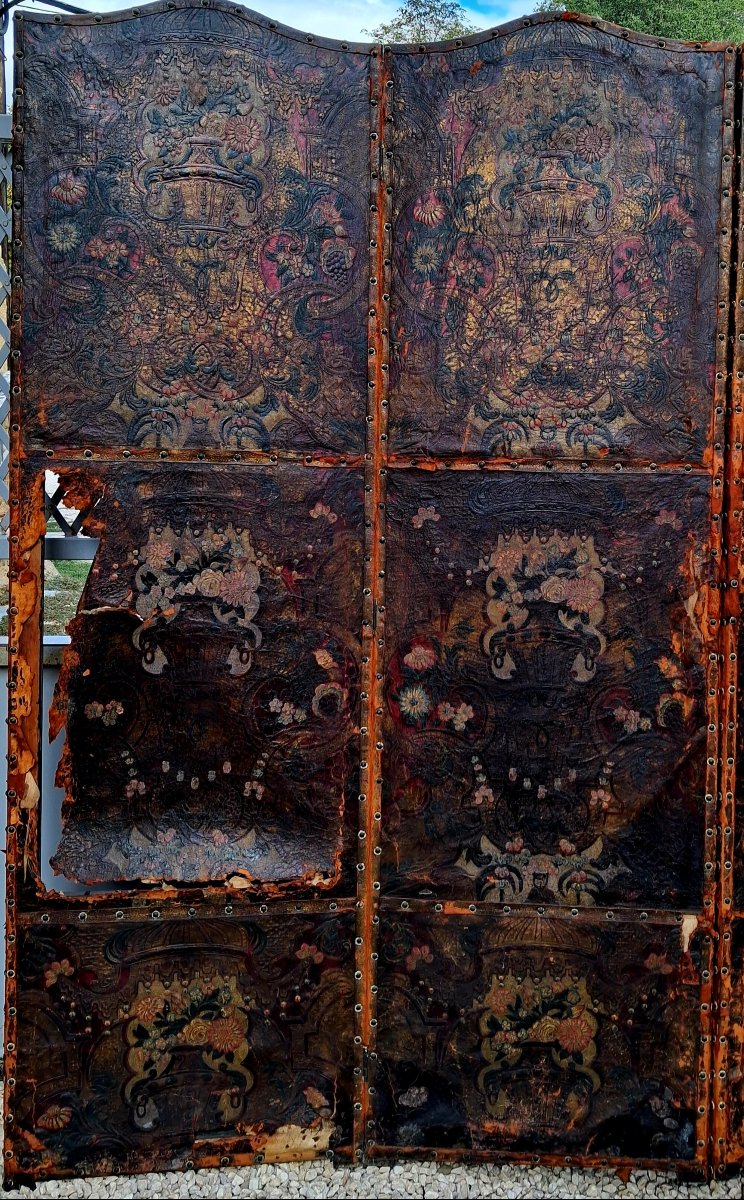
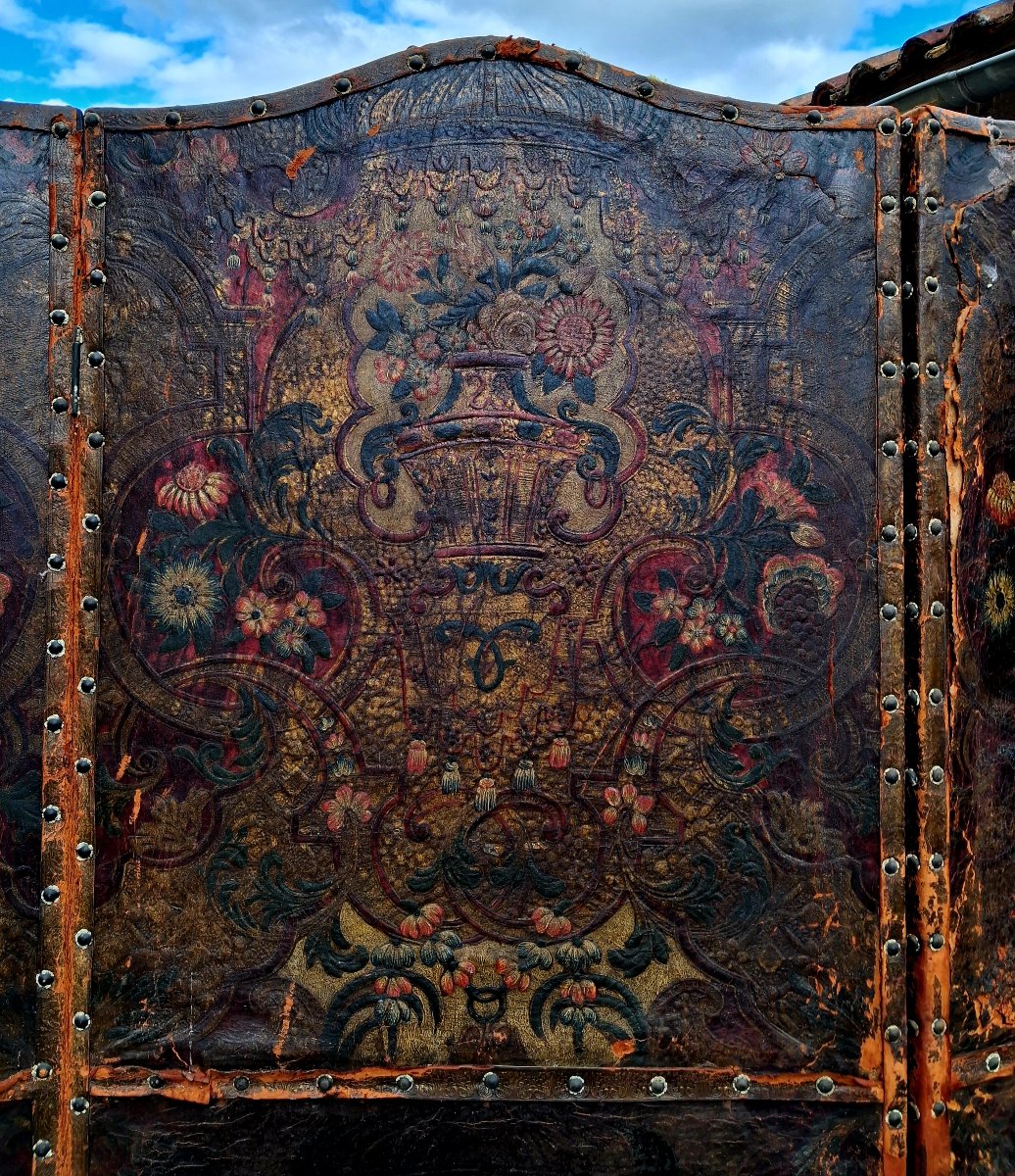
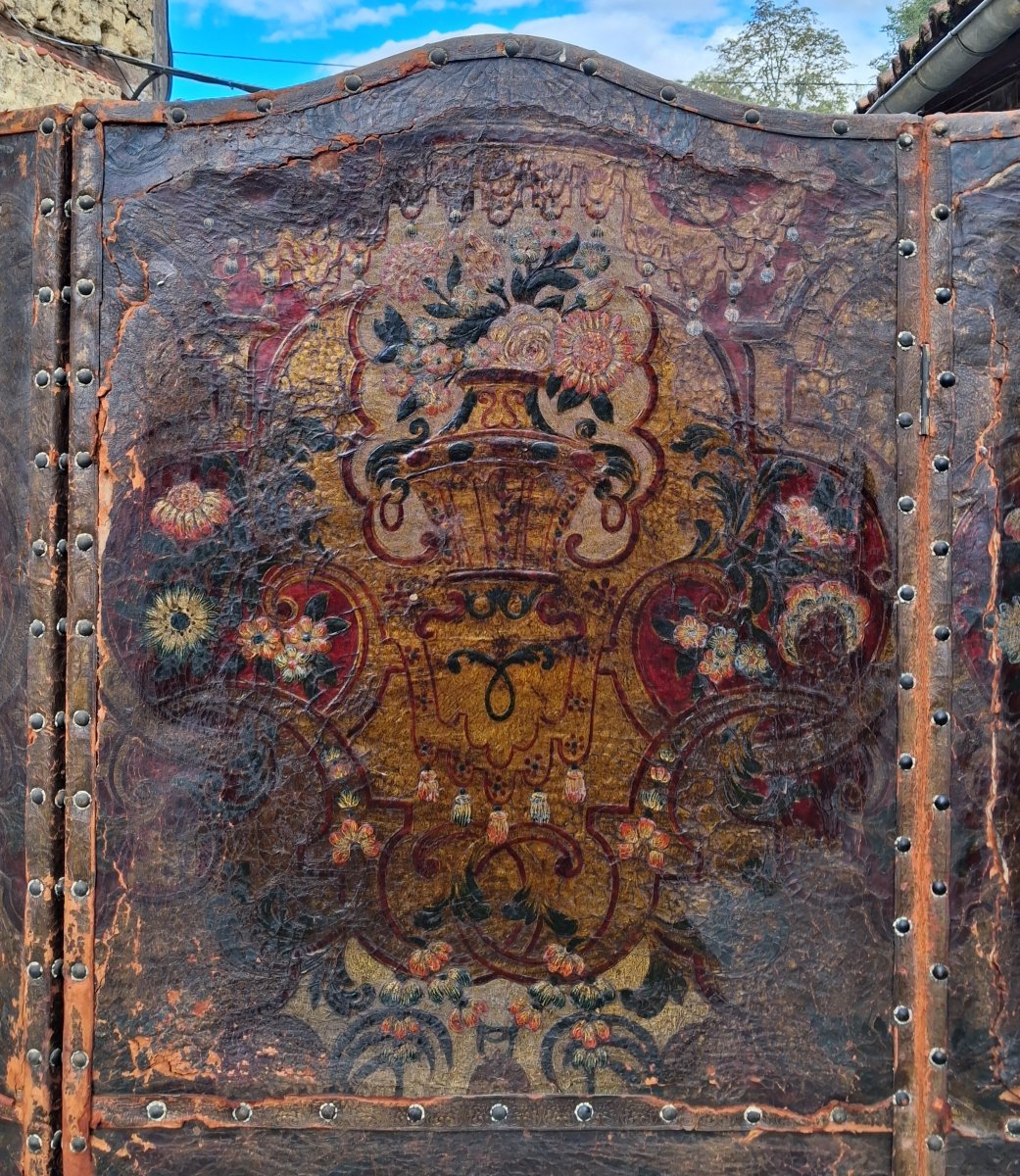
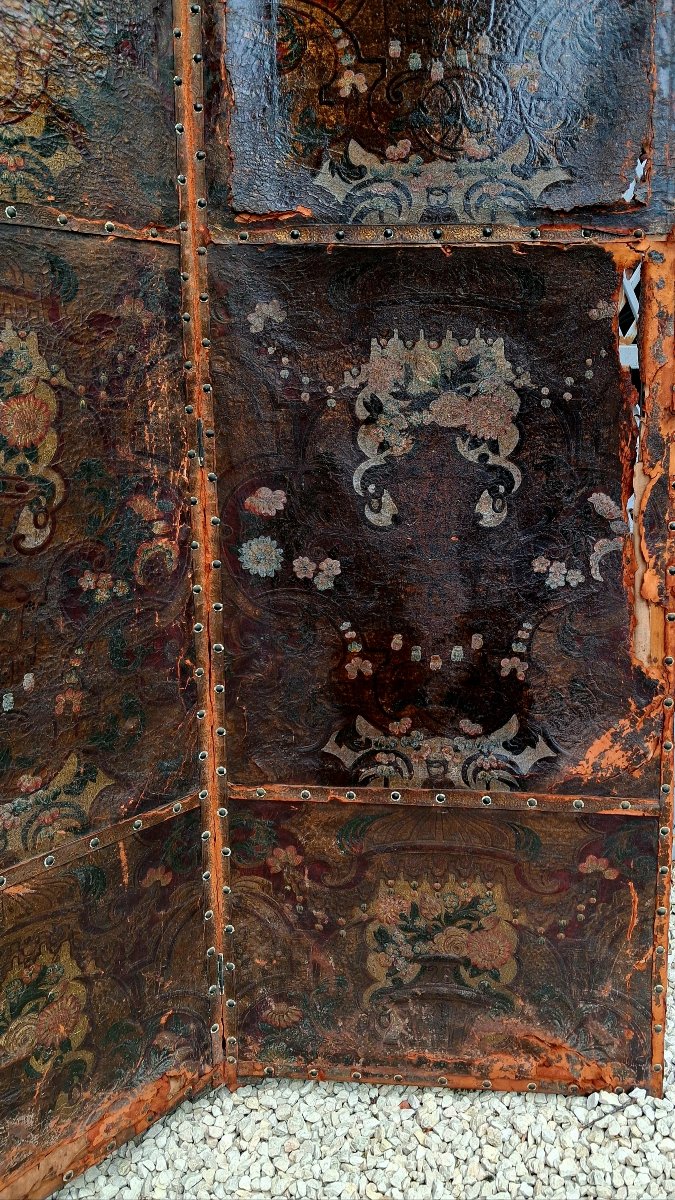
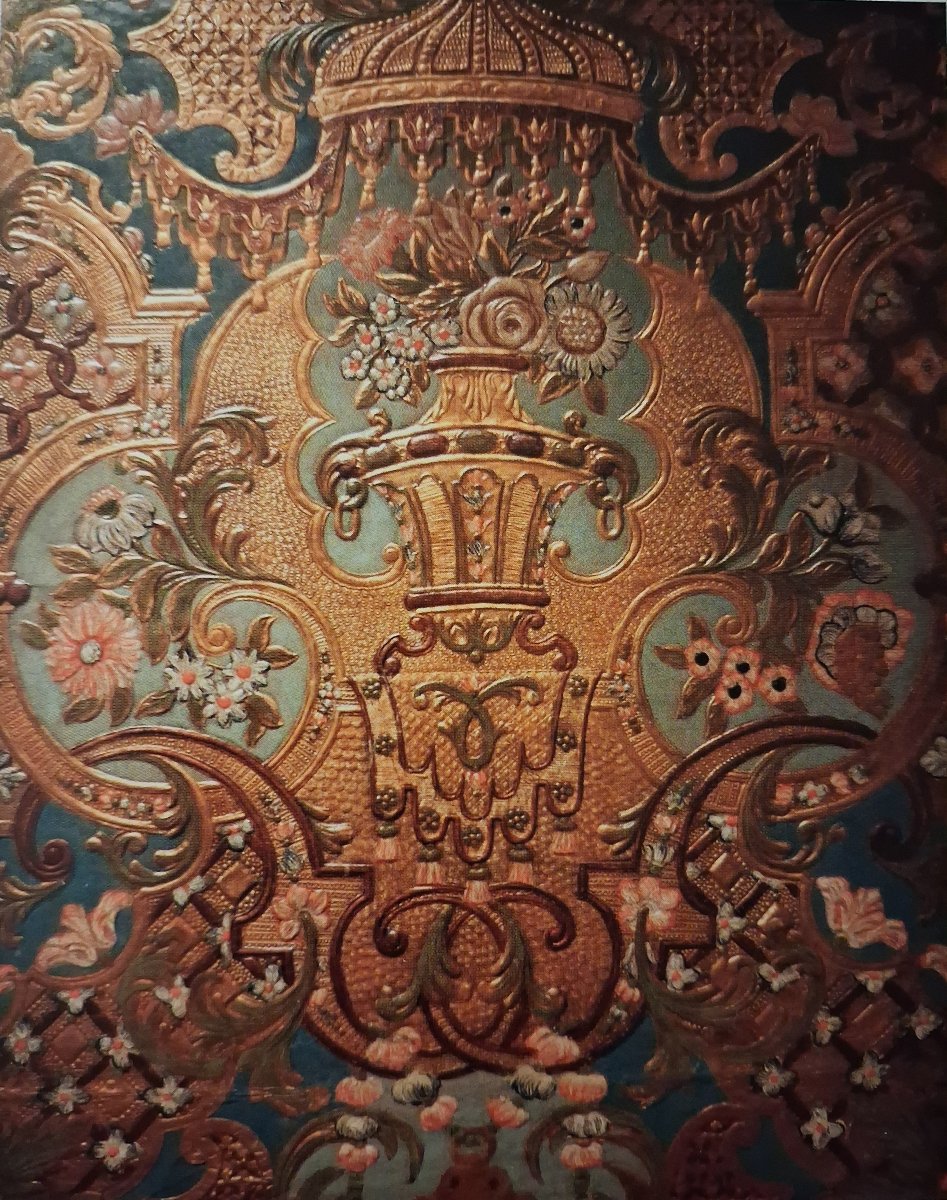
Four-panel folding screen in embossed and worked leather, made up of twelve panels and four half-panels (bottom frieze) with a "golden" background and a polychrome decoration featuring a central motif of a large vase of flowers on a wall-mounted console, topped with a monumental canopy, garlands of lambrequins, scrolling acanthus leaves, flowers, and stylized patterns on a background of polychrome or golden panels, in the style of Daniel Marot's work (Paris, 1661 - The Hague, 1752).
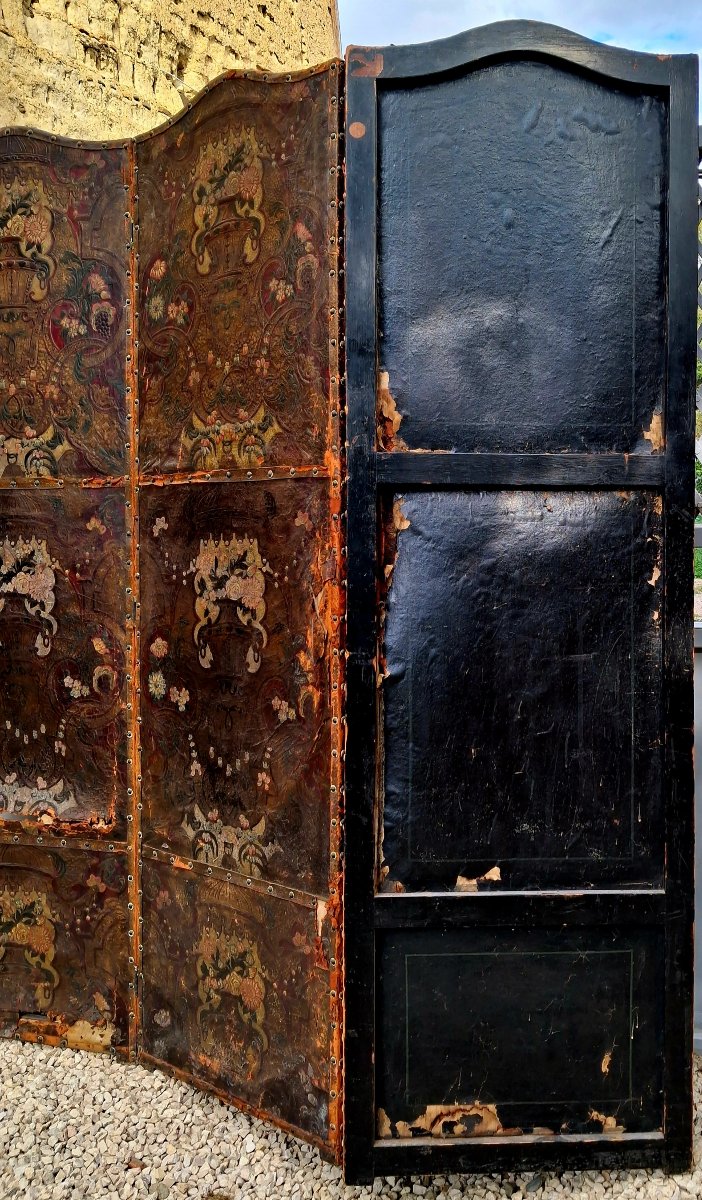
The back has a plain black background with simple lines forming panels.
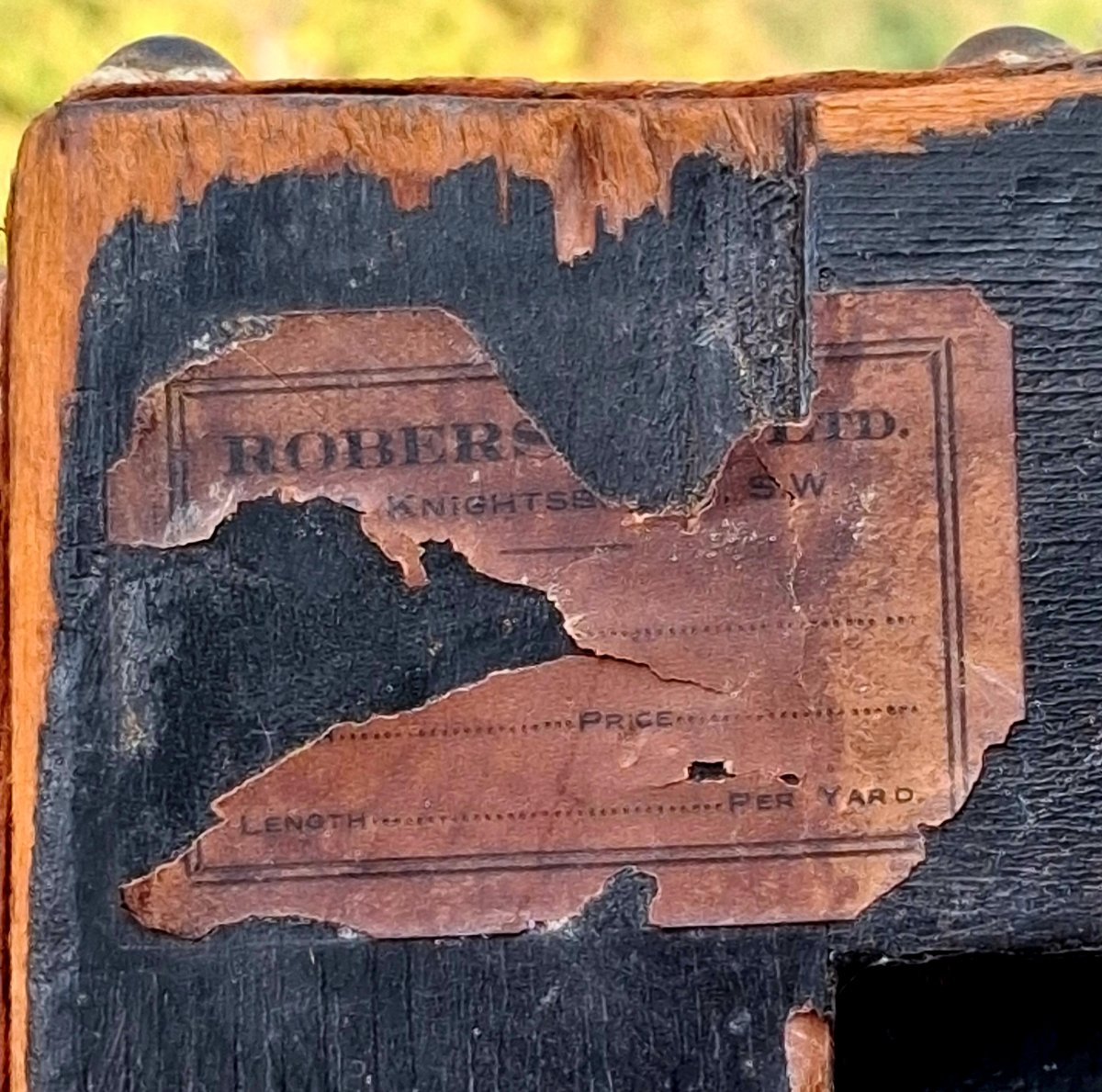
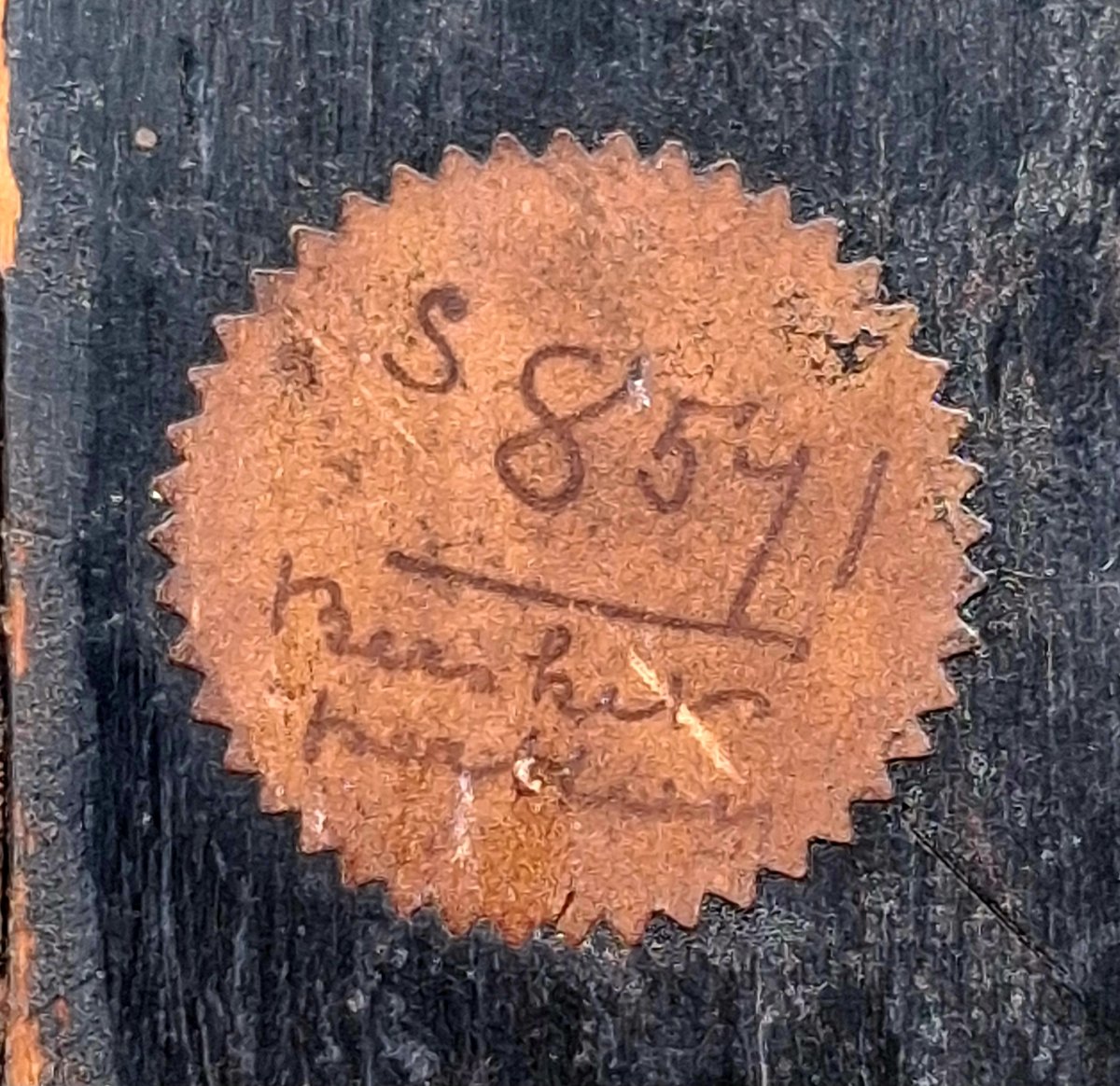
On the frames, carrier or storage labels in the name of 'Robersons Ltd' and tags bearing the number 375 for one, s 8541 and two words for the other, presumably inventory and/or auction numbers. Work from a Dutch workshop, first quarter of the 18th century.
Dimensions: height cm / width cm.
Provenance : Château d'Arcangues, furniture of the marquises of Arcangues, Basque Country, France. Poor condition, needs restoration (additional photos available on request).
[* ref.: an embossed and gilded leather tile, perfectly restored (0.73 cm x 0.49 cm), with identical patterns but with color variations, is kept in the Glass Tielker collection of gilded leathers, D-Hückelhoven, Rhineland, Germany. It is reproduced with the photos of the screen]
Started in the Middle Ages in the Cordoba region, the production of gilded leathers developed in Spain during the 16th century. Valued and sought after by the aristocracy and European courts, they found their place in the most beautiful interiors as wall hangings, screens, and seat coverings...
Because of this craze, workshops began to develop in Italy, Portugal, France, England, and the Netherlands.
Many types of ornaments and decorative themes appeared, made based on ornament engravings by famous artists or inspired by goldsmith work.
There was also the influence and trend of various works imported from the Far East, leading makers to create decorations inspired by "China" crafts.
It was probably at the beginning of the 17th century that the first workshops developed in The Hague, Amsterdam, Dordrecht, and Middelburg...
It was also in the first half of the 17th century, in 1628 precisely, that the Netherlands saw the invention of the new 'repoussé' technique, which made it possible to repeatedly reproduce embossed gilt leathers using carved wooden panels with designs carved into them in relief, and through which the leathers were kind of molded under high pressure.
By the turn of the 17th and 18th centuries, the production of gilt and decorated leathers continued.
This period was marked by the influence of French ornamentalists like Charmeton, Jean Le Pautre, Jean Bérain the Elder, Jean Bérain the Younger… and André Charles Boulle.
In the workshops, artists adopt the big styles that are fashionable in France with more symmetrical compositions.
But, at the beginning of the 18th century, it’s Daniel Marot who has a strong influence on the decorative arts of the Netherlands. He creates many remarkable designs for various works, which he publishes as engravings, showing the extraordinary range of his talent.
Very quickly, screen makers start using his decorative vocabulary...
The Château d'Arcangues, a place steeped in a long family history
The d'Arcangues family dates back to the 12th century.
Some of its ancestors served as the king's prosecutor from 1614 to 1749.
The original castle was burned and destroyed in 1636 by Spanish troops when they invaded the territory during the Thirty Years' War.
It was rebuilt the same year.
The title of Marquis of Iranda associated with the family comes from Rose d'Arragory, wife of Michel d'Arcangues (1719 - 1798), and sister of Simon d'Aragorry, finance minister to Charles III of Spain.
In 1813, Arthur Wellesley, later made Duke of Wellington after his many victories over Napoleon I in Spain, occupied the castle during the battles of the Nive.
On that occasion, he gave a silver jug to the marquis...
As an aside
But it was at the beginning of the 20th century, with the birth of Pierre d'Arcangues (1886 - 1973) and later his son Guy (1924 - 2004), that the place truly flourished.
All of Biarritz's high-society life during the Roaring Twenties was then orchestrated by the father, a central figure in the region's cultural and artistic life.
Writer, poet, novelist… Pierre d'Arcangues made Biarritz one of the 'places to be' for artists and the international jet set.
Frank Sinatra, Jean Cocteau, Prince Rainier, Maurice Ravel, Igor Stravinsky, Henri Sauguet, Jacques Février, Ricardo Viñes, or Alfred Cortot… a considerable number of celebrities and high-society figures stayed at the château during their visits to this beautiful region.
The back has a plain black background with simple lines forming panels.
On the frames, carrier or storage labels in the name of 'Robersons Ltd' and tags bearing the number 375 for one, s 8541 and two words for the other, presumably inventory and/or auction numbers. Work from a Dutch workshop, first quarter of the 18th century.
Dimensions: height cm / width cm.
Provenance : Château d'Arcangues, furniture of the marquises of Arcangues, Basque Country, France. Poor condition, needs restoration (additional photos available on request).
[* ref.: an embossed and gilded leather tile, perfectly restored (0.73 cm x 0.49 cm), with identical patterns but with color variations, is kept in the Glass Tielker collection of gilded leathers, D-Hückelhoven, Rhineland, Germany. It is reproduced with the photos of the screen]
Started in the Middle Ages in the Cordoba region, the production of gilded leathers developed in Spain during the 16th century. Valued and sought after by the aristocracy and European courts, they found their place in the most beautiful interiors as wall hangings, screens, and seat coverings...
Because of this craze, workshops began to develop in Italy, Portugal, France, England, and the Netherlands.
Many types of ornaments and decorative themes appeared, made based on ornament engravings by famous artists or inspired by goldsmith work.
There was also the influence and trend of various works imported from the Far East, leading makers to create decorations inspired by "China" crafts.
It was probably at the beginning of the 17th century that the first workshops developed in The Hague, Amsterdam, Dordrecht, and Middelburg...
It was also in the first half of the 17th century, in 1628 precisely, that the Netherlands saw the invention of the new 'repoussé' technique, which made it possible to repeatedly reproduce embossed gilt leathers using carved wooden panels with designs carved into them in relief, and through which the leathers were kind of molded under high pressure.
By the turn of the 17th and 18th centuries, the production of gilt and decorated leathers continued.
This period was marked by the influence of French ornamentalists like Charmeton, Jean Le Pautre, Jean Bérain the Elder, Jean Bérain the Younger… and André Charles Boulle.
In the workshops, artists adopt the big styles that are fashionable in France with more symmetrical compositions.
But, at the beginning of the 18th century, it’s Daniel Marot who has a strong influence on the decorative arts of the Netherlands. He creates many remarkable designs for various works, which he publishes as engravings, showing the extraordinary range of his talent.
Very quickly, screen makers start using his decorative vocabulary...
The Château d'Arcangues, a place steeped in a long family history
The d'Arcangues family dates back to the 12th century.
Some of its ancestors served as the king's prosecutor from 1614 to 1749.
The original castle was burned and destroyed in 1636 by Spanish troops when they invaded the territory during the Thirty Years' War.
It was rebuilt the same year.
The title of Marquis of Iranda associated with the family comes from Rose d'Arragory, wife of Michel d'Arcangues (1719 - 1798), and sister of Simon d'Aragorry, finance minister to Charles III of Spain.
In 1813, Arthur Wellesley, later made Duke of Wellington after his many victories over Napoleon I in Spain, occupied the castle during the battles of the Nive.
On that occasion, he gave a silver jug to the marquis...
As an aside
But it was at the beginning of the 20th century, with the birth of Pierre d'Arcangues (1886 - 1973) and later his son Guy (1924 - 2004), that the place truly flourished.
All of Biarritz's high-society life during the Roaring Twenties was then orchestrated by the father, a central figure in the region's cultural and artistic life.
Writer, poet, novelist… Pierre d'Arcangues made Biarritz one of the 'places to be' for artists and the international jet set.
Frank Sinatra, Jean Cocteau, Prince Rainier, Maurice Ravel, Igor Stravinsky, Henri Sauguet, Jacques Février, Ricardo Viñes, or Alfred Cortot… a considerable number of celebrities and high-society figures stayed at the château during their visits to this beautiful region.
1 850 €
Period: 18th century
Style: Louis 14th, Regency
Condition: Some repairs
Material: Leather
Reference (ID): 1827297
Availability: In stock
Print