

Circa 1600, Northern Italy? Pastiglia Travel Cabinet Imitating Cordoba Leather
Artist: Italie Du Nord / Lombardie ?
HAUTE EPOQUE
Exchanger's or collector's cabinet,
Northern Italy / Lombardy?
Early 17th century.
Wood (walnut?) blackened, covered with rich pastiglia panels imitating 'CORDOVA' leathers.
Mythological cycle of Apollo
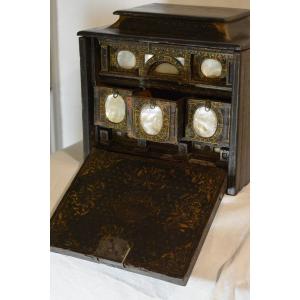
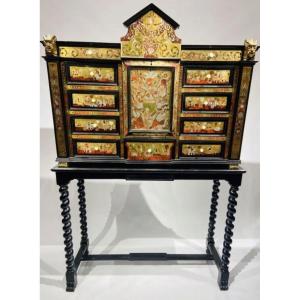
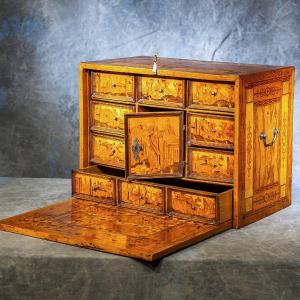
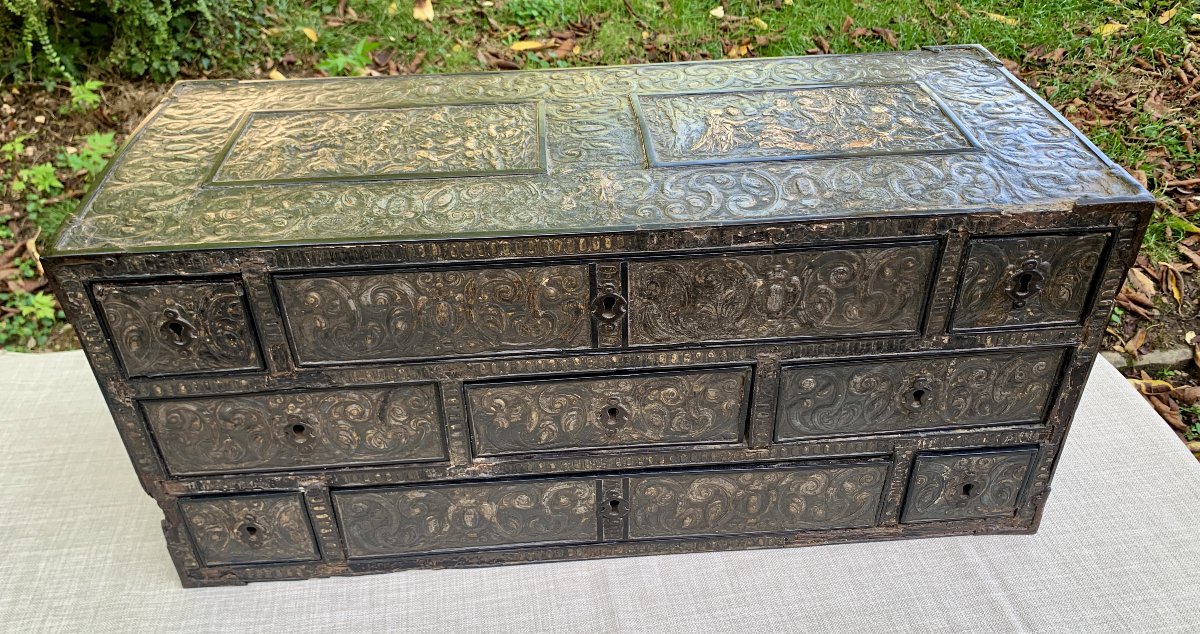
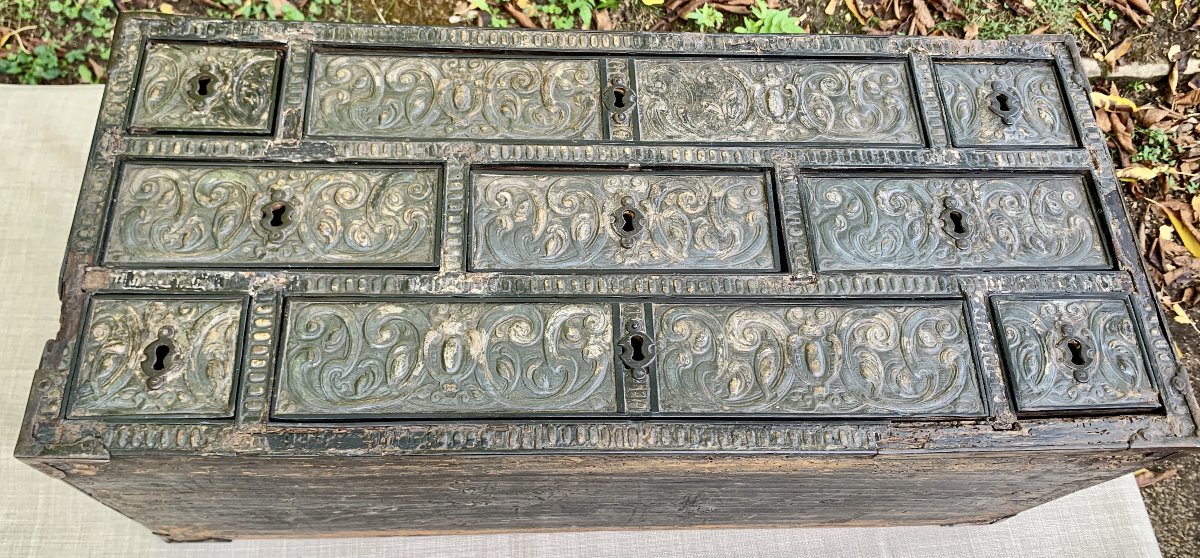
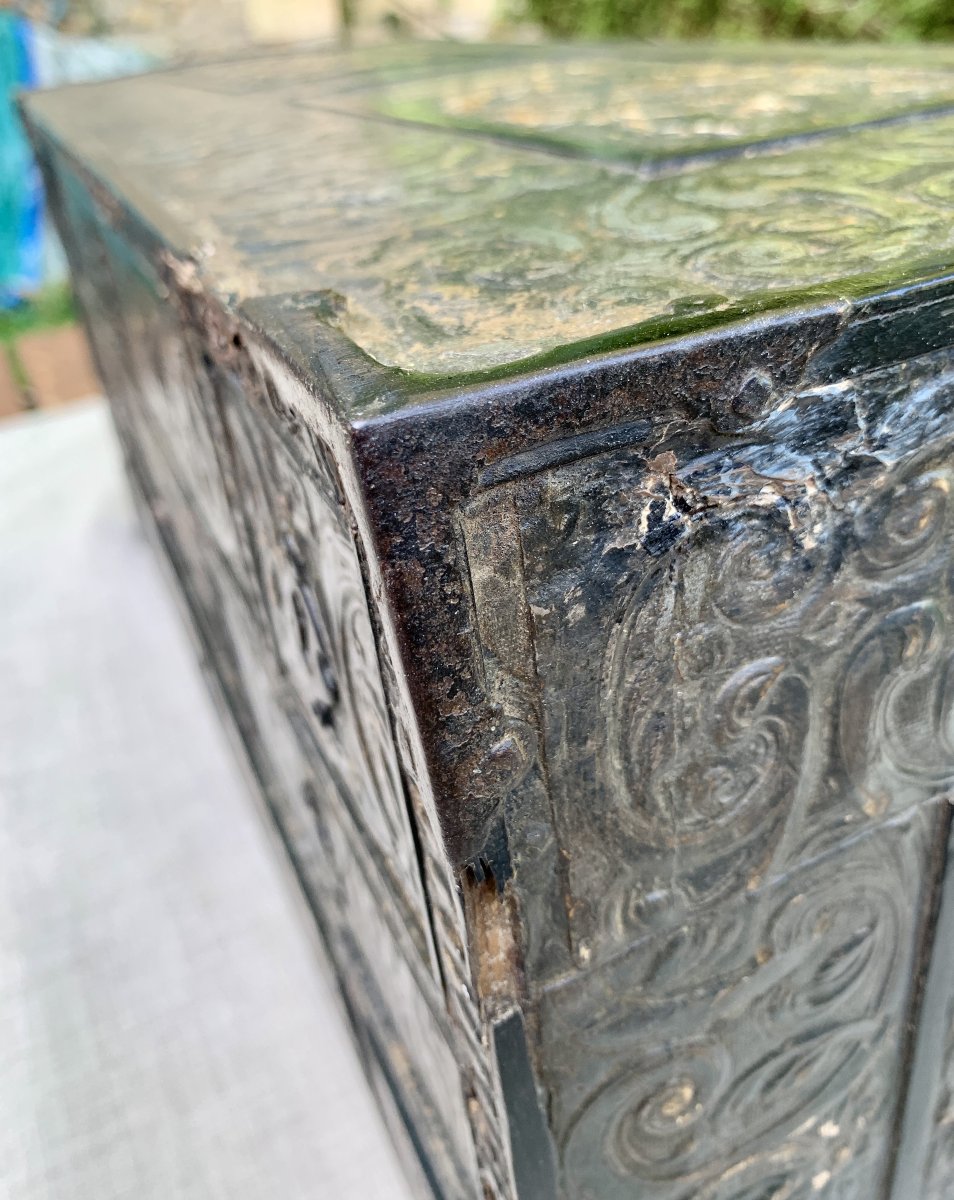
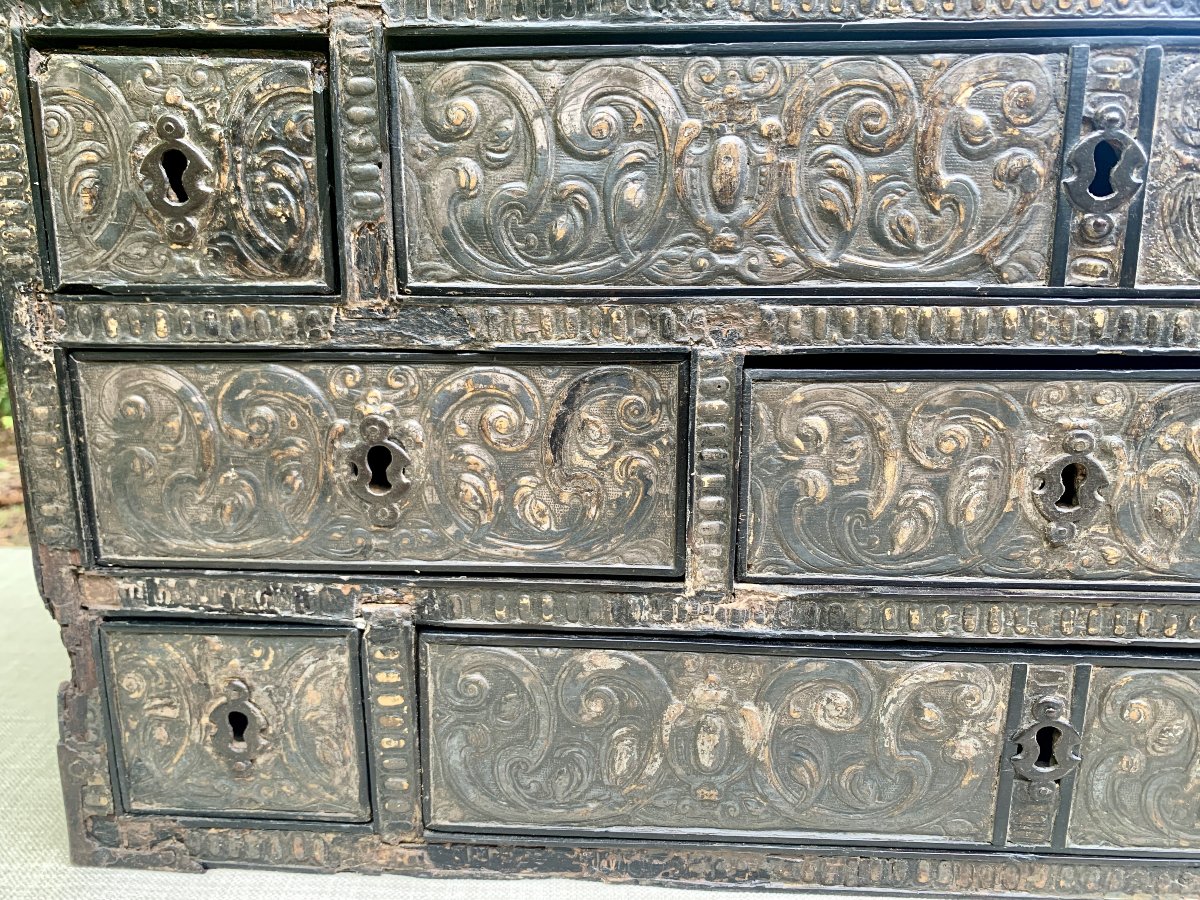
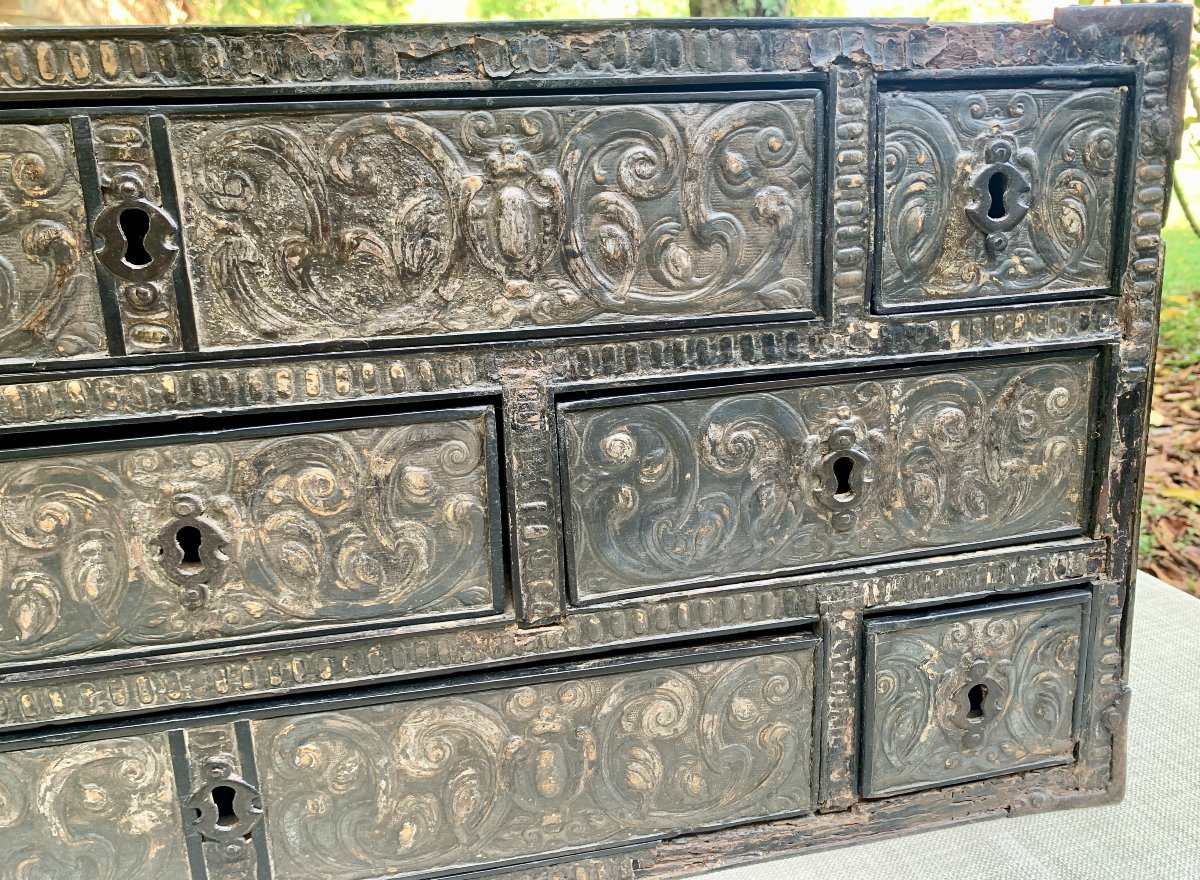
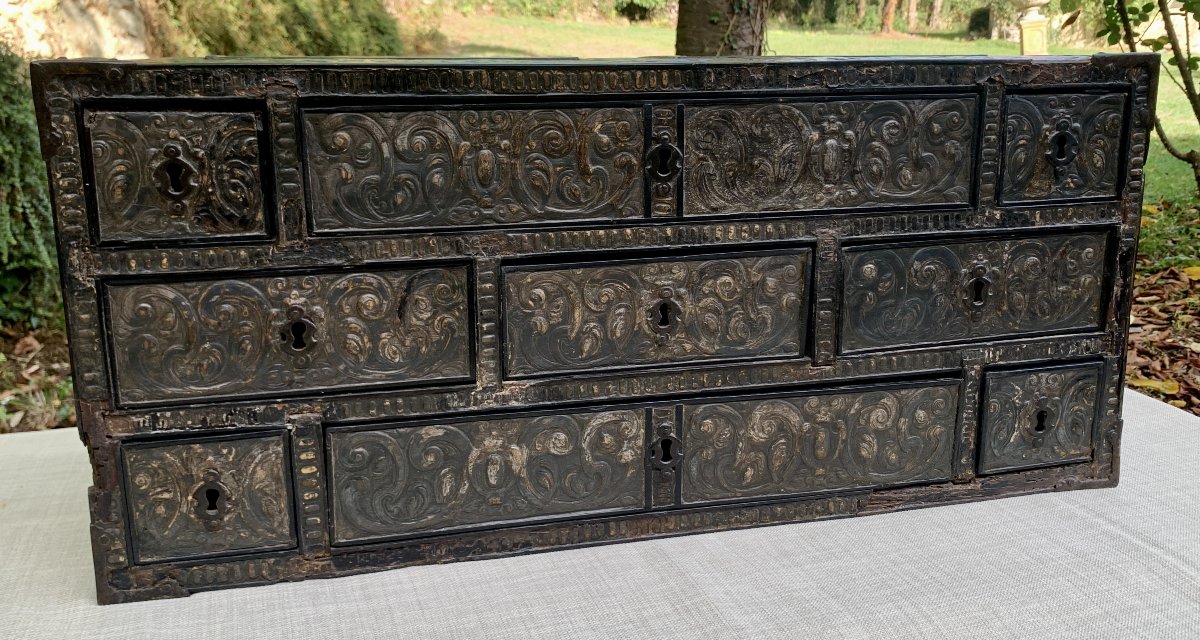
The display cabinet features an asymmetrical front with 3 rows of drawers: 2 smaller, square ones flanking a long central drawer at the top and bottom, and 3 similar drawers for the middle section. The drawers have deep geometric-cut keyholes, and the piece is further reinforced at all its corners with blackened wrought iron.
The drawer fronts are decorated with lush scrollwork, leafy spirals, and continuous raised foliage patterns, typical of the Renaissance.
The pastiglia technique here skillfully imitates the effects of Cordovan embossed leather, its silvered and/or polychrome parts, as well as its reliefs.
Pastiglia is a fragile composite material forming a fine white paste, which can be silvered or gilded and/or painted, made from gypsum, chalk, or marble powder mixed with animal glue (hide glue) and sometimes oil. The relief is not sculpted directly into the wood mass here, but molded or applied in pastiglia in the form of a fine white paste. This Italian-origin technique allowed for the creation of rich relief ornaments.
The Cordovan leather effect: The surface of the pastiglia has been dyed or patinated to faithfully reproduce the textured, bumpy, and dark look of typical embossed and silvered leather decorations.
The material effect: You can clearly see here how the pastiglia was shaped to give this typical 'flat relief,' highlighted with a dark patina and traces of old wax or silvering to create the perfect illusion of embossed leather.
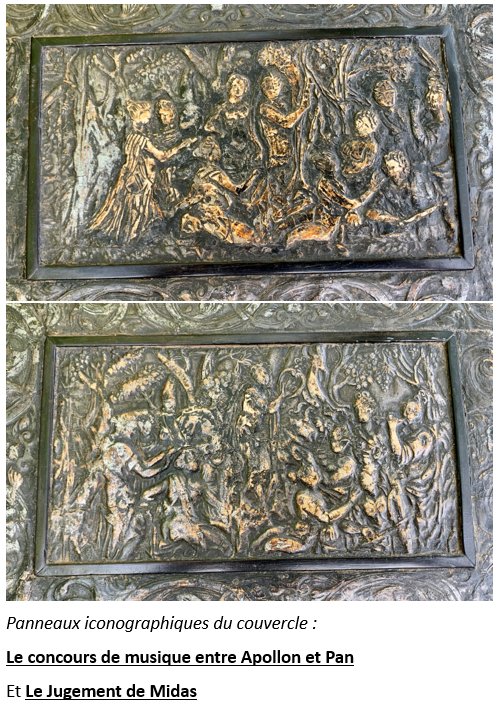
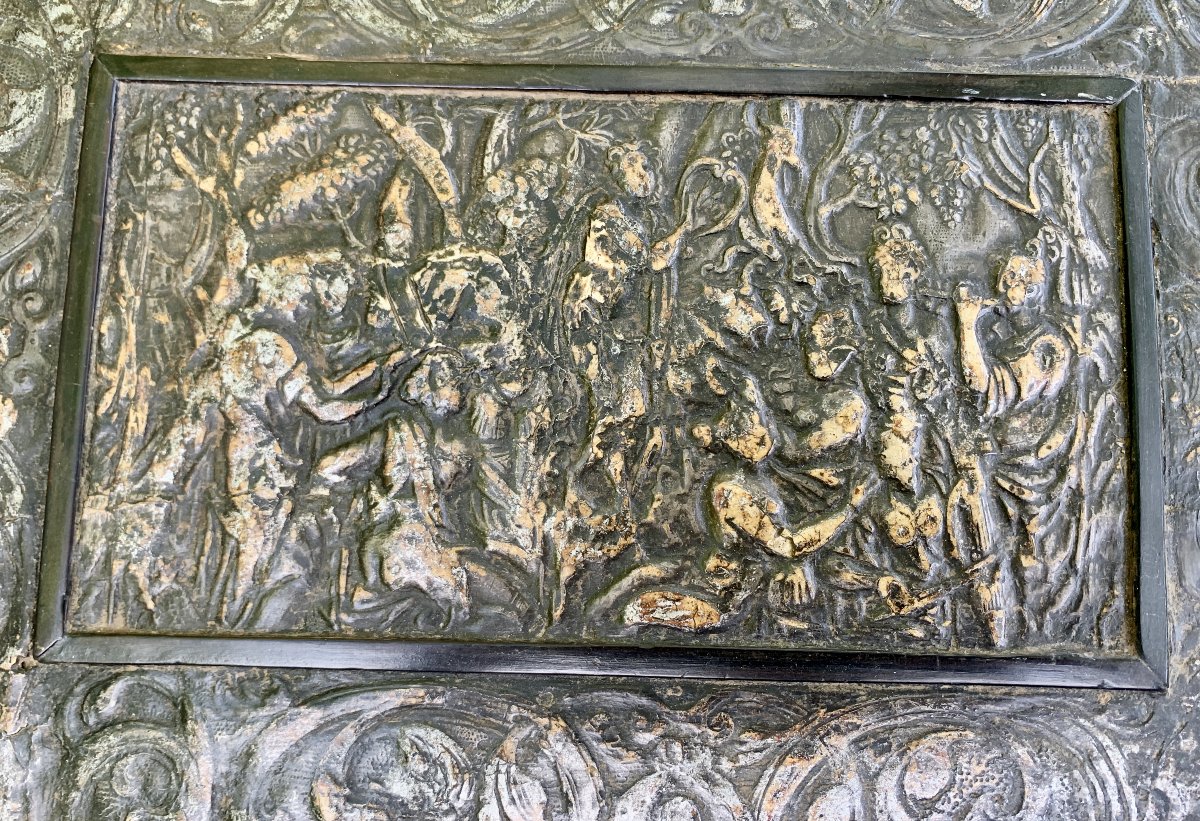
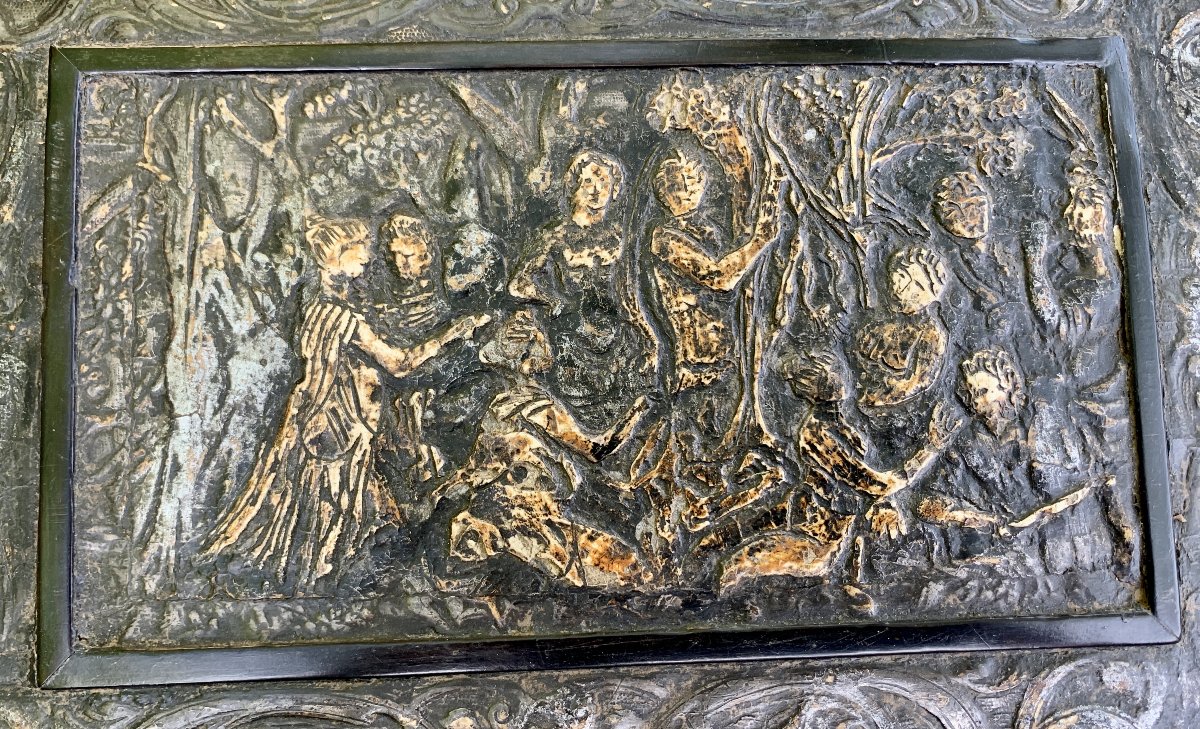
The historical scenes on the top of this cabinet and on its sides are inspired by Greco-Roman mythology, a classic iconographic repertoire that was very popular in Italy in the 17th century for decorating precious boxes and cabinets. These two pastiglia panels on the top (each 22.5 x 12.5 cm) actually form a true continuous narrative cycle centered on a specific episode from Ovid's Metamorphoses (Book XI): the musical contest between Apollo and Pan (1), and the Judgment of Midas (2).
1. The music contest between Apollo and Pan.
The illustration shows, from left to right, the famous musical challenge judged by the mountain god Tmolos, in the presence of the divine jury and audience.
* On the far right, the standing figure in profile playing a wind instrument (a Pan flute or syrinx) is the god Pan.
* In the center right, the seated and attentive figures make up the pastoral assembly and the mountain nymphs who are listening to the performance.
* In the center left (standing), the crowned figure holding his lyre (here a handheld lyre or viola, a common anachronism in the 17th century) is Apollo. He is waiting his turn or beginning to play, confident in his superiority.
* On the far left, the kneeling figure and a figure dressed in a toga represent the human audience and the kings who came to watch the duel.
2. The Judgment of Midas
This second panel shows the dramatic outcome of the contest and Apollo's verdict.
* In the center, King Midas is sitting or kneeling on the ground. He has just committed the offense of declaring Pan the winner, contradicting the god Tmolos who had chosen Apollo.
* On the left, standing, a majestic draped female figure (probably a Muse or an allegory of Music) watches the scene.
* On the center-right (standing near the tree), Apollo, furious with Midas's musical incompetence, approaches him. In Ovid’s story, Apollo declares that such stupid ears can't keep a human shape: he punishes Midas by giving him donkey ears.
https://utpictura18.univ-amu.fr/notice/23854/lightbo
* On the right, the spectators and satyrs turn away or mock, while Midas is already trying to hide his head, an iconography that fits perfectly with the prints engraved by Antonio Tempesta.
The style of the trees (the foliage stylized into little balls) and the heavy drapery of the figures confirm an Italian production from the first half of 17th century, created by a workshop skilled in the art of curiosity cabinets.
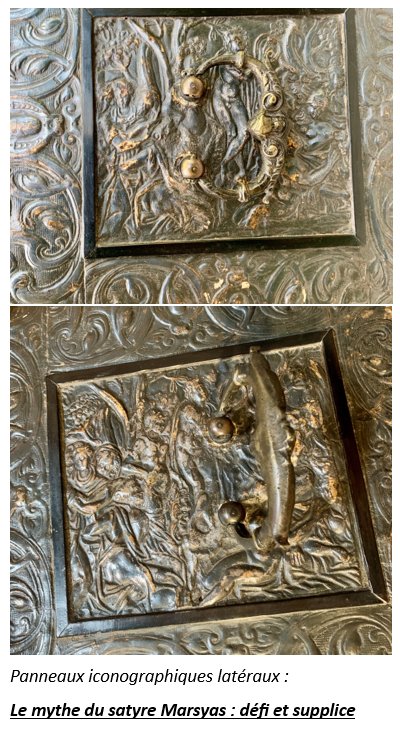
3. The side panels (14.5 x 12.5 cm) continue the iconographic cycle of Apollo.
The workshop didn't just only illustrated a single episode; it designed a complete program around the supremacy of divine music and the punishment of pride (hybris).
Their horizontal orientation on the sides of the stuff is a technical choice that really shows the practices of Italian cabinet makers of the time. These two panels form an inseparable diptych illustrating Apollo's other great musical challenge (Book VI of the Metamorphoses): the myth of the satyr Marsyas.
A. The left panel depicts Marsyas' challenge; it captures the moment just before the drama.
* In the center, the satyr Marsyas (recognizable by his wild nudity, slightly hairy legs, and dynamic posture) openly challenges the god of music by playing the aulos (the double flute invented and then discarded by Athena).
* On side, a nymph or a Muse watches the scene on the right (seated), while on the left stands a protective figure of nature under a large tree.
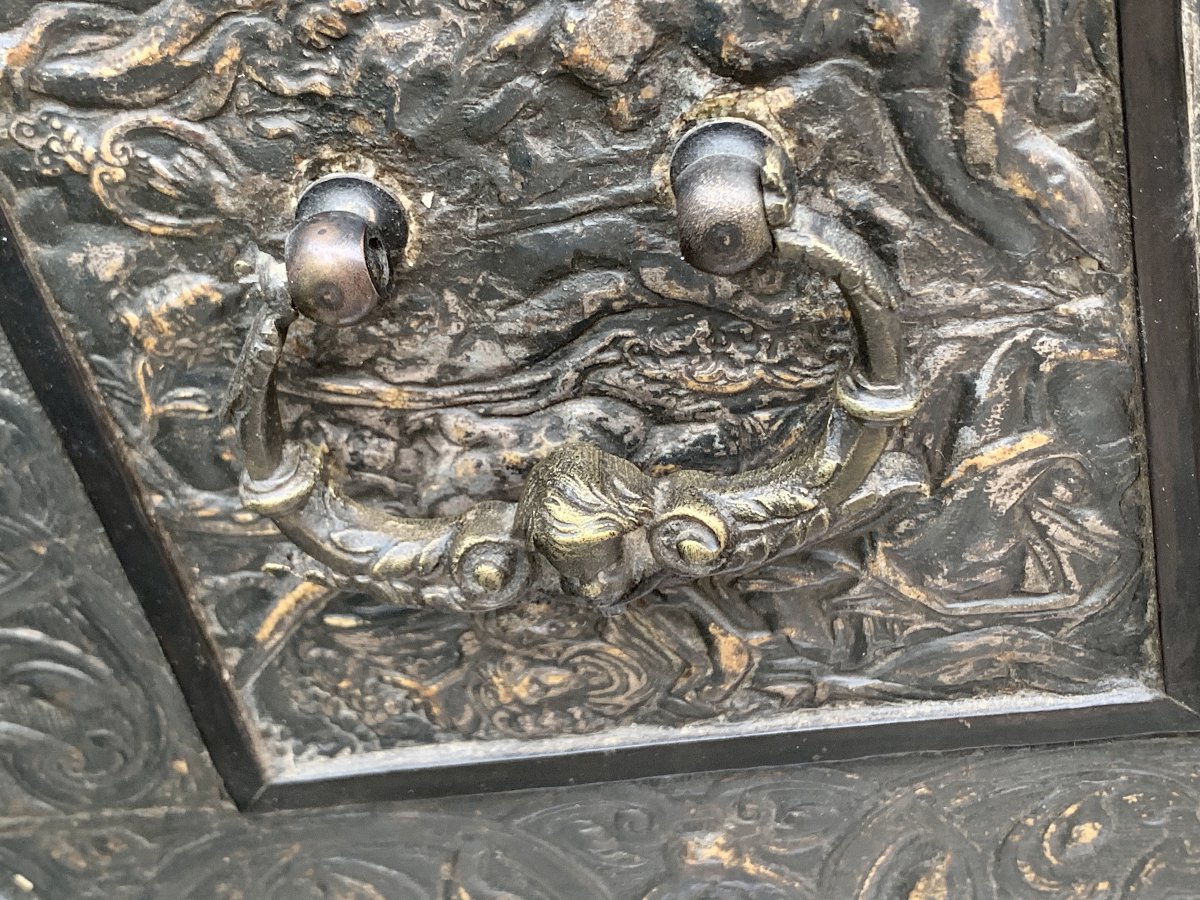
* The bronze handle attaches directly at the spot where the central tree usually appears in the composition engraved by Antonio Tempesta (Plate 58 of his 1606 series).
B. The panel on the right depicts the torment of Marsyas (The Flaying)
Having lost the contest against Apollo's lyre, Marsyas suffers the god's terrible sentence.
* On the left, the majestic figure of Apollo, laurel crown on his head and classical drapery flowing in the wind, advances with a firm step.
* On the right, the tortured body of Marsyas is tied by the hands to the branches of a tree. The pastiglia relief shows the god preparing to flay him alive. The dramatic tension of the bodies is perfectly conveyed despite the flatness of the paste.
The horizontal arrangement of these reliefs on the sides of the cabinet (which forces you to turn your head to view the scene vertically) can be explained by two main reasons, one technical and the other narrative: The exclusive reuse of a set of molds: at this period, making pastiglia relied on pre-existing wooden or sulfur molds. These molds were created in the standardized format of prints from that era (Antonio Tempesta's copper plates were almost all horizontal rectangles of about 10 x 12 cm). To decorate the side panels of this cabinet (which turn out to be perfect squares or vertical rectangles), the craftsman didn’t make new molds. He preferred to rotate his standard horizontal molds to fill the available space rather than leaving the wood bare.
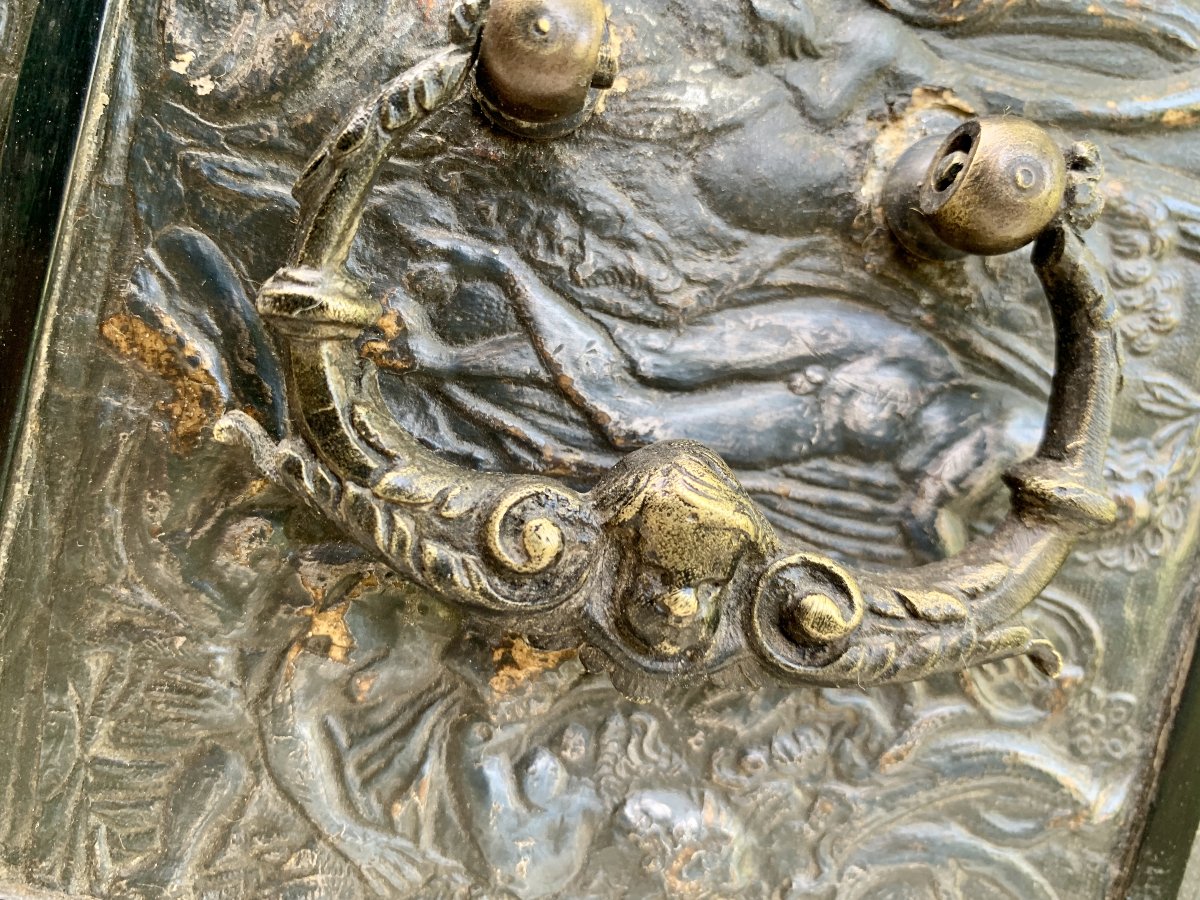
The functional handle as a reading axis:
The two applique handles in gilt or patinated bronze, decorated with cherub heads, were fixed at the exact geometric center of the panels to allow the piece of furniture to be carried. By placing the relief horizontally, the cabinetmaker cleverly used the handle to hide the central joint of the scene (the tree of torment or challenge), while preserving the readability of the figures on the left and right of the clasp. This quirk way is a signature of 17th-century craftsmanship: it shows a piece of furniture designed primarily for its front and top (seen from the front), with the sides serving as luxurious narrative complements adapted to the workshop’s constraints.
Condition:
Very good for the pastiglia panels on the top, front, and sides. The pastiglia gaps are all concentrated on the edges of the cabinet, between and around the drawers, and in the corners of the fragile and precious cabinet.
Dimensions:
70.5 cm long, 32 cm high, and only 29 cm deep.
The cabinet is therefore very long, not very tall, and deep, more in line with the typical format of Spanish burgueno cabinets.
Exchanger's or collector's cabinet,
Northern Italy / Lombardy?
Early 17th century.
Wood (walnut?) blackened, covered with rich pastiglia panels imitating 'CORDOVA' leathers.
Mythological cycle of Apollo
The display cabinet features an asymmetrical front with 3 rows of drawers: 2 smaller, square ones flanking a long central drawer at the top and bottom, and 3 similar drawers for the middle section. The drawers have deep geometric-cut keyholes, and the piece is further reinforced at all its corners with blackened wrought iron.
The drawer fronts are decorated with lush scrollwork, leafy spirals, and continuous raised foliage patterns, typical of the Renaissance.
The pastiglia technique here skillfully imitates the effects of Cordovan embossed leather, its silvered and/or polychrome parts, as well as its reliefs.
Pastiglia is a fragile composite material forming a fine white paste, which can be silvered or gilded and/or painted, made from gypsum, chalk, or marble powder mixed with animal glue (hide glue) and sometimes oil. The relief is not sculpted directly into the wood mass here, but molded or applied in pastiglia in the form of a fine white paste. This Italian-origin technique allowed for the creation of rich relief ornaments.
The Cordovan leather effect: The surface of the pastiglia has been dyed or patinated to faithfully reproduce the textured, bumpy, and dark look of typical embossed and silvered leather decorations.
The material effect: You can clearly see here how the pastiglia was shaped to give this typical 'flat relief,' highlighted with a dark patina and traces of old wax or silvering to create the perfect illusion of embossed leather.
The historical scenes on the top of this cabinet and on its sides are inspired by Greco-Roman mythology, a classic iconographic repertoire that was very popular in Italy in the 17th century for decorating precious boxes and cabinets. These two pastiglia panels on the top (each 22.5 x 12.5 cm) actually form a true continuous narrative cycle centered on a specific episode from Ovid's Metamorphoses (Book XI): the musical contest between Apollo and Pan (1), and the Judgment of Midas (2).
1. The music contest between Apollo and Pan.
The illustration shows, from left to right, the famous musical challenge judged by the mountain god Tmolos, in the presence of the divine jury and audience.
* On the far right, the standing figure in profile playing a wind instrument (a Pan flute or syrinx) is the god Pan.
* In the center right, the seated and attentive figures make up the pastoral assembly and the mountain nymphs who are listening to the performance.
* In the center left (standing), the crowned figure holding his lyre (here a handheld lyre or viola, a common anachronism in the 17th century) is Apollo. He is waiting his turn or beginning to play, confident in his superiority.
* On the far left, the kneeling figure and a figure dressed in a toga represent the human audience and the kings who came to watch the duel.
2. The Judgment of Midas
This second panel shows the dramatic outcome of the contest and Apollo's verdict.
* In the center, King Midas is sitting or kneeling on the ground. He has just committed the offense of declaring Pan the winner, contradicting the god Tmolos who had chosen Apollo.
* On the left, standing, a majestic draped female figure (probably a Muse or an allegory of Music) watches the scene.
* On the center-right (standing near the tree), Apollo, furious with Midas's musical incompetence, approaches him. In Ovid’s story, Apollo declares that such stupid ears can't keep a human shape: he punishes Midas by giving him donkey ears.
https://utpictura18.univ-amu.fr/notice/23854/lightbo
* On the right, the spectators and satyrs turn away or mock, while Midas is already trying to hide his head, an iconography that fits perfectly with the prints engraved by Antonio Tempesta.
The style of the trees (the foliage stylized into little balls) and the heavy drapery of the figures confirm an Italian production from the first half of 17th century, created by a workshop skilled in the art of curiosity cabinets.
3. The side panels (14.5 x 12.5 cm) continue the iconographic cycle of Apollo.
The workshop didn't just only illustrated a single episode; it designed a complete program around the supremacy of divine music and the punishment of pride (hybris).
Their horizontal orientation on the sides of the stuff is a technical choice that really shows the practices of Italian cabinet makers of the time. These two panels form an inseparable diptych illustrating Apollo's other great musical challenge (Book VI of the Metamorphoses): the myth of the satyr Marsyas.
A. The left panel depicts Marsyas' challenge; it captures the moment just before the drama.
* In the center, the satyr Marsyas (recognizable by his wild nudity, slightly hairy legs, and dynamic posture) openly challenges the god of music by playing the aulos (the double flute invented and then discarded by Athena).
* On side, a nymph or a Muse watches the scene on the right (seated), while on the left stands a protective figure of nature under a large tree.
* The bronze handle attaches directly at the spot where the central tree usually appears in the composition engraved by Antonio Tempesta (Plate 58 of his 1606 series).
B. The panel on the right depicts the torment of Marsyas (The Flaying)
Having lost the contest against Apollo's lyre, Marsyas suffers the god's terrible sentence.
* On the left, the majestic figure of Apollo, laurel crown on his head and classical drapery flowing in the wind, advances with a firm step.
* On the right, the tortured body of Marsyas is tied by the hands to the branches of a tree. The pastiglia relief shows the god preparing to flay him alive. The dramatic tension of the bodies is perfectly conveyed despite the flatness of the paste.
The horizontal arrangement of these reliefs on the sides of the cabinet (which forces you to turn your head to view the scene vertically) can be explained by two main reasons, one technical and the other narrative: The exclusive reuse of a set of molds: at this period, making pastiglia relied on pre-existing wooden or sulfur molds. These molds were created in the standardized format of prints from that era (Antonio Tempesta's copper plates were almost all horizontal rectangles of about 10 x 12 cm). To decorate the side panels of this cabinet (which turn out to be perfect squares or vertical rectangles), the craftsman didn’t make new molds. He preferred to rotate his standard horizontal molds to fill the available space rather than leaving the wood bare.
The functional handle as a reading axis:
The two applique handles in gilt or patinated bronze, decorated with cherub heads, were fixed at the exact geometric center of the panels to allow the piece of furniture to be carried. By placing the relief horizontally, the cabinetmaker cleverly used the handle to hide the central joint of the scene (the tree of torment or challenge), while preserving the readability of the figures on the left and right of the clasp. This quirk way is a signature of 17th-century craftsmanship: it shows a piece of furniture designed primarily for its front and top (seen from the front), with the sides serving as luxurious narrative complements adapted to the workshop’s constraints.
Condition:
Very good for the pastiglia panels on the top, front, and sides. The pastiglia gaps are all concentrated on the edges of the cabinet, between and around the drawers, and in the corners of the fragile and precious cabinet.
Dimensions:
70.5 cm long, 32 cm high, and only 29 cm deep.
The cabinet is therefore very long, not very tall, and deep, more in line with the typical format of Spanish burgueno cabinets.
4 500 €
Period: 17th century
Style: Renaissance, Louis 13th
Condition: Good condition
Length: 70,5 cm
Width: 29 cm
Height: 32 cm
Reference (ID): 1840089
Availability: In stock
Print