



Henri Schouten (1860–1927) – Rooster, Hen And Chicks In A Woodland Setting – Late 19th Century
Artist: Henri Schouten
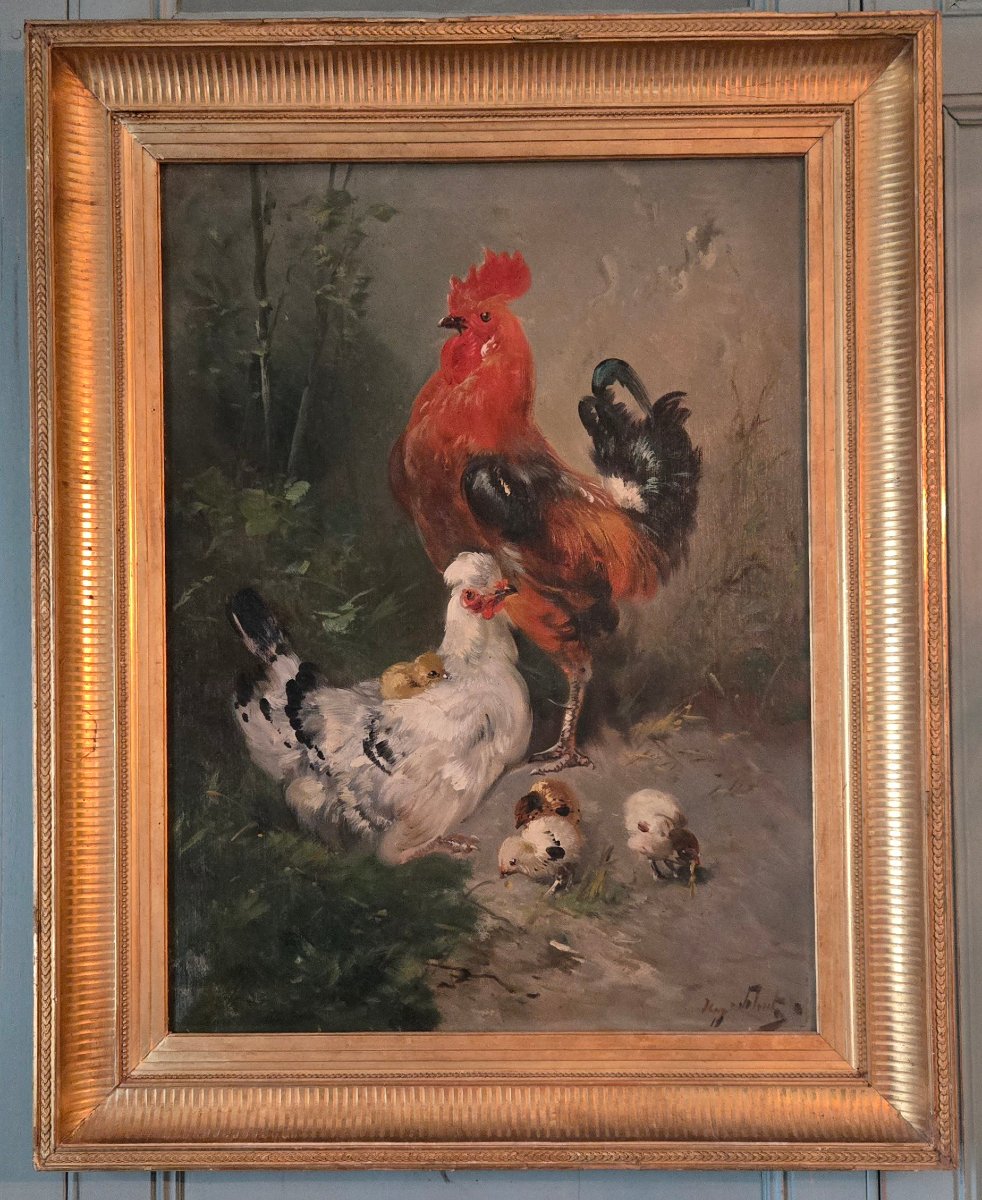
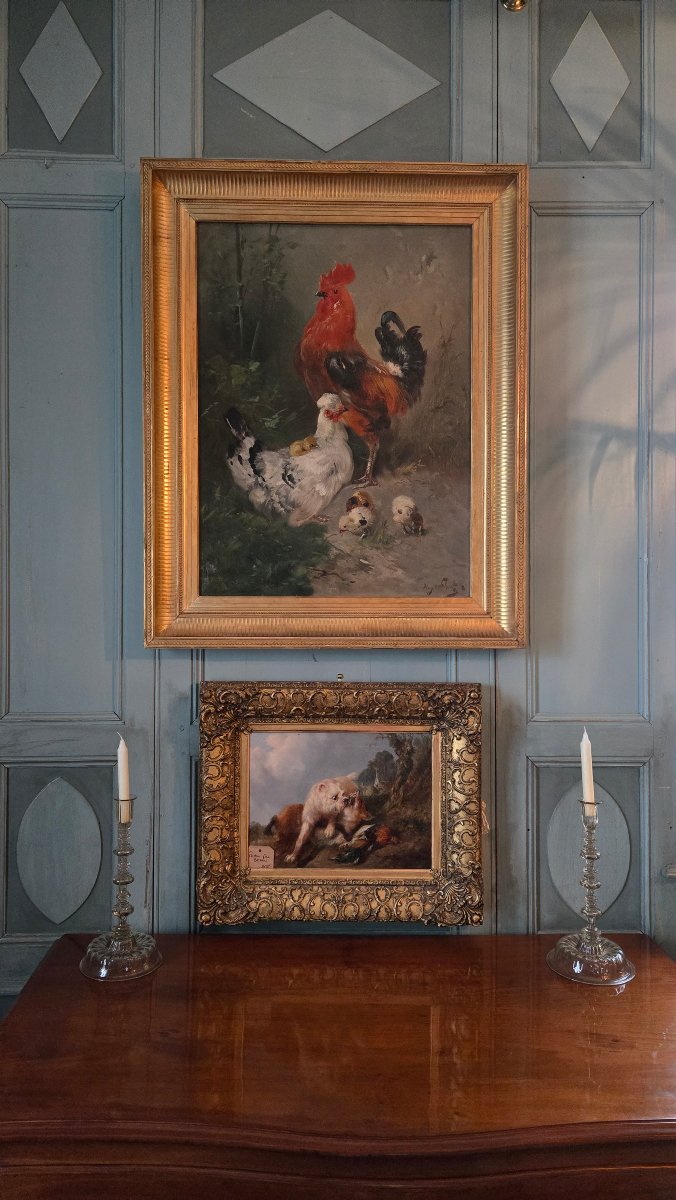
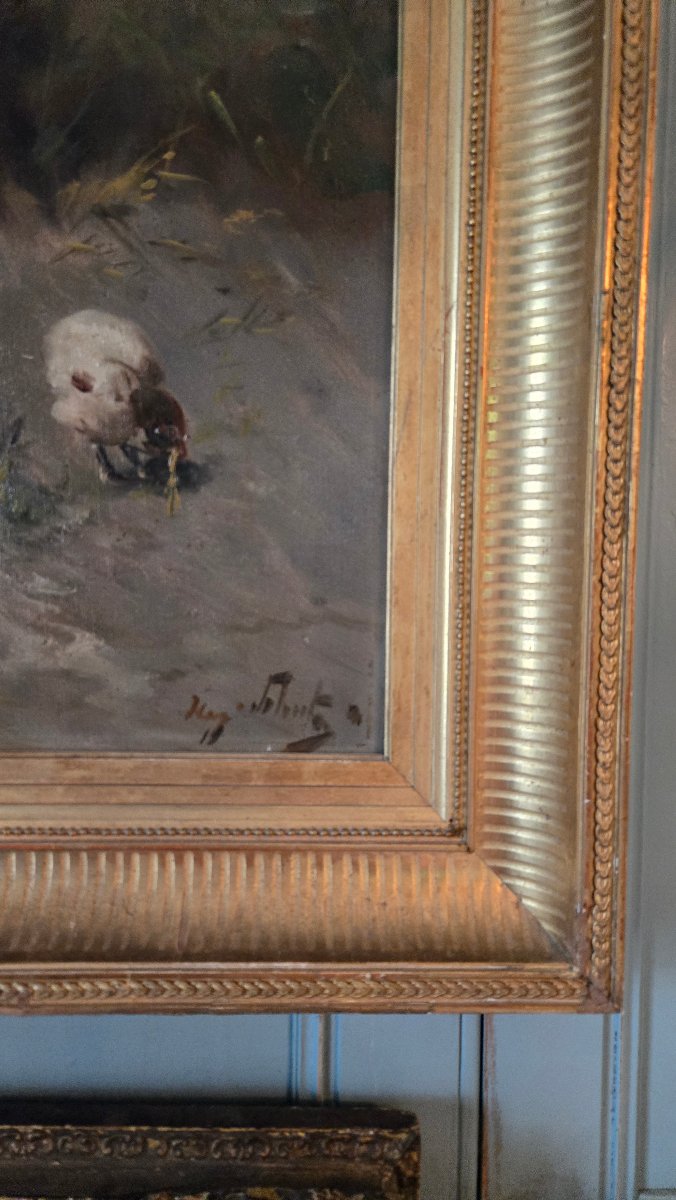
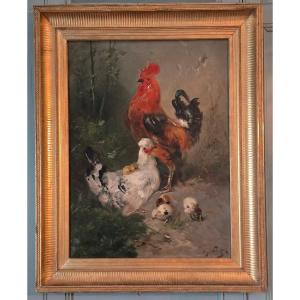
A beautiful oil on canvas depicting a lively farmyard scene by Belgian animal painter Henri Schouten (1860–1927). Signed lower right, the painting is presented in an elegant 19th-century gilded wood and gesso frame.
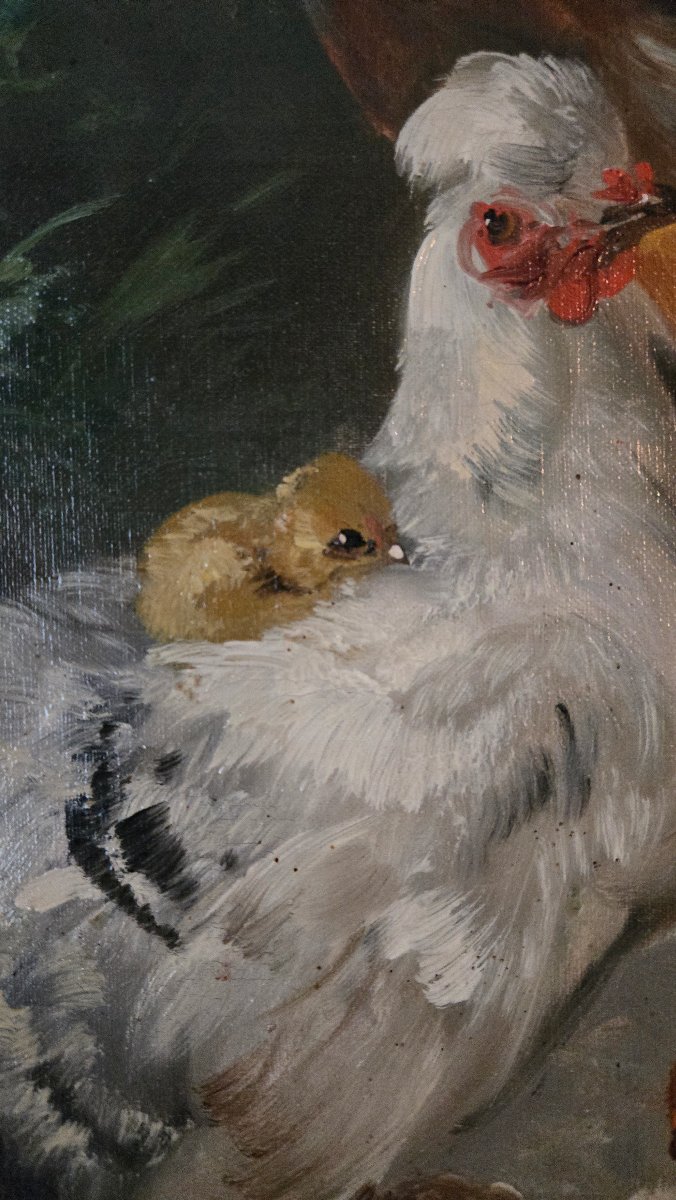
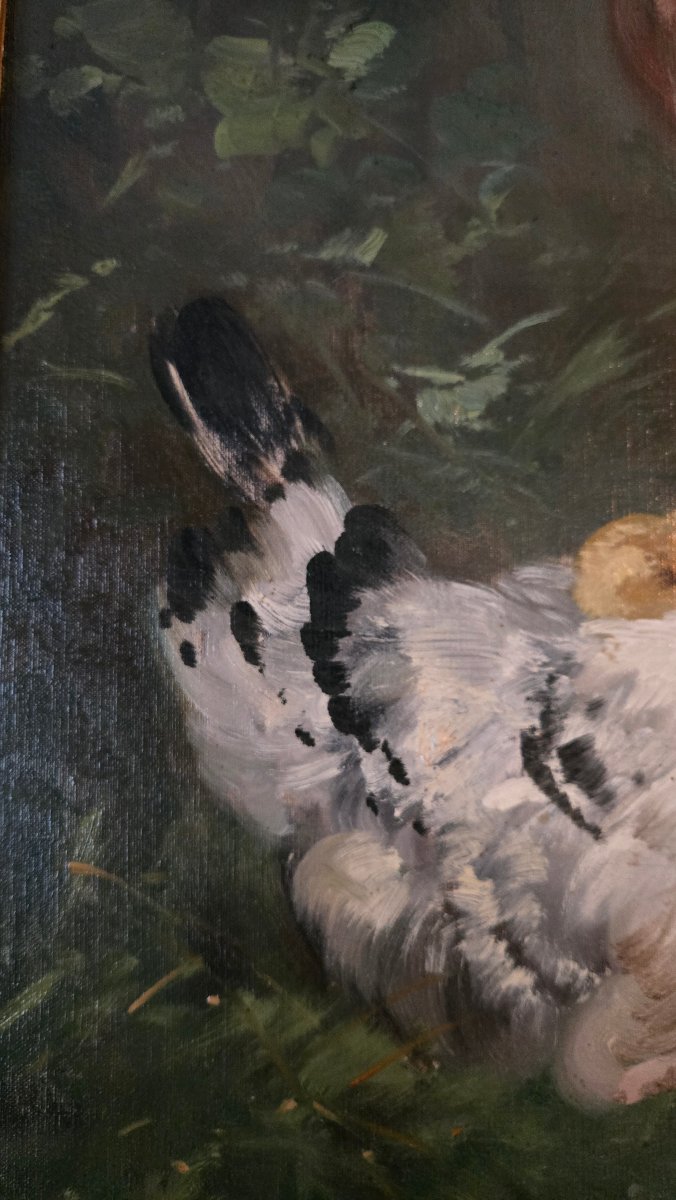
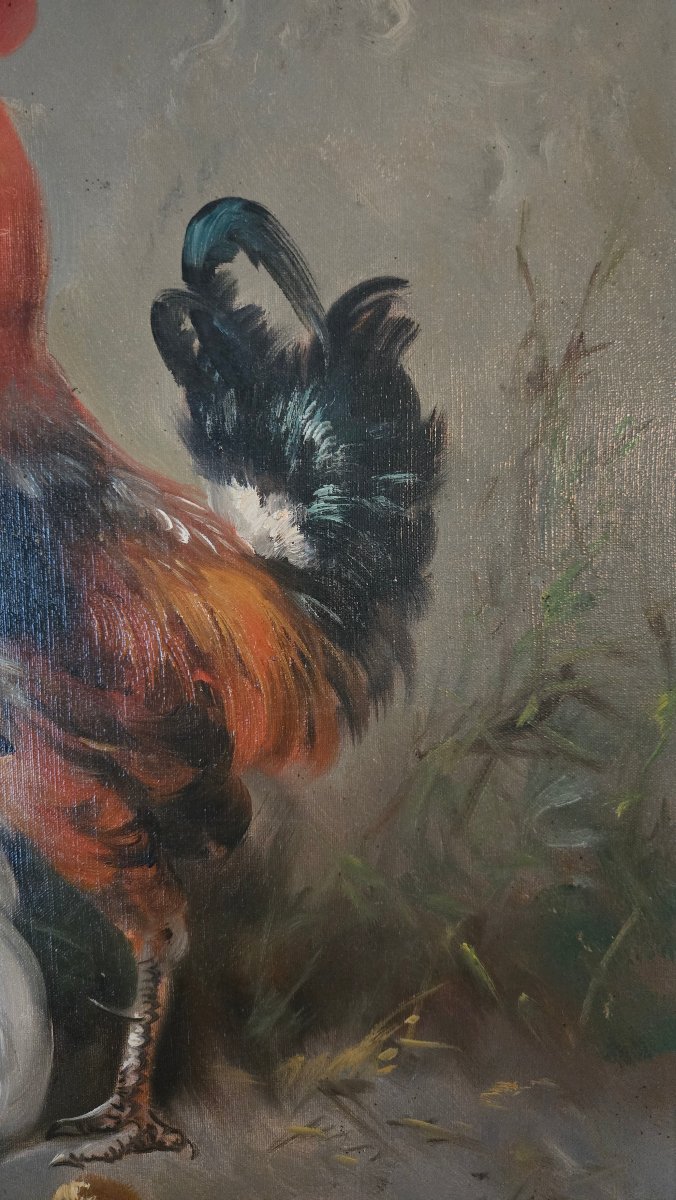
The composition features a magnificent rooster with brilliant reddish-brown plumage, standing proudly behind a white crested hen surrounded by her chicks. The rooster dominates the scene with his impressive stature, bright red comb, and long black tail feathers displaying subtle blue-green iridescent reflections.
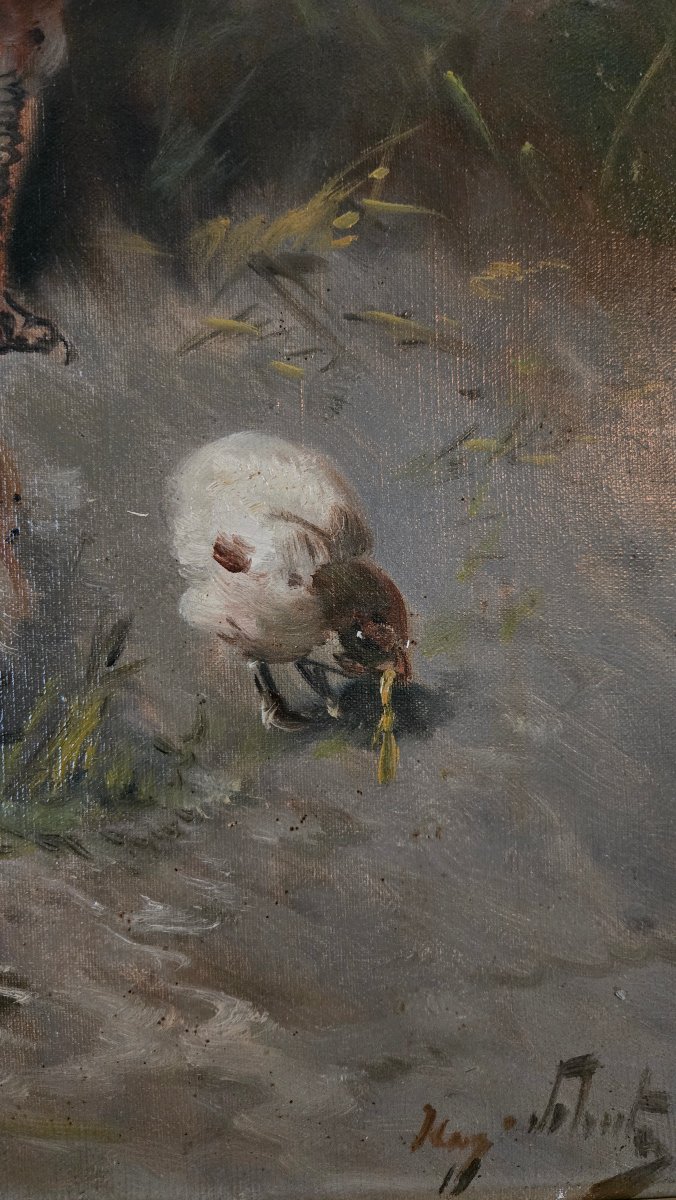
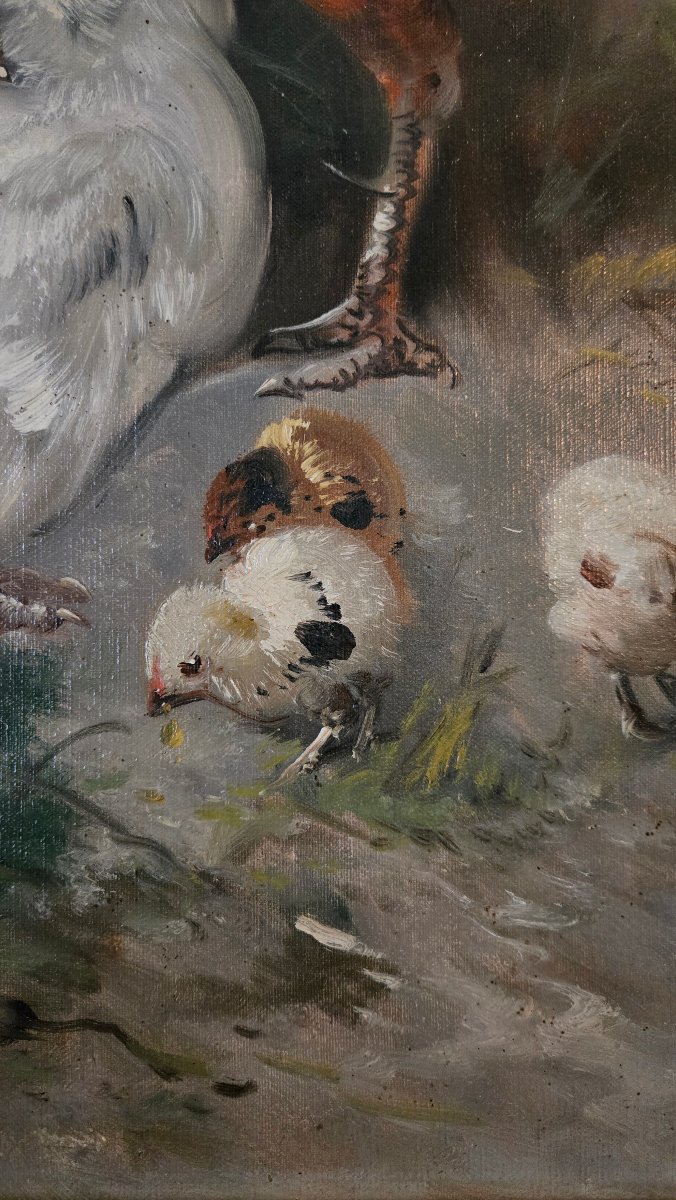
At his feet, the white hen, whose delicate plumage is accented with shades of gray and black, watches over her young. One little yellow chick has nestled comfortably on its mother's back, while three others explore the ground, pecking among the grasses.
This charming family scene, full of life and tenderness, beautifully illustrates Schouten's ability to capture the natural behavior and individual character of animals.
The painter's technique is particularly appealing. His lively, expressive brushwork conveys the softness and movement of the feathers, while delicate touches of light enhance the white plumage of the hen and the warm tones of the rooster.
The shimmering reflections of the dark tail feathers contrast with the soft, downy texture of the chicks. The surrounding vegetation, painted with freer brushstrokes in a harmonious palette of deep greens, grays, and browns, provides a subtle background that emphasizes the animals.
The painting demonstrates a fine command of drawing, texture, and light, characteristic of European animal painting during the second half of the 19th century.
Henri Schouten – A Belgian Animal Painter Admired by His Contemporaries
Henri Victor Pierre Schouten was born in Paris in 1860 into a family with artistic connections. After settling in Belgium, he studied at the Royal Academy of Fine Arts in Brussels between 1876 and 1881.
His work belongs to the distinguished Belgian and Flemish tradition of animal painting, particularly associated with Alfred Verwee (1838–1895), whose paintings influenced Schouten's artistic development.
Beginning in the early 1880s, Schouten participated in several important exhibitions. His works were shown at the Salons of Brussels, Antwerp, and Ghent, as well as at the Paris Salon in 1882.
He specialized in the depiction of domestic animals, including horses, cattle, sheep, dogs, and farmyard birds. His paintings of roosters, hens, ducks, and other poultry became an especially characteristic part of his artistic production.
His talent was recognized early in his career by contemporary Belgian art critics.
In March 1882, the literary and artistic journal La Jeune Belgique, reviewing an exhibition organized by L'Union des Arts in Brussels, praised his particular skill in depicting farmyard animals:
"Turkeys, hens and ducks inspire his finest studies. He approaches them with both conscientious attention and spirited execution."
The critic also admired his ability to capture the brilliance of feathers and the subtle variations of color found in birds.
This contemporary observation is particularly relevant to the present painting, in which Schouten's skillful rendering of plumage, vibrant brushwork, and sensitive observation of animal behavior are beautifully demonstrated.
Such historical commentary confirms that farmyard scenes were among the subjects for which Schouten was especially appreciated during his lifetime.
Through his close observation of nature, expressive handling of paint, and refined sense of color, Henri Schouten established himself within the Belgian tradition of animal painting during the late 19th century.
Frame and Condition
The painting is housed in a beautiful 19th-century wood and gilded gesso frame, featuring broad fluted moldings enhanced by decorative ornamental borders.
The frame retains its original gold-leaf gilding, with a few minor touch-ups and older restorations. Its warm, gently aged gilding complements the rich colors of the painting.
Oil on canvas, signed lower right.
Late 19th century.
Dimensions
Painting (visible area): Height 78.5 cm × Width 58 cm (30.9 × 22.8 inches).
Including frame: Height 100 cm × Width 80 cm (39.4 × 31.5 inches).
2 200 €
Period: 19th century
Style: Napoleon 3rd
Condition: Good condition
Material: Oil painting
Reference (ID): 1841989
Availability: In stock
Print