

Giberne Set And Carabiner Holder From The Lyon National Horse Guard, First Empire
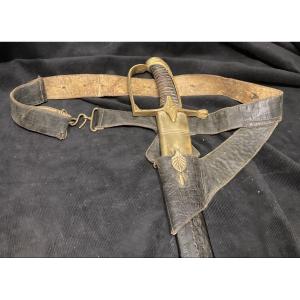
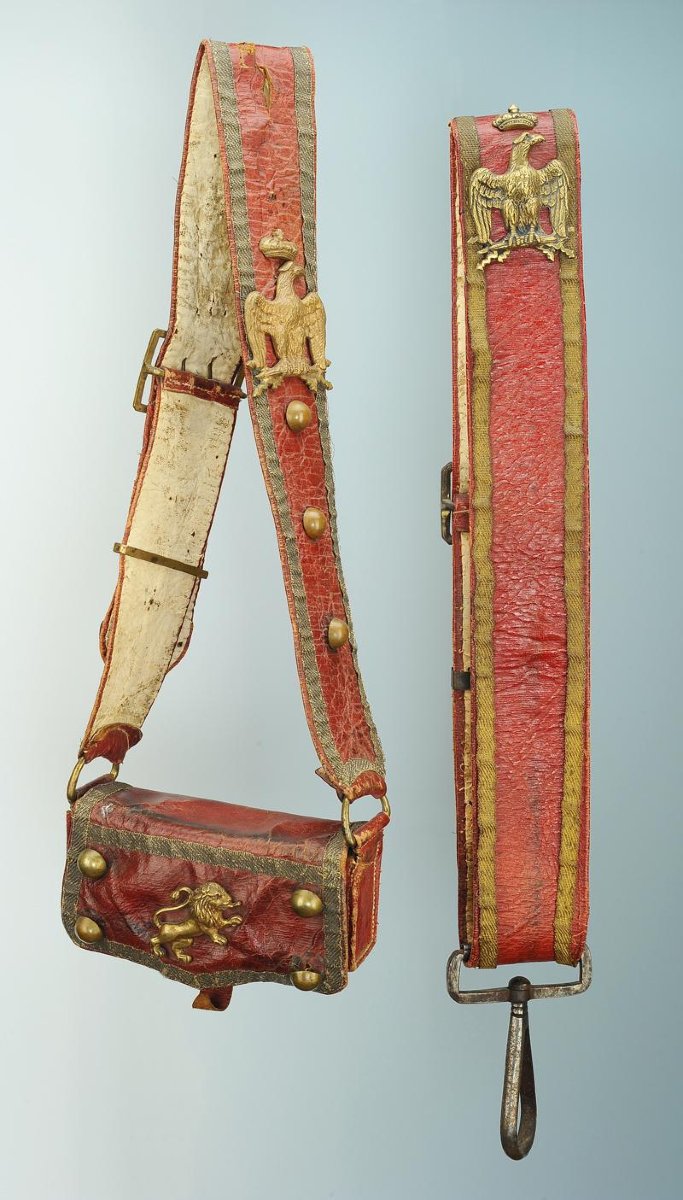
GIBERNE AND BANDEROLE SET WITH CARABINER HOLDER OF THE NATIONAL GUARD ON HORSEBACK OF LYON, FIRST EMPIRE.
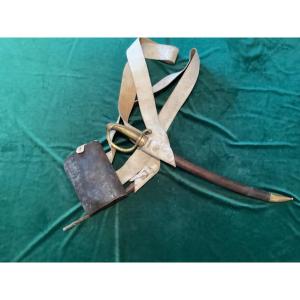
GIBERNE:
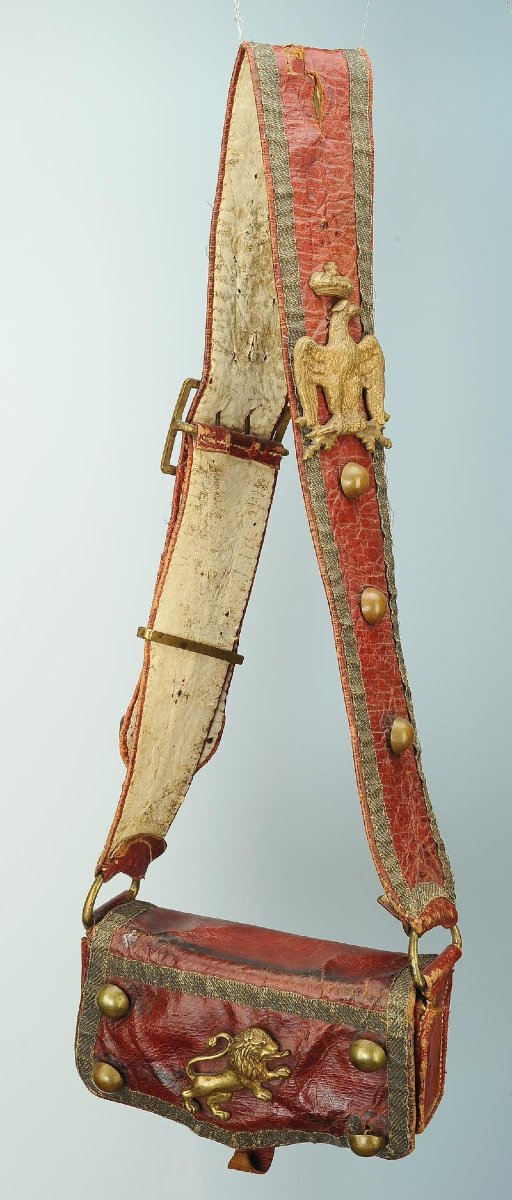
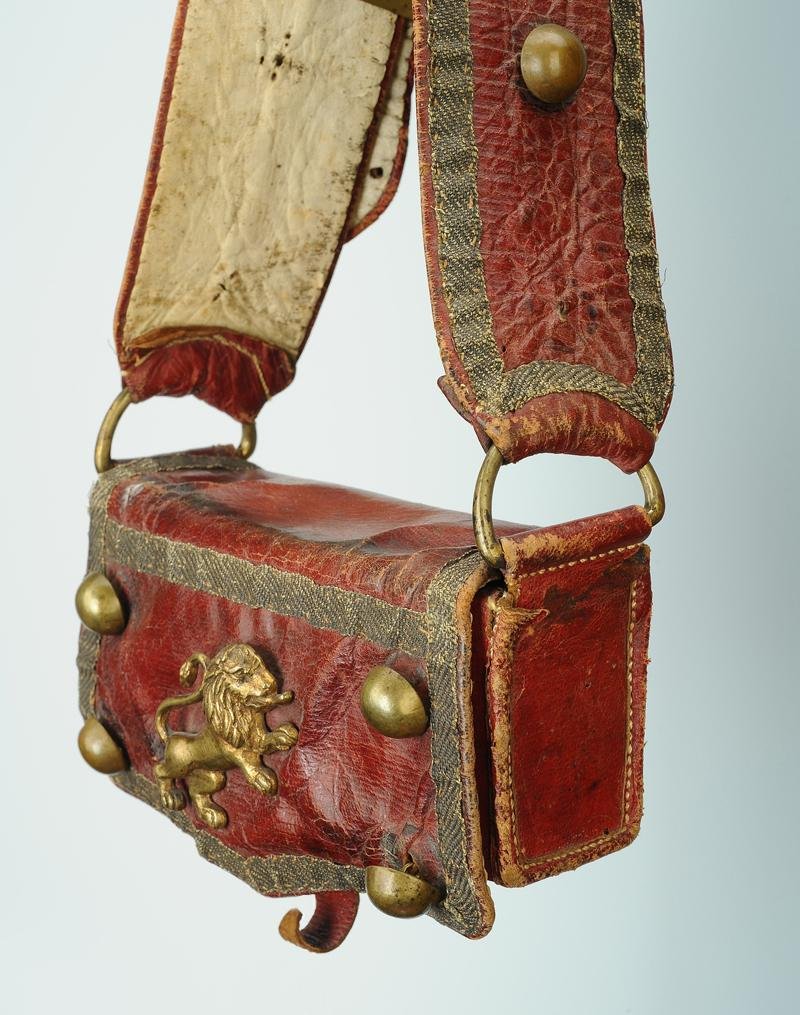
Giberne or "cartridge belt" in wood covered with waxed Bordeaux calf leather.
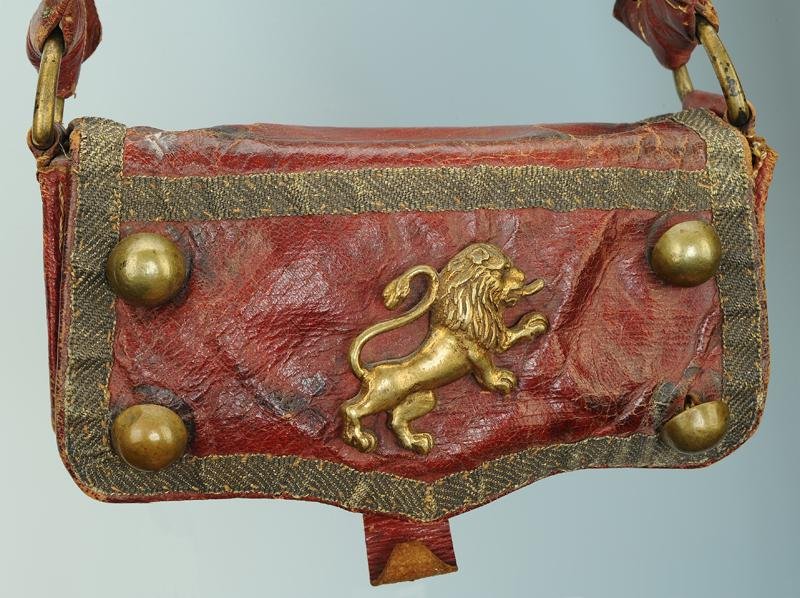
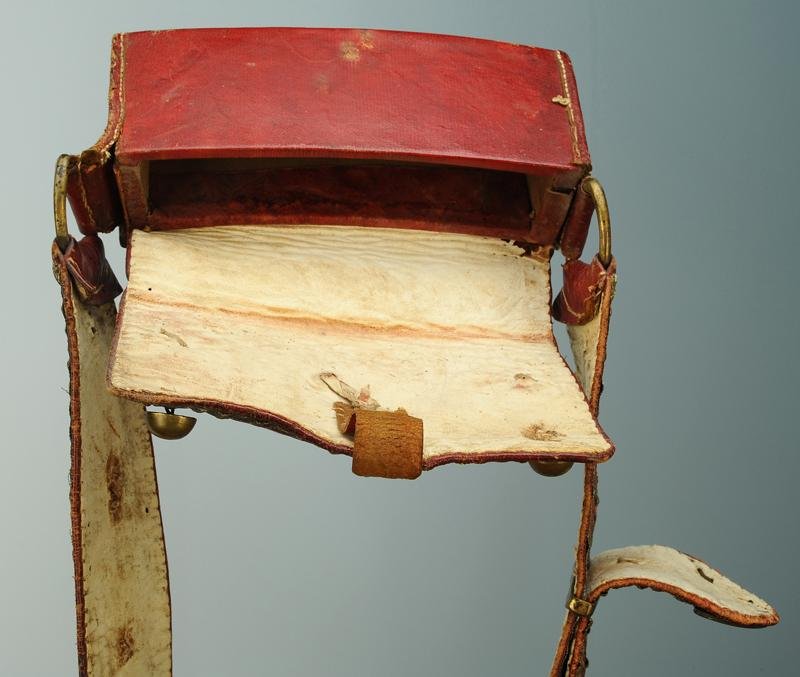
Shoulder strap, in leather, rectangular cut in accolade shape, measuring 183 mm in width at the bottom, and 172 mm at the top, with a height of 96 mm; bottom made of waxed Bordeaux morocco leather, with the exterior rim folded inside. The shoulder strap is framed by a 10 mm wide gold braid that underlines the edges, with a half-spherical gilded brass uniform button (18 mm in diameter) fixed in each corner, and a molded brass lion affixed to the center, chiselled and gilded (56 mm wide, 51 mm high, thickness approximately 7 mm). It is lined with white calf leather. A Bordeaux waxed leather strap is sewn at the bottom to close the shoulder strap.
The cartridge pattern, in beech wood with a large box, measuring 60 mm in height, 174 mm in width, 43.5 mm in depth. The sides are also made of wood covered with waxed Bordeaux morocco leather, with a ring sewn on each side at the top for the passage of the banderole. A brass nail is fixed under the cartridge to hold the shoulder strap closed.
Golden brass banderole hook.
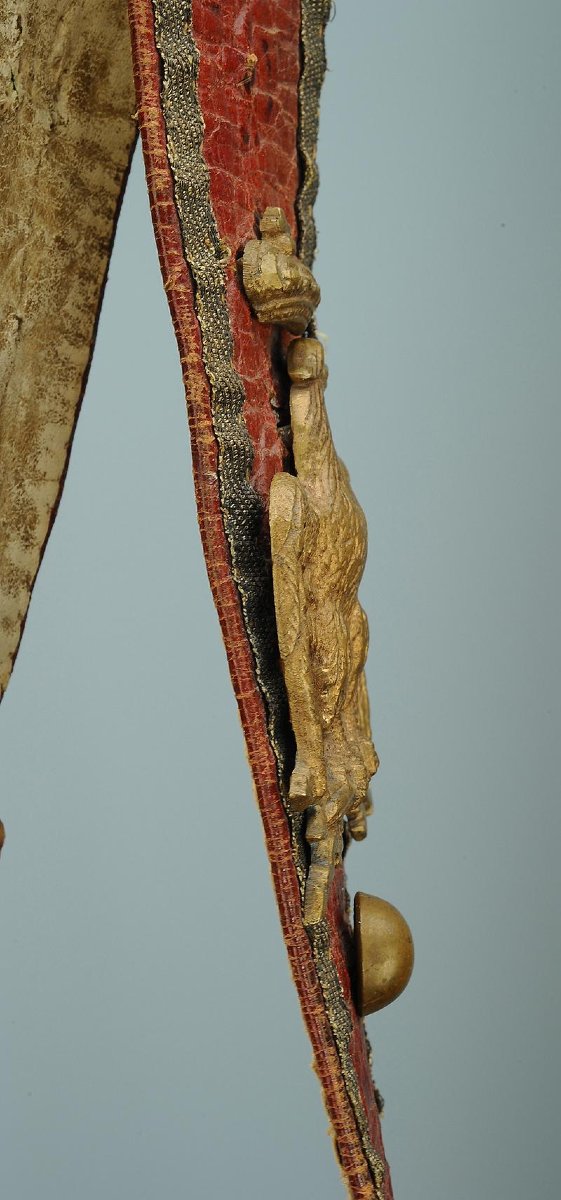
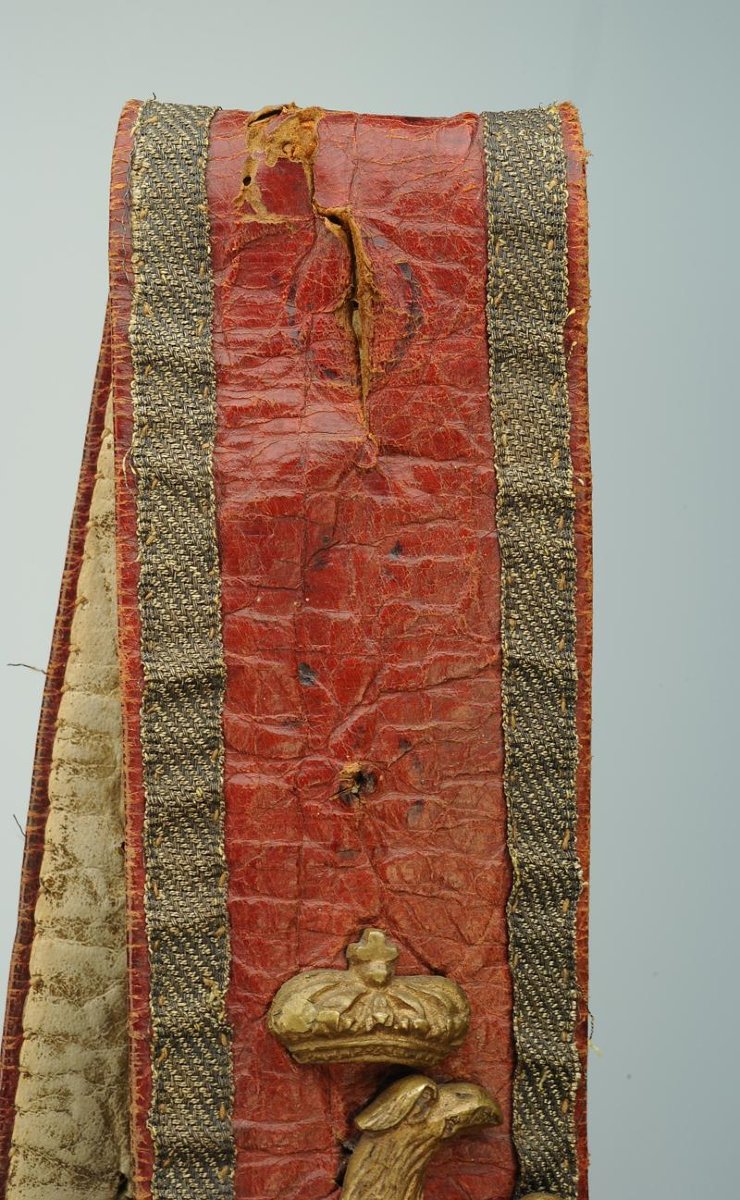
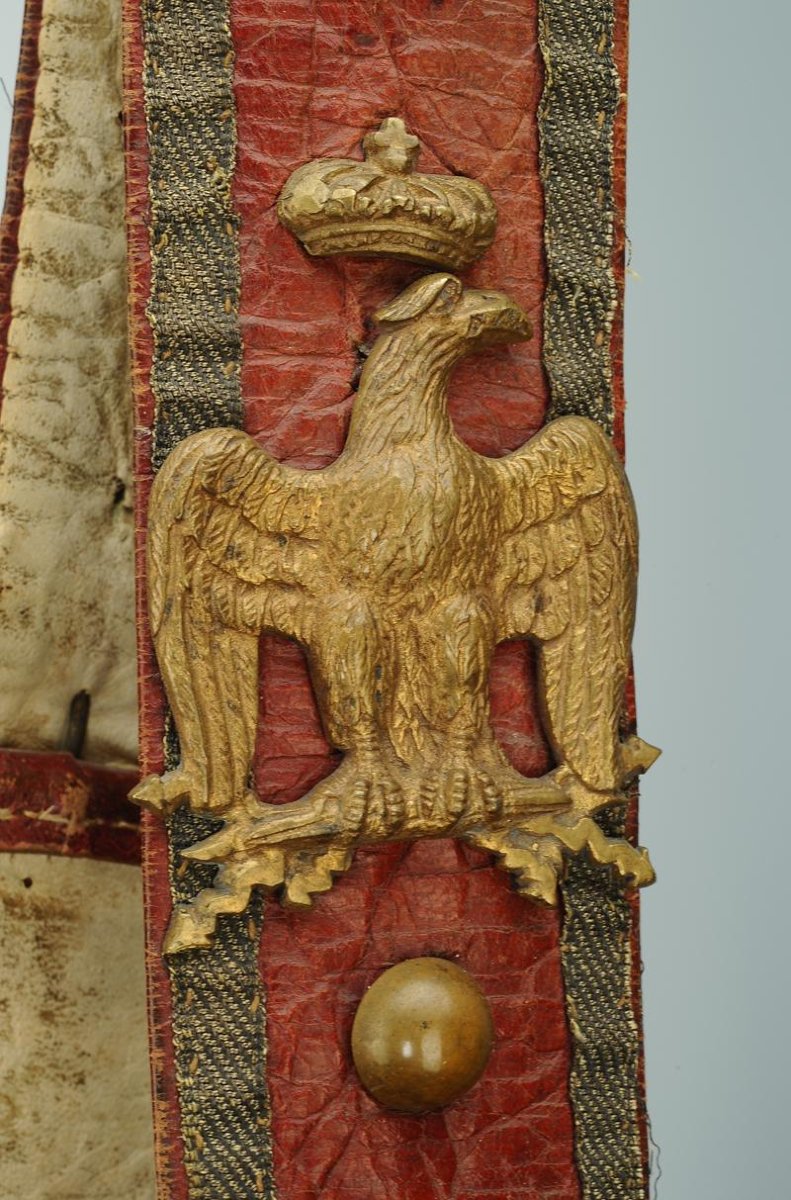
Banderole made of leather covered with waxed Bordeaux morocco leather and lined with white calf leather. It is bordered by a 10mm wide gold braid on each side and adorned in the center with a series of gilded brass half-spherical uniform buttons like those on the shoulder strap; out of the original ten buttons, only three remain in place. The banderole features a beautiful imperial eagle surmounted by a crown, both elements are entirely molded in brass and finely chiselled and gilded with mercury. Eagle: height 82 mm, width 65 mm, thickness approximately 8 mm. Imperial crown: height 16 mm, width 25.5 mm, thickness approximately 8 mm. The other fittings of the banderole are also gilded brass and polished with agate stone: a shield ending the banderole, a barrette for banderole attachment, and a buckle with hook and loop for adjusting the banderole's length.
Banderole width 62 mm.
CARABINER HOLDER:
Banderole made of leather covered with waxed Bordeaux morocco leather and lined with white calf leather. It is bordered by a 10 mm wide gold braid on each side. A flat gilded brass button with an engraved imperial eagle face is fixed at the top. The banderole is decorated with a beautiful imperial eagle surmounted by a crown, both elements are entirely molded in brass and finely chiselled and gilded with mercury. Eagle: height 82 mm, width 65 mm, thickness approximately 8 mm. Imperial crown: height 16 mm, width 25.5 mm, thickness approximately 8 mm. The other fittings of the banderole are also gilded brass and polished with agate stone: a shield ending the banderole, a barrette for banderole attachment, and a buckle with hook and loop for adjusting the banderole's length.
A sturdy iron hook (height 113 mm, width 44 mm, thickness 11 mm) for holding the carabiner is riveted to a rectangular iron ring (height 34.5 mm, width 90 mm, thickness 5.5 mm).
Banderole width 70 mm.
France.
First Empire, 1804-1814.
Very good condition.
This set is particularly interesting as both elements have the same patina and are perfectly original.
HISTORICAL BACKGROUND:
HISTORICAL BACKGROUND BY JÉRÔME CROYET: http://www.histoire-empire.org/historiques_de_regiments/gardes_honneur_lyon.htm
From 1802 to 1814, Napoleon's travels and visits within the Empire were occasions for grand events and displays of splendor and communication devices. During imperial visits, gatherings of young people, who took on the duty of ensuring the protection of imperial persons during their visit and providing an escort, were often formed under the name of Guards of Honor. These could be community or departmental. Their number was estimated at 174.
The one in Lyon claims to be the first one formed, as Lyon claims to be the first city of the Empire: "Lyon is the first city where a guard of honor was formed; therefore, this guard is the 1st in the Empire.”
The beginnings of a prestigious body: the visit of the First Consul in 1802
During the First Consul Bonaparte's first official visit to Lyon, from 21 nivôse to 7 pluviôse year X, to oversee the deliberations of the Cisalpine deputies on their Constitution, the Lyon Guard of Honour was formed. The latter, a gathering of the "bright young Lyonnais" making up the social elite of Lyon, formed an autonomous light cavalry corps. The guards pledged to pay for their uniforms, equipment, and horses. In order to honor the consul appropriately and provide acceptable service, the young men engaged in equestrian maneuvers. Their uniform consisted of a tailcoat, a Hungarian-style breeches, a hat, and a saber of the light cavalry type of the Guard.
Equipped with a flag that distinguished it from the National Guard, the Lyon Guard of Honor prepared for the arrival of the "restorer of the fatherland" from 19 nivôse, and for two days they awaited the arrival of the august personage, accompanying him, preceding the imperial convoy. During this consul's stay, the Lyon Guard of Honor drew closer to the Consular Guard, not only by jointly serving Bonaparte but also by hosting a meal offered by the former to the latter.
Bonaparte was impressed by the military attire and service of these young Lyonnais. From his second trip to Brittany onwards, he used the comparison with Lyon to judge the welcome of a city: "I am as pleased with Rouen as I am with Lyon. This city gives me proofs of attachment that touch me," he wrote on November 2, 1802, to his brother Joseph.
In response to Lyon residents' desire for grandeur and demonstrations, the Lyon Guard of Honor, despite Bonaparte's departure, remained active, which the government allowed through the circular of the 2nd complementary day of year XI.
The Lyon Guard of Honor: grandeur and communication tools of the city
Eager to show their attachment to a Napoleon impressed during his visit to Lyon, the "young men" of Lyon expressed the desire to permanently establish the guard of honor. This transformation of the Lyon Guard of Honor, desired by the Minister of the Interior, was accelerated with Napoleon's coronation.
As of the 23rd ventôse year XIII, General Duhesme provided the Prefect of Rhône with cost estimates to transform the Lyon Guard of Honor into "His Majesty the Emperor's Guard of Honor." The next day, desiring to support the zeal of Lyon's "young men," the municipality made available 5,000 francs to the head of the Guard of Honor, with 3,000 francs from the town hall and 2,000 francs from the prefecture, to assist volunteers with funding their uniforms.
Responding to the desires of the Lyonnais to form a truly organized body, showcasing the city militarily and communicatively, on the 15th germinal year XIII, the Lyon Municipal Council decided to reorganize its Guard of Honor. To reform it effectively, military authority was sought, leading to the formation of a body with two infantry companies and one mounted company. Military authority required guards of honor to be born in Lyon and willingly serve as escorts to Napoleon during his visits and stays (Lyon was one of the four cities set to host an imperial palace). This service demonstrated the Lyonnais' devotion to the imperial cause, especially to Napoleon's physical personality, as well as an important stake for the city's future and image in Europe: "None within the entire Empire has received more prominent and repeated demonstrations of devotion from the Emperor," the Minister of the Interior wrote on the 1st vendémiaire year XIV.
From a mounted company of 100 to 150 men in 1802, the Lyon Guard of Honor became a genuine corps composed of a company of foot chasseurs, a company of grenadiers, and a company of mounted chasseurs, totaling 231 men. Command was entrusted to a general, with a colonel working in the imperial administration as his assistant, thereby transferring part of the guard's prestige to the administration.
To give the Guard of Honor a grandeur, prominence, and a formal appearance, the municipality accepted the formation of a voluntary musicians' corps attached to the staff, paid at their expense.
A lasting establishment under the approving eye of Paris
The reformation of the Lyon Guard of Honor was approved in Paris through requests for inspections. However, these inspections took time to reach the capital, highlighting the shortcomings of the Guard of Honor: the seriousness and diligence of the officers. Indeed, on the 14th brumaire year XIV, the surprised minister, by not receiving the inspection, requested it from the Prefect of Rhône, who forwarded it to the mayor, who informed the Guard of Honor's general on the 17th. These issues persisted for several years. On December 4, 1808, the officers of the grenadiers and chasseurs of the Lyon Guard of Honor could not agree on the attire of the men at the drill: some arrived "with only sabers, while others brought their weapons." On December 5th, 26 "members of the imperial Guard of Honor" afoot from Lyon complained to the mayor about the officers' absenteeism during ceremonies, or the ignorance and contradiction of orders, and demanded that officers adhere to regulations.
Nevertheless, the prestige of the Lyon Guard of Honor, which refused to be assimilated into the National Guard, was such that when the Prefect of Rhône appointed deputies of the latter to travel to Paris to take the oath on the day of the coronation, he designated only fourteen men out of the 18 requested, leaving room for three deputies from the Lyon Guard of Honor. Aware of their position, the latter took advantage of their trip to request the minister's favor to exempt three Guard members from conscription to accompany the Emperor.
Desiring to prepare for the imperial reception in Lyon and make the best use of the Lyon Guard of Honor, the Minister of the Interior, on the 1st vendémiaire year XIV, instructed the Prefect of Rhône and the Mayor of Lyon to coordinate in defining the Guard of Honor's service. This service was crucial to Napoleon. While the "central government is unaware of the Guard of Honor in general," it made a point of taking an interest in the Lyon Guard of Honor, considering it different from others, a corps whose "functions are not short-lived."
While Paris insisted on guards of honor paying for their uniforms and equipment, as of year XIV, the Lyon Guard of Honor was partly financed by the city and the prefecture. The Guard's Administrative Council reported its accounts to the mayor: on the 12th frimaire year XIV, the city financed the purchase of weapons for the foot soldiers of the Lyon Guard of Honor. Until 1811, the city was authorized by the prefecture to allocate part of the budget earmarked for events to finance the Lyon Guard of Honor.
Now under the Emperor's benevolence, the Lyon Guard of Honor, while the government tasked elite members of the National Guard with rendering honors, was blessed with a standard, blessed by Pope Pius VII, and a regulation. The latter, partially published in 1807, described the uniform and required morning exercises at 6:30 a.m. at the St. Pierre building, as well as regular reviews.
The Lyon Guard of Honor and the Imperial Guard of Honor in year XIV: Prelude to the 1813 Guard
The government's desire for the Lyon Guard of Honor to become a militarized unit aligned with preparations for the 1805 campaign. Following spontaneous requests from individuals to voluntarily join Napoleon[10], "in the autumn of 1805, the government attempted to transform these local guards of honor into a military body." Lyon was one of the first cities to send such requests, much to the satisfaction of the Minister of the Interior, who cited Lyon's enthusiasm: "The expectations I had of the Lyonnais' sentiments and their devotion to his majesty were not disappointed," he wrote on the 20th vendémiaire year XIV. Thirteen Lyon volunteers, comprising 4 grenadiers and 9 chasseurs, requested to serve. Their average age was 19 and a half years and most were still from Lyon's petite bourgeoisie. To inspire Lyon's residents and demonstrate imperial recognition to an important city in Napoleon's political map, the Minister granted some indulgences to the volunteers: the draftees of year XV were allowed to accompany the Emperor, while those of year XIV were required to find replacements.
From the 24th brumaire year XIV, an enrollment register was opened by the Lyon Guard of Honor colonel. Colonel Rousset even assembled the Guard of Honor to recruit the first volunteers. The announcement was a real success: aside from those required to join as part of the detachment, 21 volunteers enlisted: the colonel, 10 grenadiers, and 10 foot chasseurs. Their average age was 23 years. They no longer solely represented Lyon's young bourgeoisie but also included individuals from the trading sector. However, the fast-paced campaign and subsequent peace rendered the Lyon residents' commitments null, and Napoléon, appreciative of their dedication, sent them home but expressed his gratitude.
During the creation of the Orderly Gendarmes, central administration considered the Lyon Guard of Honor a recruitment pool for prestigious corps. On November 6, 1806, aiming to attract Lyon residents to these ranks, the Minister of the Interior promised that the city would cover the expenses for the first 8 Lyon Guard of Honor members who enlisted. This call was well received, with 6 guards departing. In 1813, the practice of tapping into a resource pool for the formation of the guards of honor continued, with more mixed results.
From then on, the Lyon Guard of Honor had a lofty view of its military function and the role its members had to play in the imperial army. The guard imagined creating a bridge with the Imperial Guard, particularly the prestigious chasseurs à cheval.
The Horse Guard of Honor
The publication of the 1807 regulation coincided with the resurgence and reorganization of the Lyon Horse Guard of Honor. Until September 15, 1808, the Lyon Horse Guard of Honor was in a lethargic state compared to the foot Guard of Honor, as it had few members[14], insufficient for service due to the high expenses associated with keeping a horse in the city. This particularly troubled the administration council of the mounted company, especially since no other city's cavalry and guard of honor exceeded theirs, which "plunged them into profound discouragement."[15] On September 15, 1808, the administration council of the mounted chasseurs of the Lyon Horse Guard of Honor proposed to Lyon's municipality a means of expanding the company: the city would be responsible for the forage and lodging for the 60 horses the mounted chasseurs company required. The council declared that more than 25 individuals were ready to fund their own attire, weapons, and mount by taking care to acquire, from Normandy, horses of the light cavalry type. The council also committed, in case of acceptance, to cover the pay and sustenance for stable hands as well as the fees for a riding instructor. On February 2, 1809, the squadron commander reiterated a request for stables and forage to the mayor. However, the city seemed compelled to adhere to central directives by no longer providing financial aid to the Guards of Honor.
Despite the municipality's lack of response, the mounted chasseurs of the Lyon Horse Guard of Honor reorganized on September 27, 1807: 126 Lyon residents voluntarily enlisted. Two-thirds were still young people living with their parents, while the remaining third comprised artisans.
On October 13, 1808, the administration council of the mounted Horse Guard of Honor requested Lyon's mayor to authorize the integration of a Lyon surgeon who sought to serve as a major surgeon. In 1811, the three trumpeters of the mounted company of the Lyon Horse Guard of Honor received new uniforms paid for by the city, which, anticipating opposition from the prefecture, declared the trumpeters to serve both the Guard of Honor and the National Guard. In 1813, the mounted chasseurs of the Lyon Horse Guard of Honor, like the entire unit, still hoped to play a role. On September 20, the Lyon municipality received the invoice for the uniforms of the three trumpeters of the mounted company as the three men departed for the army.
Establishing a prestigious body
In 1809, a grand review of the mounted Lyon Guard of Honor was conducted, composed of a company of grenadiers, with fluctuating sizes[17], a company of foot chasseurs[18], and a company of mounted chasseurs. Music, previously entrusted to amateurs, was disbanded on February 19, 1809, and replaced by 21 contracted musicians, as in line regiments. They consisted of a conductor, instructor, two bassoons, a bass drum, four clarinets, three piccolos, three cymbalists, three triangle players, a flute, a trombone, a trumpet, a serpent, and two horns. These 21 contracted musicians, mostly professors, were paid 3,995 francs per year. While the Guard's prestige was enhanced, the use of music became problematic. The gagistes, who made a living through music, could not dedicate all their time to the Lyon Guard of Honor's music. To earn a living, they committed on Sundays to play in processions or during Te Deums, but as members of the Guard of Honor, they were required to obtain a request for availability, which was granted by the municipality.
In 1810, an inspection of the Lyon mounted Guard of Honor was sent to Paris, coinciding with the government's circular on July 30, 1810, demonstrating its interest in these formations, which were now to become official.
As the 4th regiment of Guards of Honor was established in 1813, the Lyon Guard of Honor seized this occasion for one final rallying as General Valence planned to reorganize them into a single unit. A review of the 1813 chasseur company was conducted, consisting of 77 members. The average age was considerably higher than in 1805, at 28 years. The chasseurs were mainly tradesmen and merchants from Lyon: 44 merchants, traders, and merchants, and only one proprietor. The 1813 Guard of Honor also included former soldiers, 7, whereas none were present in 1805. This Guard of Honor was much more focused on the city of Lyon than the 1805 iteration. Starting from July 30, 1810, Guards of Honor were officially recognized formations, and the Lyon Guard was no exception. The presence of two former federalist combatants from the Lyon siege, who were also the humblest guards, underscore
GIBERNE:
Giberne or "cartridge belt" in wood covered with waxed Bordeaux calf leather.
Shoulder strap, in leather, rectangular cut in accolade shape, measuring 183 mm in width at the bottom, and 172 mm at the top, with a height of 96 mm; bottom made of waxed Bordeaux morocco leather, with the exterior rim folded inside. The shoulder strap is framed by a 10 mm wide gold braid that underlines the edges, with a half-spherical gilded brass uniform button (18 mm in diameter) fixed in each corner, and a molded brass lion affixed to the center, chiselled and gilded (56 mm wide, 51 mm high, thickness approximately 7 mm). It is lined with white calf leather. A Bordeaux waxed leather strap is sewn at the bottom to close the shoulder strap.
The cartridge pattern, in beech wood with a large box, measuring 60 mm in height, 174 mm in width, 43.5 mm in depth. The sides are also made of wood covered with waxed Bordeaux morocco leather, with a ring sewn on each side at the top for the passage of the banderole. A brass nail is fixed under the cartridge to hold the shoulder strap closed.
Golden brass banderole hook.
Banderole made of leather covered with waxed Bordeaux morocco leather and lined with white calf leather. It is bordered by a 10mm wide gold braid on each side and adorned in the center with a series of gilded brass half-spherical uniform buttons like those on the shoulder strap; out of the original ten buttons, only three remain in place. The banderole features a beautiful imperial eagle surmounted by a crown, both elements are entirely molded in brass and finely chiselled and gilded with mercury. Eagle: height 82 mm, width 65 mm, thickness approximately 8 mm. Imperial crown: height 16 mm, width 25.5 mm, thickness approximately 8 mm. The other fittings of the banderole are also gilded brass and polished with agate stone: a shield ending the banderole, a barrette for banderole attachment, and a buckle with hook and loop for adjusting the banderole's length.
Banderole width 62 mm.
CARABINER HOLDER:
Banderole made of leather covered with waxed Bordeaux morocco leather and lined with white calf leather. It is bordered by a 10 mm wide gold braid on each side. A flat gilded brass button with an engraved imperial eagle face is fixed at the top. The banderole is decorated with a beautiful imperial eagle surmounted by a crown, both elements are entirely molded in brass and finely chiselled and gilded with mercury. Eagle: height 82 mm, width 65 mm, thickness approximately 8 mm. Imperial crown: height 16 mm, width 25.5 mm, thickness approximately 8 mm. The other fittings of the banderole are also gilded brass and polished with agate stone: a shield ending the banderole, a barrette for banderole attachment, and a buckle with hook and loop for adjusting the banderole's length.
A sturdy iron hook (height 113 mm, width 44 mm, thickness 11 mm) for holding the carabiner is riveted to a rectangular iron ring (height 34.5 mm, width 90 mm, thickness 5.5 mm).
Banderole width 70 mm.
France.
First Empire, 1804-1814.
Very good condition.
This set is particularly interesting as both elements have the same patina and are perfectly original.
HISTORICAL BACKGROUND:
HISTORICAL BACKGROUND BY JÉRÔME CROYET: http://www.histoire-empire.org/historiques_de_regiments/gardes_honneur_lyon.htm
From 1802 to 1814, Napoleon's travels and visits within the Empire were occasions for grand events and displays of splendor and communication devices. During imperial visits, gatherings of young people, who took on the duty of ensuring the protection of imperial persons during their visit and providing an escort, were often formed under the name of Guards of Honor. These could be community or departmental. Their number was estimated at 174.
The one in Lyon claims to be the first one formed, as Lyon claims to be the first city of the Empire: "Lyon is the first city where a guard of honor was formed; therefore, this guard is the 1st in the Empire.”
The beginnings of a prestigious body: the visit of the First Consul in 1802
During the First Consul Bonaparte's first official visit to Lyon, from 21 nivôse to 7 pluviôse year X, to oversee the deliberations of the Cisalpine deputies on their Constitution, the Lyon Guard of Honour was formed. The latter, a gathering of the "bright young Lyonnais" making up the social elite of Lyon, formed an autonomous light cavalry corps. The guards pledged to pay for their uniforms, equipment, and horses. In order to honor the consul appropriately and provide acceptable service, the young men engaged in equestrian maneuvers. Their uniform consisted of a tailcoat, a Hungarian-style breeches, a hat, and a saber of the light cavalry type of the Guard.
Equipped with a flag that distinguished it from the National Guard, the Lyon Guard of Honor prepared for the arrival of the "restorer of the fatherland" from 19 nivôse, and for two days they awaited the arrival of the august personage, accompanying him, preceding the imperial convoy. During this consul's stay, the Lyon Guard of Honor drew closer to the Consular Guard, not only by jointly serving Bonaparte but also by hosting a meal offered by the former to the latter.
Bonaparte was impressed by the military attire and service of these young Lyonnais. From his second trip to Brittany onwards, he used the comparison with Lyon to judge the welcome of a city: "I am as pleased with Rouen as I am with Lyon. This city gives me proofs of attachment that touch me," he wrote on November 2, 1802, to his brother Joseph.
In response to Lyon residents' desire for grandeur and demonstrations, the Lyon Guard of Honor, despite Bonaparte's departure, remained active, which the government allowed through the circular of the 2nd complementary day of year XI.
The Lyon Guard of Honor: grandeur and communication tools of the city
Eager to show their attachment to a Napoleon impressed during his visit to Lyon, the "young men" of Lyon expressed the desire to permanently establish the guard of honor. This transformation of the Lyon Guard of Honor, desired by the Minister of the Interior, was accelerated with Napoleon's coronation.
As of the 23rd ventôse year XIII, General Duhesme provided the Prefect of Rhône with cost estimates to transform the Lyon Guard of Honor into "His Majesty the Emperor's Guard of Honor." The next day, desiring to support the zeal of Lyon's "young men," the municipality made available 5,000 francs to the head of the Guard of Honor, with 3,000 francs from the town hall and 2,000 francs from the prefecture, to assist volunteers with funding their uniforms.
Responding to the desires of the Lyonnais to form a truly organized body, showcasing the city militarily and communicatively, on the 15th germinal year XIII, the Lyon Municipal Council decided to reorganize its Guard of Honor. To reform it effectively, military authority was sought, leading to the formation of a body with two infantry companies and one mounted company. Military authority required guards of honor to be born in Lyon and willingly serve as escorts to Napoleon during his visits and stays (Lyon was one of the four cities set to host an imperial palace). This service demonstrated the Lyonnais' devotion to the imperial cause, especially to Napoleon's physical personality, as well as an important stake for the city's future and image in Europe: "None within the entire Empire has received more prominent and repeated demonstrations of devotion from the Emperor," the Minister of the Interior wrote on the 1st vendémiaire year XIV.
From a mounted company of 100 to 150 men in 1802, the Lyon Guard of Honor became a genuine corps composed of a company of foot chasseurs, a company of grenadiers, and a company of mounted chasseurs, totaling 231 men. Command was entrusted to a general, with a colonel working in the imperial administration as his assistant, thereby transferring part of the guard's prestige to the administration.
To give the Guard of Honor a grandeur, prominence, and a formal appearance, the municipality accepted the formation of a voluntary musicians' corps attached to the staff, paid at their expense.
A lasting establishment under the approving eye of Paris
The reformation of the Lyon Guard of Honor was approved in Paris through requests for inspections. However, these inspections took time to reach the capital, highlighting the shortcomings of the Guard of Honor: the seriousness and diligence of the officers. Indeed, on the 14th brumaire year XIV, the surprised minister, by not receiving the inspection, requested it from the Prefect of Rhône, who forwarded it to the mayor, who informed the Guard of Honor's general on the 17th. These issues persisted for several years. On December 4, 1808, the officers of the grenadiers and chasseurs of the Lyon Guard of Honor could not agree on the attire of the men at the drill: some arrived "with only sabers, while others brought their weapons." On December 5th, 26 "members of the imperial Guard of Honor" afoot from Lyon complained to the mayor about the officers' absenteeism during ceremonies, or the ignorance and contradiction of orders, and demanded that officers adhere to regulations.
Nevertheless, the prestige of the Lyon Guard of Honor, which refused to be assimilated into the National Guard, was such that when the Prefect of Rhône appointed deputies of the latter to travel to Paris to take the oath on the day of the coronation, he designated only fourteen men out of the 18 requested, leaving room for three deputies from the Lyon Guard of Honor. Aware of their position, the latter took advantage of their trip to request the minister's favor to exempt three Guard members from conscription to accompany the Emperor.
Desiring to prepare for the imperial reception in Lyon and make the best use of the Lyon Guard of Honor, the Minister of the Interior, on the 1st vendémiaire year XIV, instructed the Prefect of Rhône and the Mayor of Lyon to coordinate in defining the Guard of Honor's service. This service was crucial to Napoleon. While the "central government is unaware of the Guard of Honor in general," it made a point of taking an interest in the Lyon Guard of Honor, considering it different from others, a corps whose "functions are not short-lived."
While Paris insisted on guards of honor paying for their uniforms and equipment, as of year XIV, the Lyon Guard of Honor was partly financed by the city and the prefecture. The Guard's Administrative Council reported its accounts to the mayor: on the 12th frimaire year XIV, the city financed the purchase of weapons for the foot soldiers of the Lyon Guard of Honor. Until 1811, the city was authorized by the prefecture to allocate part of the budget earmarked for events to finance the Lyon Guard of Honor.
Now under the Emperor's benevolence, the Lyon Guard of Honor, while the government tasked elite members of the National Guard with rendering honors, was blessed with a standard, blessed by Pope Pius VII, and a regulation. The latter, partially published in 1807, described the uniform and required morning exercises at 6:30 a.m. at the St. Pierre building, as well as regular reviews.
The Lyon Guard of Honor and the Imperial Guard of Honor in year XIV: Prelude to the 1813 Guard
The government's desire for the Lyon Guard of Honor to become a militarized unit aligned with preparations for the 1805 campaign. Following spontaneous requests from individuals to voluntarily join Napoleon[10], "in the autumn of 1805, the government attempted to transform these local guards of honor into a military body." Lyon was one of the first cities to send such requests, much to the satisfaction of the Minister of the Interior, who cited Lyon's enthusiasm: "The expectations I had of the Lyonnais' sentiments and their devotion to his majesty were not disappointed," he wrote on the 20th vendémiaire year XIV. Thirteen Lyon volunteers, comprising 4 grenadiers and 9 chasseurs, requested to serve. Their average age was 19 and a half years and most were still from Lyon's petite bourgeoisie. To inspire Lyon's residents and demonstrate imperial recognition to an important city in Napoleon's political map, the Minister granted some indulgences to the volunteers: the draftees of year XV were allowed to accompany the Emperor, while those of year XIV were required to find replacements.
From the 24th brumaire year XIV, an enrollment register was opened by the Lyon Guard of Honor colonel. Colonel Rousset even assembled the Guard of Honor to recruit the first volunteers. The announcement was a real success: aside from those required to join as part of the detachment, 21 volunteers enlisted: the colonel, 10 grenadiers, and 10 foot chasseurs. Their average age was 23 years. They no longer solely represented Lyon's young bourgeoisie but also included individuals from the trading sector. However, the fast-paced campaign and subsequent peace rendered the Lyon residents' commitments null, and Napoléon, appreciative of their dedication, sent them home but expressed his gratitude.
During the creation of the Orderly Gendarmes, central administration considered the Lyon Guard of Honor a recruitment pool for prestigious corps. On November 6, 1806, aiming to attract Lyon residents to these ranks, the Minister of the Interior promised that the city would cover the expenses for the first 8 Lyon Guard of Honor members who enlisted. This call was well received, with 6 guards departing. In 1813, the practice of tapping into a resource pool for the formation of the guards of honor continued, with more mixed results.
From then on, the Lyon Guard of Honor had a lofty view of its military function and the role its members had to play in the imperial army. The guard imagined creating a bridge with the Imperial Guard, particularly the prestigious chasseurs à cheval.
The Horse Guard of Honor
The publication of the 1807 regulation coincided with the resurgence and reorganization of the Lyon Horse Guard of Honor. Until September 15, 1808, the Lyon Horse Guard of Honor was in a lethargic state compared to the foot Guard of Honor, as it had few members[14], insufficient for service due to the high expenses associated with keeping a horse in the city. This particularly troubled the administration council of the mounted company, especially since no other city's cavalry and guard of honor exceeded theirs, which "plunged them into profound discouragement."[15] On September 15, 1808, the administration council of the mounted chasseurs of the Lyon Horse Guard of Honor proposed to Lyon's municipality a means of expanding the company: the city would be responsible for the forage and lodging for the 60 horses the mounted chasseurs company required. The council declared that more than 25 individuals were ready to fund their own attire, weapons, and mount by taking care to acquire, from Normandy, horses of the light cavalry type. The council also committed, in case of acceptance, to cover the pay and sustenance for stable hands as well as the fees for a riding instructor. On February 2, 1809, the squadron commander reiterated a request for stables and forage to the mayor. However, the city seemed compelled to adhere to central directives by no longer providing financial aid to the Guards of Honor.
Despite the municipality's lack of response, the mounted chasseurs of the Lyon Horse Guard of Honor reorganized on September 27, 1807: 126 Lyon residents voluntarily enlisted. Two-thirds were still young people living with their parents, while the remaining third comprised artisans.
On October 13, 1808, the administration council of the mounted Horse Guard of Honor requested Lyon's mayor to authorize the integration of a Lyon surgeon who sought to serve as a major surgeon. In 1811, the three trumpeters of the mounted company of the Lyon Horse Guard of Honor received new uniforms paid for by the city, which, anticipating opposition from the prefecture, declared the trumpeters to serve both the Guard of Honor and the National Guard. In 1813, the mounted chasseurs of the Lyon Horse Guard of Honor, like the entire unit, still hoped to play a role. On September 20, the Lyon municipality received the invoice for the uniforms of the three trumpeters of the mounted company as the three men departed for the army.
Establishing a prestigious body
In 1809, a grand review of the mounted Lyon Guard of Honor was conducted, composed of a company of grenadiers, with fluctuating sizes[17], a company of foot chasseurs[18], and a company of mounted chasseurs. Music, previously entrusted to amateurs, was disbanded on February 19, 1809, and replaced by 21 contracted musicians, as in line regiments. They consisted of a conductor, instructor, two bassoons, a bass drum, four clarinets, three piccolos, three cymbalists, three triangle players, a flute, a trombone, a trumpet, a serpent, and two horns. These 21 contracted musicians, mostly professors, were paid 3,995 francs per year. While the Guard's prestige was enhanced, the use of music became problematic. The gagistes, who made a living through music, could not dedicate all their time to the Lyon Guard of Honor's music. To earn a living, they committed on Sundays to play in processions or during Te Deums, but as members of the Guard of Honor, they were required to obtain a request for availability, which was granted by the municipality.
In 1810, an inspection of the Lyon mounted Guard of Honor was sent to Paris, coinciding with the government's circular on July 30, 1810, demonstrating its interest in these formations, which were now to become official.
As the 4th regiment of Guards of Honor was established in 1813, the Lyon Guard of Honor seized this occasion for one final rallying as General Valence planned to reorganize them into a single unit. A review of the 1813 chasseur company was conducted, consisting of 77 members. The average age was considerably higher than in 1805, at 28 years. The chasseurs were mainly tradesmen and merchants from Lyon: 44 merchants, traders, and merchants, and only one proprietor. The 1813 Guard of Honor also included former soldiers, 7, whereas none were present in 1805. This Guard of Honor was much more focused on the city of Lyon than the 1805 iteration. Starting from July 30, 1810, Guards of Honor were officially recognized formations, and the Lyon Guard was no exception. The presence of two former federalist combatants from the Lyon siege, who were also the humblest guards, underscore
15 000 €
Period: 19th century
Style: Consulat, Empire
Condition: Excellent condition
Reference (ID): 1840062
Availability: In stock
Print