

Gaston Jolly Fils, Paris—diane Chasseresse. Empire-style Clock In Patinated And Gilded Bronze
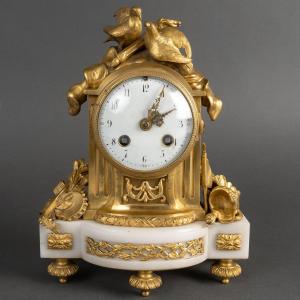
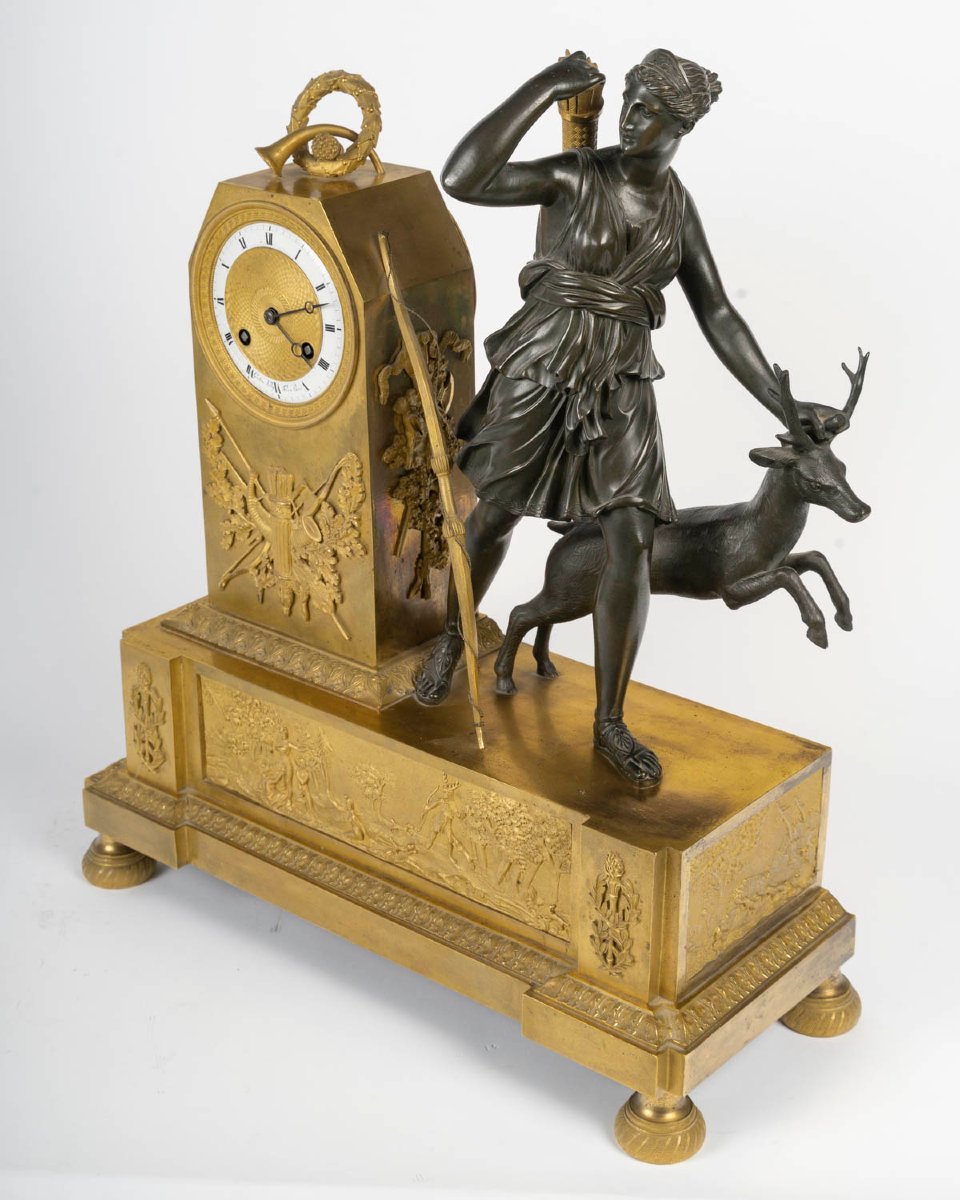
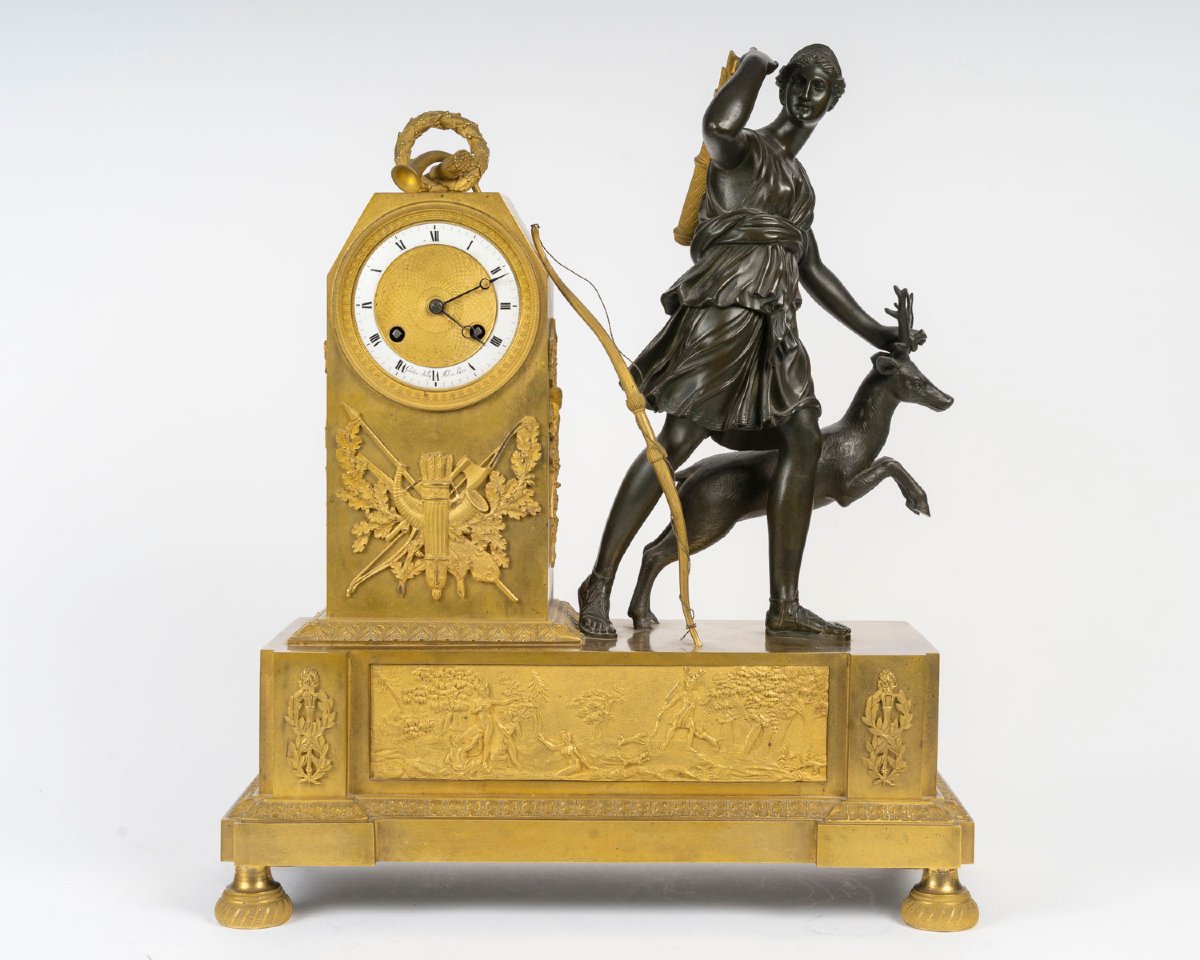
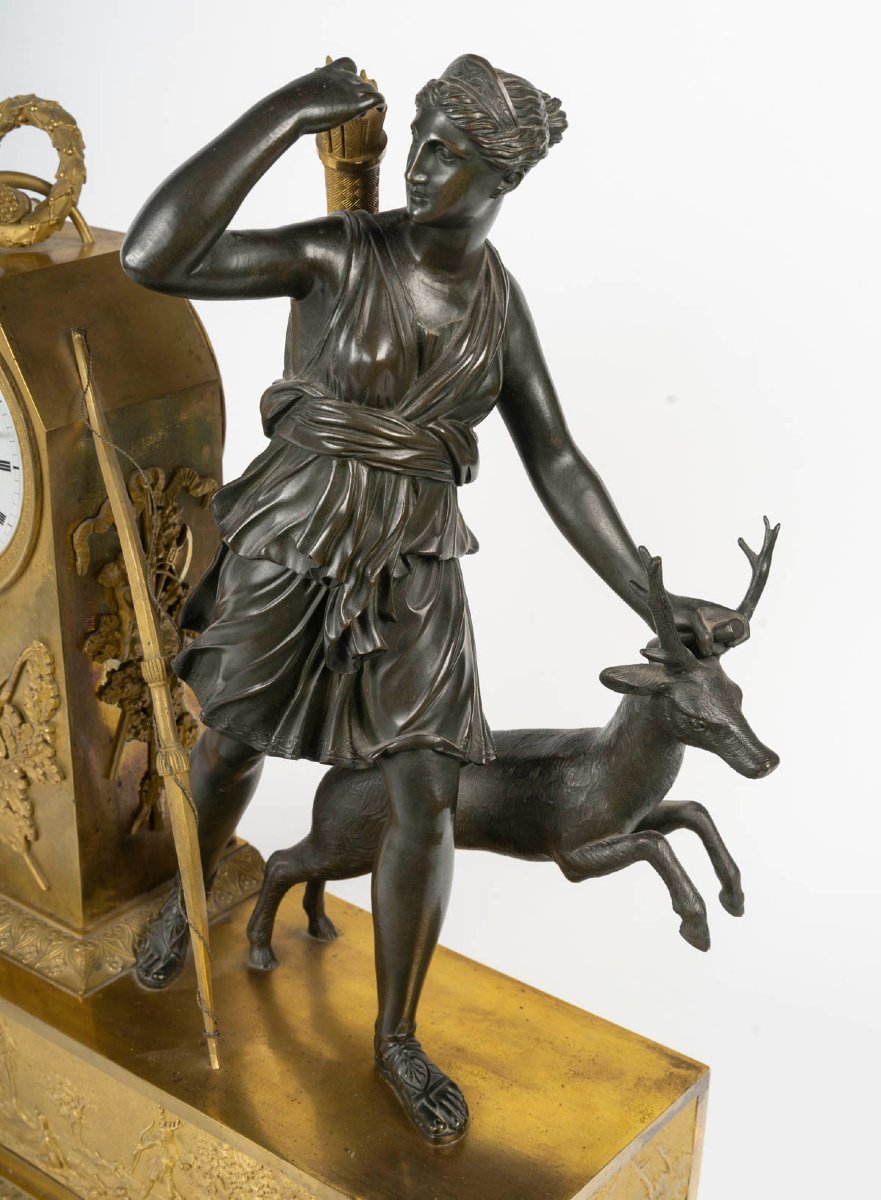
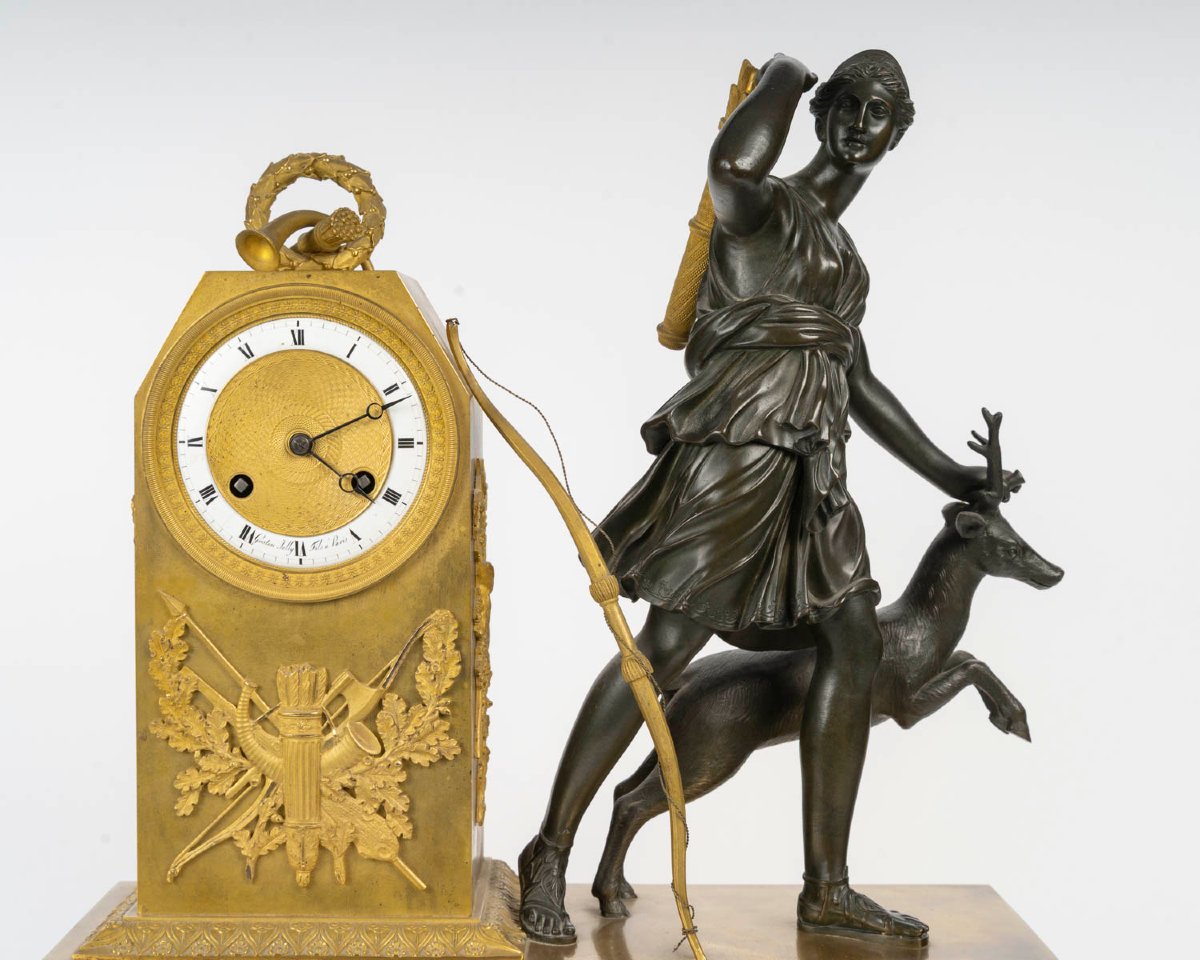
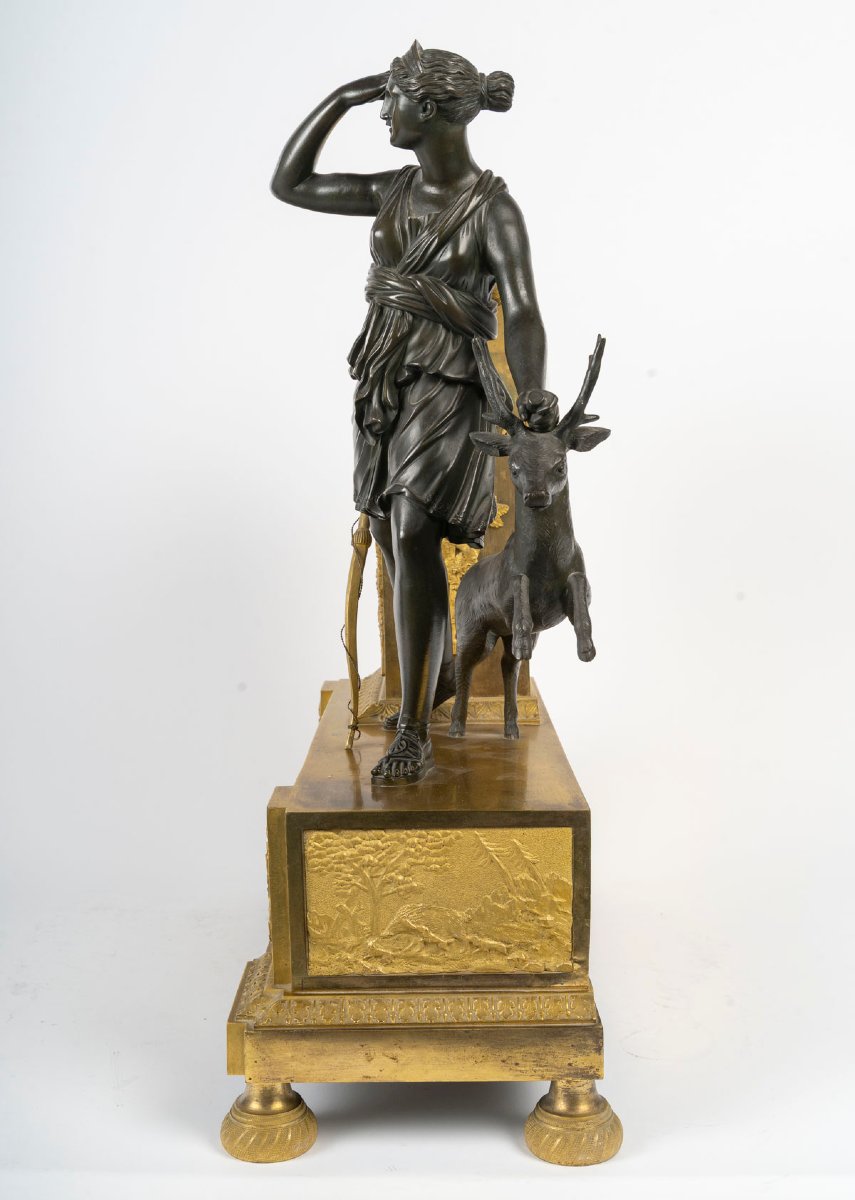
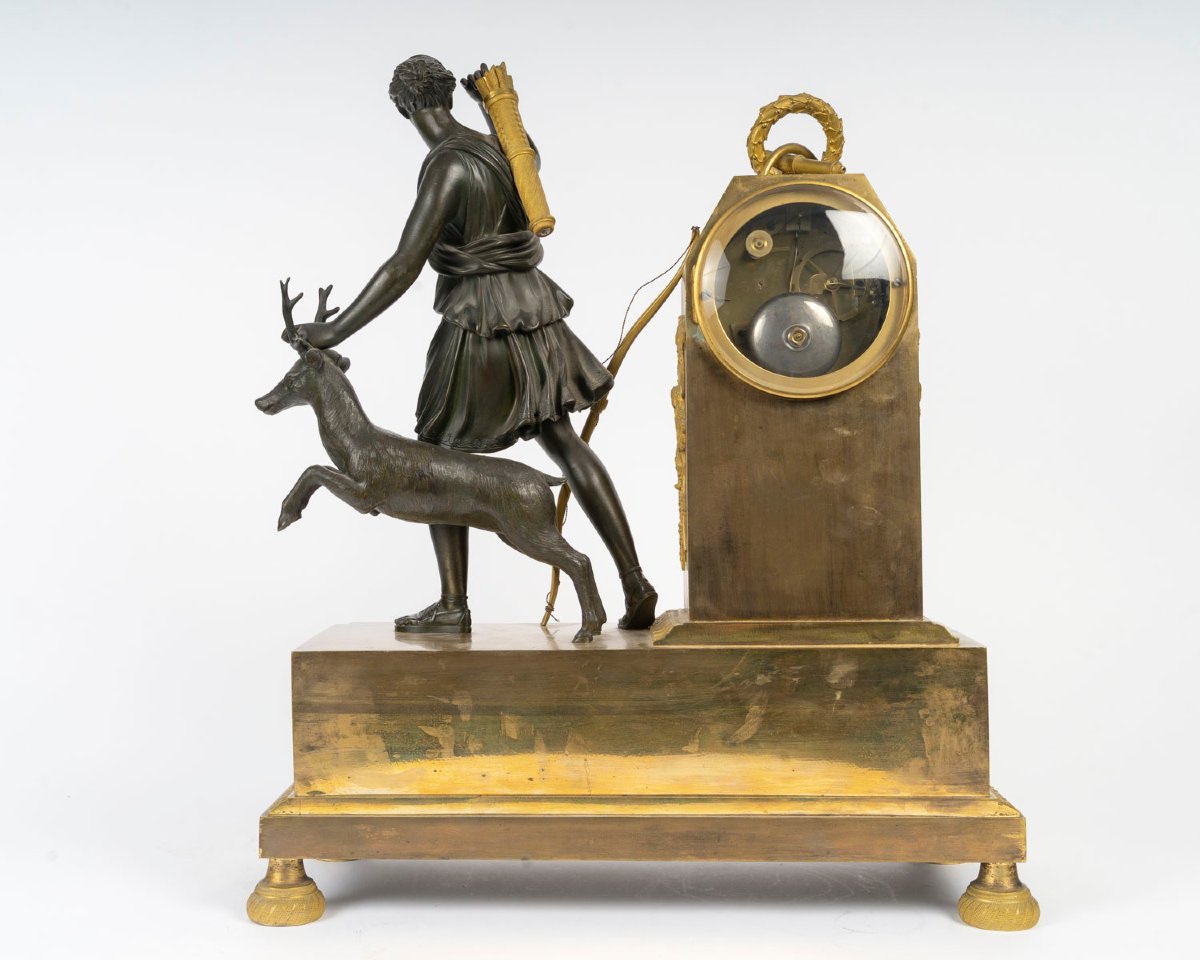
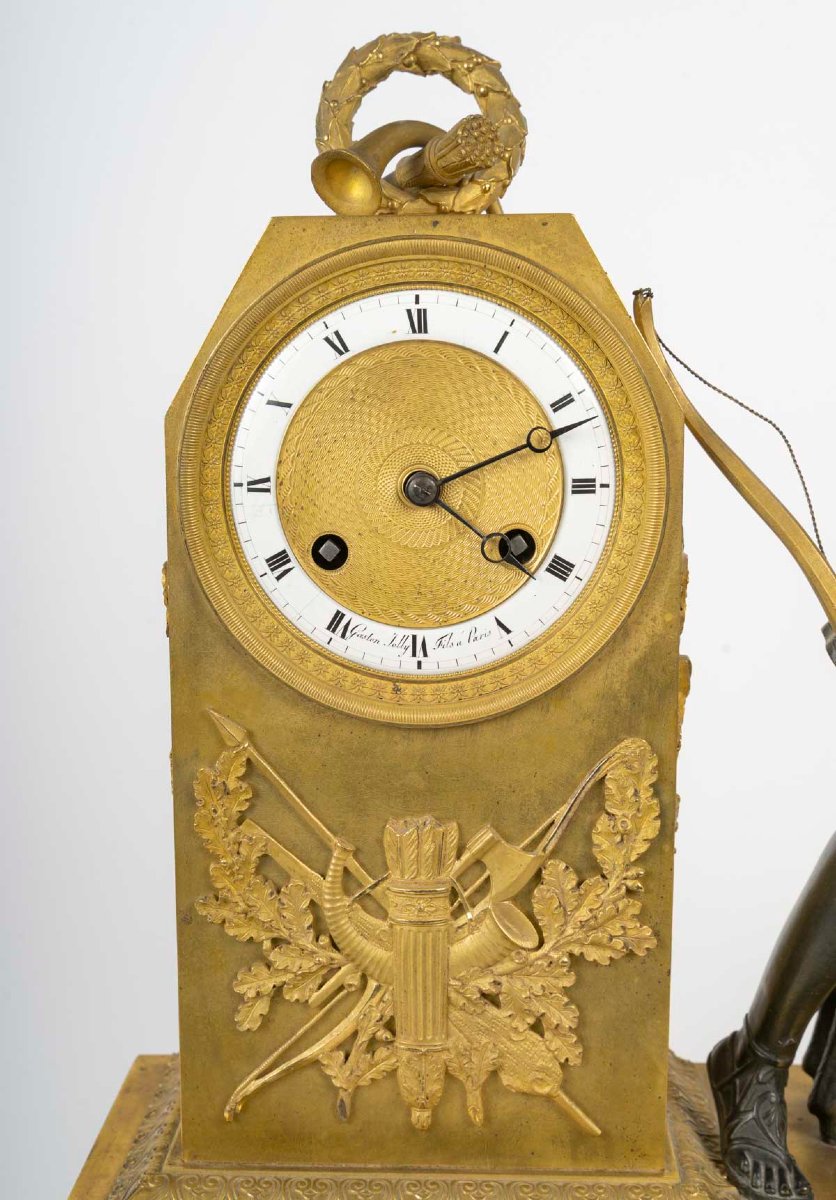
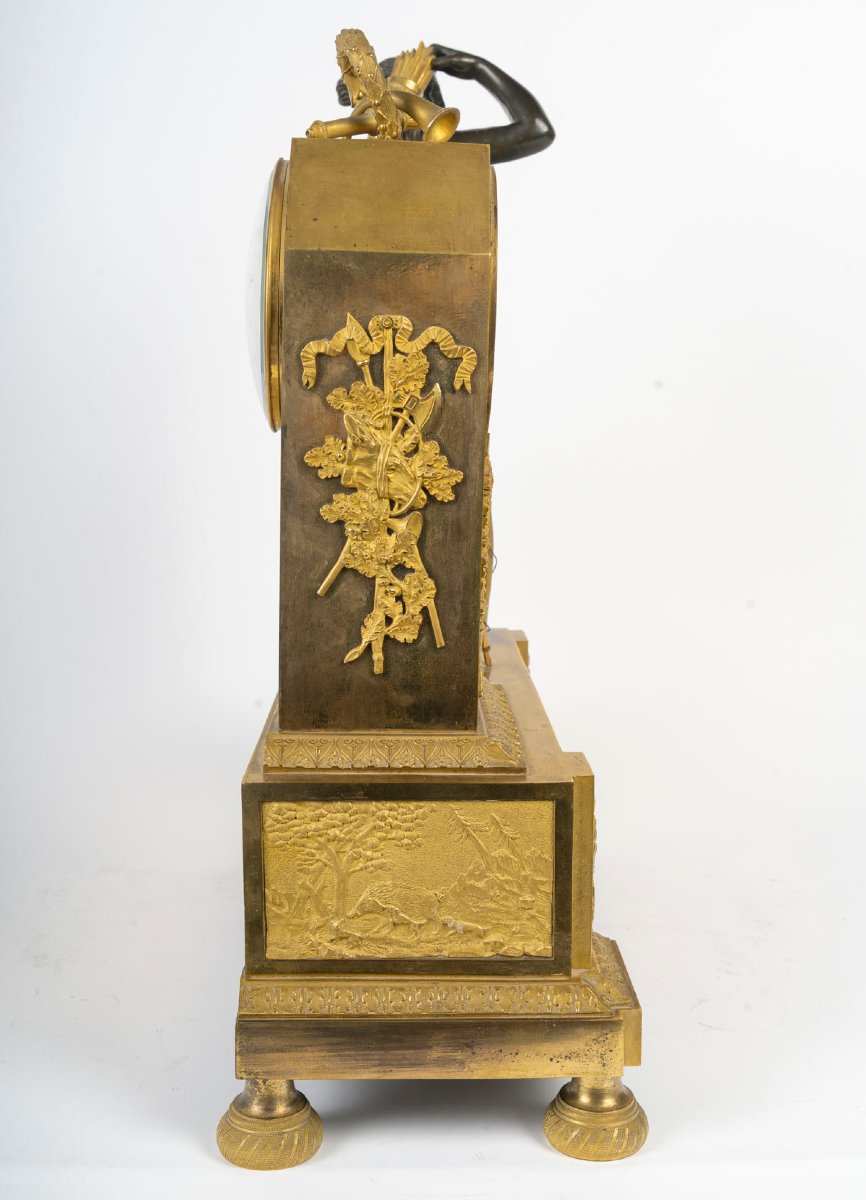
GASTON JOLLY Fils, Paris – A fine Empire-period mantel clock in finely chased bronze, featuring "antique-style" patina and both matte and burnished gilding. The composition depicts the Goddess Artemis standing beside a boundary stone—adorned on the front and sides with mounts representing her attributes and hunting trophies, including a bow—as she grasps an arrow from her quiver with one hand and rests the other on the antlers of a young, galloping stag. This sculptural group is based on a 17th-century bronze statuette titled *Diana of Ephesus*, currently held in the Louvre Museum (Inv. OA 5084). The entire composition rests on a rectangular, stepped base featuring delicate mythological bas-reliefs: the metamorphosis of Actaeon into a stag after surprising Diana and her nymphs bathing, and the *hallali* (final kill) of the Calydonian Boar. Molded friezes—alternating between leaf-and-dart and quadrilobe flower motifs, as well as oak leaves and acorns—accentuate the architectural structure of the clock, which stands on flattened, chased ball feet. It features a white enamel annular dial with Roman numerals, signed "Gaston Jolly Fils à Paris." Circa 1810–1815.
------------------
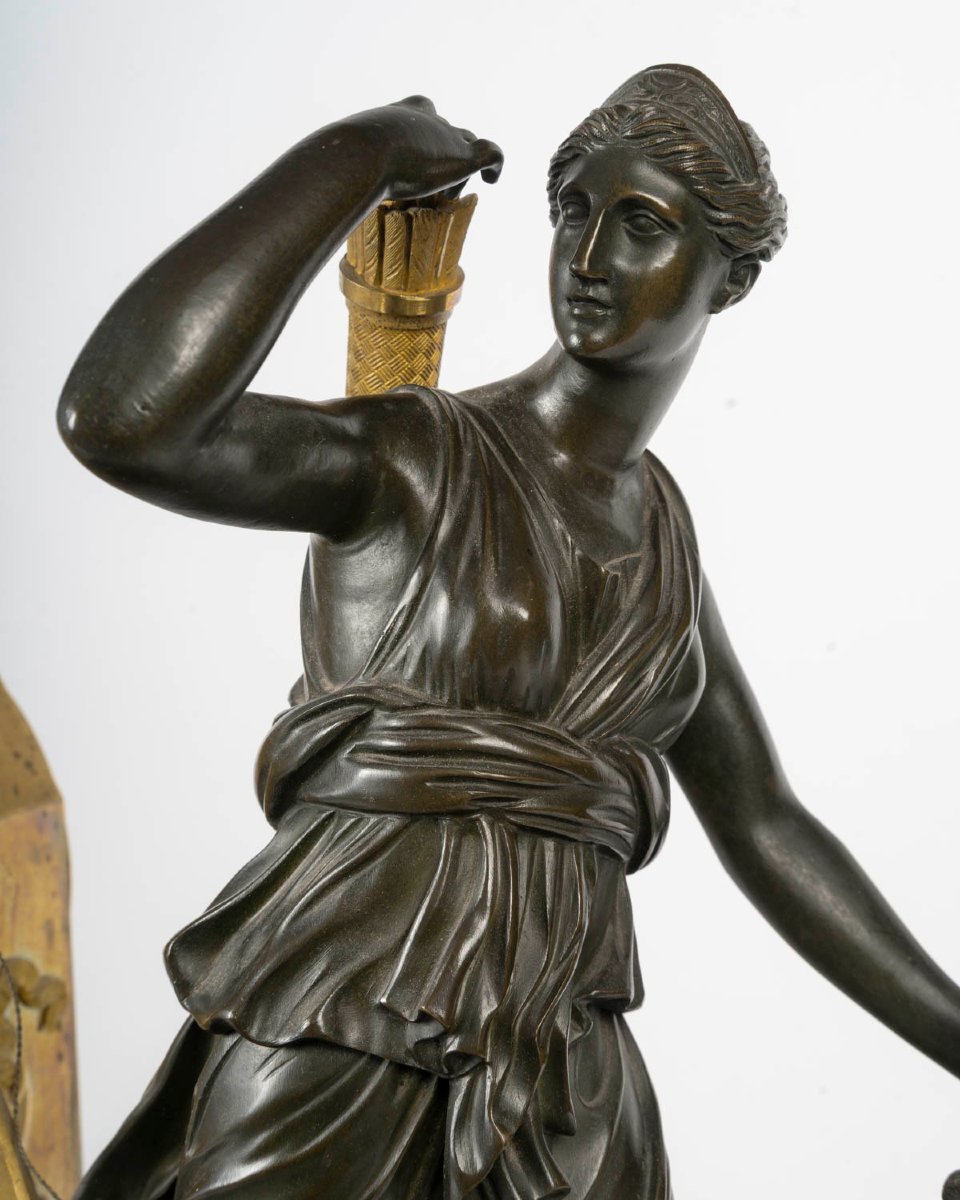
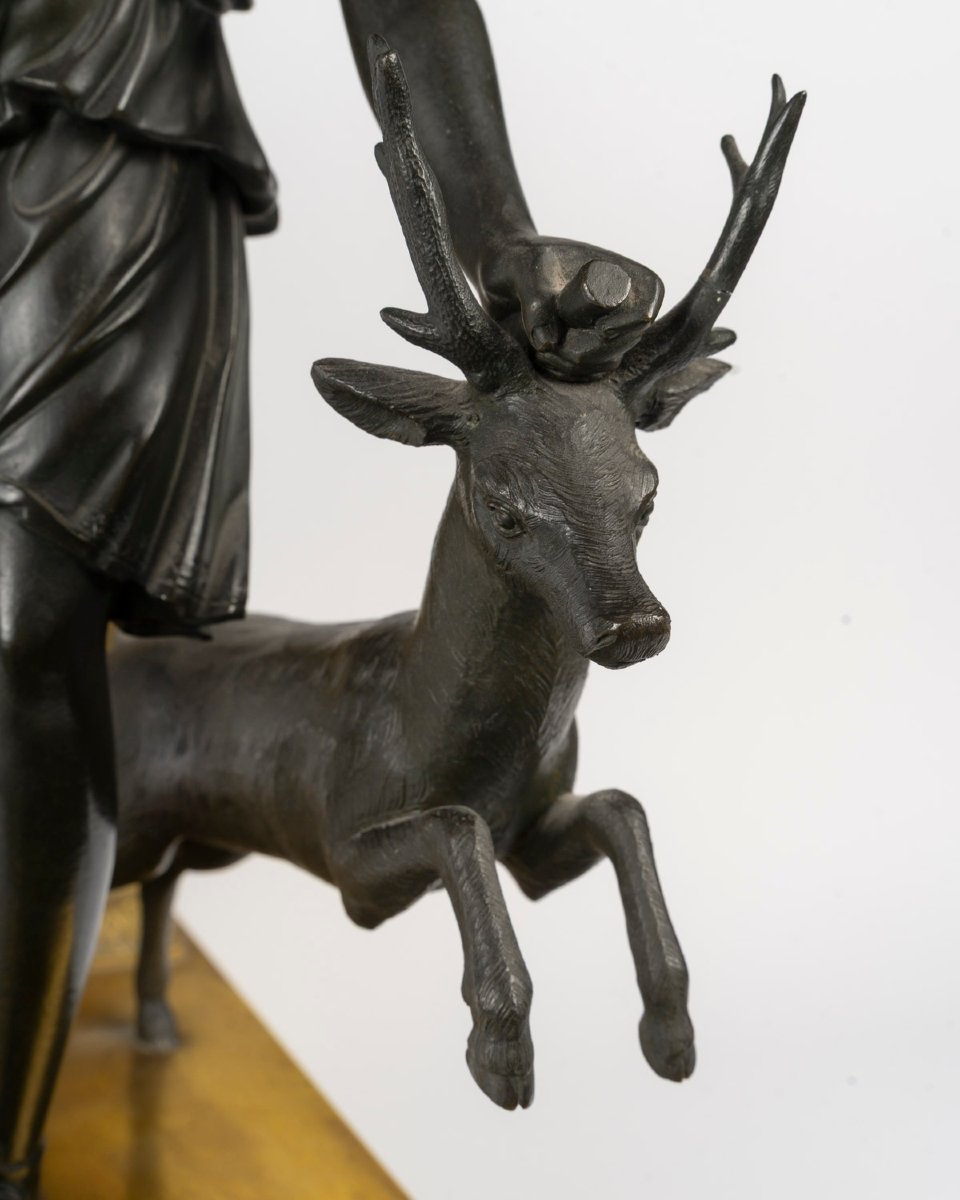
Dedicated to one of the female figures of Greco-Roman mythology frequently featured—alongside Juno, Minerva, Cybele, Venus, and Psyche—in the decorative arts of the early 19th century, this striking Empire-period mantel clock (crafted in "antique-patina" and gilt bronze) takes as its central theme the fierce huntress goddess, Artemis. Directly derived from a 17th-century statuette titled *Diana of Ephesus*—formerly part of the French Royal Collections and now housed at the Louvre Museum in Paris (Department of Decorative Arts, Inv. No. OA 5084)—this depiction shows the sovereign deity of forests and the wild striding forward energetically. Wearing strappy sandals, a short *chiton* (*krotôtos*), and an *himation* knotted at her waist, with her wavy hair swept up into a bun and encircled by a diadem, she prepares—her right arm raised—to draw an arrow from her shoulder-slung quiver with a resolute gesture; with her left hand, she holds a galloping young deer by the antlers. Beside her, leaning against a boundary stone that serves as the housing for the clock mechanism, rests a bow—the favored weapon of the daring Huntress.
Crowned by a quiver and a hunting horn nestled within a wreath of berried laurel, the clock case—featuring a restrained architectural form enhanced by a molded frieze of alternating heart-leaf and quatrefoil motifs—displays a lush, finely chased mount on its front. This mount depicts the goddess's attributes (bow, arrow-filled quiver, spear, throwing axe, and hunting horn) encircled by oak branches. Suspended from a pleated ribbon bow—a feature inherited from the Louis XVI style—hunting trophies combining a hunting horn, axe, pike, hind's head, and leafy boughs adorn the sides of the case. Elegantly balanced in composition, the ensemble—comprising the statuary group, the arch, and the plinth—stands upon a tall, rectangular base with slight projections, featuring an ornate molding of oak leaves and acorns along its lower edge. Resting on four flattened ball feet embellished with gadrooned bands, the base is further adorned with fine bas-reliefs set within rectangular panels; these motifs provide a fitting thematic echo for a timepiece dedicated to the majestic Goddess. Flanked by appliqués featuring quivers topped with finials and olive branches, the central relief depicts a legendary mythological episode recounted by Ovid in his famous *Metamorphoses* (Book III, line 138 et seq.): the youthful hunter Actaeon, transformed into a stag and pursued by his own pack of hounds after stumbling upon Diana—unarmed and naked—bathing in a spring amidst her faithful nymphs, who were startled by the young man's untimely intrusion. Two flanking reliefs illustrate a masculine theme frequently found on timepieces dedicated to Diana the Huntress between 1795 and 1804: the *hallali* (final kill) of a wild boar. This evokes a pivotal episode in Greek mythology—the hunt for the Calydonian Boar led by Meleager, another young hunter who fell victim to the wrath of the vengeful Goddess. Framed by the bezel and centered on a gilt-bronze disc featuring ornamental motifs characteristic of the Empire period—such as *brettes*, *sorcières* with fleurons, beading, honeycomb patterns, and *grain d'orge* (barleycorn) texturing—the clock's white enamel annular dial displays Roman numerals and features "oeil-de-perdrix" style hands; it bears the signature of "Gaston Jolly, Fils," the worthy successor to his father Pierre-François-Gaston Jolly (?-1829)—also known simply as Gaston Jolly—who was one of the most renowned master clockmakers of the late 18th century.
GASTON JOLLY Fils: Also working as a clockmaker, Pierre-François-Gaston Jolly—based in the capital on Rue du Pavé Saint-Sauveur (1810–1820) and later on Boulevard Poissonnière (1820–1850)—was the successor and worthy representative of his father, known as GASTON-JOLLY (d. 1829). The elder Jolly was one of the most remarkable Parisian clockmakers of the late 18th and early 19th centuries. Admitted as a Master Clockmaker on May 6, 1784, he worked successively on Rue d'Arcis, Rue Michel Le Comte (later renamed Rue Le Pelletier; 1784–1789), and Rue du Pavé Saint-Sauveur (1810–1820). He quickly gained great renown among Parisian horological enthusiasts, a distinguished group that included the wife (1764–1807) of the Comte de Lévis-Mirepoix and the Marquis de Lostanges, a Chamberlain (1809) to Napoleon I. Attuned to the aesthetic tastes of his prestigious clientele, he collaborated with the master bronziers of his day—such as Robert and Jean-Baptiste Osmond—to design numerous clock models prized for their original compositions, the finely chased details of their cases, and the quality of their movements.
--------------------------------
Related literature: Tardy, *Dictionnaire des Horlogers Français*, Paris: 1971, p. 331, 333.—*Les Bronzes de la Couronne*, exhibition catalogue, Paris, Musée du Louvre, 12 April–12 July 1999, Paris: RMN, 1999, p. 41, no. 324;—Augarde, Jean-Dominique, *Une Odyssée en Pendules: Chefs-d’œuvre de la Collection Parnassia*, Paris: Éditions Faton, 2022, Vol. I, pp. 124–134.
----------------
Materials: Bronze with matte or burnished gilding; bronze with dark "antique-style" (*à l’antique*) patina; white enamel; steel.
Mark and signature: at the base of the annular dial: "Gaston Jolly / Fils à Paris"
------------------
Dedicated to one of the female figures of Greco-Roman mythology frequently featured—alongside Juno, Minerva, Cybele, Venus, and Psyche—in the decorative arts of the early 19th century, this striking Empire-period mantel clock (crafted in "antique-patina" and gilt bronze) takes as its central theme the fierce huntress goddess, Artemis. Directly derived from a 17th-century statuette titled *Diana of Ephesus*—formerly part of the French Royal Collections and now housed at the Louvre Museum in Paris (Department of Decorative Arts, Inv. No. OA 5084)—this depiction shows the sovereign deity of forests and the wild striding forward energetically. Wearing strappy sandals, a short *chiton* (*krotôtos*), and an *himation* knotted at her waist, with her wavy hair swept up into a bun and encircled by a diadem, she prepares—her right arm raised—to draw an arrow from her shoulder-slung quiver with a resolute gesture; with her left hand, she holds a galloping young deer by the antlers. Beside her, leaning against a boundary stone that serves as the housing for the clock mechanism, rests a bow—the favored weapon of the daring Huntress.
Crowned by a quiver and a hunting horn nestled within a wreath of berried laurel, the clock case—featuring a restrained architectural form enhanced by a molded frieze of alternating heart-leaf and quatrefoil motifs—displays a lush, finely chased mount on its front. This mount depicts the goddess's attributes (bow, arrow-filled quiver, spear, throwing axe, and hunting horn) encircled by oak branches. Suspended from a pleated ribbon bow—a feature inherited from the Louis XVI style—hunting trophies combining a hunting horn, axe, pike, hind's head, and leafy boughs adorn the sides of the case. Elegantly balanced in composition, the ensemble—comprising the statuary group, the arch, and the plinth—stands upon a tall, rectangular base with slight projections, featuring an ornate molding of oak leaves and acorns along its lower edge. Resting on four flattened ball feet embellished with gadrooned bands, the base is further adorned with fine bas-reliefs set within rectangular panels; these motifs provide a fitting thematic echo for a timepiece dedicated to the majestic Goddess. Flanked by appliqués featuring quivers topped with finials and olive branches, the central relief depicts a legendary mythological episode recounted by Ovid in his famous *Metamorphoses* (Book III, line 138 et seq.): the youthful hunter Actaeon, transformed into a stag and pursued by his own pack of hounds after stumbling upon Diana—unarmed and naked—bathing in a spring amidst her faithful nymphs, who were startled by the young man's untimely intrusion. Two flanking reliefs illustrate a masculine theme frequently found on timepieces dedicated to Diana the Huntress between 1795 and 1804: the *hallali* (final kill) of a wild boar. This evokes a pivotal episode in Greek mythology—the hunt for the Calydonian Boar led by Meleager, another young hunter who fell victim to the wrath of the vengeful Goddess. Framed by the bezel and centered on a gilt-bronze disc featuring ornamental motifs characteristic of the Empire period—such as *brettes*, *sorcières* with fleurons, beading, honeycomb patterns, and *grain d'orge* (barleycorn) texturing—the clock's white enamel annular dial displays Roman numerals and features "oeil-de-perdrix" style hands; it bears the signature of "Gaston Jolly, Fils," the worthy successor to his father Pierre-François-Gaston Jolly (?-1829)—also known simply as Gaston Jolly—who was one of the most renowned master clockmakers of the late 18th century.
GASTON JOLLY Fils: Also working as a clockmaker, Pierre-François-Gaston Jolly—based in the capital on Rue du Pavé Saint-Sauveur (1810–1820) and later on Boulevard Poissonnière (1820–1850)—was the successor and worthy representative of his father, known as GASTON-JOLLY (d. 1829). The elder Jolly was one of the most remarkable Parisian clockmakers of the late 18th and early 19th centuries. Admitted as a Master Clockmaker on May 6, 1784, he worked successively on Rue d'Arcis, Rue Michel Le Comte (later renamed Rue Le Pelletier; 1784–1789), and Rue du Pavé Saint-Sauveur (1810–1820). He quickly gained great renown among Parisian horological enthusiasts, a distinguished group that included the wife (1764–1807) of the Comte de Lévis-Mirepoix and the Marquis de Lostanges, a Chamberlain (1809) to Napoleon I. Attuned to the aesthetic tastes of his prestigious clientele, he collaborated with the master bronziers of his day—such as Robert and Jean-Baptiste Osmond—to design numerous clock models prized for their original compositions, the finely chased details of their cases, and the quality of their movements.
--------------------------------
Related literature: Tardy, *Dictionnaire des Horlogers Français*, Paris: 1971, p. 331, 333.—*Les Bronzes de la Couronne*, exhibition catalogue, Paris, Musée du Louvre, 12 April–12 July 1999, Paris: RMN, 1999, p. 41, no. 324;—Augarde, Jean-Dominique, *Une Odyssée en Pendules: Chefs-d’œuvre de la Collection Parnassia*, Paris: Éditions Faton, 2022, Vol. I, pp. 124–134.
----------------
Materials: Bronze with matte or burnished gilding; bronze with dark "antique-style" (*à l’antique*) patina; white enamel; steel.
Mark and signature: at the base of the annular dial: "Gaston Jolly / Fils à Paris"
4 800 €
Period: 19th century
Style: Consulat, Empire
Condition: Excellent condition
Material: Bronze
Width: 45 cm
Height: 53 cm
Depth: 17 cm
Reference (ID): 1826984
Availability: In stock
Print