


Napoleon III Side Table With Inlaid Floral Vase Design. Circa 1860–1870.
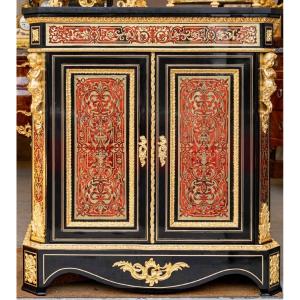
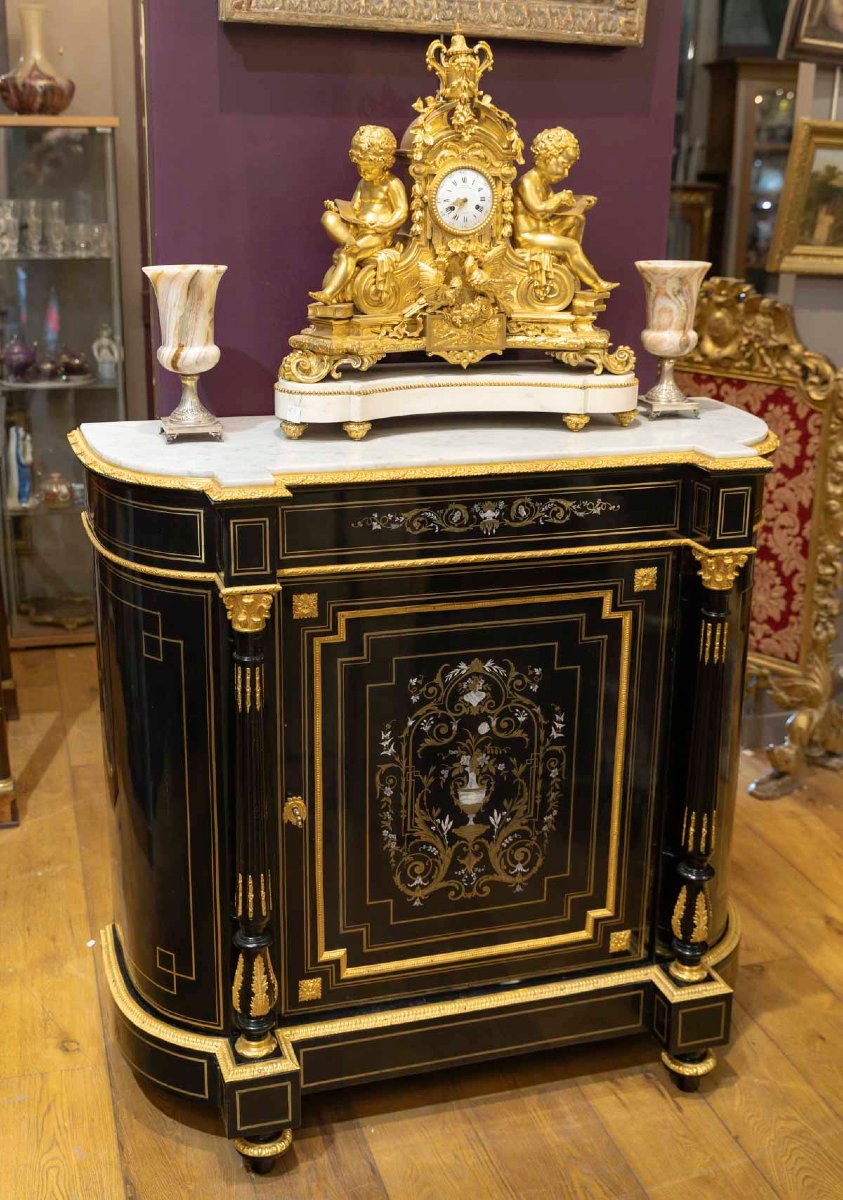
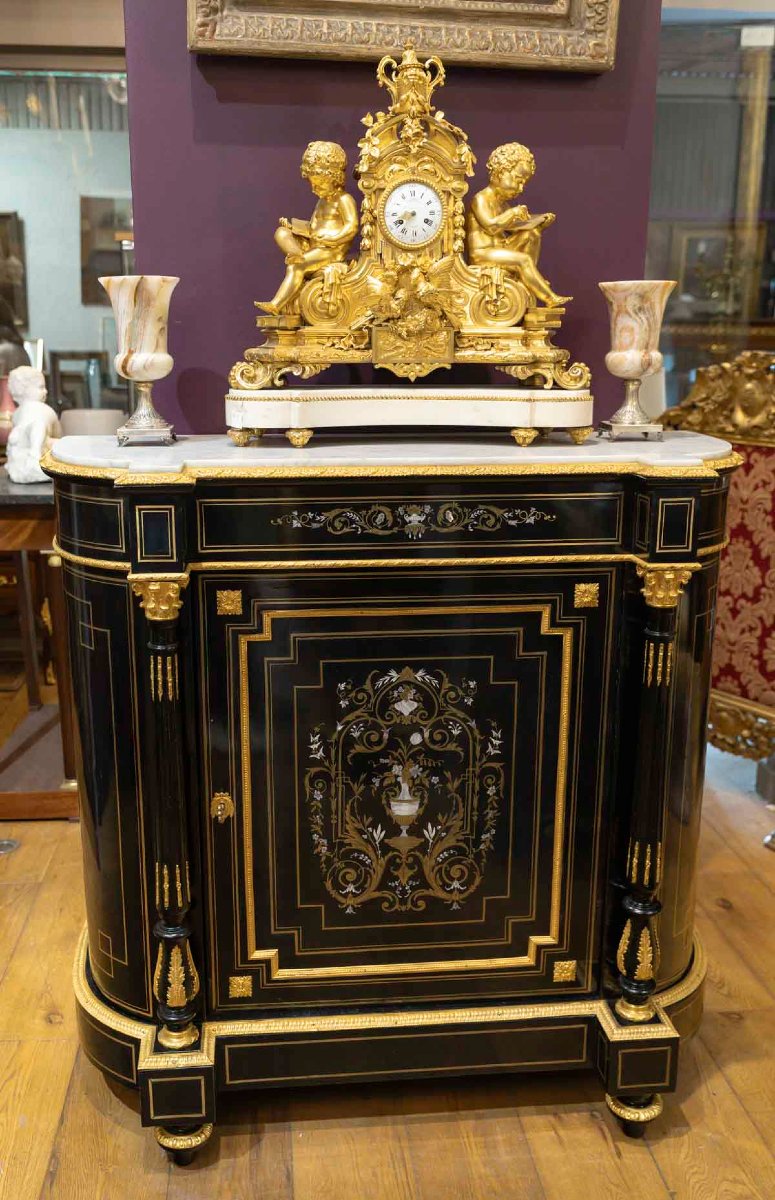
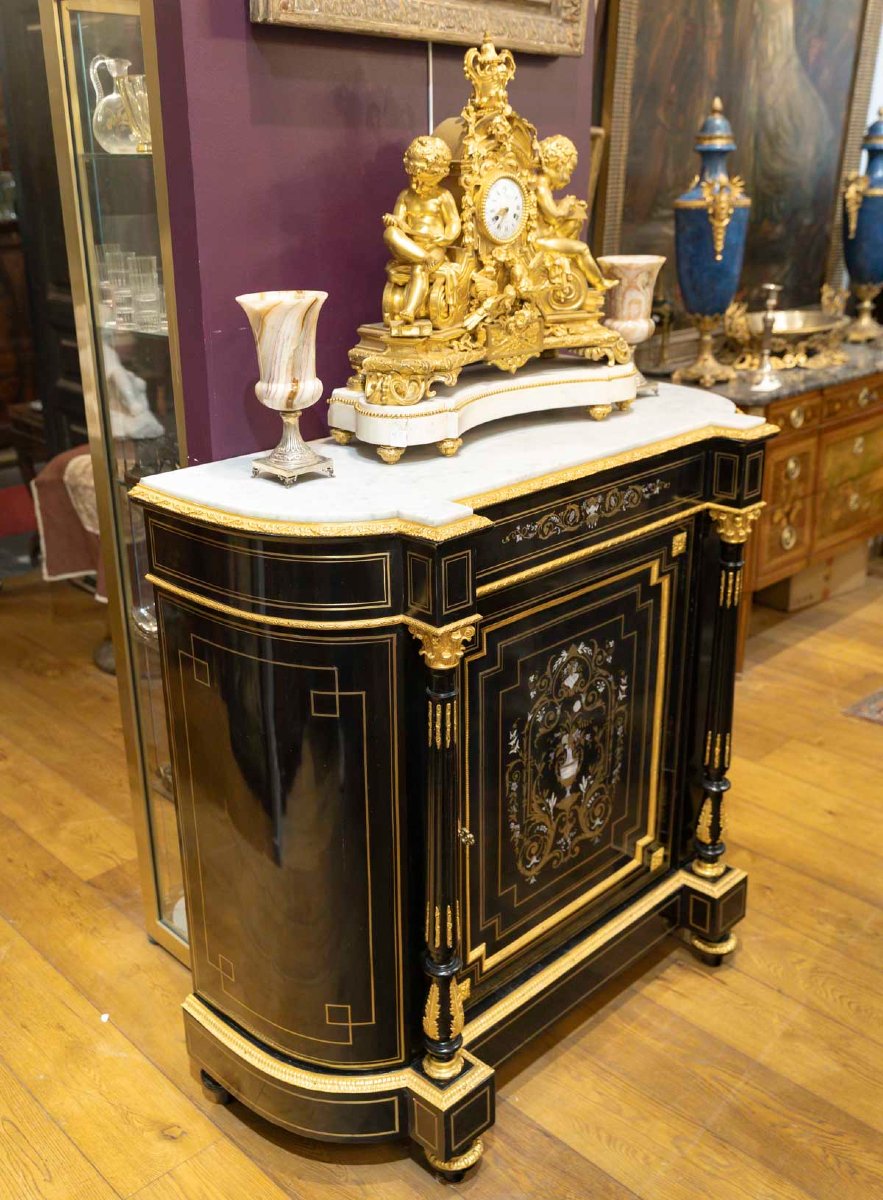
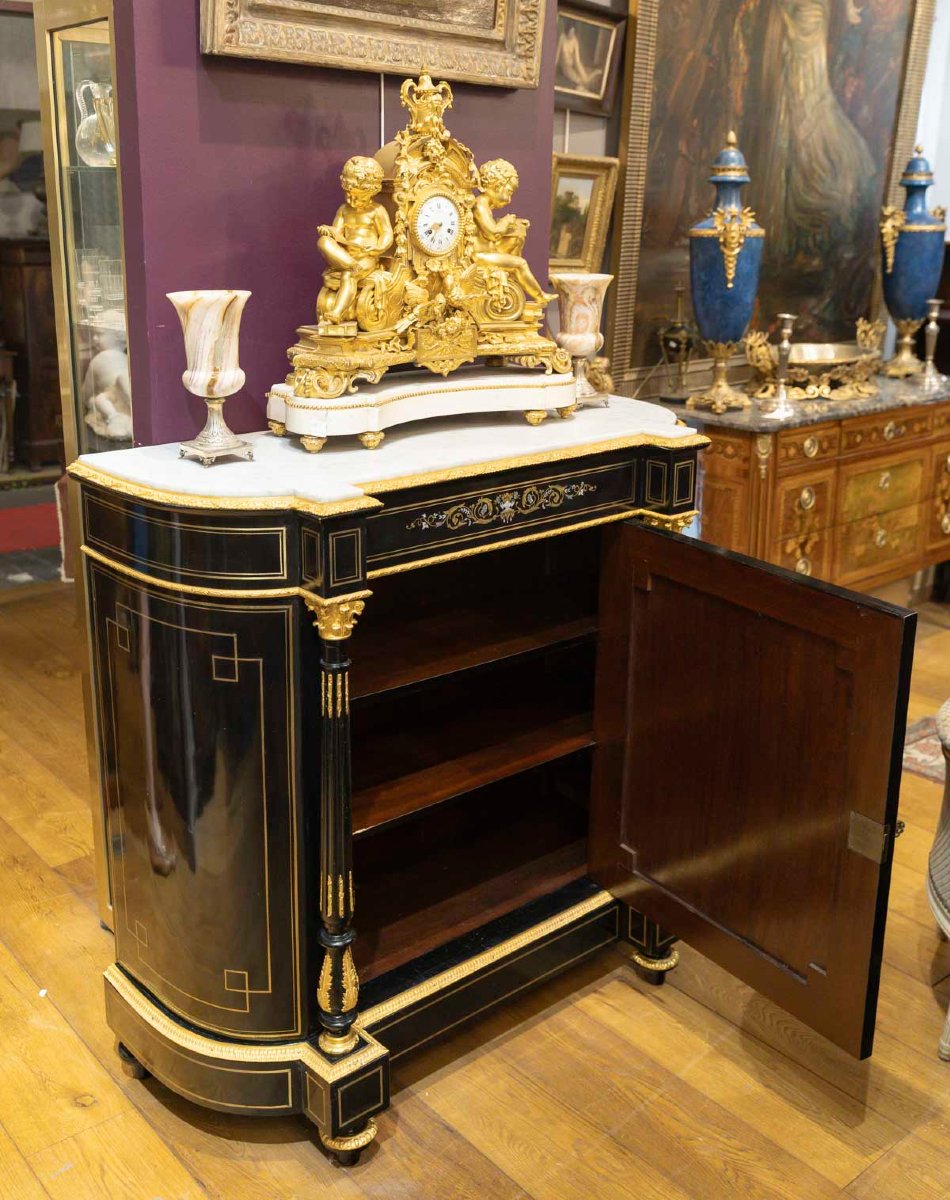
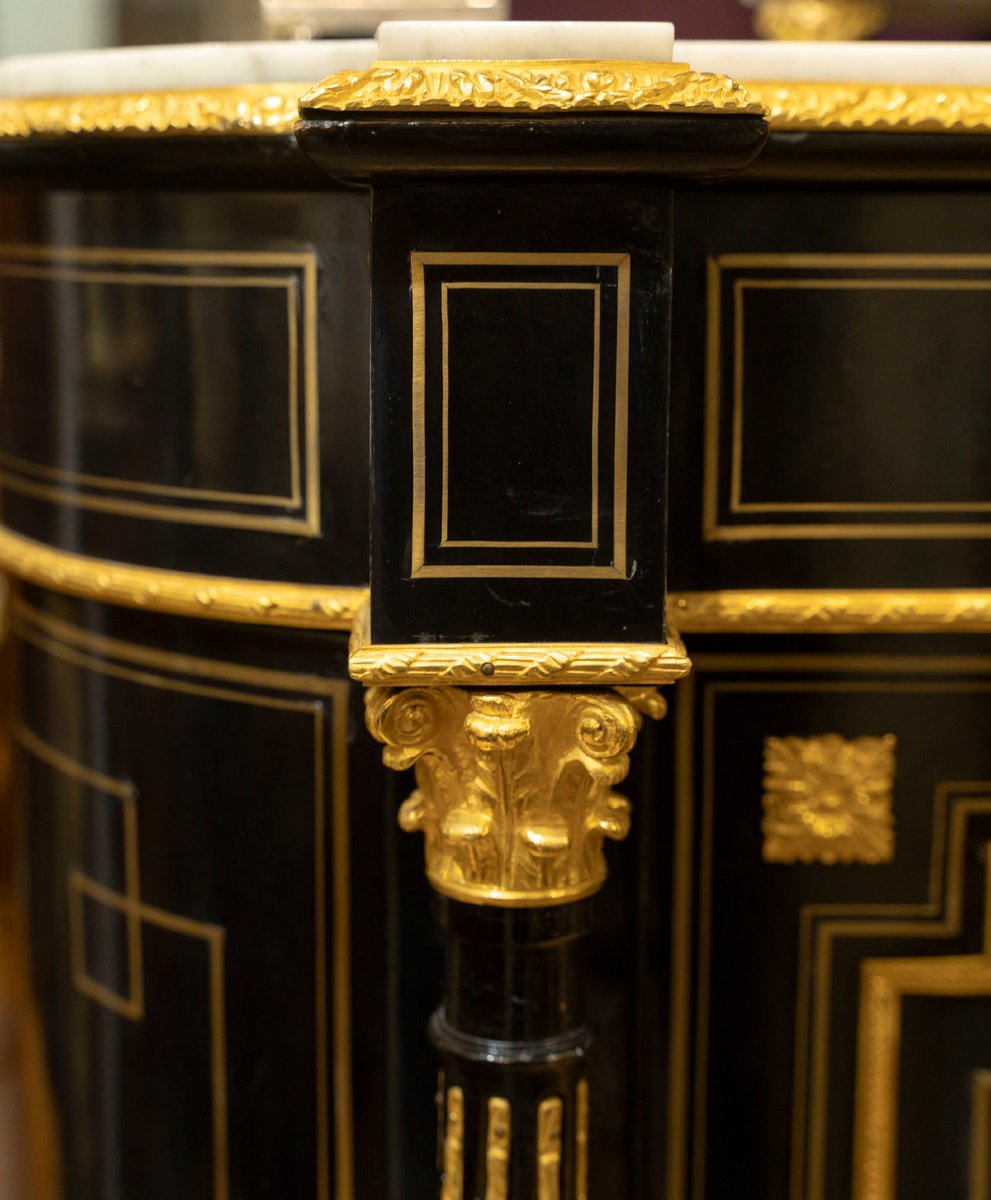
An elegant *meuble d'entre-deux* (pier cabinet) of waist height, featuring an architectural form with straight projecting sections and rounded sides. It is clad in ebonized (blackened) wood veneer, with the front—specifically the frieze and the door panel—displaying "Boulle-style" marquetry featuring delicate inlays of brass and mother-of-pearl. Executed with great finesse, the marquetry combines rectangular frames with scrolls, acanthus leaf volutes, and floral motifs centered on flower-filled vases. Finely chased, gilt-bronze mounts—inspired by the Louis XVI style and featuring beading, ribboned reeds, water leaves, *culots*, rosettes, acanthus palmettes, and laurel tori—adorn the piece and accent its two detached baluster-shaped colonnettes with Corinthian capitals. When opened, it reveals a mahogany-veneered interior fitted with adjustable shelves on rack supports. Resting on toupie feet set with gadrooned collars, the piece is topped with a white marble slab. A fine example of Parisian high-quality cabinetmaking from the second half of the 19th century. Napoleon III period, circa 1860. Napoleon III stamp. Possessing an elegant presence, this highly attractive pier cabinet features an architectural body with harmoniously contoured lines, clad in ebonized wood veneer. Set against a background of rich, lustrous tones and sophisticated chromatic interplay,
the front panel—framed by simple, double brass lines punctuated by gilt-bronze beaded moldings—
displays a delicate marquetry design of engraved brass embellished with exquisite
mother-of-pearl inlays. The execution of this work is remarkably fine.
Centered
around a floral urn resting on an entablature draped with a lambrequin
and bell-shaped tassels, leafy interlacing adorned with stylized
passionflowers embellishes the piece's frieze.
An elaborate floral marquetry design illuminates the center of the door:
scattered with periwinkles, bindweeds, fritillaries, fine-petaled acanthus,
pinnacles, and mother-of-pearl motifs, slender stems and leafy scrolls
extend and intertwine their airy branches; volutes and bell-shaped
floral finials—accompanied by acanthus leaves and palmettes—frame
an ornamental vase standing on a molded entablature; from its slender
neck spill forth gardenias, China pinks, hyacinths, and tulips on their stems.
Enclosed within a lobed, scrolling motif, a globular vase holding
a bouquet of spring flowers completes the highly refined composition
of this small inlaid brass and mother-of-pearl tableau.
Finely chased and gilt bronze mounts
bring a sense of restrained balance to this piece,
whose measured ornamentation nonetheless possesses a certain nobility.
Featuring water-leaf motifs, molded strips combined with a ribboned
reed molding highlight its architectural structure and trace the contours
of its gently rounded sides. A ribbon-wrapped laurel torus and acanthus palmettes—along with asparagus-like motifs cascading from finial-like bases—adorn two slender, fluted, and cable-molded baluster-shaped colonnettes; these are topped by Corinthian capitals that enrich the projecting front uprights. Rosettes featuring a radiating acanthus-leaf pattern punctuate the spandrels of the façade, while a ribbon bow with a central shell motif embellishes the keyhole escutcheon.
When opened, the door reveals an interior lined with mahogany veneer and fitted with two adjustable shelves resting on rack-and-pinion supports.
A white marble top with flat edges, shaped to match the furniture's contours, crowns the piece; the base—characterized by clean, understated lines—rests on four toupie feet accented by gadrooned collars.
Formal elegance, the lustrous quality of the materials, and refined ornamentation distinguish this exceptionally fine *meuble d'entre-deux* (pier cabinet). It stands as a prime example of the luxurious Parisian fine cabinetry produced during the second half of the 19th century. More specifically, its characteristics link it to the distinguished work created between 1855 and 1870 by master cabinetmakers and marquetry specialists—such as Henry Ahrens, Cornu Jeune, and Ch.—who billed themselves as "Manufacturers of Boulle-style furniture." G. Dielh (early in his career), Léon Gradé, E. Lemarchand, and Léon Marcotte—craftsmen who, with equal skill and finesse, reinterpreted marquetry motifs inspired by the work of Charles-André Boulle (1642–1732) and his followers, adapting them to the form of this piece of furniture, which was highly prized by Second Empire society. Materials: ebonized (blackened) wood and mahogany veneer; mother-of-pearl and brass marquetry; gilt bronze mounts; white marble top. Dimensions: H. 110 cm; W. 115 cm; D. 47 cm. Fine-quality Parisian cabinetmaking from the second half of the 19th century. Napoleon III period, circa 1860. Perfect condition. French polish finish.
the front panel—framed by simple, double brass lines punctuated by gilt-bronze beaded moldings—
displays a delicate marquetry design of engraved brass embellished with exquisite
mother-of-pearl inlays. The execution of this work is remarkably fine.
Centered
around a floral urn resting on an entablature draped with a lambrequin
and bell-shaped tassels, leafy interlacing adorned with stylized
passionflowers embellishes the piece's frieze.
An elaborate floral marquetry design illuminates the center of the door:
scattered with periwinkles, bindweeds, fritillaries, fine-petaled acanthus,
pinnacles, and mother-of-pearl motifs, slender stems and leafy scrolls
extend and intertwine their airy branches; volutes and bell-shaped
floral finials—accompanied by acanthus leaves and palmettes—frame
an ornamental vase standing on a molded entablature; from its slender
neck spill forth gardenias, China pinks, hyacinths, and tulips on their stems.
Enclosed within a lobed, scrolling motif, a globular vase holding
a bouquet of spring flowers completes the highly refined composition
of this small inlaid brass and mother-of-pearl tableau.
Finely chased and gilt bronze mounts
bring a sense of restrained balance to this piece,
whose measured ornamentation nonetheless possesses a certain nobility.
Featuring water-leaf motifs, molded strips combined with a ribboned
reed molding highlight its architectural structure and trace the contours
of its gently rounded sides. A ribbon-wrapped laurel torus and acanthus palmettes—along with asparagus-like motifs cascading from finial-like bases—adorn two slender, fluted, and cable-molded baluster-shaped colonnettes; these are topped by Corinthian capitals that enrich the projecting front uprights. Rosettes featuring a radiating acanthus-leaf pattern punctuate the spandrels of the façade, while a ribbon bow with a central shell motif embellishes the keyhole escutcheon.
When opened, the door reveals an interior lined with mahogany veneer and fitted with two adjustable shelves resting on rack-and-pinion supports.
A white marble top with flat edges, shaped to match the furniture's contours, crowns the piece; the base—characterized by clean, understated lines—rests on four toupie feet accented by gadrooned collars.
Formal elegance, the lustrous quality of the materials, and refined ornamentation distinguish this exceptionally fine *meuble d'entre-deux* (pier cabinet). It stands as a prime example of the luxurious Parisian fine cabinetry produced during the second half of the 19th century. More specifically, its characteristics link it to the distinguished work created between 1855 and 1870 by master cabinetmakers and marquetry specialists—such as Henry Ahrens, Cornu Jeune, and Ch.—who billed themselves as "Manufacturers of Boulle-style furniture." G. Dielh (early in his career), Léon Gradé, E. Lemarchand, and Léon Marcotte—craftsmen who, with equal skill and finesse, reinterpreted marquetry motifs inspired by the work of Charles-André Boulle (1642–1732) and his followers, adapting them to the form of this piece of furniture, which was highly prized by Second Empire society. Materials: ebonized (blackened) wood and mahogany veneer; mother-of-pearl and brass marquetry; gilt bronze mounts; white marble top. Dimensions: H. 110 cm; W. 115 cm; D. 47 cm. Fine-quality Parisian cabinetmaking from the second half of the 19th century. Napoleon III period, circa 1860. Perfect condition. French polish finish.
4 900 €
Period: 19th century
Style: Napoleon 3rd
Condition: Perfect condition
Material: Wood marquetry
Length: 115 cm
Height: 110 cm
Depth: 47 cm
Reference (ID): 1814815
Availability: In stock
Print