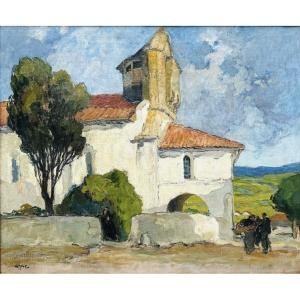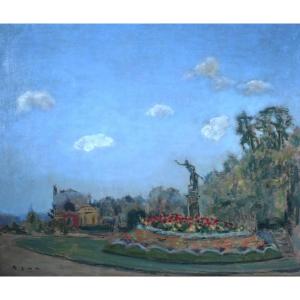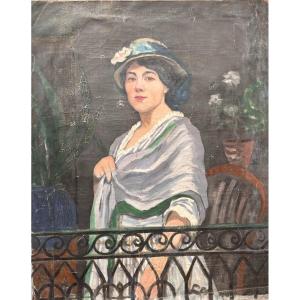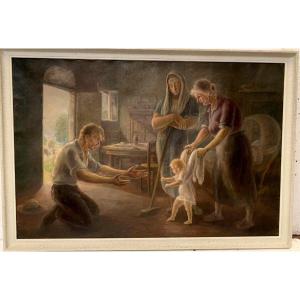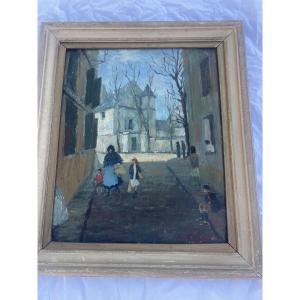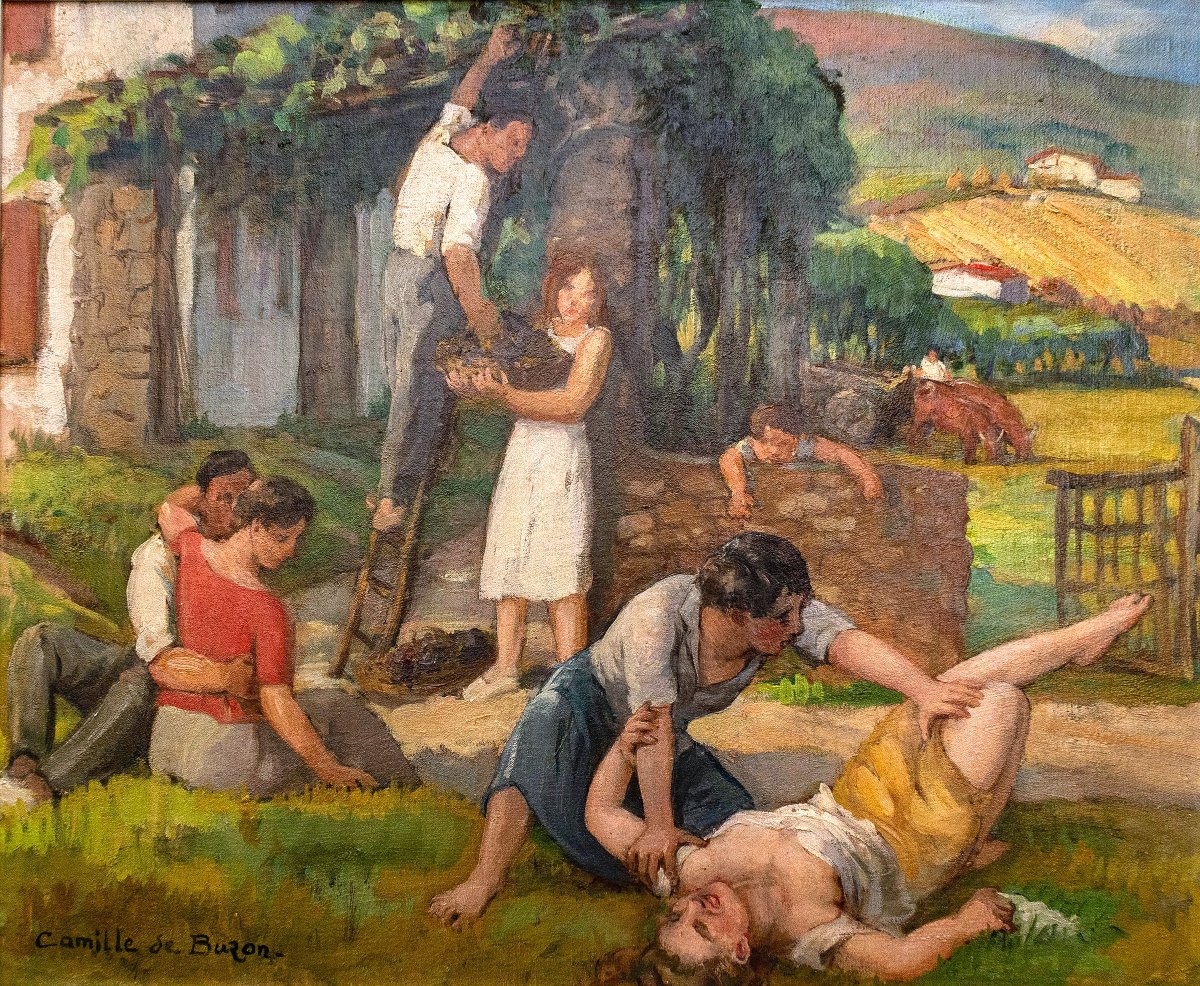
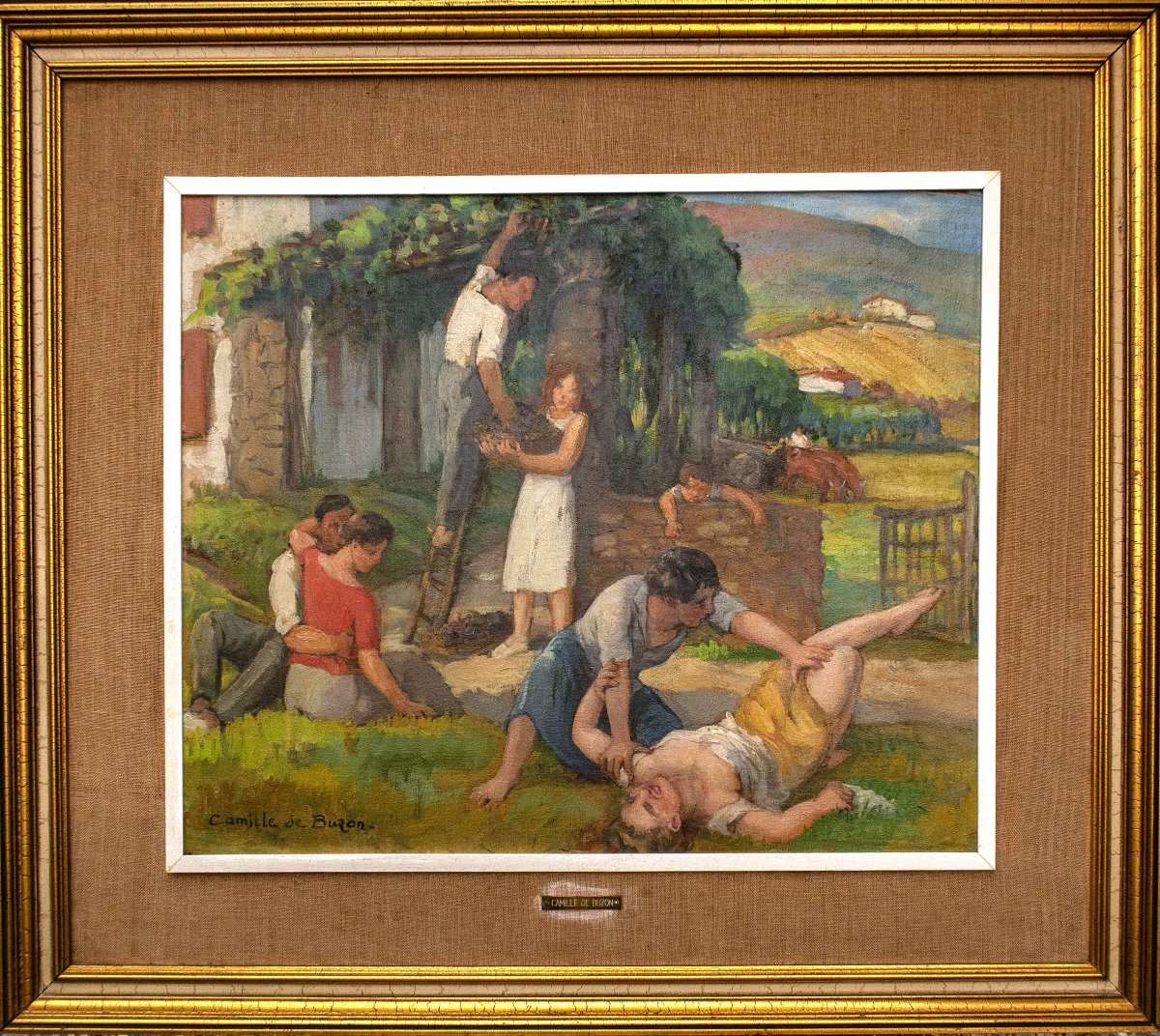
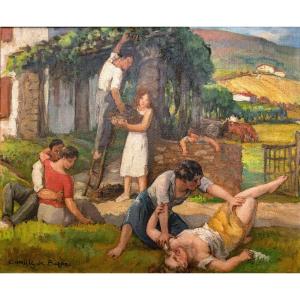


Camille De Buzon (1885–1964) Grape Harvest Festival In The Basque Country Oil/panel 50 X 60
Camille DE BUZON (Bordeaux 1885 – Mérignac 1964)
“Grape Harvest Festival in the Basque Country”
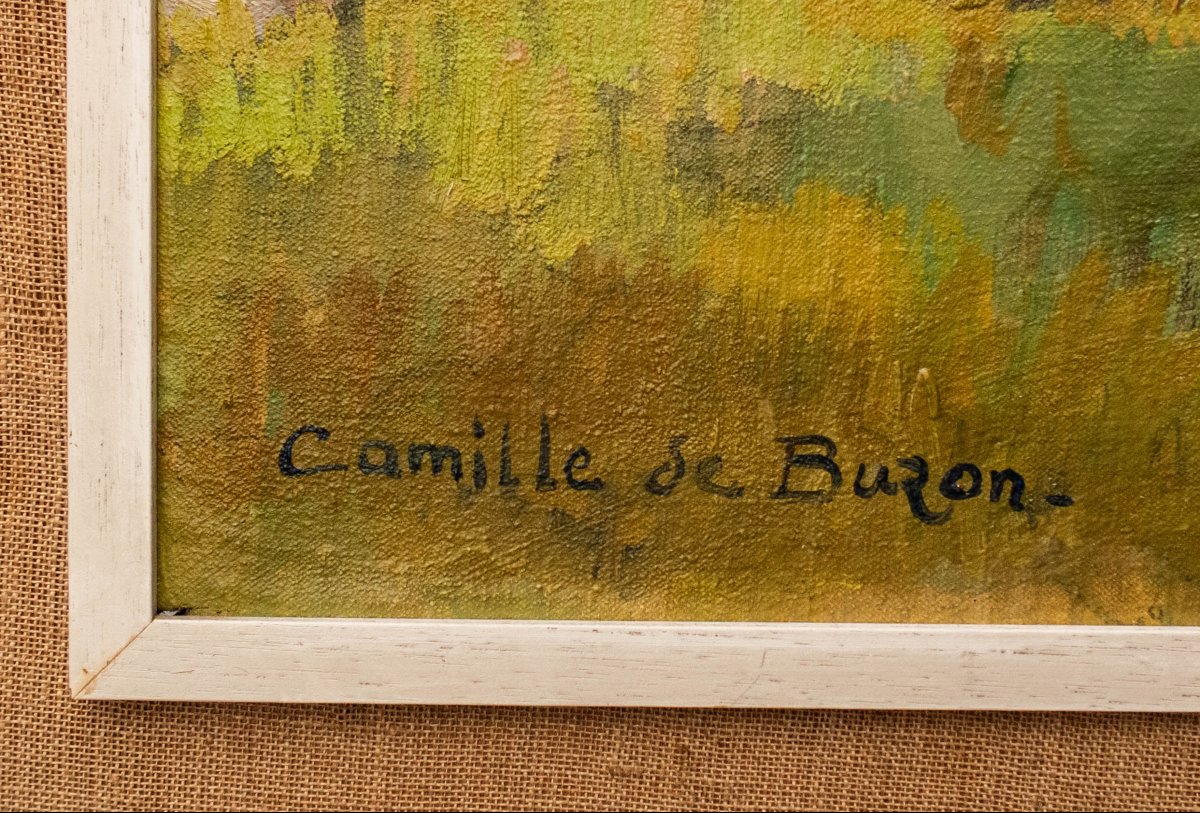
Oil on panel, signed lower left
H: 50 cm x W: 60 cm
Biography:
Photographer and painter, Camille Frédéric de Buzon was born in Bordeaux on January 18, 1885.
His mother, María Joaquina Goikoetxea, was from Erize, in Navarre, while his father was a native of Vitoria-Gasteiz.
Camille studied at the École des Beaux-Arts in Bordeaux, where he was a student of Paul Quinsac, and later at the École des Beaux-Arts de Paris, just like his brother Marius. After returning to Bordeaux, he made his first visit to Getaria, where, according to his wife Mady, “he was as captivated by the beauty of the region as by the nobility of its inhabitants (the Basques).” Between 1924 and 1929, Camille settled in Algeria, in the Kabylie region, where his brother also lived—one of the leading figures of the Algiers School. Starting in 1930, he spent his summers in Getaria and also visited other Spanish Basque towns such as Mutriku, Ondarroa, and Lekeitio, as well as Bidarray, where he often went with his friends Pierre-Albert Bégaud and René Rodes, to the point that people spoke of the “School of Bidarray” when referring to these three painters. In Bordeaux, he helped decorate the lobbies of the Bourse du Travail (the Art Deco Palace) alongside André Caverne, Albert Bégaud, and François-Maurice Roganeau, creating in 1938 a monumental fresco entitled:“The Glory of the Port of Bordeaux” in a style known as neoclassical or neo-Ingrist, which remains his best-known masterpiece. As a painter, Camille de Buzon created portraits, nudes, and genre scenes—including depictions of the port and Basque fishermen—as well as landscapes, particularly of the French and Spanish Basque Country. As a photographer, Camille de Buzon left behind nearly five hundred images in the form of 10 x 15 cm glass plates, 6 x 9 cm acetate negatives, and photographic prints. The vast majority of these images depict the Basque Country, although one album is devoted to the inhabitants of Kabylie in Algeria.His photographs also include nude models, whom he later used as subjects for his paintings. A study of his photographic archives and his paintings clearly shows that Camille used most of his photographs as sketches or, at the very least, as references for his paintings. The Bordeaux Museum of Fine Arts in Bordeaux houses some of his paintings.
“Grape Harvest Festival in the Basque Country”
Oil on panel, signed lower left
H: 50 cm x W: 60 cm
Biography:
Photographer and painter, Camille Frédéric de Buzon was born in Bordeaux on January 18, 1885.
His mother, María Joaquina Goikoetxea, was from Erize, in Navarre, while his father was a native of Vitoria-Gasteiz.
Camille studied at the École des Beaux-Arts in Bordeaux, where he was a student of Paul Quinsac, and later at the École des Beaux-Arts de Paris, just like his brother Marius. After returning to Bordeaux, he made his first visit to Getaria, where, according to his wife Mady, “he was as captivated by the beauty of the region as by the nobility of its inhabitants (the Basques).” Between 1924 and 1929, Camille settled in Algeria, in the Kabylie region, where his brother also lived—one of the leading figures of the Algiers School. Starting in 1930, he spent his summers in Getaria and also visited other Spanish Basque towns such as Mutriku, Ondarroa, and Lekeitio, as well as Bidarray, where he often went with his friends Pierre-Albert Bégaud and René Rodes, to the point that people spoke of the “School of Bidarray” when referring to these three painters. In Bordeaux, he helped decorate the lobbies of the Bourse du Travail (the Art Deco Palace) alongside André Caverne, Albert Bégaud, and François-Maurice Roganeau, creating in 1938 a monumental fresco entitled:“The Glory of the Port of Bordeaux” in a style known as neoclassical or neo-Ingrist, which remains his best-known masterpiece. As a painter, Camille de Buzon created portraits, nudes, and genre scenes—including depictions of the port and Basque fishermen—as well as landscapes, particularly of the French and Spanish Basque Country. As a photographer, Camille de Buzon left behind nearly five hundred images in the form of 10 x 15 cm glass plates, 6 x 9 cm acetate negatives, and photographic prints. The vast majority of these images depict the Basque Country, although one album is devoted to the inhabitants of Kabylie in Algeria.His photographs also include nude models, whom he later used as subjects for his paintings. A study of his photographic archives and his paintings clearly shows that Camille used most of his photographs as sketches or, at the very least, as references for his paintings. The Bordeaux Museum of Fine Arts in Bordeaux houses some of his paintings.
6 500 €
Period: 20th century
Style: Art Deco
Condition: Excellent condition
Material: Oil painting on wood
Width: 60
Height: 50
Reference (ID): 1814495
Availability: In stock
Print