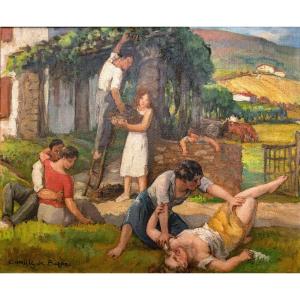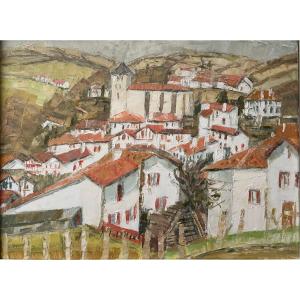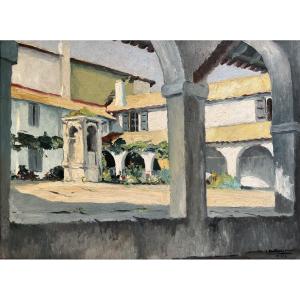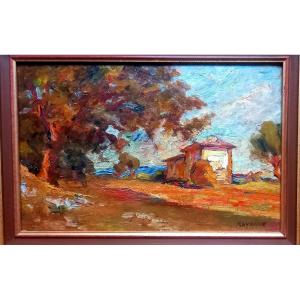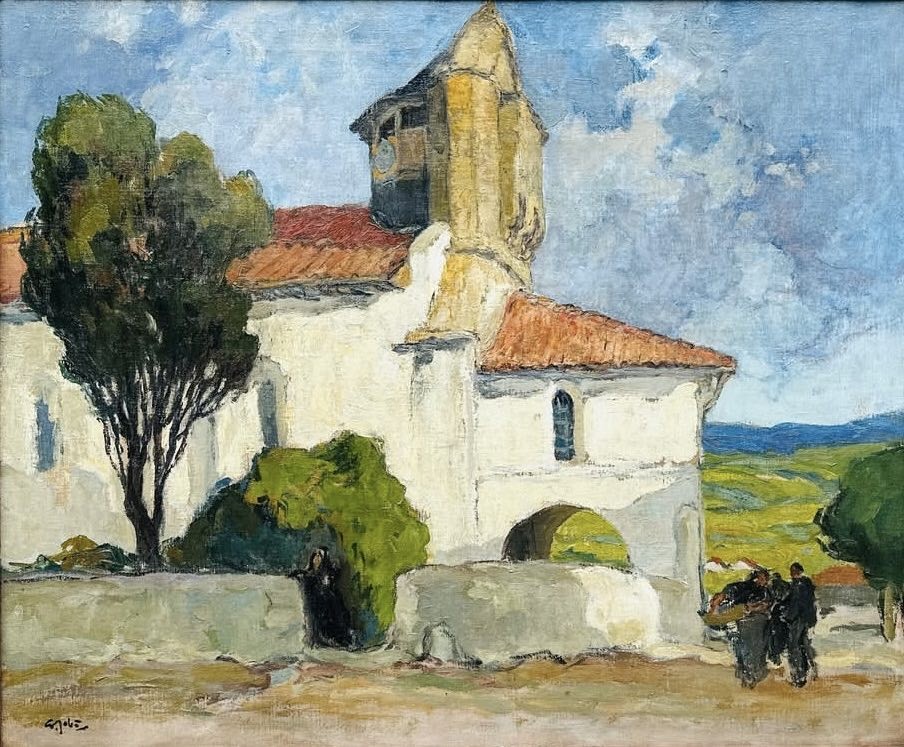
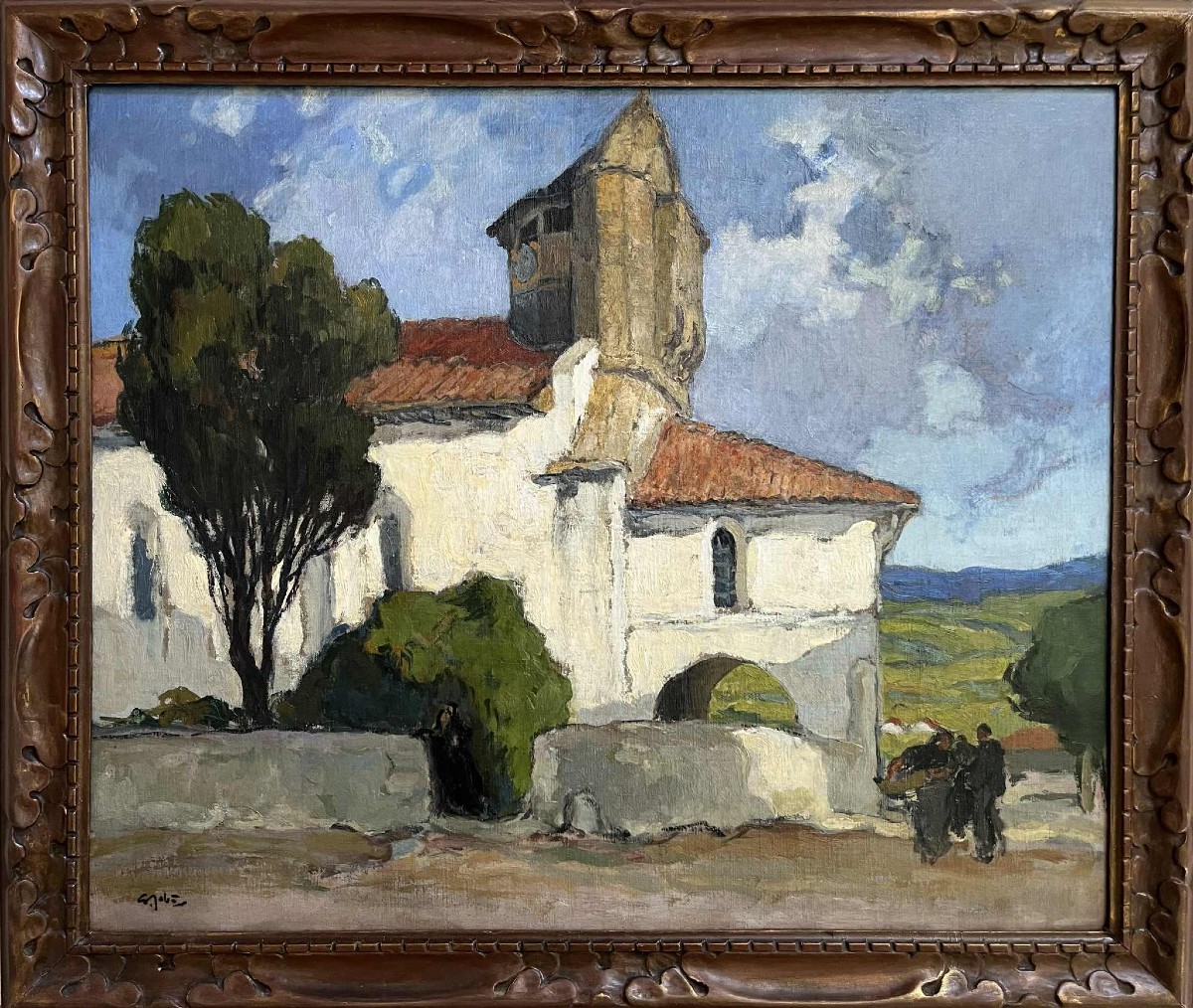

Georges Gobo (1876 – 1958) “animated View Of The Church Of Bidart” - Basque Country - Oil On Canvas, 54.5 X 65 Cm
Georges GOBO (San Francisco 1876 – Rezé 1958) “Lively View of the Church of Bidart” Oil on canvas, signed lower left. Dimensions: 54.5 cm x 65 cm. Georges Gobeau, known as Gobo, was born on June 19, 1876, in San Francisco, where his father, from the Charente region of France, had gone to seek his fortune after fighting in the Mexican-American War. His father died in 1882, and the family returned to France, to Angoulême, where young Georges apprenticed as a draftsman with a printer and lithographer. At the age of twenty-four, he settled in Angers. His time in Angers was pivotal. His talent blossomed. Watercolor, drawing, pastel, lithography, oil painting, then etching, wood engraving, and even batik: he successfully experimented with all these techniques on his own, having never attended art school; he was entirely self-taught. The Society of Friends of the Arts provided him with his first exhibition in December 1900, at its annual salon. Initially, however, his profession was that of an advertising illustrator: brochures and menus, calendars, labels, trade catalogs, and postcards were all illustrated with his whimsical pencil. He designed splendid calendars and a highly acclaimed series of color postcards. In 1907, he attempted his first etchings on pieces of zinc guttering and printed them himself. A first attempt, a resounding success… The first signs of recognition came in 1908, a pivotal year in which he was accepted into the salon of the National Society of Fine Arts with two of his vigorous and powerful etchings. This year, in which he exhibited for the first time in Paris, also saw the creation of the Society of Original Black Engraving, of which he was a founding member. From then on, he regularly participated in the salons of the "Nationale" and the events of the Société de la Gravure en Noir, especially since he had settled in Paris in 1911, without, however, abandoning the exhibitions in Angers where, every year, he contributed to the annual salon of the Société des Amis des Arts. The State purchased his works, and laudatory articles followed one after another. Critics emphasized his extraordinary visual acuity, which allowed him to capture both landscapes and the teeming crowds of a market. Gobo was a perfectionist, never satisfied with the result. He amassed sketchbooks, produced preliminary sketches, then numerous small-format versions, before arriving at the final work. He tried his hand at painting, art books, color etching, and wood engraving, but abandoned these last two techniques, which were ill-suited to the impetuousness of his line. Each year he travels, from the Netherlands to Spain, from Germany to Italy and the Basque Country, but spends most of his time in Brittany, his beloved region, at his home in Douarnenez. A tireless worker, he exhibits several times a year in the most prestigious Parisian galleries—Bernheim, Durand-Ruel, and others—as well as in other parts of France and abroad. Gobo's talent is recognized by prestigious awards and nominations. He is awarded the Puvis de Chavannes Prize, the Grand Prix of the Société Nationale des Beaux-Arts, in 1933. He serves on the jury of the 1937 International Exposition and receives several gold medals in the painting, engraving, and art book sections in which he exhibits. The Société Nationale des Beaux-Arts awarded him the Grand Prix for engraving in 1939, the Charles Cottet Prize in 1945, and the Gillot-Dard Grand Prix for composition in 1950 for his painting *The Resurrection of Lazarus*. After a period of glory, Gobo's situation became more difficult in the late 1930s, faced with the rise of the new Cubist and abstract schools that diverted the world's attention away from figurative traditions. The artist remained modest, tirelessly researching and drawing. He died in 1958 in Rezé, near Nantes. His work remains a testament to his great talent: virtuosic, spontaneous, and imbued with keen sensitivity.
2 200 €
Period: 20th century
Style: Modern Art
Condition: Excellent condition
Material: Oil painting
Width: 65
Height: 54,5
Reference (ID): 1689721
Availability: In stock
Print