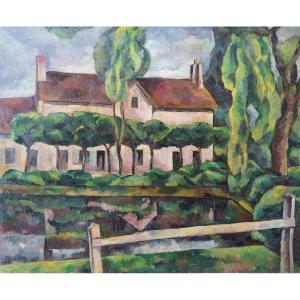
"Louis Floutier (1882 - 1936) Woman In The Rue Agorette In Ciboure Oil On Panel 25x33 Cm"
Louis FLOUTIER (Toulouse 1882 - Saint-Jean-de-Luz 1936) Woman in the Rue Agorette in Ciboure Oil on panel, signed lower right H: 25.5 cm x W: 33 cm Inventory No. 1544 in the catalogue raisonné of Louis Floutier by Mary-Anne Prunet. Louis-Benjamin Floutier (Toulouse 1882- Saint-Jean-de-Luz 1936) was not born in the Basque Country, but in Toulouse, in 1882. It was there, at the École des Beaux-Arts, that he began his artistic training. A prize-winner at the school, he went on to the École des Beaux-Arts in Paris, from which he also graduated. Very quickly, he accumulated awards and began to make a name for himself. The war, however, would disrupt his career. A volunteer in the army, he decided to put his art at the service of his country and joined the 13th Artillery Regiment and the 1st Engineer Regiment as a camouflage specialist. In 1919, with the war over, he did not return to Paris, but settled in Saint-Jean-de-Luz and, with Lukas and Etienne Vilotte—two artists he had met in the trenches—founded the Ciboure art pottery workshop. He worked there for two years, decorating stoneware pottery and creating a new Basque Art Deco style that blended forms and inspirations from Ancient Greece with a modern Basque regionalism. In 1922, he set up his own studio in the Pergola in Saint-Jean-de-Luz and devoted himself to painting the Basque Country, its landscapes, customs, and people. Floutier was a wonderful landscape painter who belonged to the Impressionist movement, and to whom we owe the popularization of the Basque Country. At his death in 1936 in Saint-Jean-de-Luz, he left behind more than a thousand works, now scattered in private and public collections. 












 Le Magazine de PROANTIC
 TRÉSORS Magazine
 Rivista Artiquariato