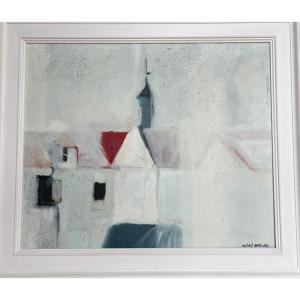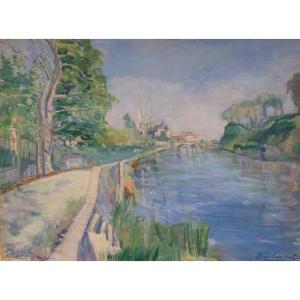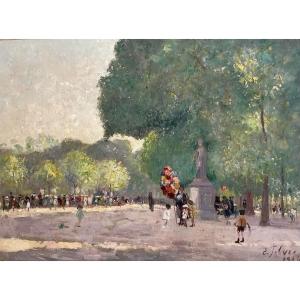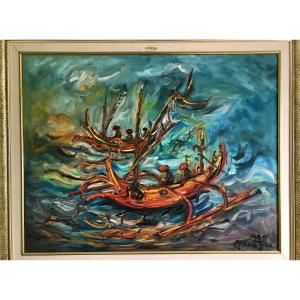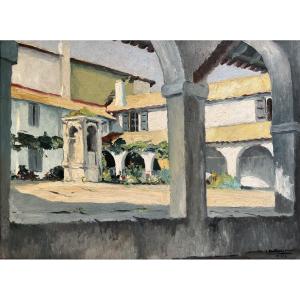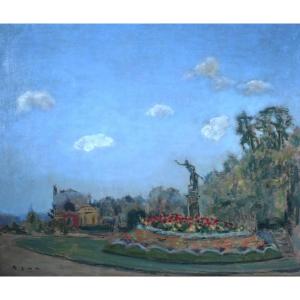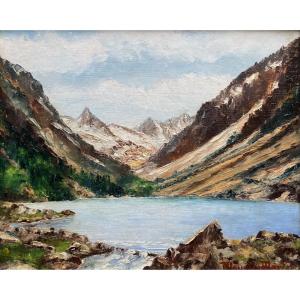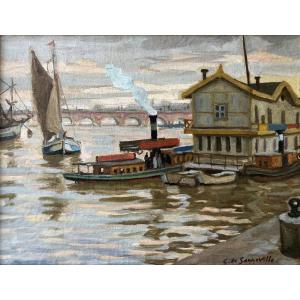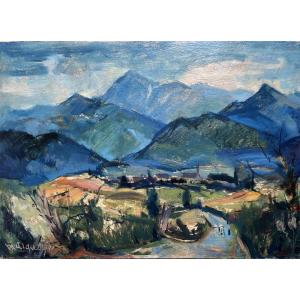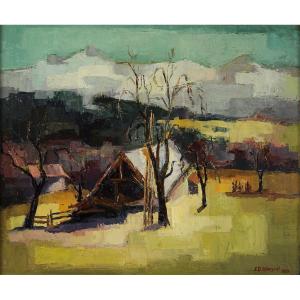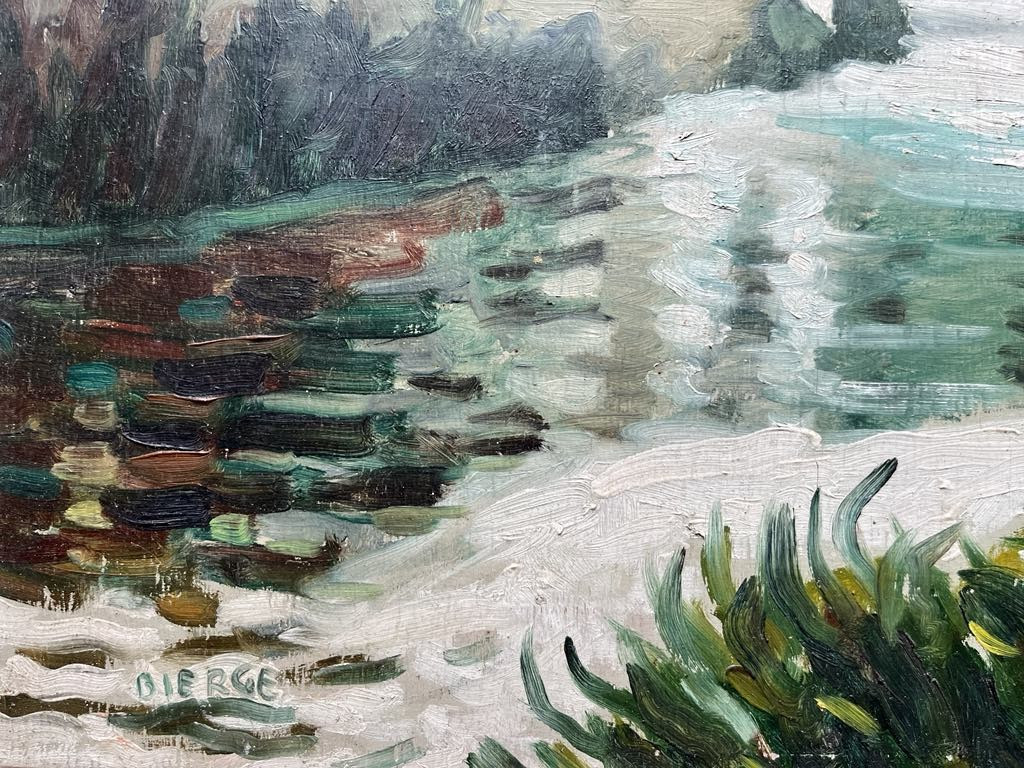


Roland Bierge (1922 – 1991) “st-etienne-de-baïgorry” - Basque Country (1945) Hsp 38 X 46 Cm
Roland BIERGE (Boucau 1922 – Saint-Antoine 1991) Grey weather in St-Etienne-de-Baïgorry (1945) Oil on panel signed lower left Titled on the backStencil stamp from the canvas supplier P. Richer / Paris Dimensions: 38 x 46 cm Roland Bierge was born in 1922 in Boucau (Basses-Pyrénées), to a French father and a Spanish mother. In 1936, the young boy abandoned his studies to join his father's painting business. At the same time, he attended evening classes in Applied Arts in the City of Bayonne, where his teacher immediately noticed him. Very early on, the young man dreamed of becoming a painter. The war broke out and he worked as an autodidact. He exhibited once or twice with a group of painters from Biarritz (Les Saltimbanques). Deported to Germany, he eluded the German authorities and remained hidden on a farm in the Landes region until the Liberation. Roland Bierge returned to his father's business in 1945, but he had no ambition to take it over. He left for Paris in 1946, but his beginnings were difficult. He was hired as a set designer at the Comédie Française. The young artist worked alone and visited museums to quench his thirst for knowledge. The Van Gogh retrospective at the Musée de l'Orangerie des Tuileries in 1947 was a real revelation for him and undoubtedly marked a turning point. He exhibited a painting for the first time at the Salon des Indépendants. Three years later (1950), the painting he presented at the same Salon des Indépendants was critically acclaimed. He had his first solo exhibition in Paris (Galerie La Boétie) and from then on participated in group exhibitions such as Vendémiaires alongside Jacques Villon, André Marchand, Antoni Clavé, and Bernard Buffet. Group exhibitions will now follow one another: Salon d'Automne, Salon des Jeunes Peintres, Salon Comparaisons, Salon de Mai (from 1969), etc. In 1953, the State bought a painting from him ("Tasse jaune et pomme"), then the City of Paris, the following year. That same year (1954), he exhibited with the "Rencontres" group with Edouard Pignon, among others. Until his death, Roland Bierge will exhibit regularly (in France, but also abroad), receiving, over the years, several prizes and honorary awards. Landscapes, portraits, nudes and still lifes are his favorite subjects. As a painter, he will also approach the techniques of pastel, lithography and stained glass (Church of Bouchevilliers in Eure). While Roland Bierge, attracted by the work of Jacques Villon and André Lhote in the 1950s, created in a post-Cubist manner, his style gradually evolved. He moved from drawing to purity and the exaltation of colors in the 1960s: "Bierge's art suggests more than it describes; it is at the frontiers of stable forms that impose themselves and those that vanish into dreams and the imagination," wrote Jean-Albert Cartier after a New York exhibition. The artist is now adept at a sort of union between abstraction and figuration. From 1969 onwards, Roland Bierge gradually took liberties with drawing to cross the transition to non-figuration, revealing a palette of dazzling polychromy. The Polychromies marks his final period. It is the art of balance and harmony of colors. Roland Bierge died in 1991 in Saint-Antoine (Gers). His work is part of what is commonly called the New School of Paris. "Pure, sonorous colors, great rhythms forcefully opposing shadow and light: Bierge practices abstraction with the palette of a Fauvist painter. Starting with Roger de La Fresnaye and a softened cubism, he gradually evolved towards a non-figurative art of pure, compartmentalized colors and geometric interweavings that recall, but from a distance, the art of Maurice Estève." Gérald Schurr
380 €
Period: 20th century
Style: Modern Art
Condition: Perfect condition
Material: Oil painting on wood
Width: 46
Height: 38
Reference (ID): 1600767
Availability: In stock
Print