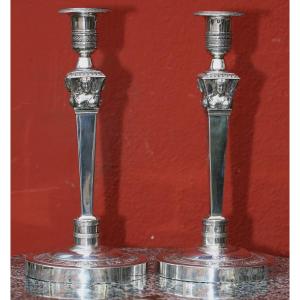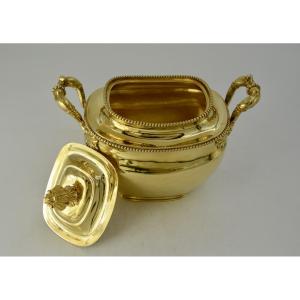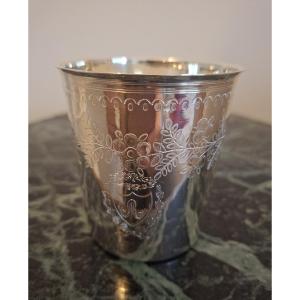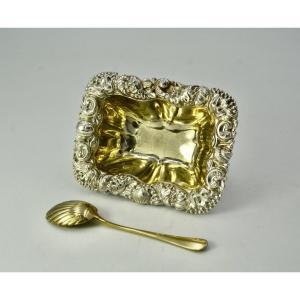
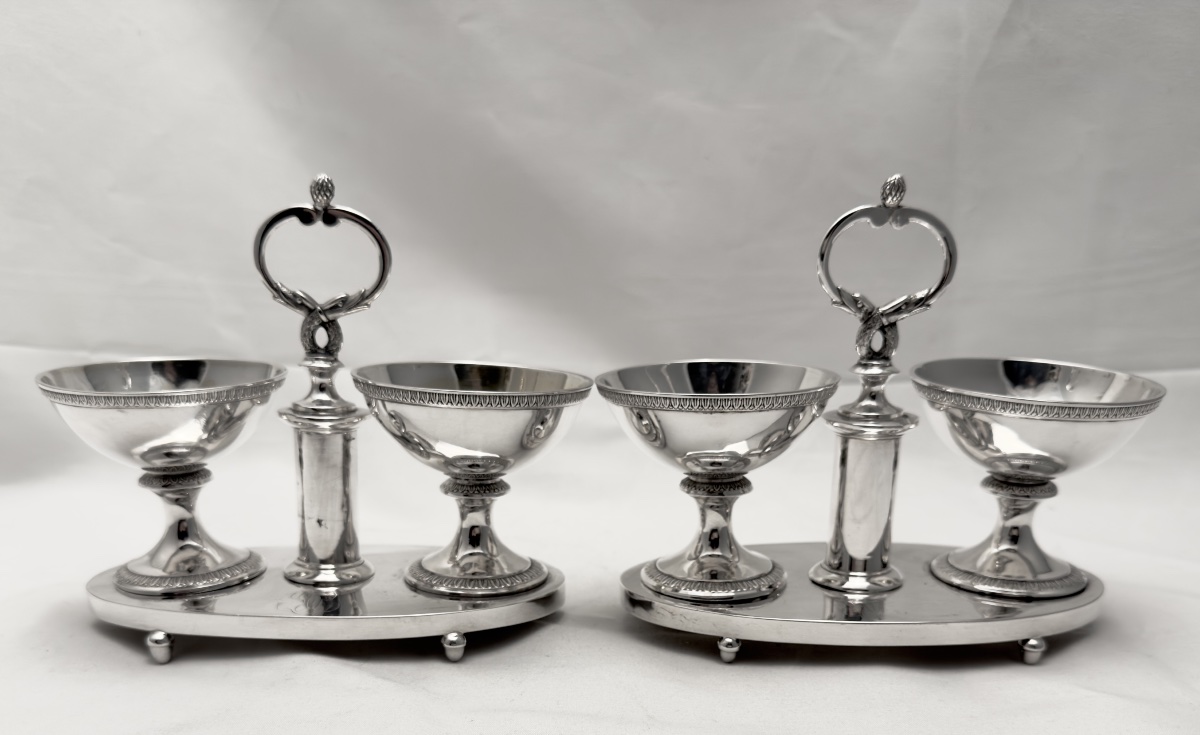


Brussels 2830-40, Josse Allard, Pair Of Double Salt Cellars In Solid Silver, Restoration Style
Pair of Solid Silver Double Salt Cellars by Josse Allard
Brussels, circa 1830–1840
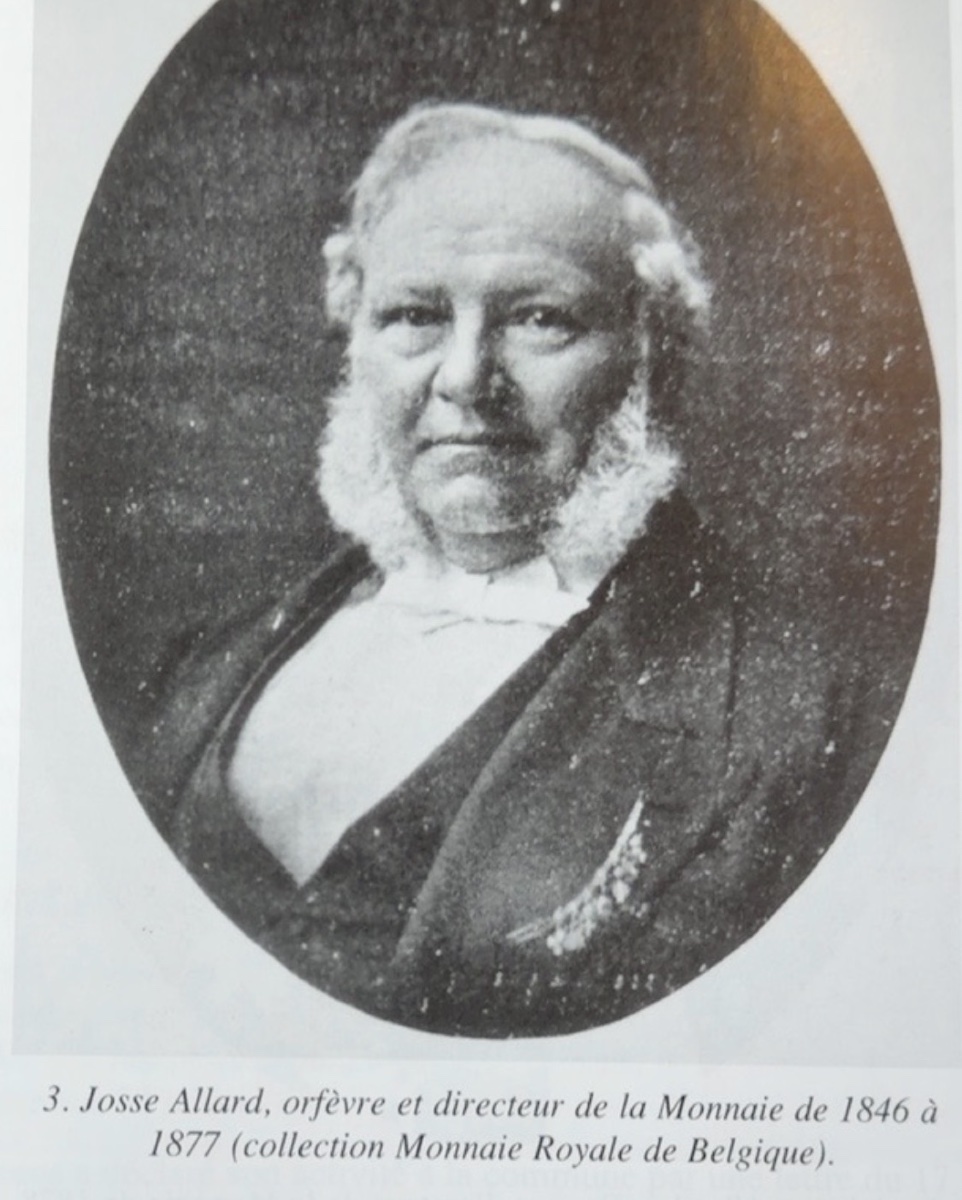
Remarkable pair of double salt cellars in solid silver, made in Brussels by Philippe Joseph Allard, known as Josse Allard (1805–1877), one of the leading Brussels silversmiths of the first half of the 19th century.
Total weight: 635 g
Height: 15 cm
Length: 17 cm
Width: 8.5 cm
Solid silver, second standard: 834/1000
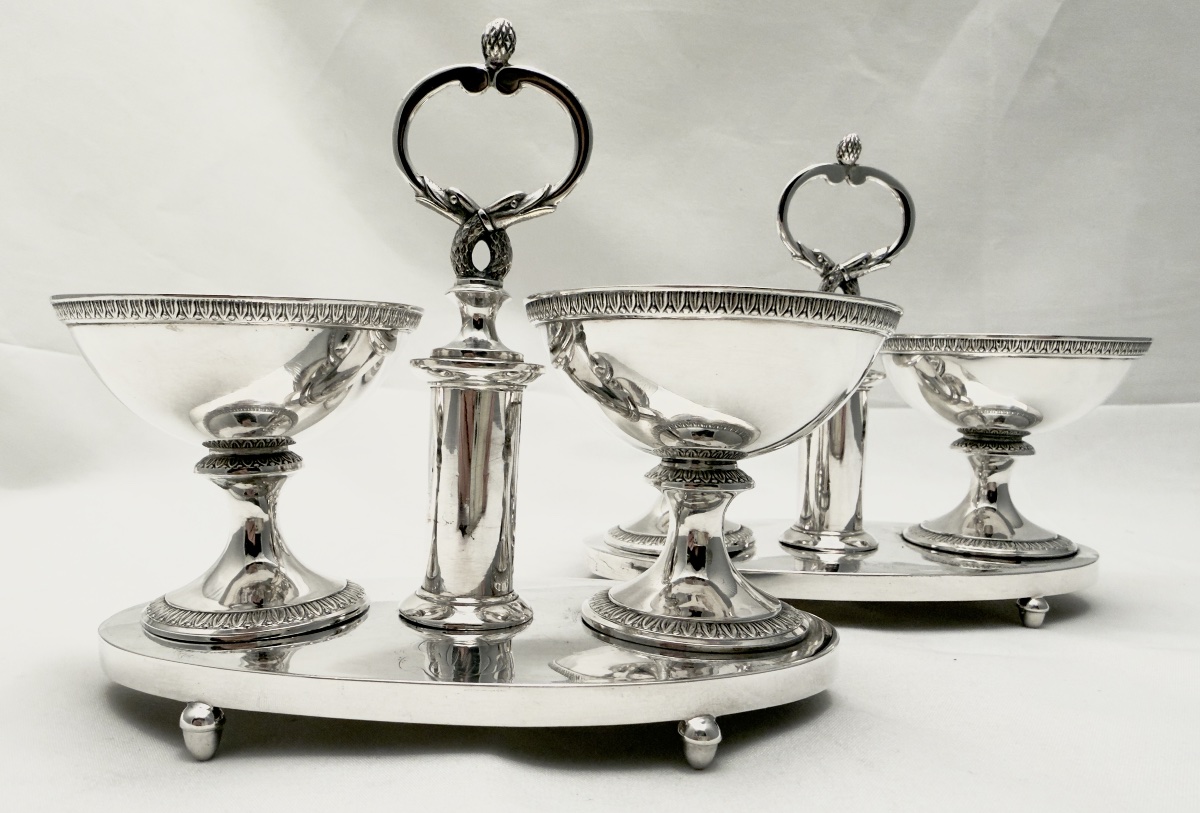
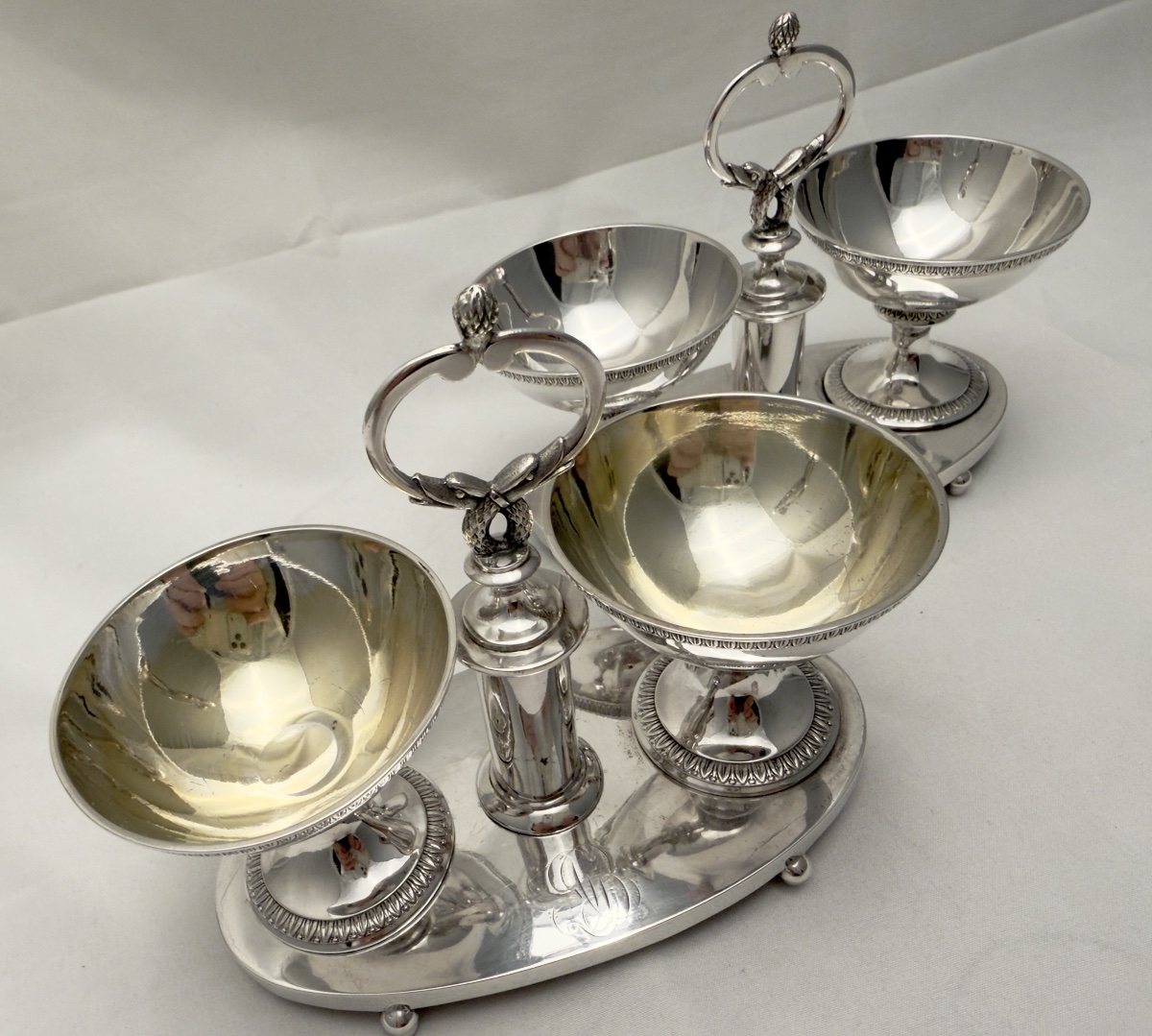
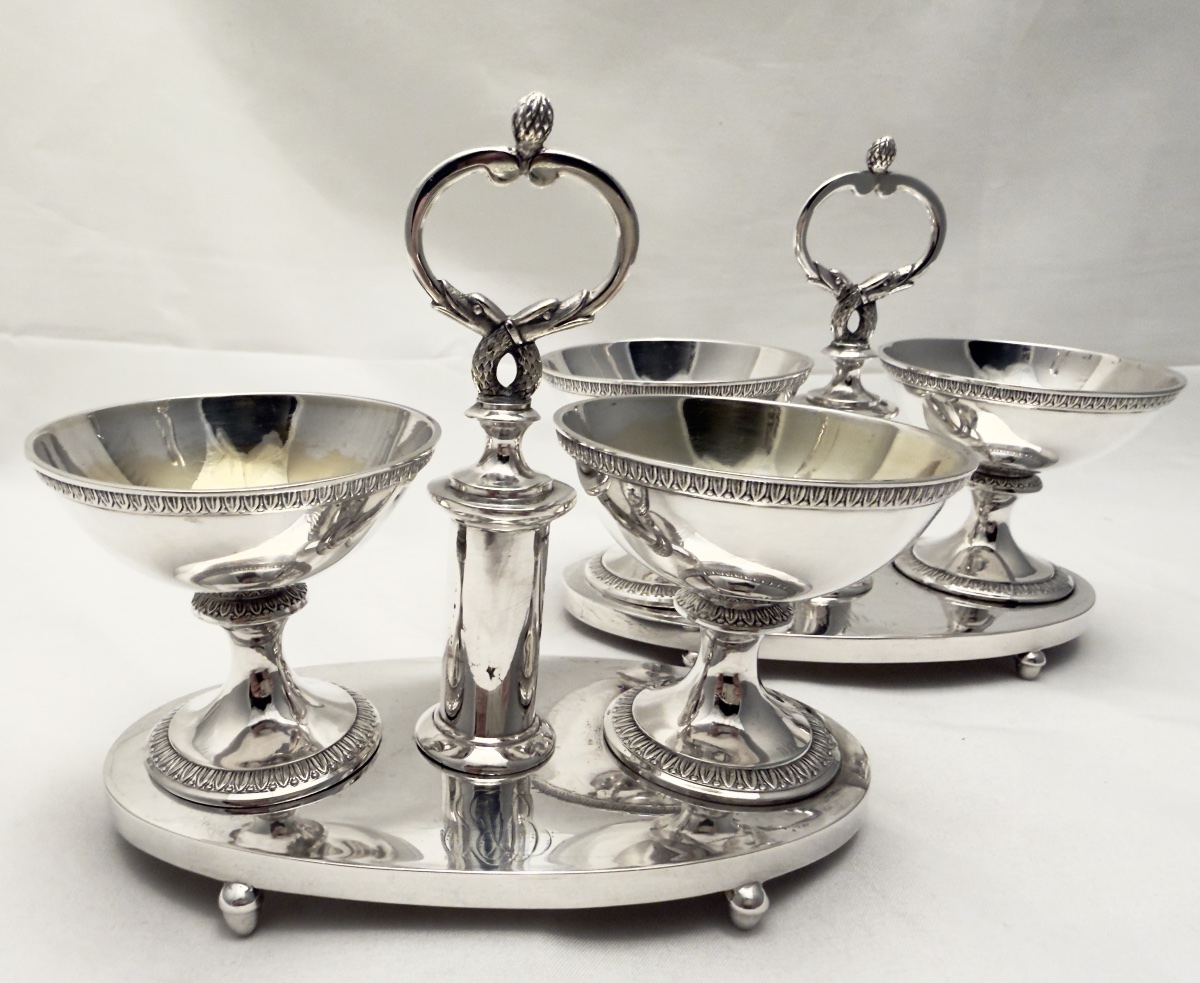
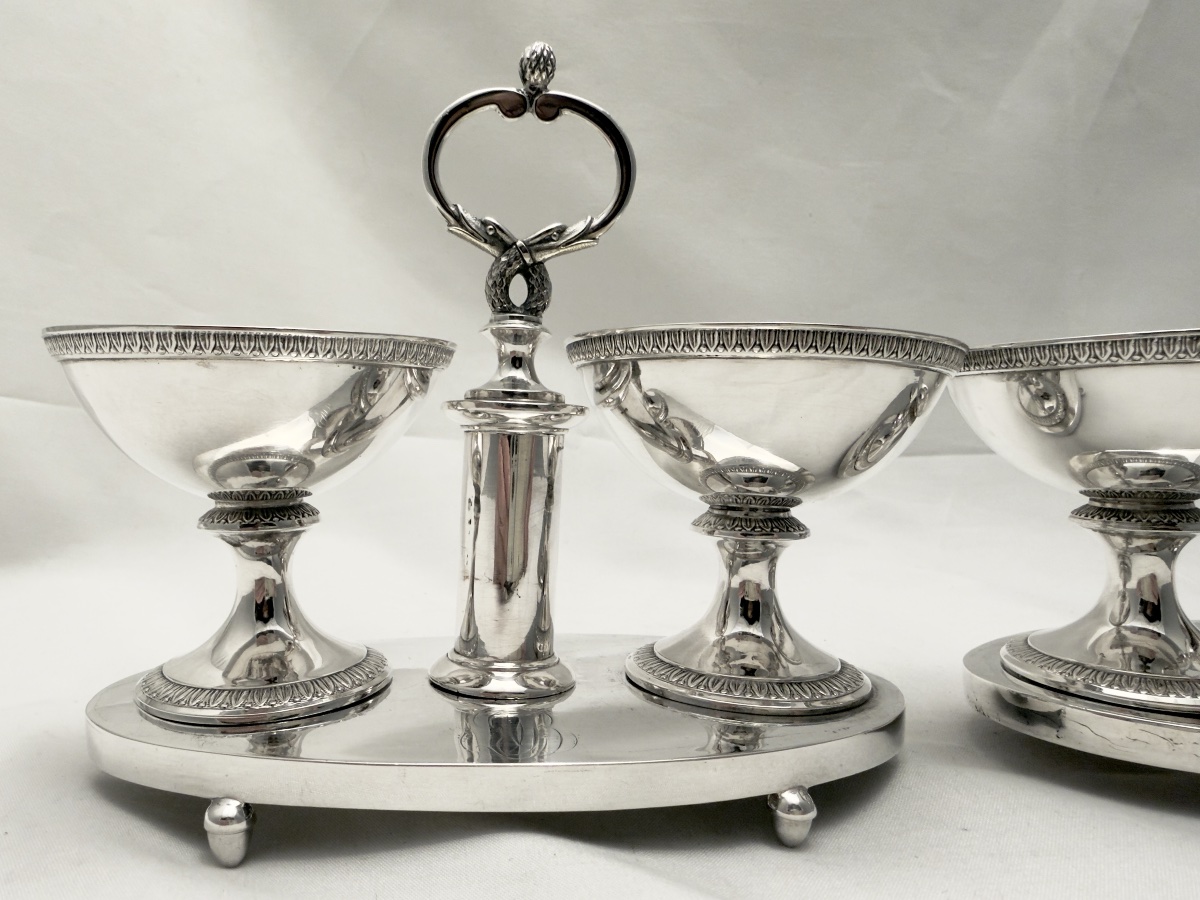
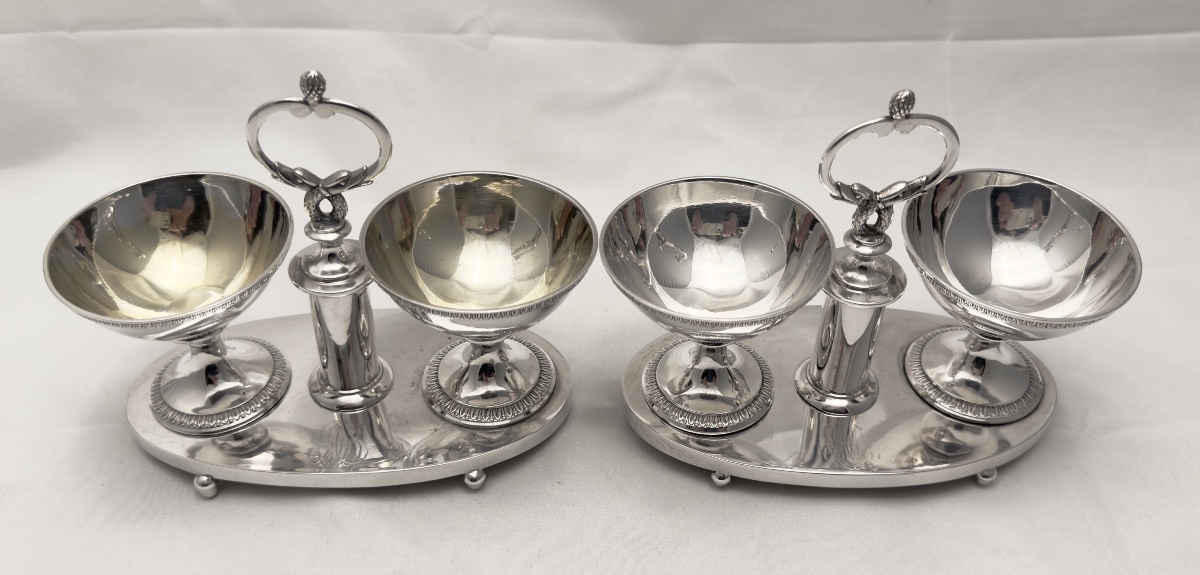
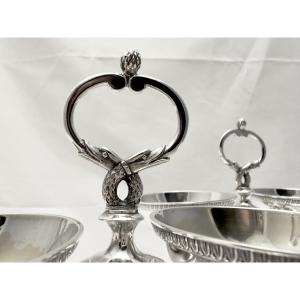
Each double salt cellar consists of an elegant oval tray resting on four ball feet and supporting two hemispherical bowls raised on spreading feet. The restrained and perfectly balanced decoration still belongs to the Neoclassical vocabulary inherited from the late 18th century and perpetuated throughout the Empire and Restoration periods. Borders of water leaves decorate the rims and bases of the bowls.
The two bowls of one of the salt cellars retain significant traces of their original gilding. In addition to its decorative purpose, this gilding protected the silver from direct contact with the salt. On the second salt cellar, the interior gilding has disappeared.
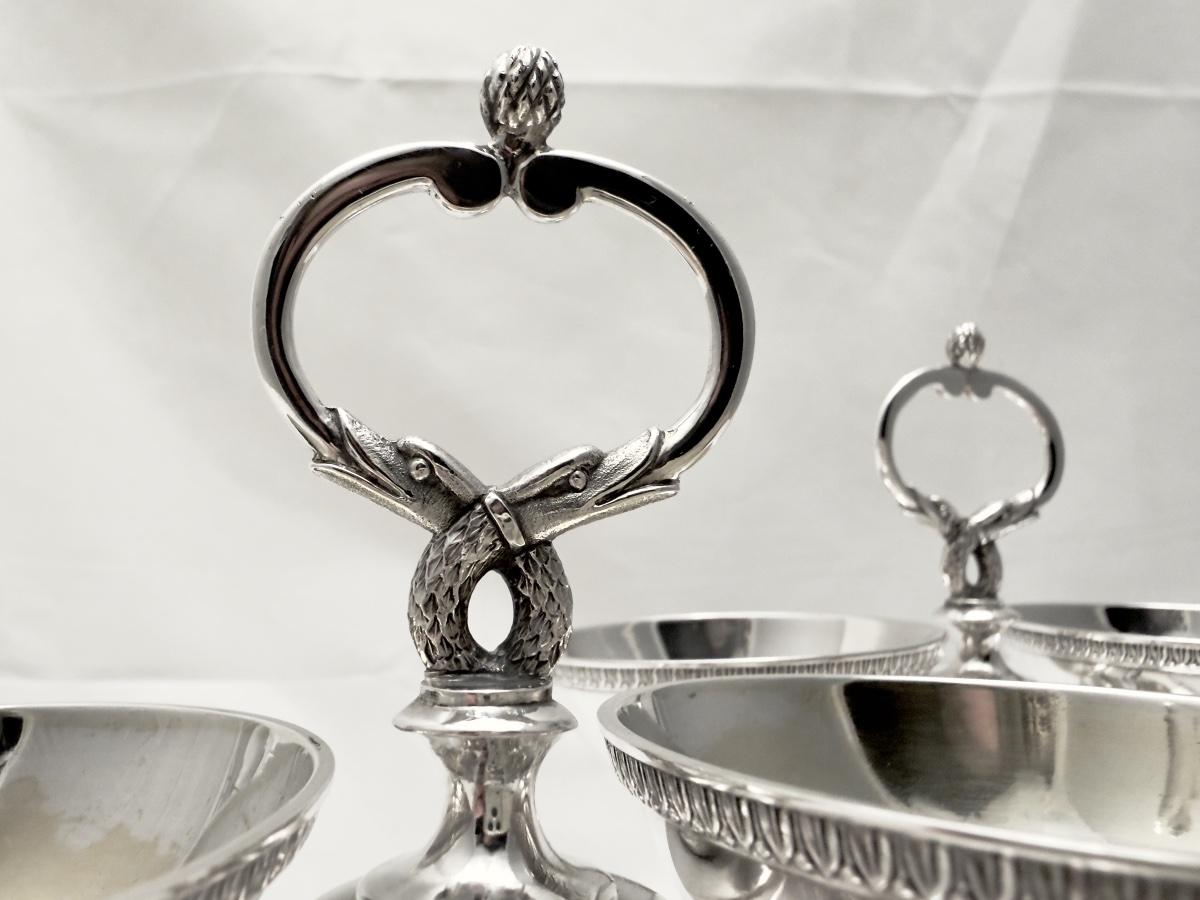
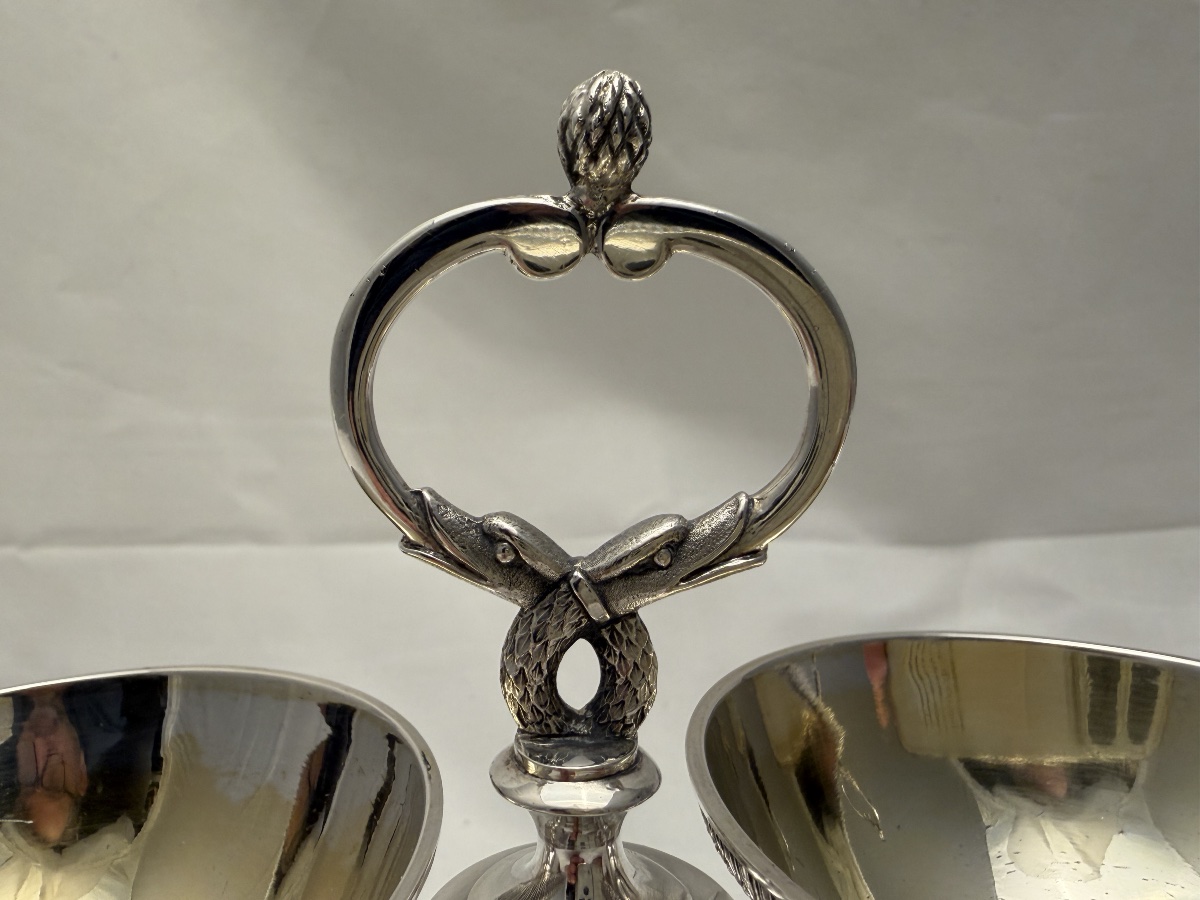
Between the two bowls rises a tall central stem supporting a remarkable sculptural handle: two confronted and intertwined dolphins support a large carrying ring surmounted by a pine-cone finial. The dolphins, water leaves and pine cone all belong to the Neoclassical and Empire ornamental repertoire that remained highly influential in the decorative arts during the first decades of the 19th century.
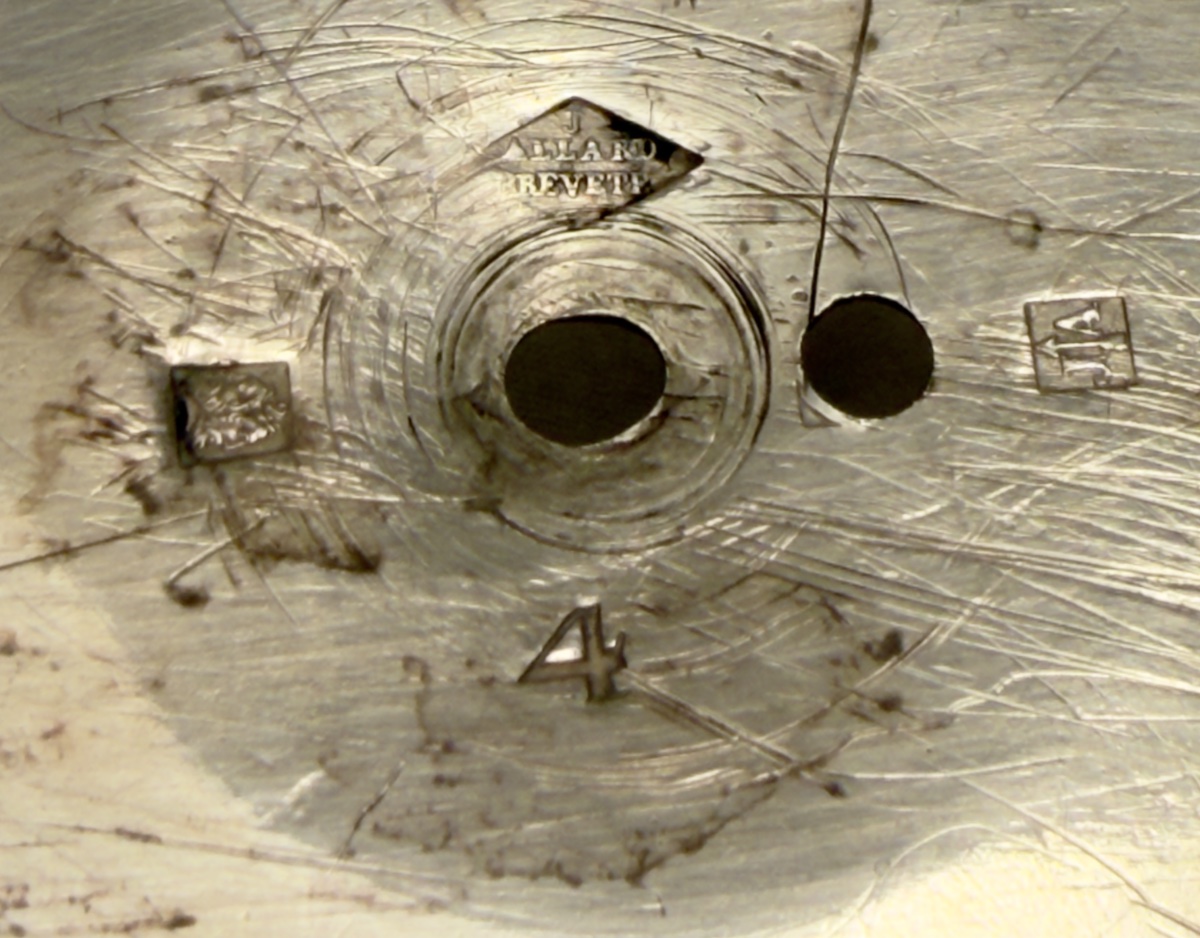
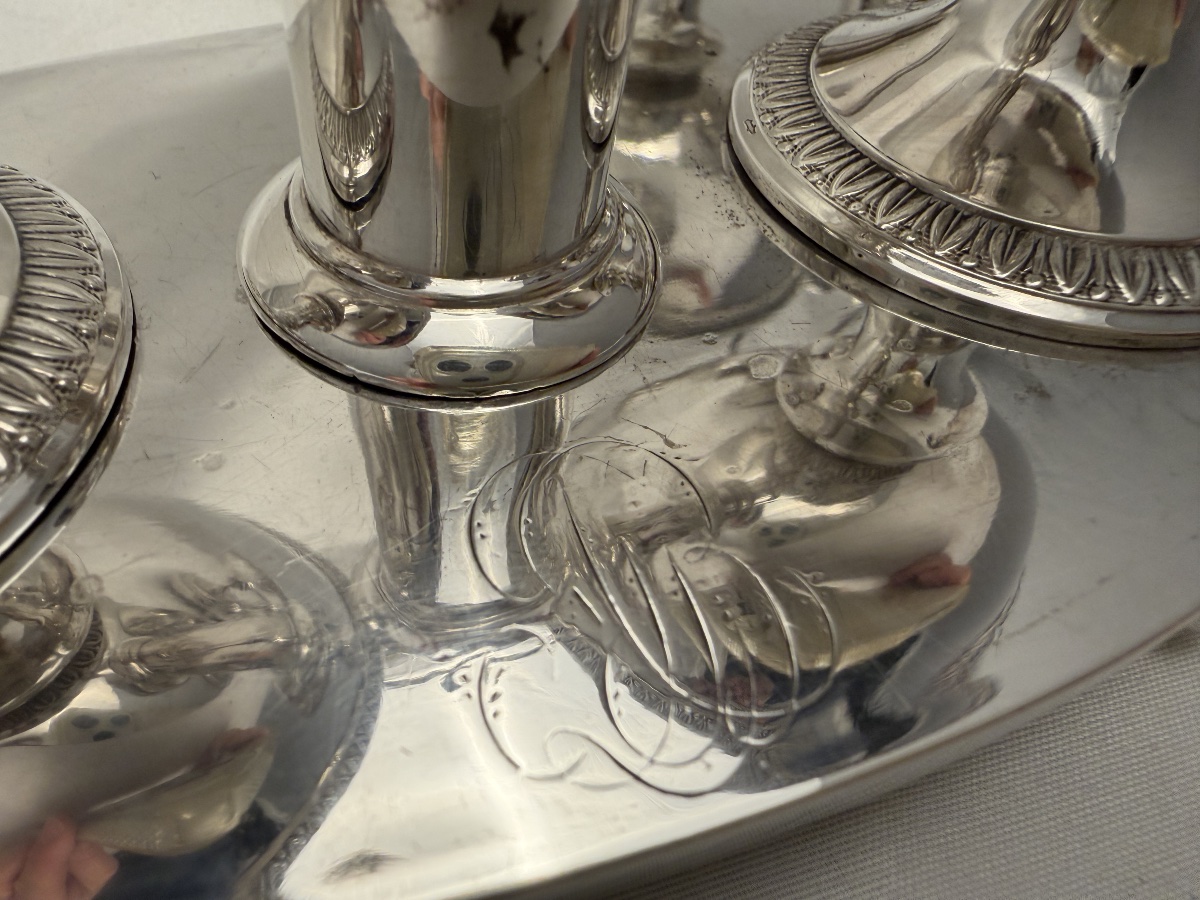
Both pieces are clearly struck with Josse Allard’s maker’s mark, the initials J and A separated by an arrow, together with the official Belgian assay marks for second-standard silver, 834/1000.
From Dutalis to Allard: A Remarkable Affinity Between Two Brussels Workshops
These double salt cellars are particularly interesting when compared with the work of Joseph Germain Dutalis (1780–1852), one of the most important Brussels silversmiths of the generation immediately preceding Josse Allard.
The comparison goes well beyond a general stylistic resemblance. A double salt cellar identical in design to the present examples, but bearing the maker’s mark of Joseph Germain Dutalis, is known in a Belgian collection. Another double salt cellar by Dutalis, illustrated in the reference monograph devoted to the silversmith by Wim Nys, likewise has an identical tray and central stem, differing only in the shape of the salt bowls themselves.
This striking affinity can also be observed in other works by the two masters: certain forms, handle attachments, spouts and decorative borders recur in the production of both workshops. This is all the more interesting because the two workshops were active simultaneously in Brussels. Wim Nys’s study of the earliest Belgian horse-racing trophies shows Dutalis and Allard succeeding one another in commissions for the Brussels races: Dutalis from 1826 to 1829, Allard in 1830, Dutalis again in 1835–1836, and Allard from 1837 to 1841.
These elements demonstrate a remarkable proximity between the two workshops and suggest a circulation of models and working practices, perhaps even some form of collaboration, although the precise nature of their professional relationship remains undocumented.
Dutalis and Allard also both belonged to the circle of silversmiths working for the Belgian Royal Household under King Leopold I, as documented by Werner Adriaenssens in his research on the silver of the Belgian Court.
Josse Allard: From Silversmith to Director of the Mint
Philippe Joseph Allard, generally known as Josse Allard, was born in Brussels on 5 February 1805. On 20 July 1827, he officially declared his profession as a silversmith and was entered in the provincial register on 1 August of that year. His workshop was then established at 28 rue des Fripiers, Brussels. His maker’s mark, consisting of the initials J and A separated by an arrow, was registered in 1827 and again in 1832.
His professional rise was remarkably rapid. By the 1840s, the patent-tax registers ranked him, as a manufacturer, among the most important silversmiths and jewellers in Brussels. His workshop supplied a distinguished clientele, including the newly established Belgian Royal Household.
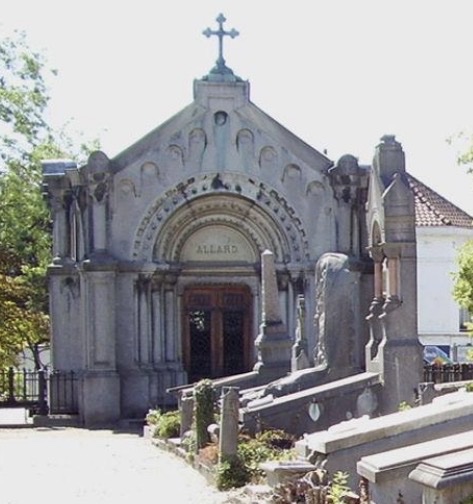
His career took a spectacular turn in 1846, when he was appointed Director of the Belgian Mint, a position he retained until his death in 1877. At the same time, he developed substantial banking interests. The former silversmith thus became both a director of coin production and a banker, laying the foundations for the remarkable economic and social rise of the Allard family.
His son Alphonse Allard, himself a silversmith, jeweller, goldsmith and precious-metal refiner, succeeded him as Director of the Mint from 1878 to 1891. Over successive generations, the Allard family amassed a considerable fortune and became one of Belgium’s prominent banking and financial dynasties.
These double salt cellars therefore belong to the early decades of Josse Allard’s exceptional career, at a time when his work remained closely connected with the great Neoclassical tradition of Brussels silver represented by Joseph Germain Dutalis.
References
Walter van Dievoet, Dictionnaire des orfèvres de Bruxelles au XIXe siècle, Leuven, 2003, pp. 24–25.
Wim Nys (ed.), Joseph Germain Dutalis 1780–1852. Orfèvre du Roi Guillaume Ier, Antwerp, Sterckshof Silver Museum, 2005.
Wim Nys, “De Brusselse zilversmid Joseph Germain Dutalis (1780–1852) en de creatie van de eerste Belgische trofeeën voor paardenrennen (ca. 1825–1840),” Tijdschrift voor Interieurgeschiedenis en Design, 2005.
Werner Adriaenssens et al., Tables en Majesté, Brussels, King Baudouin Foundation, 2012.
Archives of the City of Brussels, Police Fund and registers relating to Philippe Joseph Allard.
Period: 19th century
Style: Louis Philippe, Charles 10th
Condition: Excellent condition
Material: Sterling silver
Length: 17 cm
Width: 8,5 cm
Height: 15 cm
Reference (ID): 1812747
Availability: In stock