

Engelhard Nunzer — Joshua, Baroque Biblical Engraving — Nuremberg, Early 18th Century
Artist: Engelhard Nunzer (1661–1733)
Engelhard Nunzer — Joshua, Baroque Biblical Engraving — Nuremberg, Early 18th Century
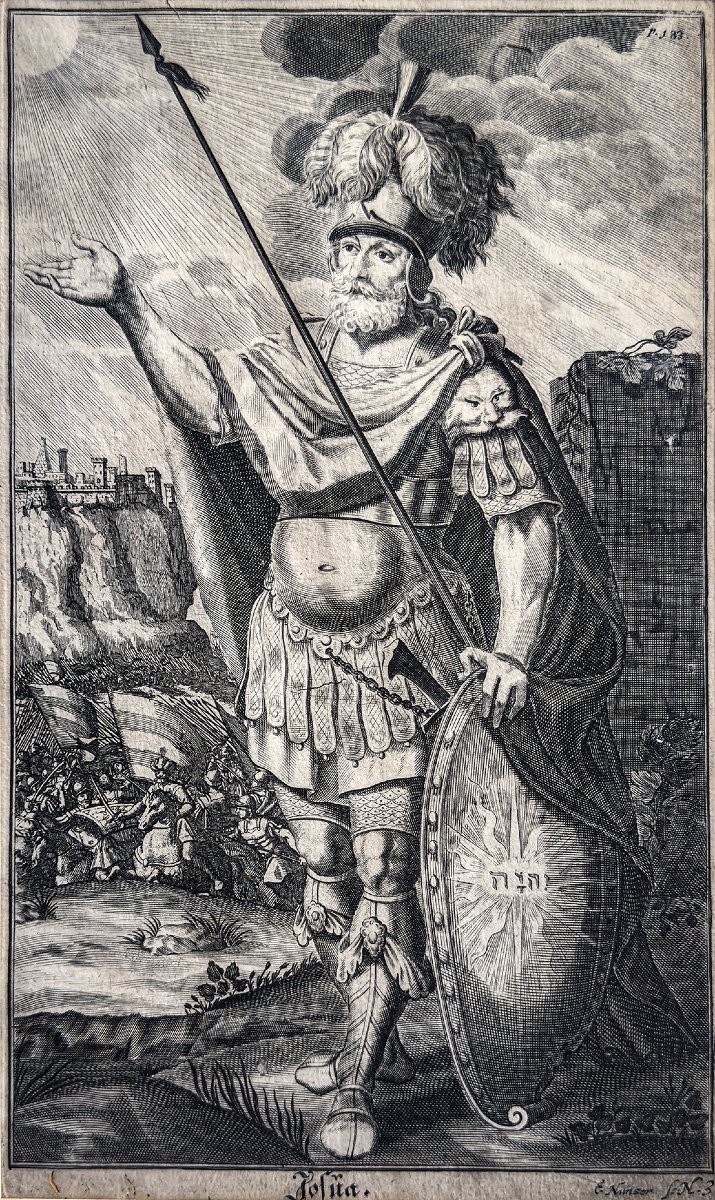
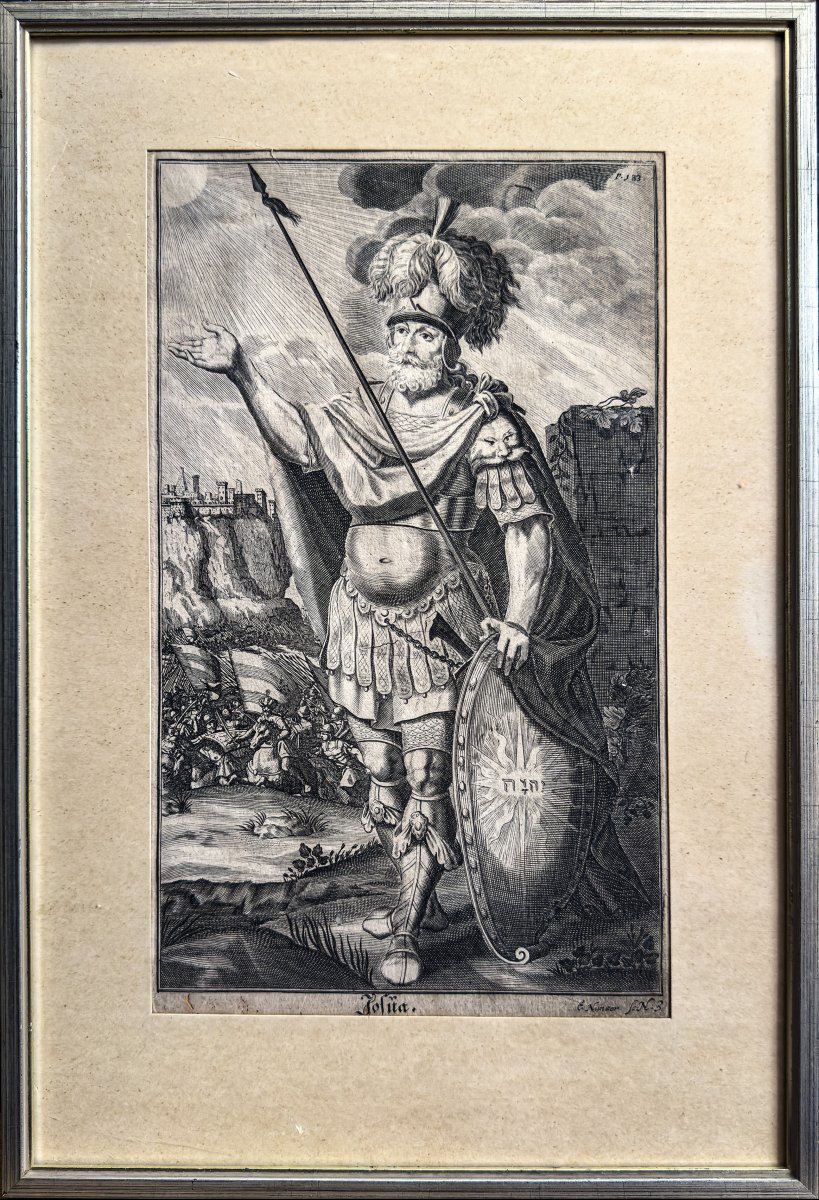
Antique copper engraving depicting Joshua, the successor of Moses and leader of the people of Israel, executed by the Nuremberg engraver Engelhard Nunzer, who died in 1733.
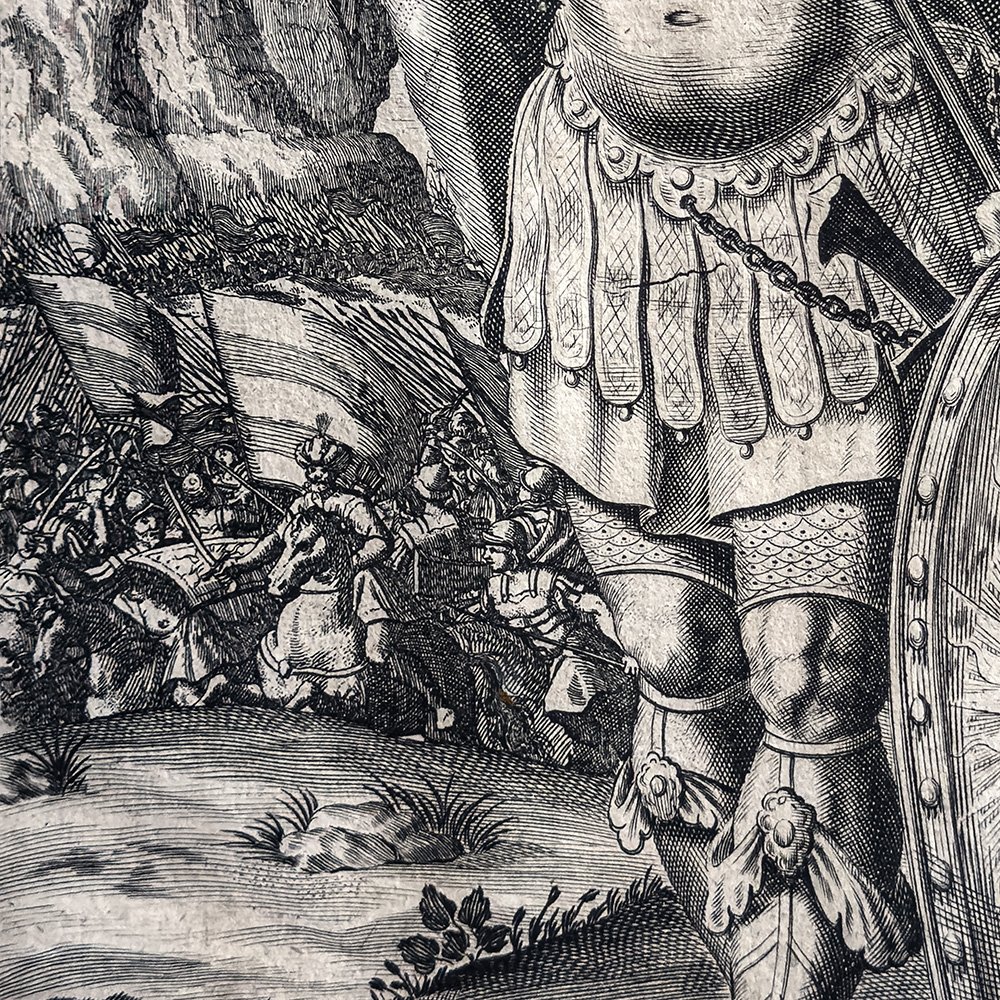
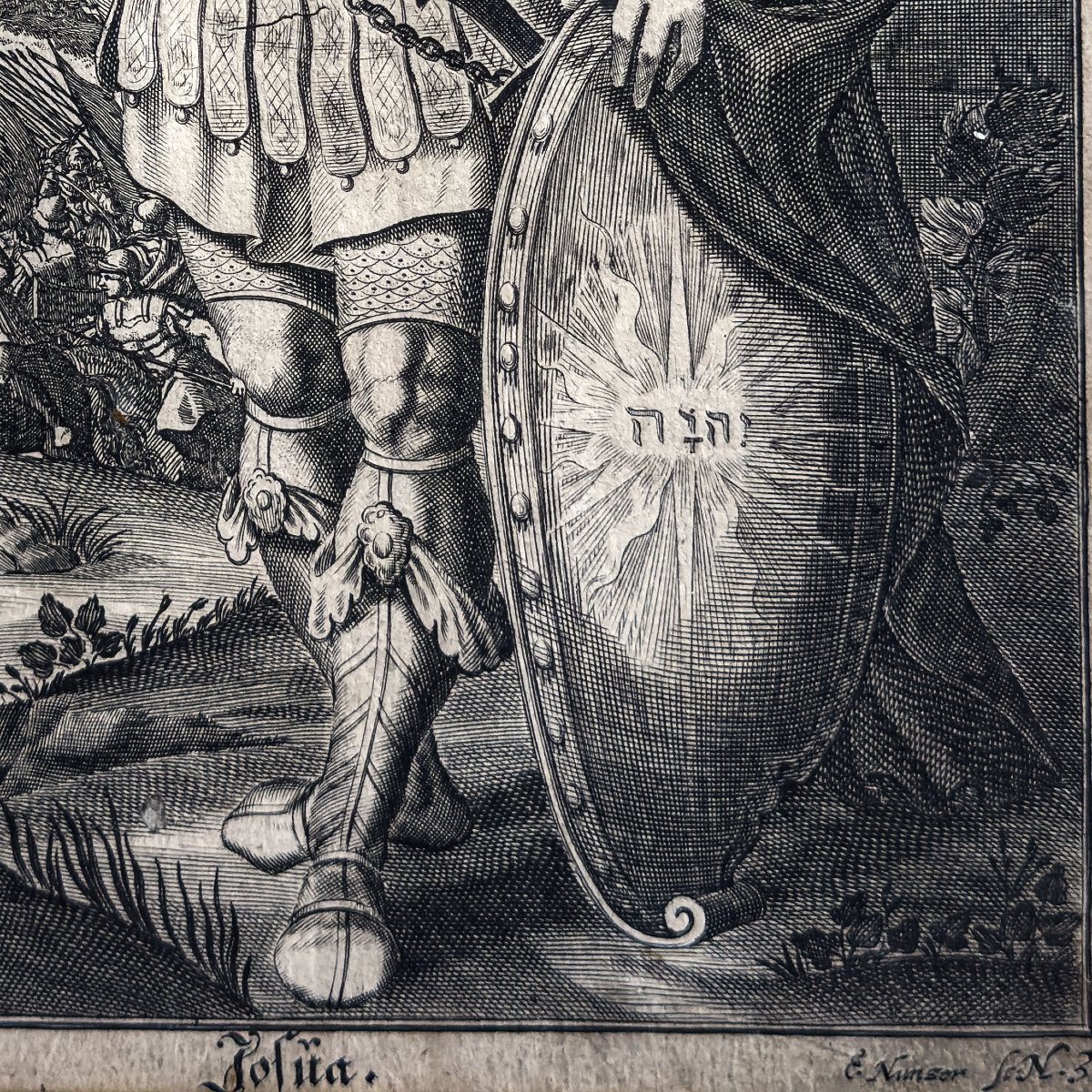
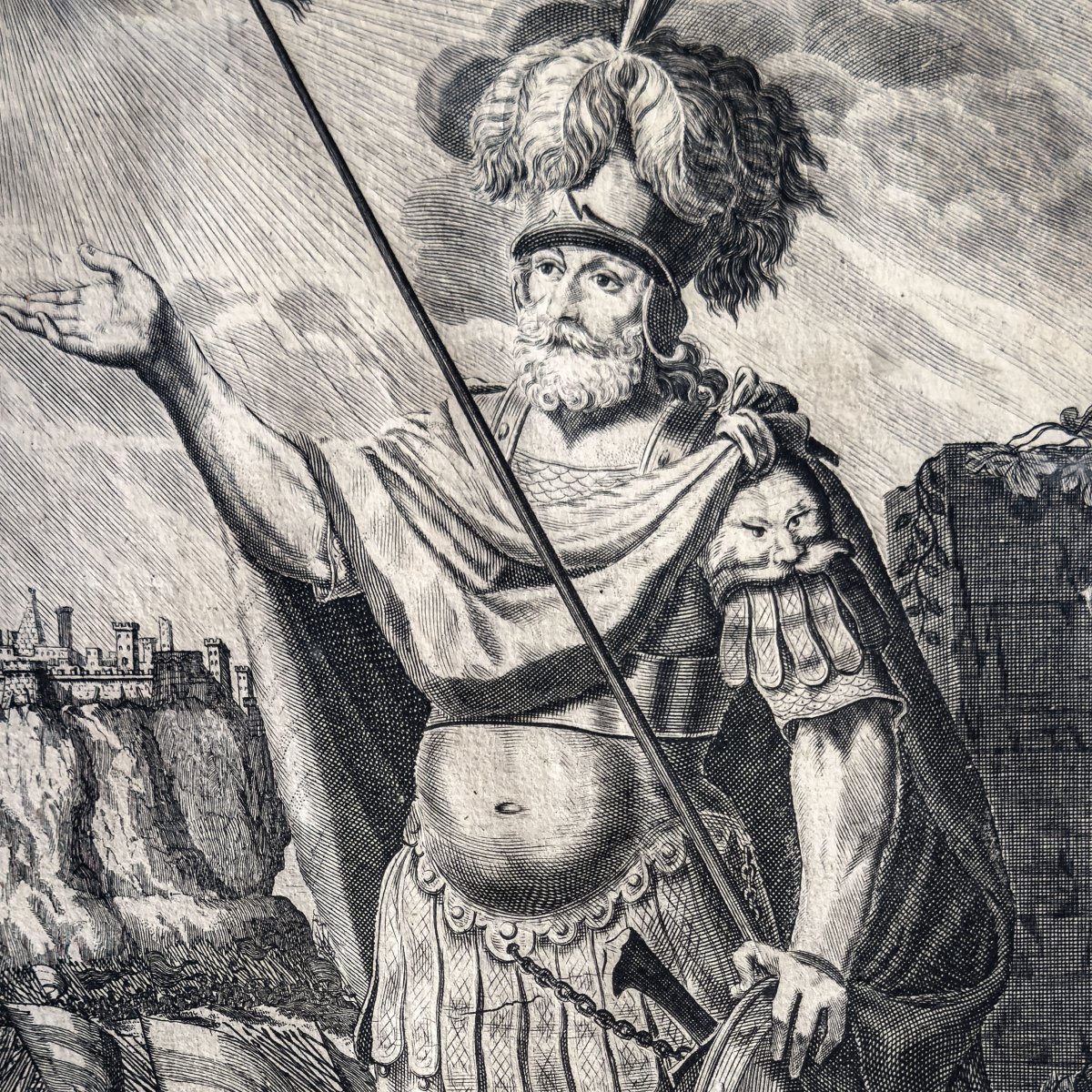
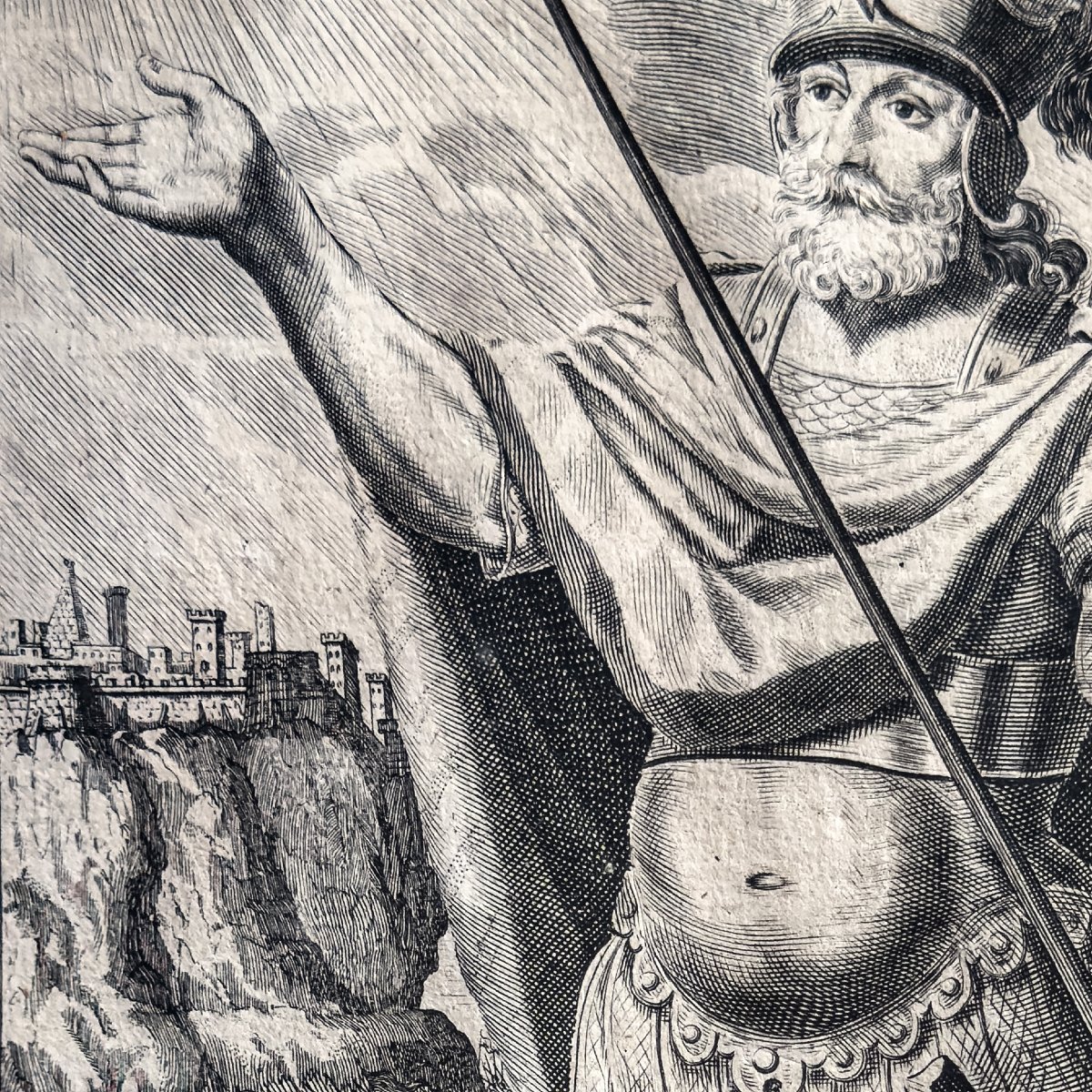
Joshua is shown full-length, wearing armour and a plumed helmet, holding a long spear and a shield bearing the divine name in Hebrew characters. A battle and a fortified town appear in the background, while clouds and heavenly rays emphasise the providential character of the composition.
One of the most compelling aspects of the engraving is the way it brings the biblical narrative into the artist’s own historical moment. Among the soldiers in the background are figures wearing turbans and Ottoman-style clothing. For an early 18th-century Central European audience, conflicts with the Ottoman Empire were part of recent history and immediate collective memory. Their presence lends Joshua’s story a contemporary resonance, transforming the biblical leader into an image of military command and the defence of faith against an instantly recognisable adversary.
The print belongs to an engraved series devoted to major figures from the Old Testament, associated with illustrated editions of the Sacra Biblia translated by Caspar Ulenberg and circulated during the early 18th century.
The significance of the series is further reflected in the presence of related engravings in public collections. Depictions of Moses, the Prophet Samuel and the Prophet Isaiah are preserved at the Vlastivědné muzeum Jesenicka in the Czech Republic, while an engraving of Judas Maccabaeus is held in the collections of the Jewish Museum Vienna.
An engraving depicting Moses, from the same series and presented in an identical frame, is offered separately. Together, the two prints form a particularly coherent pair: Moses embodies the Law and divine revelation, while Joshua represents their continuation through action and military leadership.
Inscribed in the lower margin: “Josua.”
Signed lower right: “E. Nunzer fec. N. 3”.
Page number upper right: “p. 183”.
Presented with a broad light-coloured mount and a restrained frame. Some foxing, folds and age-related marks consistent with the age of the print.
Engraving dimensions: 31 × 19 cm
Framed dimensions: 44 × 29.5 cm
Technique: copper engraving
Origin: Nuremberg, early 18th century
Antique copper engraving depicting Joshua, the successor of Moses and leader of the people of Israel, executed by the Nuremberg engraver Engelhard Nunzer, who died in 1733.
Joshua is shown full-length, wearing armour and a plumed helmet, holding a long spear and a shield bearing the divine name in Hebrew characters. A battle and a fortified town appear in the background, while clouds and heavenly rays emphasise the providential character of the composition.
One of the most compelling aspects of the engraving is the way it brings the biblical narrative into the artist’s own historical moment. Among the soldiers in the background are figures wearing turbans and Ottoman-style clothing. For an early 18th-century Central European audience, conflicts with the Ottoman Empire were part of recent history and immediate collective memory. Their presence lends Joshua’s story a contemporary resonance, transforming the biblical leader into an image of military command and the defence of faith against an instantly recognisable adversary.
The print belongs to an engraved series devoted to major figures from the Old Testament, associated with illustrated editions of the Sacra Biblia translated by Caspar Ulenberg and circulated during the early 18th century.
The significance of the series is further reflected in the presence of related engravings in public collections. Depictions of Moses, the Prophet Samuel and the Prophet Isaiah are preserved at the Vlastivědné muzeum Jesenicka in the Czech Republic, while an engraving of Judas Maccabaeus is held in the collections of the Jewish Museum Vienna.
An engraving depicting Moses, from the same series and presented in an identical frame, is offered separately. Together, the two prints form a particularly coherent pair: Moses embodies the Law and divine revelation, while Joshua represents their continuation through action and military leadership.
Inscribed in the lower margin: “Josua.”
Signed lower right: “E. Nunzer fec. N. 3”.
Page number upper right: “p. 183”.
Presented with a broad light-coloured mount and a restrained frame. Some foxing, folds and age-related marks consistent with the age of the print.
Engraving dimensions: 31 × 19 cm
Framed dimensions: 44 × 29.5 cm
Technique: copper engraving
Origin: Nuremberg, early 18th century
150 €
Period: 18th century
Style: Louis 14th, Regency
Condition: Good condition
Material: Paper
Length: 19 cm
Height: 31 cm
Reference (ID): 1812220
Availability: In stock
Print