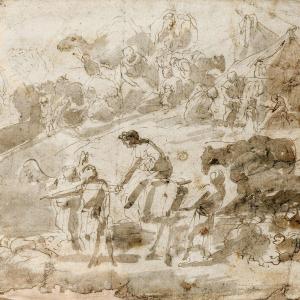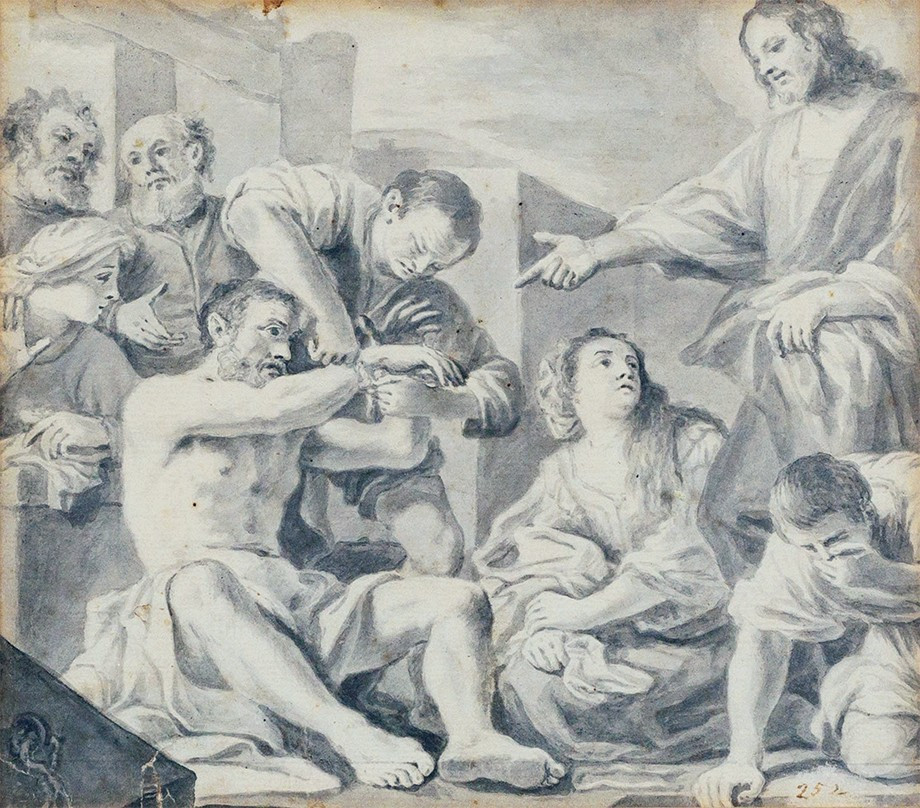
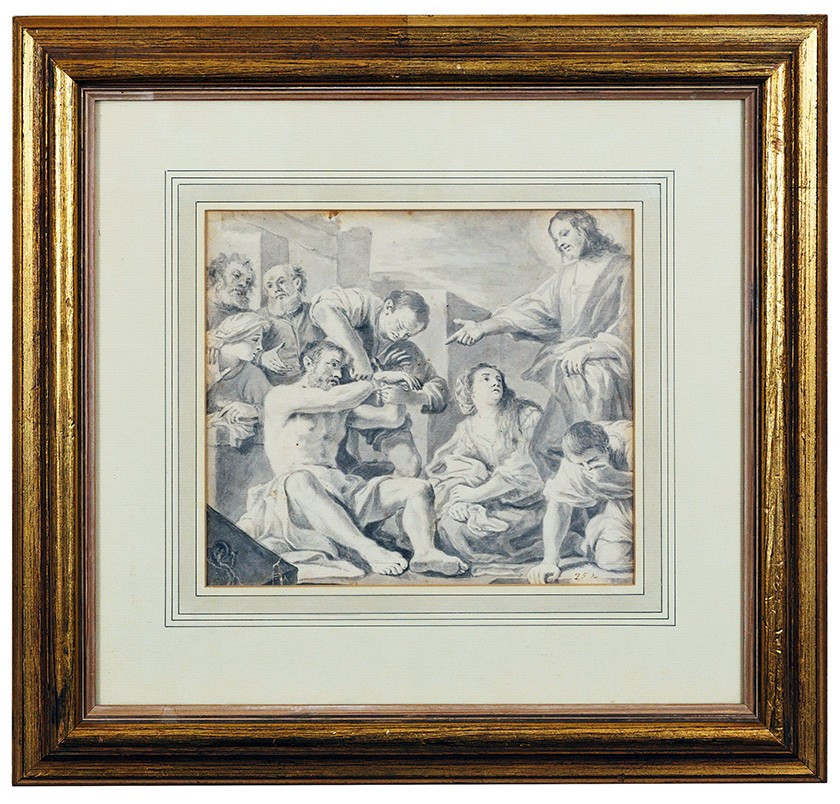
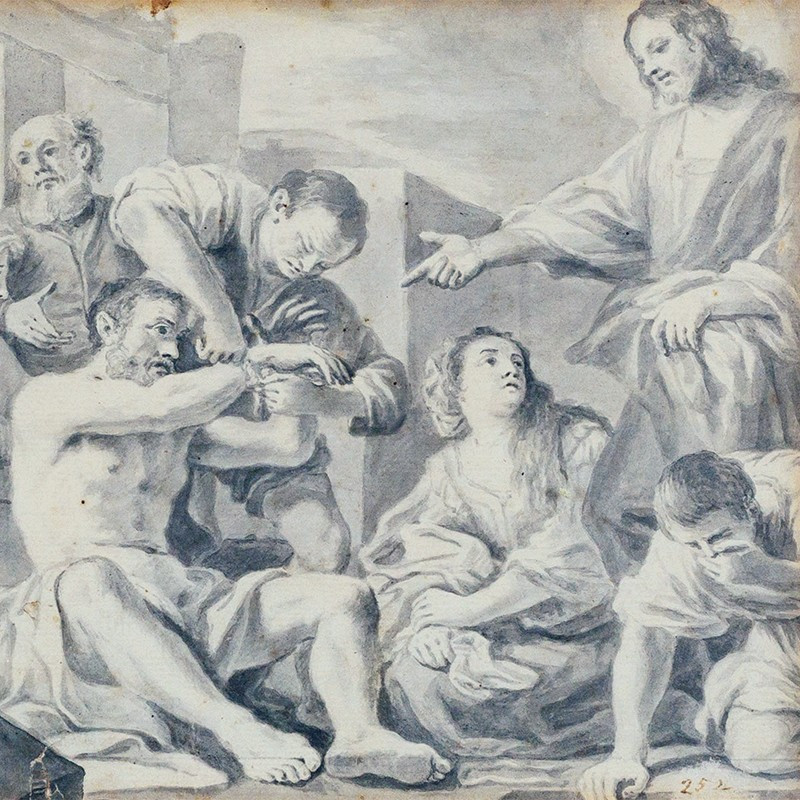


Neapolitan School 1700-1750, The Resurrection Of Lazarus (after Guercino, 1619)
Artist: école Napolitaine, Première Moitié Du Xviiiᵉ Siècle
NEAPOLITAN SCHOOL, FIRST HALF OF THE 18TH CENTURY
THE RAISING OF LAZARUS
(after Guercino, 1619)
NEAPOLITAN SCHOOL
First half of the 18th century
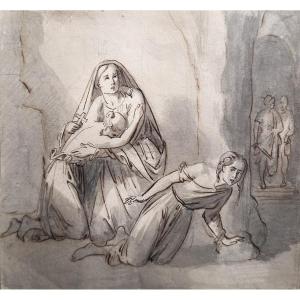
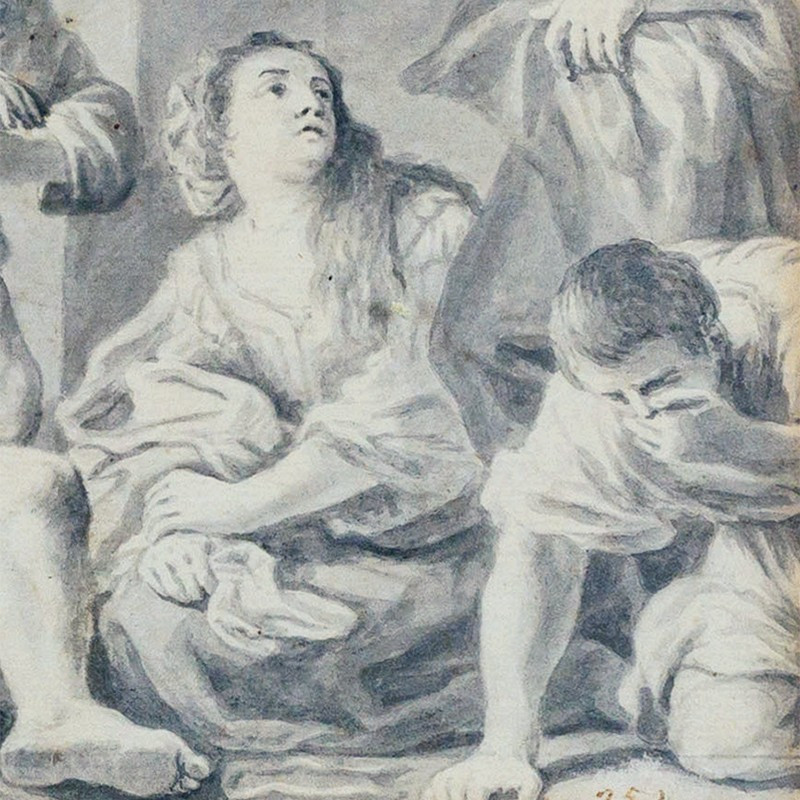
Pen and brown ink, brush and grey wash on laid paper, traces of old inventory number “252” lower right
16.5 × 19 cm / 6.5 × 7.5 in
with frame: 35 × 37 cm / 13.8 × 14.6 in
PROVENANCE: Private collection
This refined drawing reproduces the celebrated Raising of Lazarus painted in 1619 by Giovanni Francesco Barbieri, known as Guercino (1591–1666), today in the Musée du Louvre (inv. no. 77). The painting, executed for Cardinal Serra, was conceived as a pendant to Samson Captured by the Philistines and belongs to the artist’s early Cento period, marked by dramatic chiaroscuro and spiritual intensity.
The composition gained fame soon after its creation: in 1621 it was engraved in reverse by Giovanni Battista Pasqualini, with a dedication to Sebastiano Fabbri, thus disseminating the image across Europe. By the late 17th century, Guercino’s original was recorded in Naples, in the collection of the brothers Carlo and Francesco Garofali, before passing in 1785 to the collection of Louis XVI and ultimately entering the Louvre, where it remains today.
The present sheet was most likely executed while the painting was still in Naples, as the drawing reproduces the composition in its correct orientation — not in reverse, as in Pasqualini’s print — indicating direct observation of the original canvas.
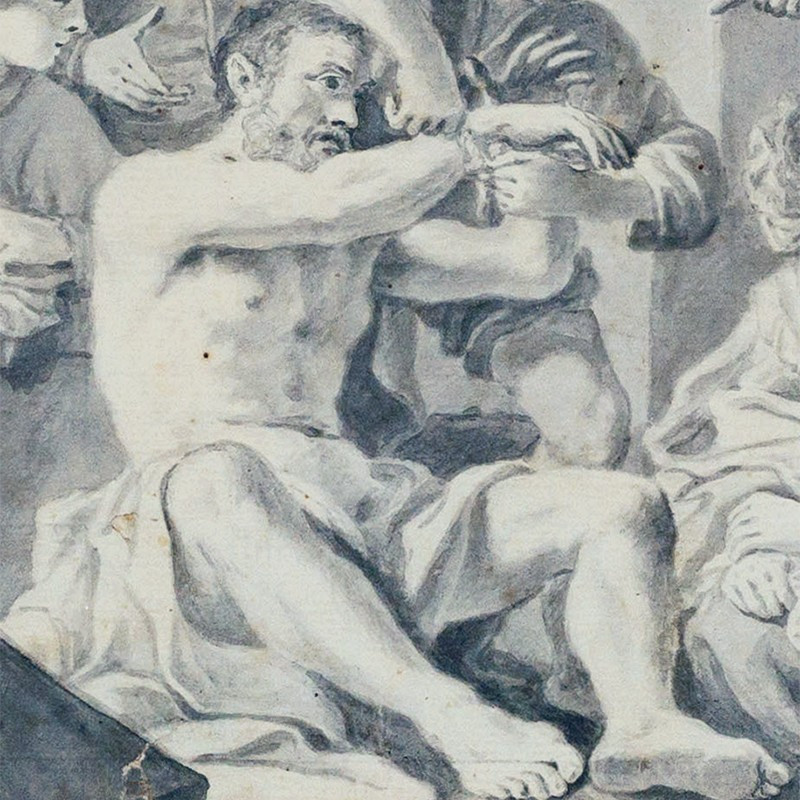
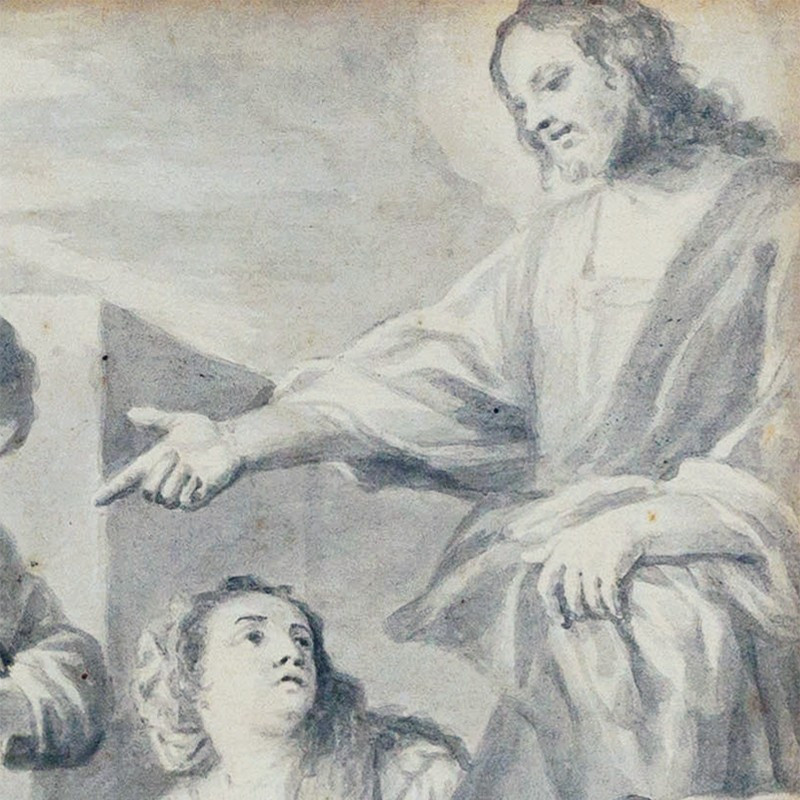
Stylistic analysis supports an attribution to the Neapolitan school of the first half of the 18th century: the confident pen line, broad ink wash and balanced chiaroscuro recall the refined draughtsmanship of artists such as Francesco De Mura, Paolo De Matteis and Giuseppe Bonito. The faint inventory number “252” suggests that the drawing once formed part of an important collection, possibly catalogued in the 18th century.
This sheet thus stands as a rare testimony to the Neapolitan reception of Guercino’s work and to the circulation of his imagery among Southern Italian artists long before the rise of academic historicism.
THE RAISING OF LAZARUS
(after Guercino, 1619)
NEAPOLITAN SCHOOL
First half of the 18th century
Pen and brown ink, brush and grey wash on laid paper, traces of old inventory number “252” lower right
16.5 × 19 cm / 6.5 × 7.5 in
with frame: 35 × 37 cm / 13.8 × 14.6 in
PROVENANCE: Private collection
This refined drawing reproduces the celebrated Raising of Lazarus painted in 1619 by Giovanni Francesco Barbieri, known as Guercino (1591–1666), today in the Musée du Louvre (inv. no. 77). The painting, executed for Cardinal Serra, was conceived as a pendant to Samson Captured by the Philistines and belongs to the artist’s early Cento period, marked by dramatic chiaroscuro and spiritual intensity.
The composition gained fame soon after its creation: in 1621 it was engraved in reverse by Giovanni Battista Pasqualini, with a dedication to Sebastiano Fabbri, thus disseminating the image across Europe. By the late 17th century, Guercino’s original was recorded in Naples, in the collection of the brothers Carlo and Francesco Garofali, before passing in 1785 to the collection of Louis XVI and ultimately entering the Louvre, where it remains today.
The present sheet was most likely executed while the painting was still in Naples, as the drawing reproduces the composition in its correct orientation — not in reverse, as in Pasqualini’s print — indicating direct observation of the original canvas.
Stylistic analysis supports an attribution to the Neapolitan school of the first half of the 18th century: the confident pen line, broad ink wash and balanced chiaroscuro recall the refined draughtsmanship of artists such as Francesco De Mura, Paolo De Matteis and Giuseppe Bonito. The faint inventory number “252” suggests that the drawing once formed part of an important collection, possibly catalogued in the 18th century.
This sheet thus stands as a rare testimony to the Neapolitan reception of Guercino’s work and to the circulation of his imagery among Southern Italian artists long before the rise of academic historicism.
550 €
Period: 18th century
Style: Louis 14th, Regency
Condition: Good condition
Material: Paper
Length: 19 cm
Height: 16,5 cm
Reference (ID): 1645021
Availability: In stock
Print