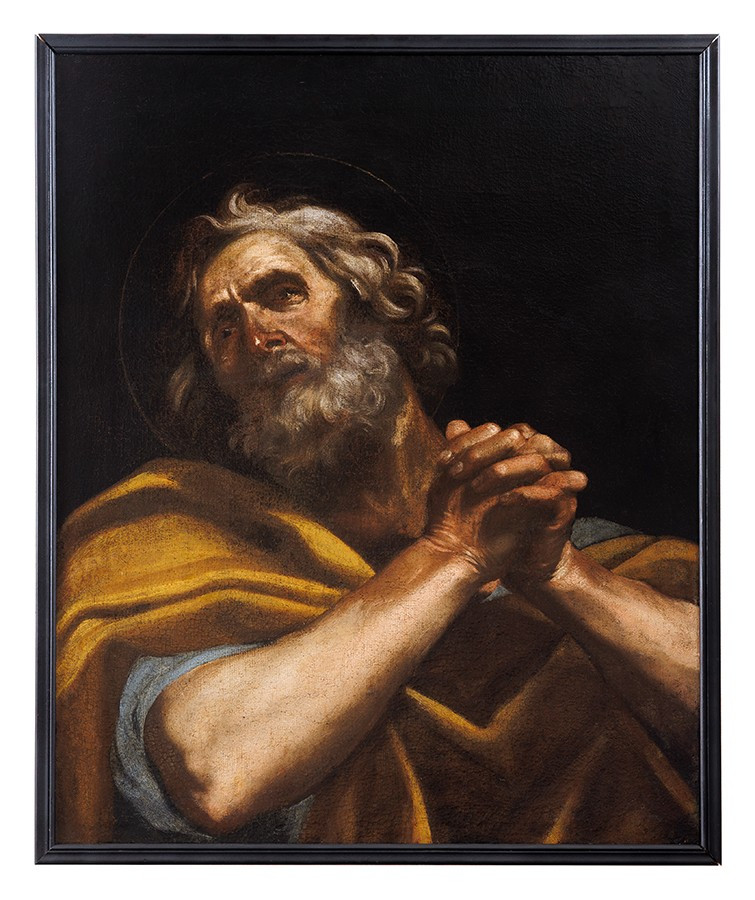



Giovan Battista Beinaschi, Attributed To, Saint Peter The Penitent
Artist: Giovan Battista Beinaschi, Attribué à
GIOVAN BATTISTA BEINASCHI, attributed to
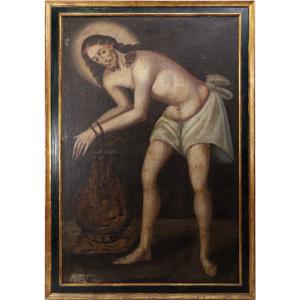
THE PENITENT ST.PETER
GIOVAN BATTISTA BEINASCHI
Torino 1636 – 1688 Napoli
Oil on canvas
74 x 62 cm / 29 x 24.4 inches, with frame 78 x 65 cm / 30.5 x 25.8 inches
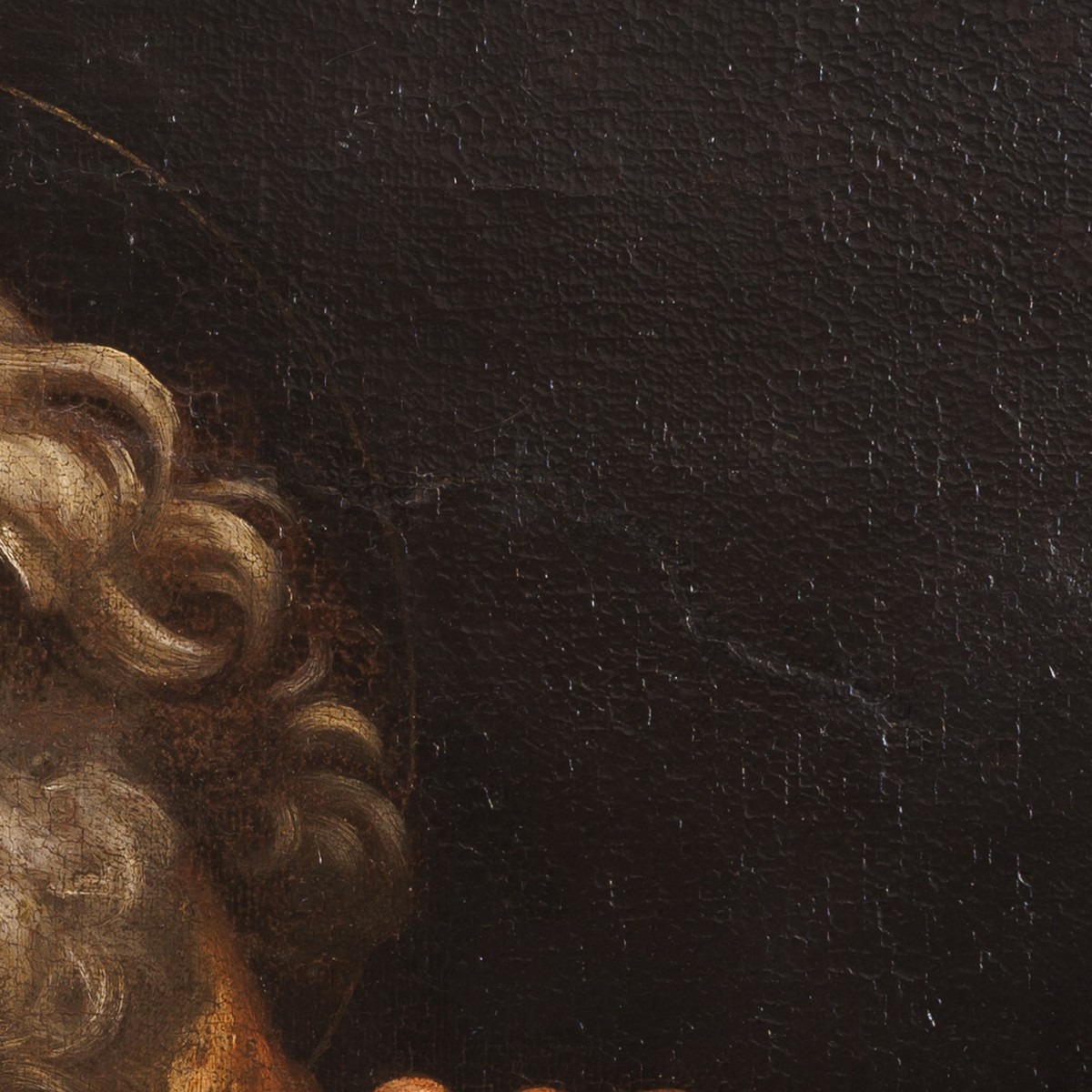
Recently attributed to Giovan Battista Beinaschi (1636–1688), this striking depiction of the Penitent Saint Peter reflects the powerful transformation of Roman Baroque painting in the later seventeenth century.
The attribution, proposed by the Italian art historian Federico Giannini, is supported both by stylistic analysis and by the presence of an inscription on the reverse, where the first group of letters may tentatively be read as “GBB” rather than “GBS”, possibly referring to the artist’s name. Deeply influenced by the legacy of Giovanni Lanfranco, Beinaschi developed a more dramatic and expressive language, characterized by vibrant brushwork, strong contrasts of light, and an almost restless emotional intensity.
These qualities are clearly visible in the present painting: the nervous handling of paint, the heightened chiaroscuro, and the deeply felt expression of the saint all point towards a mature Baroque sensibility, moving beyond the classical restraint of earlier Roman models.
Active between Rome and Naples, Beinaschi belongs to a generation that reinterpreted the legacy of Lanfranco in a more dynamic and emotionally charged direction, bridging Roman and Neapolitan artistic traditions.
This painting may thus be understood as a compelling example of this transition — a work in which inherited forms are transformed into a more immediate and dramatic visual language.
PROVENANCE
London, private collection
THE PENITENT ST.PETER
GIOVAN BATTISTA BEINASCHI
Torino 1636 – 1688 Napoli
Oil on canvas
74 x 62 cm / 29 x 24.4 inches, with frame 78 x 65 cm / 30.5 x 25.8 inches
Recently attributed to Giovan Battista Beinaschi (1636–1688), this striking depiction of the Penitent Saint Peter reflects the powerful transformation of Roman Baroque painting in the later seventeenth century.
The attribution, proposed by the Italian art historian Federico Giannini, is supported both by stylistic analysis and by the presence of an inscription on the reverse, where the first group of letters may tentatively be read as “GBB” rather than “GBS”, possibly referring to the artist’s name. Deeply influenced by the legacy of Giovanni Lanfranco, Beinaschi developed a more dramatic and expressive language, characterized by vibrant brushwork, strong contrasts of light, and an almost restless emotional intensity.
These qualities are clearly visible in the present painting: the nervous handling of paint, the heightened chiaroscuro, and the deeply felt expression of the saint all point towards a mature Baroque sensibility, moving beyond the classical restraint of earlier Roman models.
Active between Rome and Naples, Beinaschi belongs to a generation that reinterpreted the legacy of Lanfranco in a more dynamic and emotionally charged direction, bridging Roman and Neapolitan artistic traditions.
This painting may thus be understood as a compelling example of this transition — a work in which inherited forms are transformed into a more immediate and dramatic visual language.
PROVENANCE
London, private collection
6 500 €
Period: 17th century
Style: Renaissance, Louis 13th
Condition: Good condition
Material: Oil painting
Length: 62 cm
Height: 74 cm
Reference (ID): 1619183
Availability: In stock
Print