Italian Neoclassical School, Circa 1830, Sappho And Rhodope
Artist: école Néoclassique Italienne, Vers 1830
ITALIAN NEOCLASSICAL SCHOOL, CIRCA 1830
SAPPHO AND RHODOPE
ITALIAN NEOCLASSICAL SCHOOL, CIRCA 1830
Sheet size: 16.5 × 17 cm / 6.5 × 6.7 in
With frame: 44 × 44 cm / 17.3 × 17.3 in
Wooden frame from the 1930s, museum-style mount
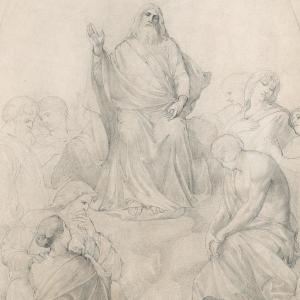
This drawing represents a rare iconographic subject — Sappho and Rhodope, a theme that appears only exceptionally within the Neoclassical tradition of the first half of the nineteenth century. Unlike the more common allegorical or mythological treatments of antiquity, this subject invites a quiet, almost intimate reading of the ancient world, focused on human emotion, bodily presence, and the subtle emotional bond between the figures.
In French and Italian Neoclassical painting and drawing of the period, the figure of Sappho was addressed only sporadically and usually in a highly elevated, literary manner. Among the few known parallels, particular mention should be made of the painting by Pelagio Palagi, depicting Sappho embracing Rhodope, now preserved in the Collezioni Comunali d’Arte in Bologna (Emilia-Romagna, Italy). In Palagi’s work, the ancient poetess is likewise treated beyond strict narrative, though in a more openly sensual and lyrical key.
In the present drawing, the artist chooses a different approach. Rather than emphasizing sensuality — seemingly inherent to the subject — he deliberately favors a restrained emotional dialogue between the two figures. Chiaroscuro modelling and the use of white heighten the clarity and presence of the forms, lending them a sculptural quality characteristic of late Italian Neoclassicism around 1830.
The presentation of the work deserves special attention. The wooden frame from the 1930s and the discreet museum-style mount resonate closely with Italian collecting traditions shaped in the post-d’Annunzio era, a period that successfully brought together a renewed interest in late Neoclassicism with the aesthetics of interwar modernism.
SAPPHO AND RHODOPE
ITALIAN NEOCLASSICAL SCHOOL, CIRCA 1830
Sheet size: 16.5 × 17 cm / 6.5 × 6.7 in
With frame: 44 × 44 cm / 17.3 × 17.3 in
Wooden frame from the 1930s, museum-style mount
This drawing represents a rare iconographic subject — Sappho and Rhodope, a theme that appears only exceptionally within the Neoclassical tradition of the first half of the nineteenth century. Unlike the more common allegorical or mythological treatments of antiquity, this subject invites a quiet, almost intimate reading of the ancient world, focused on human emotion, bodily presence, and the subtle emotional bond between the figures.
In French and Italian Neoclassical painting and drawing of the period, the figure of Sappho was addressed only sporadically and usually in a highly elevated, literary manner. Among the few known parallels, particular mention should be made of the painting by Pelagio Palagi, depicting Sappho embracing Rhodope, now preserved in the Collezioni Comunali d’Arte in Bologna (Emilia-Romagna, Italy). In Palagi’s work, the ancient poetess is likewise treated beyond strict narrative, though in a more openly sensual and lyrical key.
In the present drawing, the artist chooses a different approach. Rather than emphasizing sensuality — seemingly inherent to the subject — he deliberately favors a restrained emotional dialogue between the two figures. Chiaroscuro modelling and the use of white heighten the clarity and presence of the forms, lending them a sculptural quality characteristic of late Italian Neoclassicism around 1830.
The presentation of the work deserves special attention. The wooden frame from the 1930s and the discreet museum-style mount resonate closely with Italian collecting traditions shaped in the post-d’Annunzio era, a period that successfully brought together a renewed interest in late Neoclassicism with the aesthetics of interwar modernism.
470 €
Period: 19th century
Style: Consulat, Empire
Condition: Good condition
Material: Paper
Length: 17 cm
Height: 16,5 cm
Reference (ID): 1685763
Availability: In stock
Print