THIS OBJECT WAS SOLD
A Set Of Four Parlor Chairs Stamped "louis-madeleine Pluvinet." Louis XVI Period.
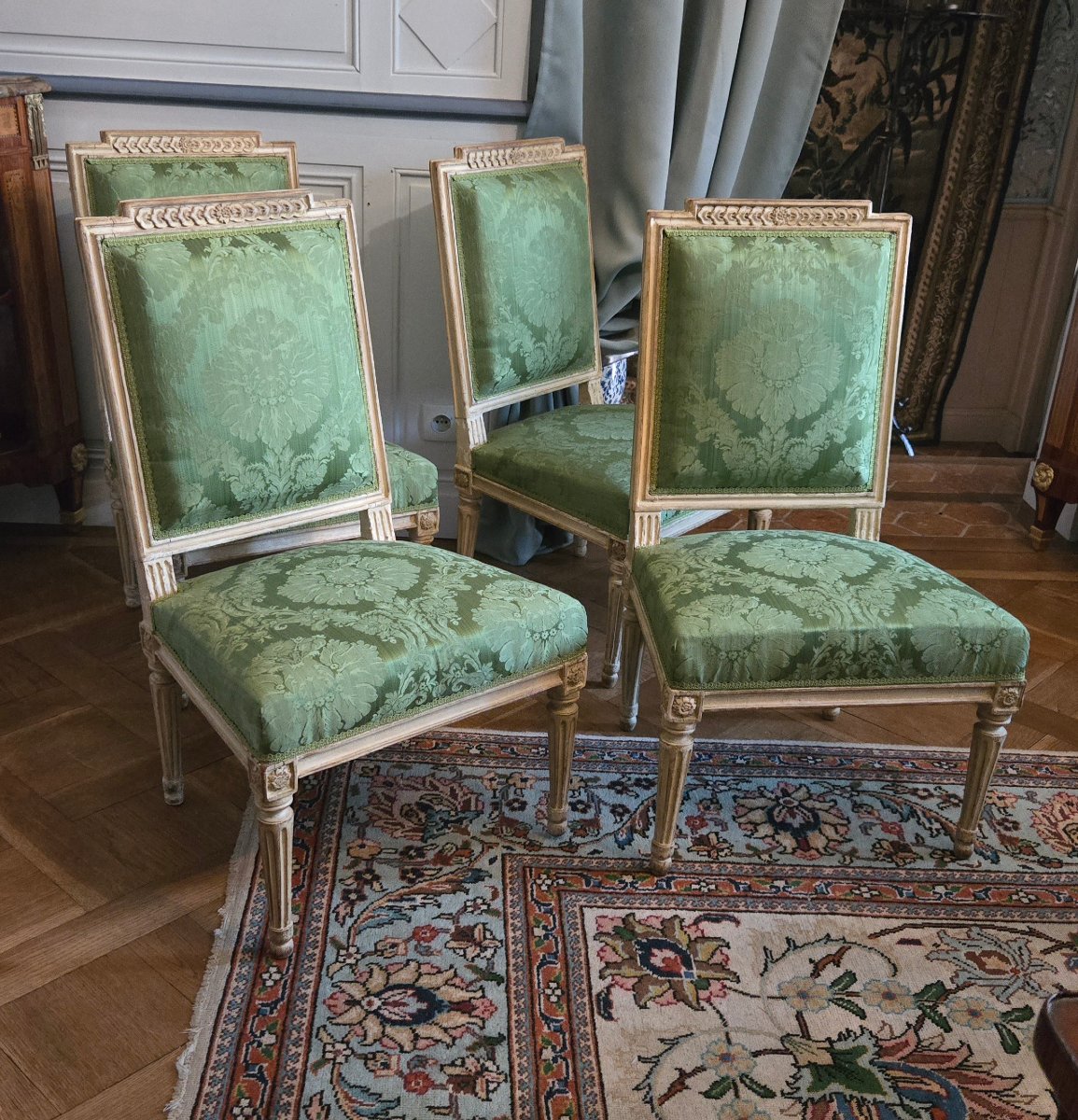
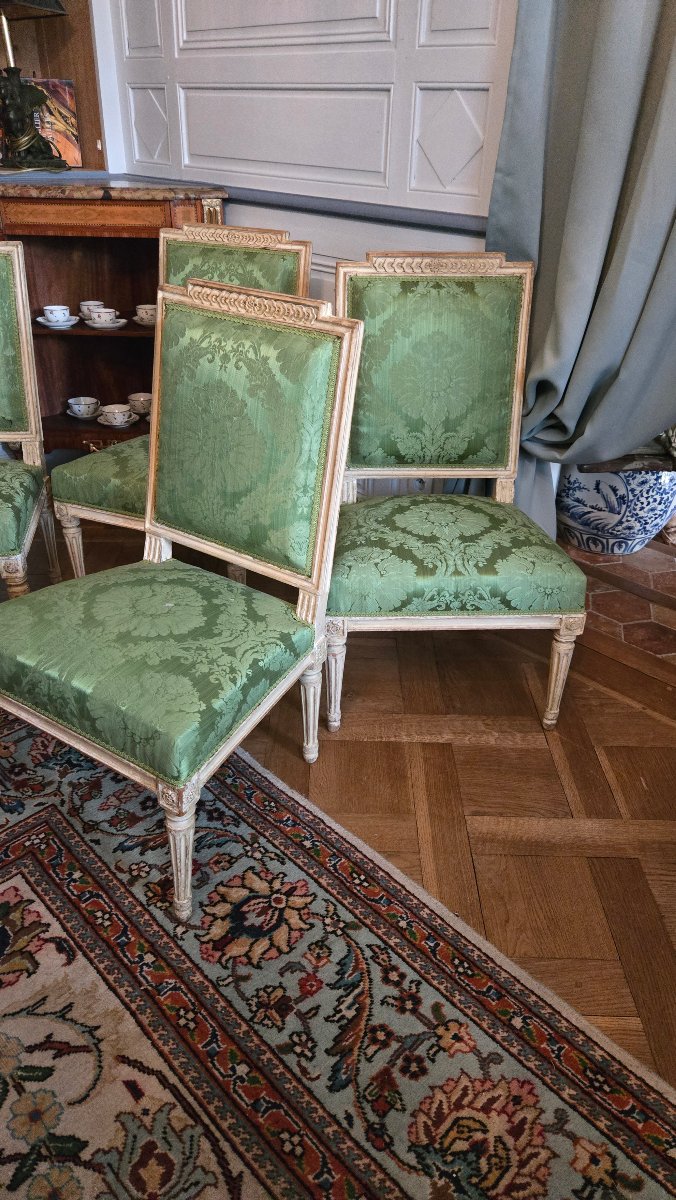
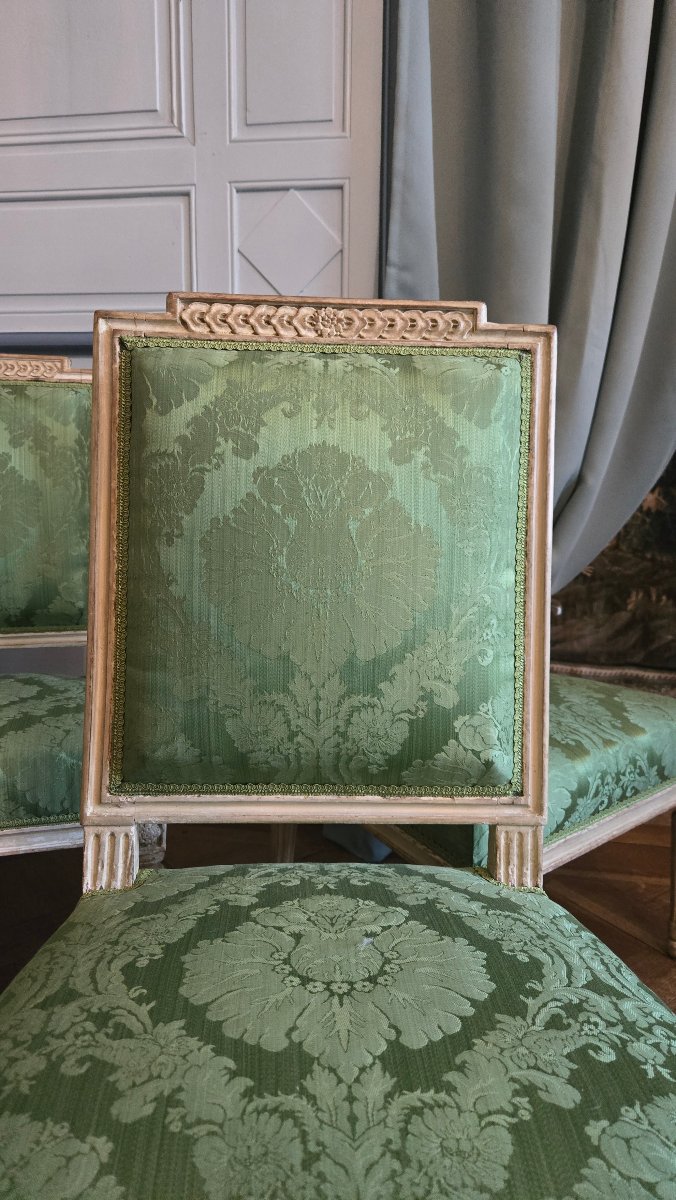
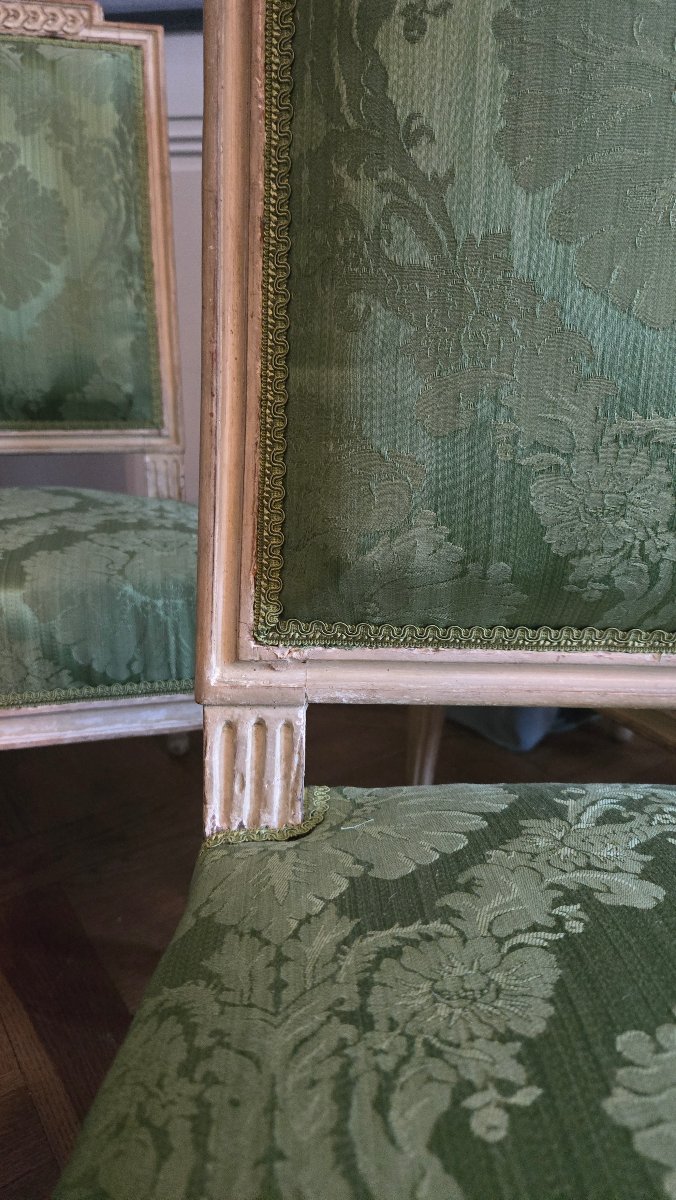
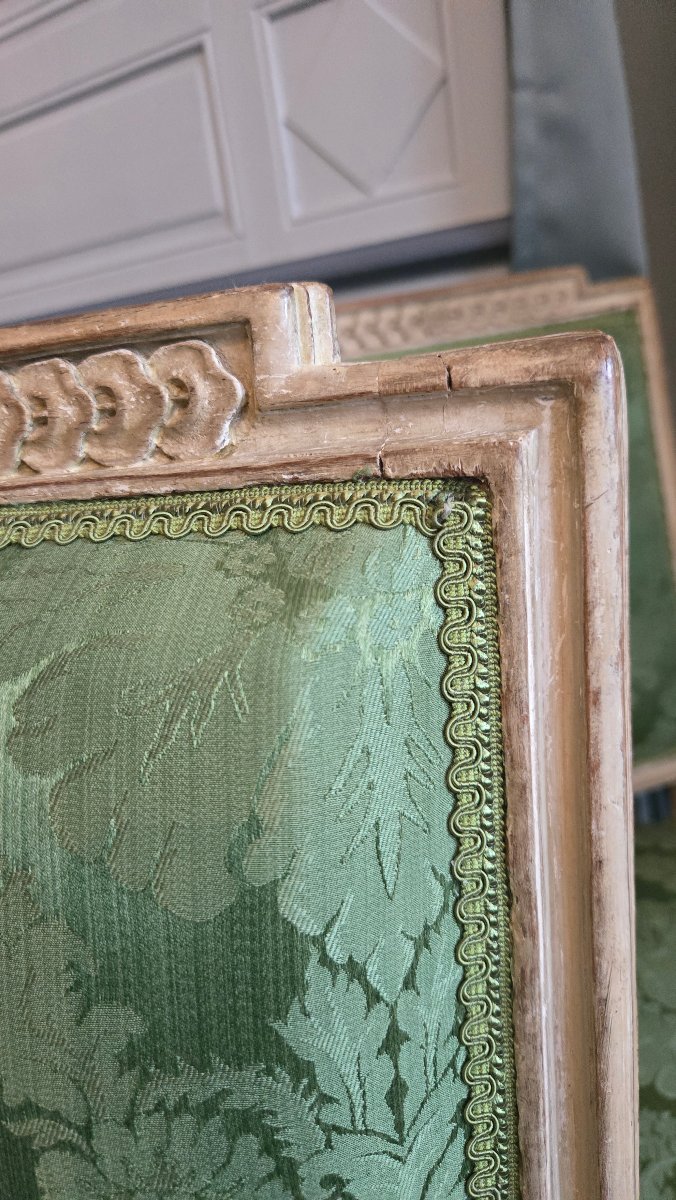
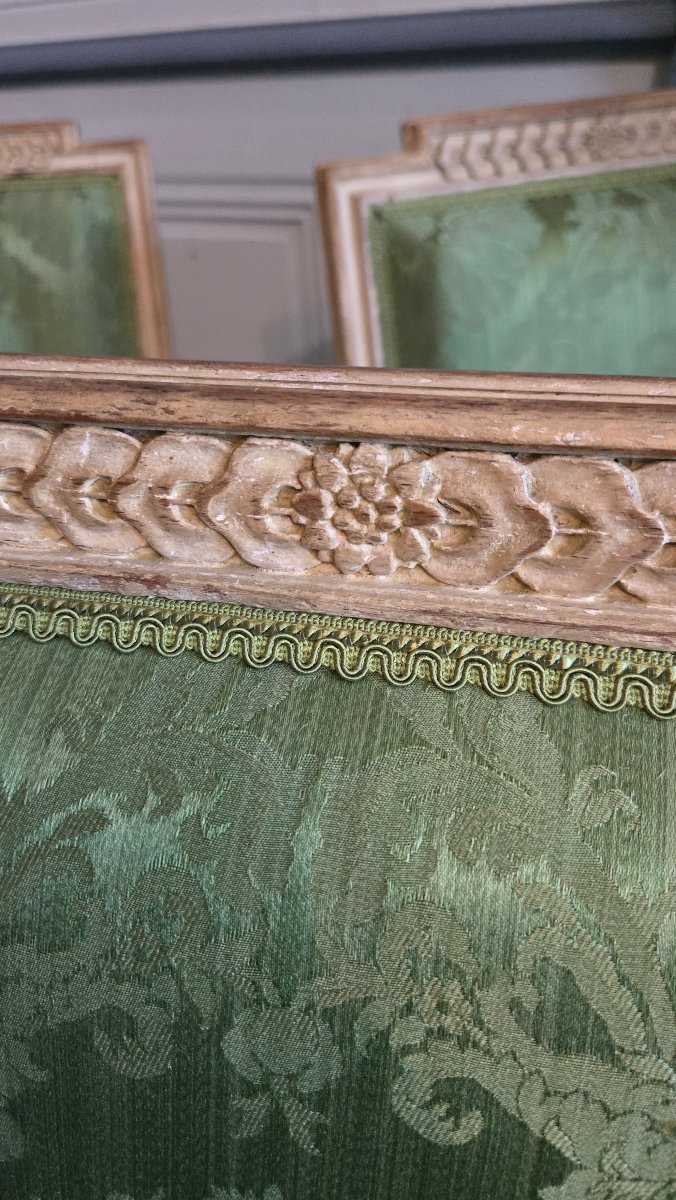
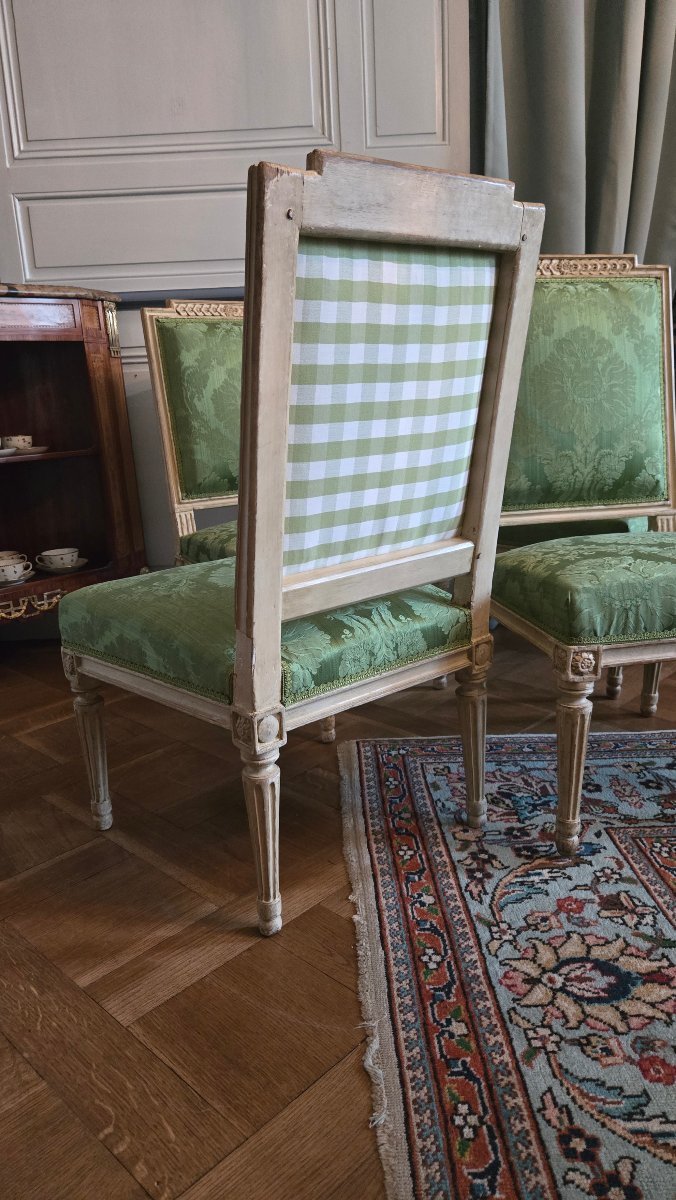
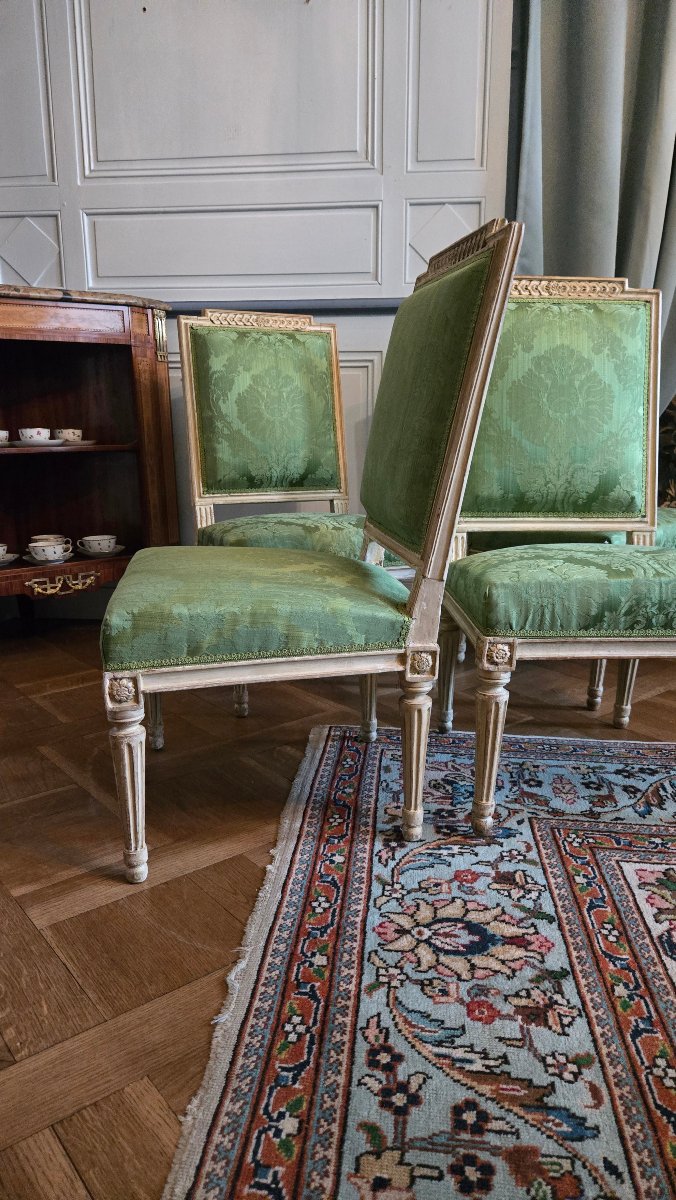
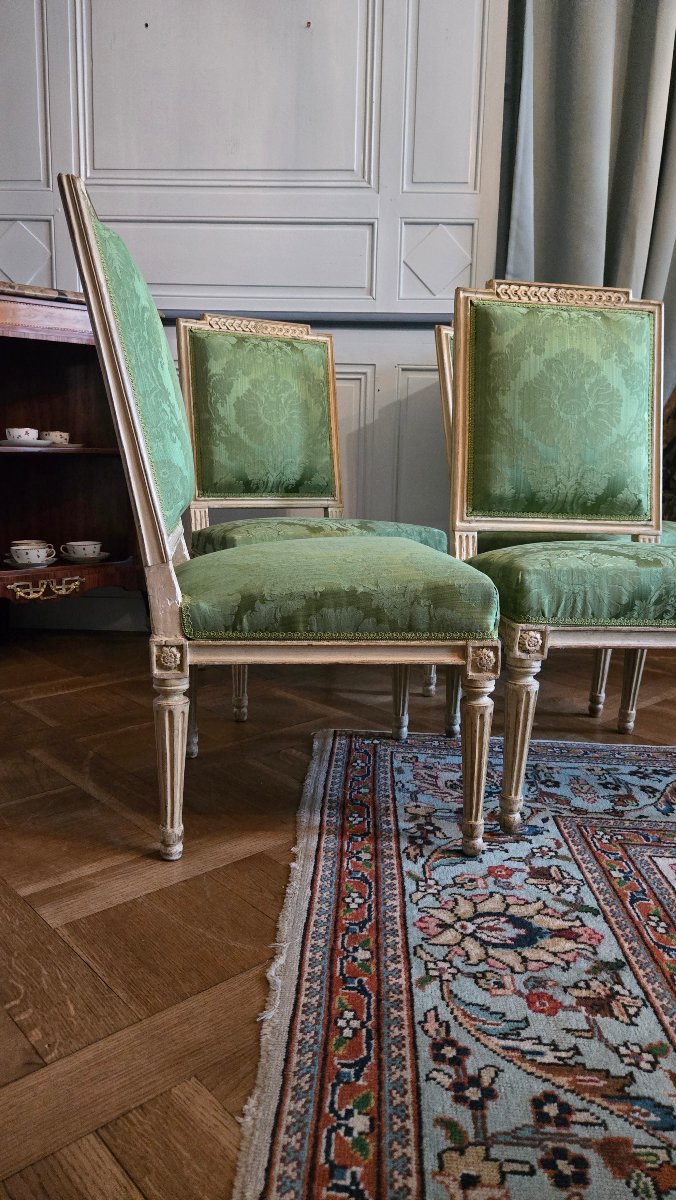
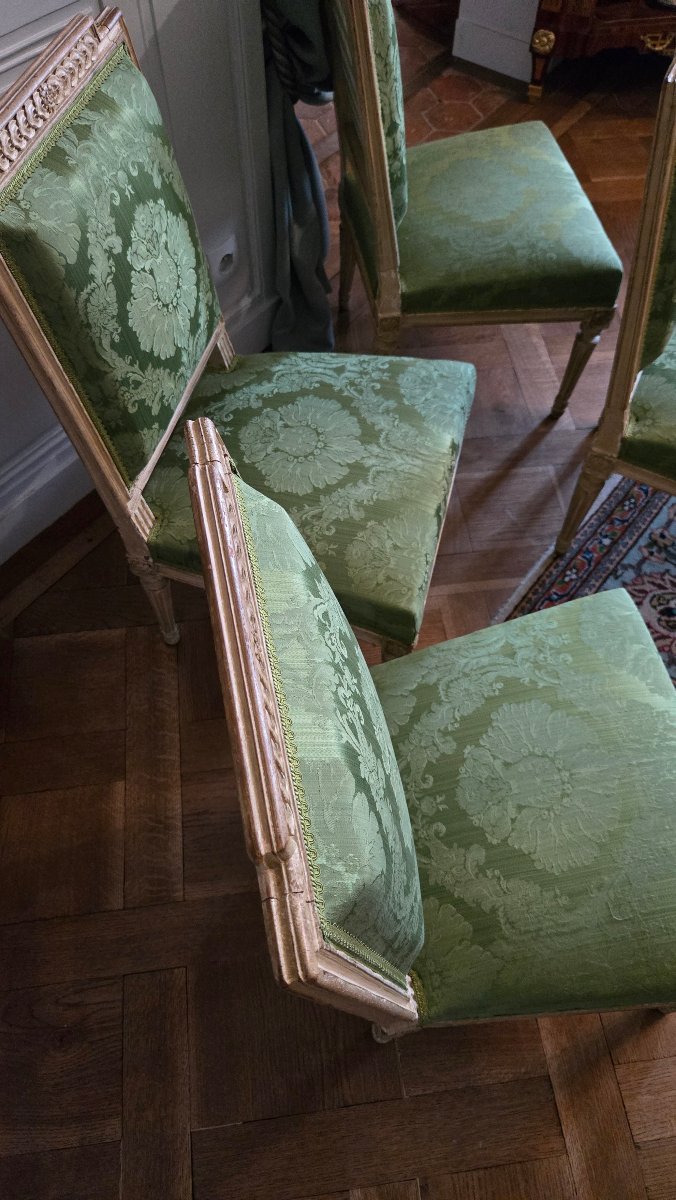
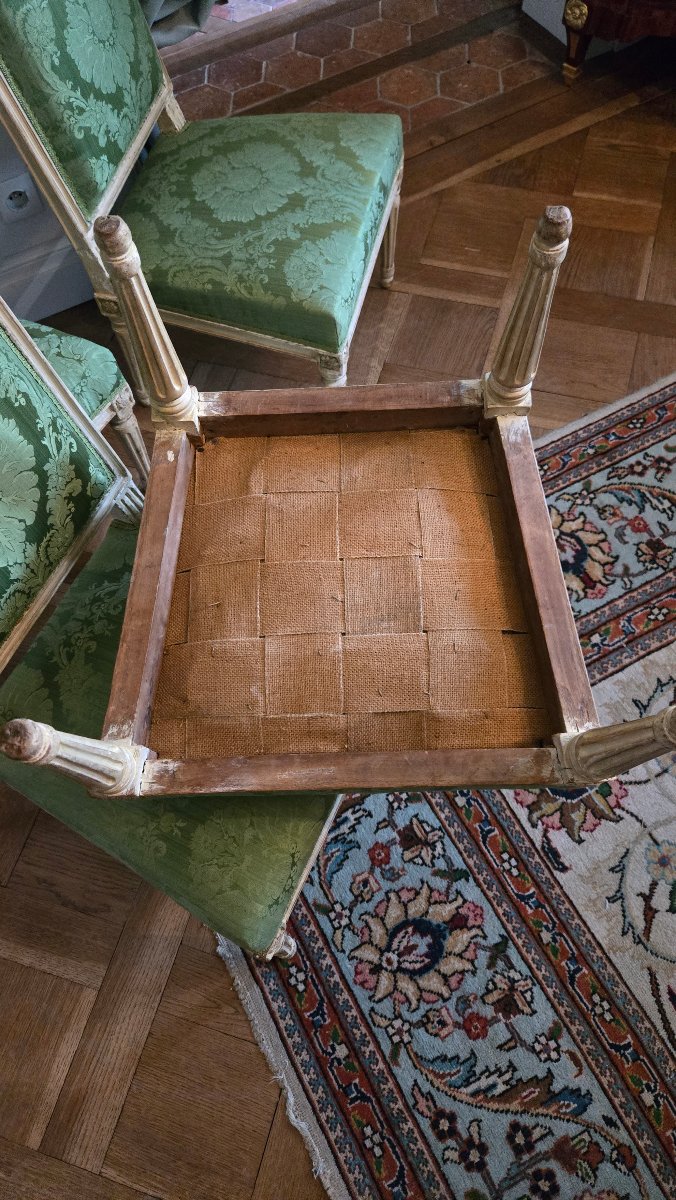
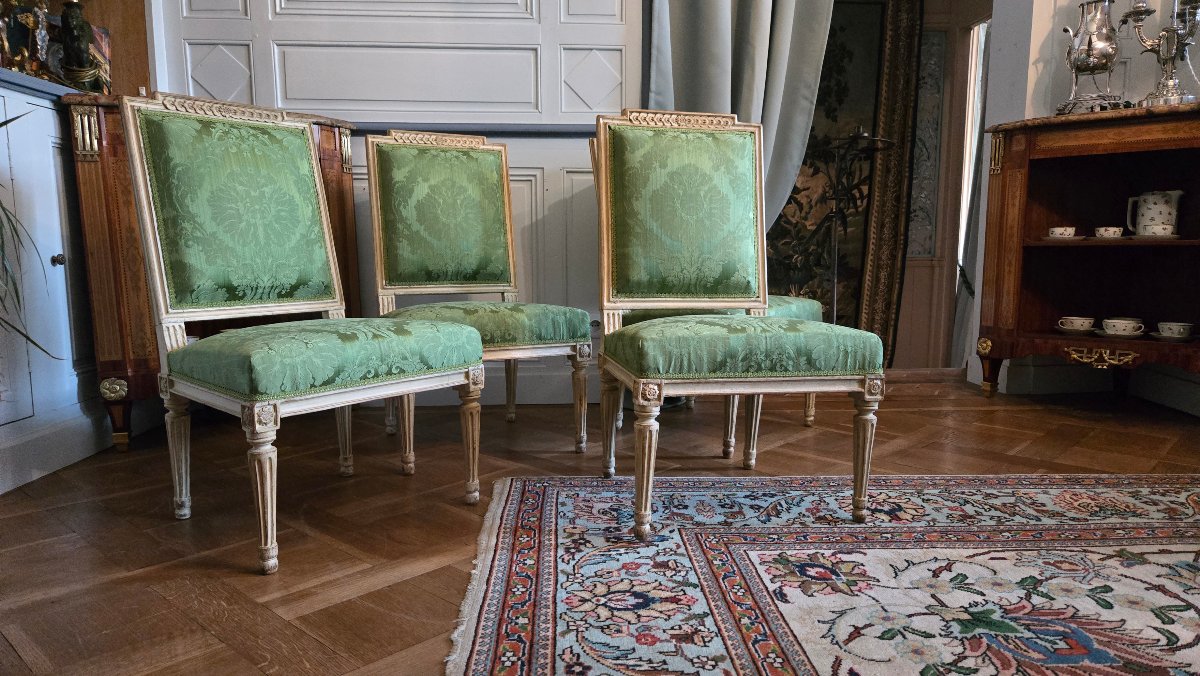


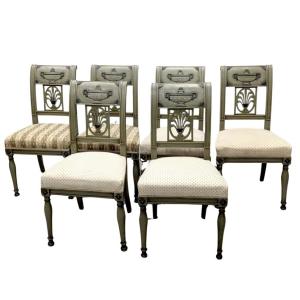
A set of four parlor chairs made of beech, featuring molded, carved, and painted details; each bears the stamp “L. M. PLUVINET,” struck beneath the front crossbar of the seat.
Louis-Madeleine Pluvinet, who was certified as a master cabinetmaker in Paris on April 19, 1775, came from a family with close ties to the chair-making trade. The son of Philippe-Joseph Pluvinet and Marie-Marguerite Godot—herself from a family of cabinetmakers—he married Marie-Louise Meunier in 1775, a member of another dynasty of Parisian cabinetmakers. After Pluvinet’s death, she remarried in 1784 to Jean-Baptiste-Claude Sené. These marriages placed his work within a particularly close-knit professional network, where the Pluvinet, Godot, Meunier, and Sené families intersected.
This set stands out for its unusual design, whose appeal lies particularly in the simple and rigorous architecture of the backrest. Rectangular, in the “à la reine” style and slightly slanted, it is framed by molded side panels. Its upper crossbar, perfectly straight, forms a distinctly marked projection at its center, designed in the manner of a small entablature with a projecting section.
This crowning element is carved with a frieze of pilasters, arranged symmetrically on either side of a central rosette. The composition thus evokes the vocabulary of ancient architectural entablatures, transposed to the scale of the chair.
This design is fully in line with the renewal of the decorative repertoire that accompanied the rise of Neoclassicism in Paris during the 1760s and 1770s. The ornamentation compendia by Jean-François de Neufforge, Jean-Charles Delafosse, and their contemporaries disseminated models in which orthogonal lines, projections, friezes, rosettes, and references to ancient architecture played a prominent role. Although they do not reproduce any specifically identified plate, these chairs clearly belong to this same formal language, which cabinetmakers adapted and reworked to create their own designs.
The straight, molded apron rests on four tapered, fluted legs. The decoration on the connecting blocks is carefully arranged in a hierarchy: the front blocks feature carved rosettes set within square recesses, both on the front and on their side faces. On the rear legs, the side panels repeat this rosette decoration, while the back panels—less visible to the eye—are more simply adorned with a disk set within the square of the leg. The legs terminate in a small turned molding.
The proportions are another distinctive feature of this model. With a seat situated 39 cm above the floor and a front crossbar at just 30 cm, these chairs have a seat that is significantly lower than that of an ordinary chair. Rather than labeling them with the sometimes imprecise term “armchairs,” we prefer to describe them as low-seated parlor chairs, a designation that reflects their proportions without assuming a specific use.
The four L. M. PLUVINET stamps are located in the same place, beneath the front crossbars. They show natural wear, varying from one chair to another, consistent with repeated handling and successive repairs to the upholstery. The presence of the stamp on each of the four frames confirms the uniformity of this set.
Louis-Madeleine Pluvinet is also mentioned in the archives as a “carpenter-merchant.” This designation serves as a reminder that the work of a Parisian master craftsman could combine manufacturing and trade. In a family and professional environment so closely intertwined, it also invites us to consider the stamp as the mark of the master under whose name the piece was produced or sold, without necessarily allowing us to identify each individual craftsman involved in its creation. The body of work known to bear Pluvinet’s stamp, moreover, reflects a wide variety of designs: chairs, armchairs, bergère chairs, sofas, office chairs, beds, and even console tables.
The four chairs retain their original paint, with wear, scuffs, and minor imperfections consistent with their age. The beech frames feature a traditional mortise-and-tenon construction secured with dowels. The original upholstery has been preserved and recently reupholstered with a Luciano Marcato fabric, distributed by Casal. The backs are lined on the reverse with a green checkered fabric.
Dimensions:
Total height: 86 cm
Seat height: 39 cm
Front crossbar height: 30 cm
Width: 49.5 cm
Depth: 49 cm
Louis-Madeleine Pluvinet, who was certified as a master cabinetmaker in Paris on April 19, 1775, came from a family with close ties to the chair-making trade. The son of Philippe-Joseph Pluvinet and Marie-Marguerite Godot—herself from a family of cabinetmakers—he married Marie-Louise Meunier in 1775, a member of another dynasty of Parisian cabinetmakers. After Pluvinet’s death, she remarried in 1784 to Jean-Baptiste-Claude Sené. These marriages placed his work within a particularly close-knit professional network, where the Pluvinet, Godot, Meunier, and Sené families intersected.
This set stands out for its unusual design, whose appeal lies particularly in the simple and rigorous architecture of the backrest. Rectangular, in the “à la reine” style and slightly slanted, it is framed by molded side panels. Its upper crossbar, perfectly straight, forms a distinctly marked projection at its center, designed in the manner of a small entablature with a projecting section.
This crowning element is carved with a frieze of pilasters, arranged symmetrically on either side of a central rosette. The composition thus evokes the vocabulary of ancient architectural entablatures, transposed to the scale of the chair.
This design is fully in line with the renewal of the decorative repertoire that accompanied the rise of Neoclassicism in Paris during the 1760s and 1770s. The ornamentation compendia by Jean-François de Neufforge, Jean-Charles Delafosse, and their contemporaries disseminated models in which orthogonal lines, projections, friezes, rosettes, and references to ancient architecture played a prominent role. Although they do not reproduce any specifically identified plate, these chairs clearly belong to this same formal language, which cabinetmakers adapted and reworked to create their own designs.
The straight, molded apron rests on four tapered, fluted legs. The decoration on the connecting blocks is carefully arranged in a hierarchy: the front blocks feature carved rosettes set within square recesses, both on the front and on their side faces. On the rear legs, the side panels repeat this rosette decoration, while the back panels—less visible to the eye—are more simply adorned with a disk set within the square of the leg. The legs terminate in a small turned molding.
The proportions are another distinctive feature of this model. With a seat situated 39 cm above the floor and a front crossbar at just 30 cm, these chairs have a seat that is significantly lower than that of an ordinary chair. Rather than labeling them with the sometimes imprecise term “armchairs,” we prefer to describe them as low-seated parlor chairs, a designation that reflects their proportions without assuming a specific use.
The four L. M. PLUVINET stamps are located in the same place, beneath the front crossbars. They show natural wear, varying from one chair to another, consistent with repeated handling and successive repairs to the upholstery. The presence of the stamp on each of the four frames confirms the uniformity of this set.
Louis-Madeleine Pluvinet is also mentioned in the archives as a “carpenter-merchant.” This designation serves as a reminder that the work of a Parisian master craftsman could combine manufacturing and trade. In a family and professional environment so closely intertwined, it also invites us to consider the stamp as the mark of the master under whose name the piece was produced or sold, without necessarily allowing us to identify each individual craftsman involved in its creation. The body of work known to bear Pluvinet’s stamp, moreover, reflects a wide variety of designs: chairs, armchairs, bergère chairs, sofas, office chairs, beds, and even console tables.
The four chairs retain their original paint, with wear, scuffs, and minor imperfections consistent with their age. The beech frames feature a traditional mortise-and-tenon construction secured with dowels. The original upholstery has been preserved and recently reupholstered with a Luciano Marcato fabric, distributed by Casal. The backs are lined on the reverse with a green checkered fabric.
Dimensions:
Total height: 86 cm
Seat height: 39 cm
Front crossbar height: 30 cm
Width: 49.5 cm
Depth: 49 cm
Explore similar pieces and discover your ideal find:
chairs & stools