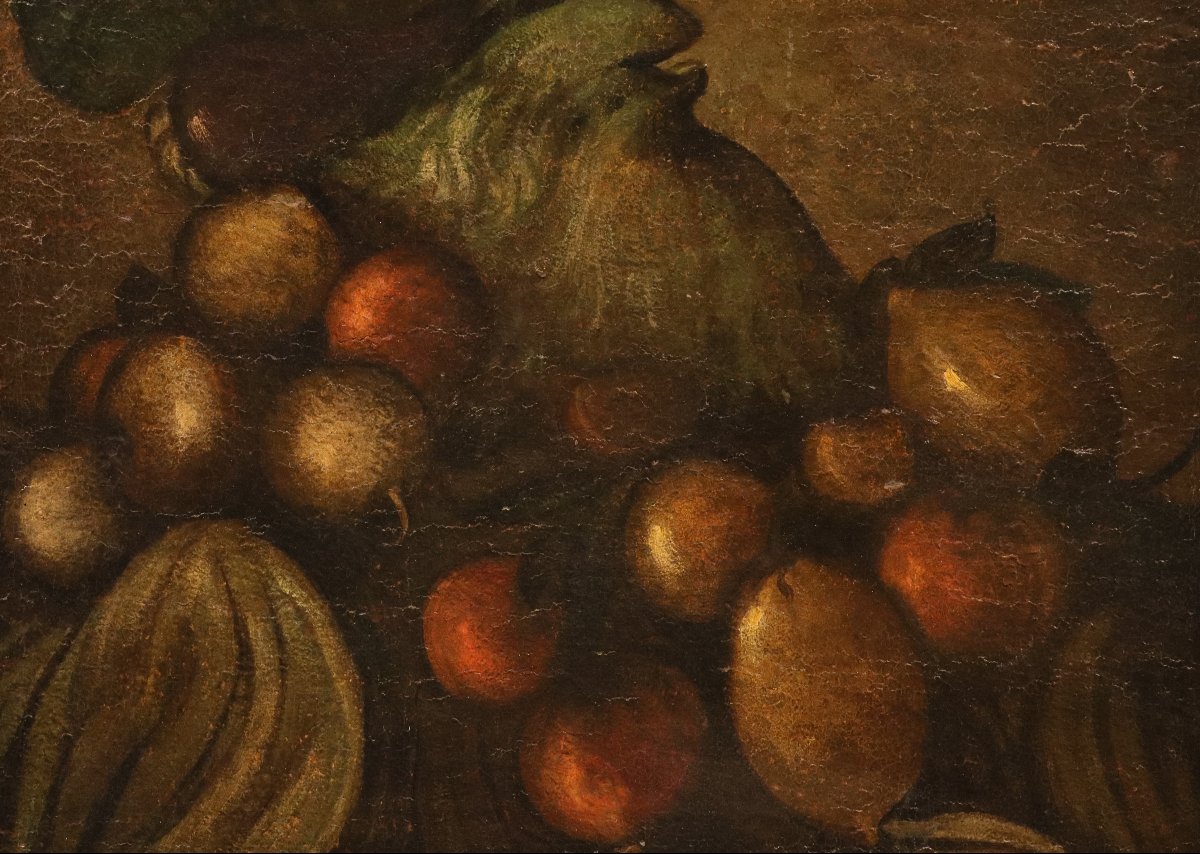
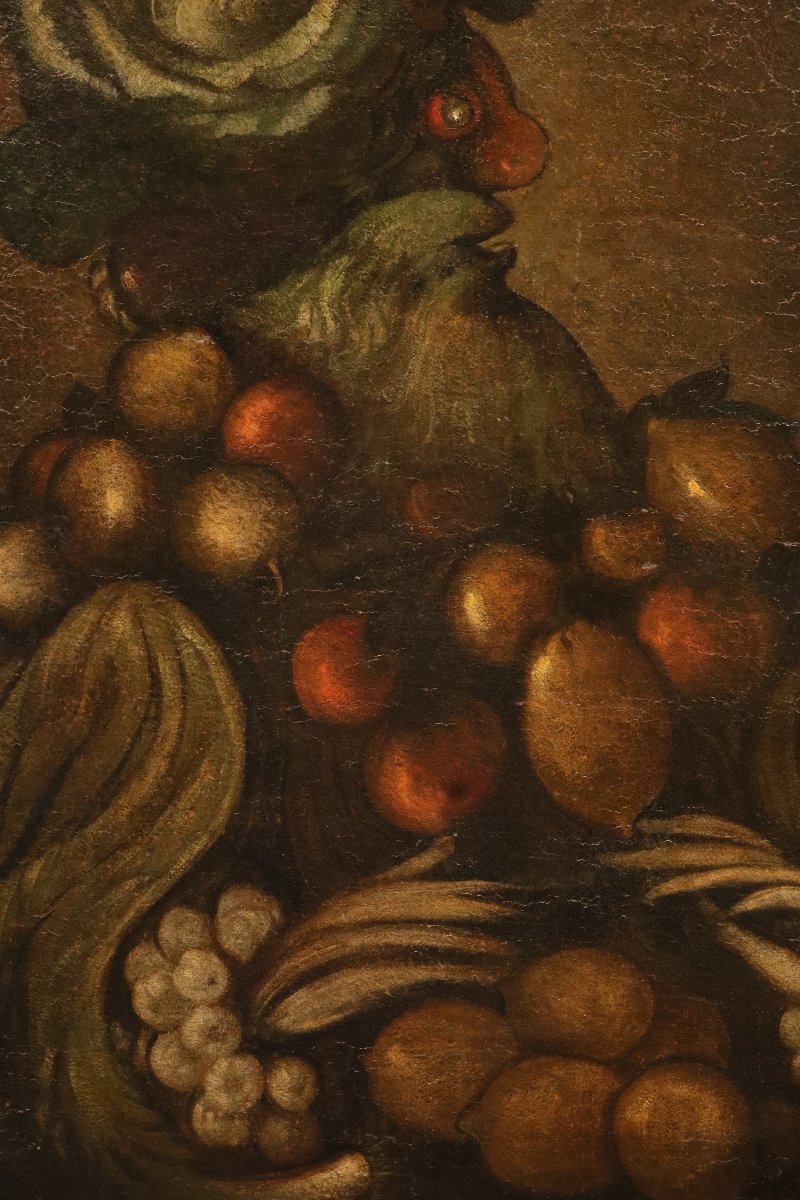
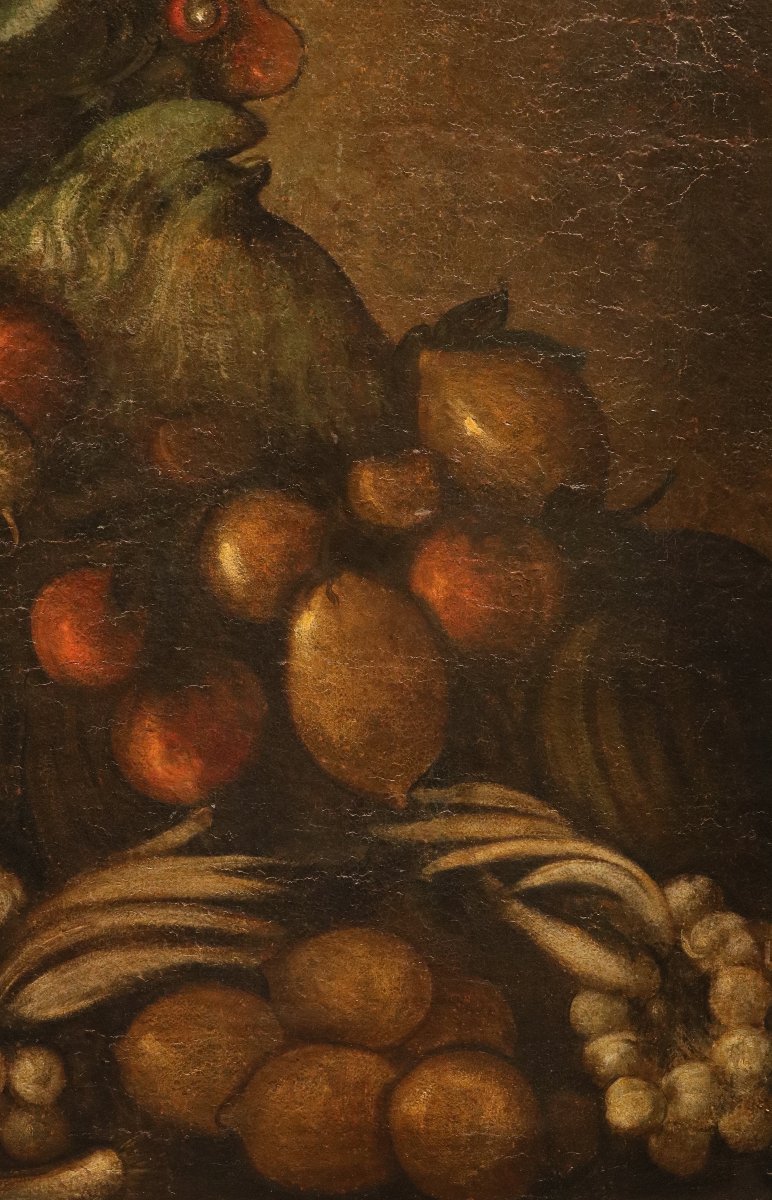
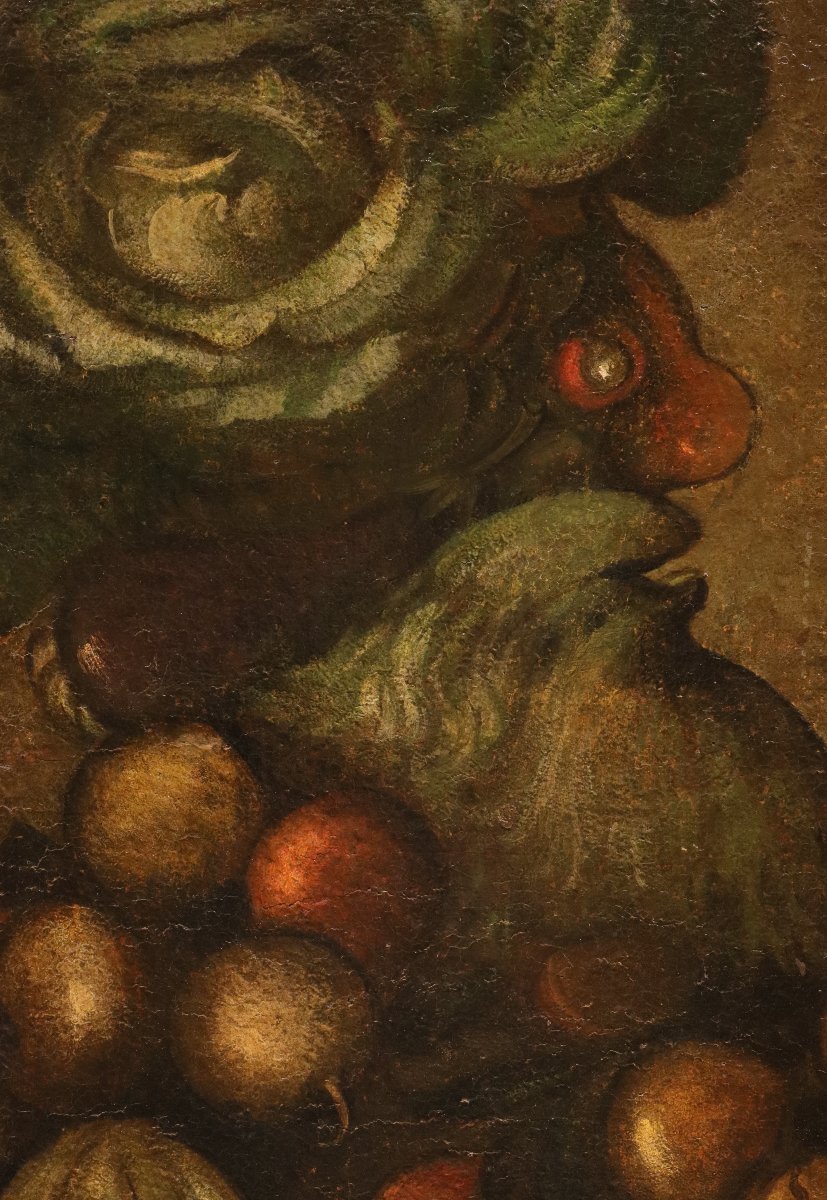


Anthropomorphic Allegory Of Winter, Giuseppe Arcimboldo (milan 1527–1593) Follower
Artist: Giuseppe Arcimboldo (milan 1527 – Milan 1593), Suiveur Du Xviie/xviiie Siècle
Giuseppe Arcimboldo (Milan 1527 – Milan 1593)
17th/18th-century follower
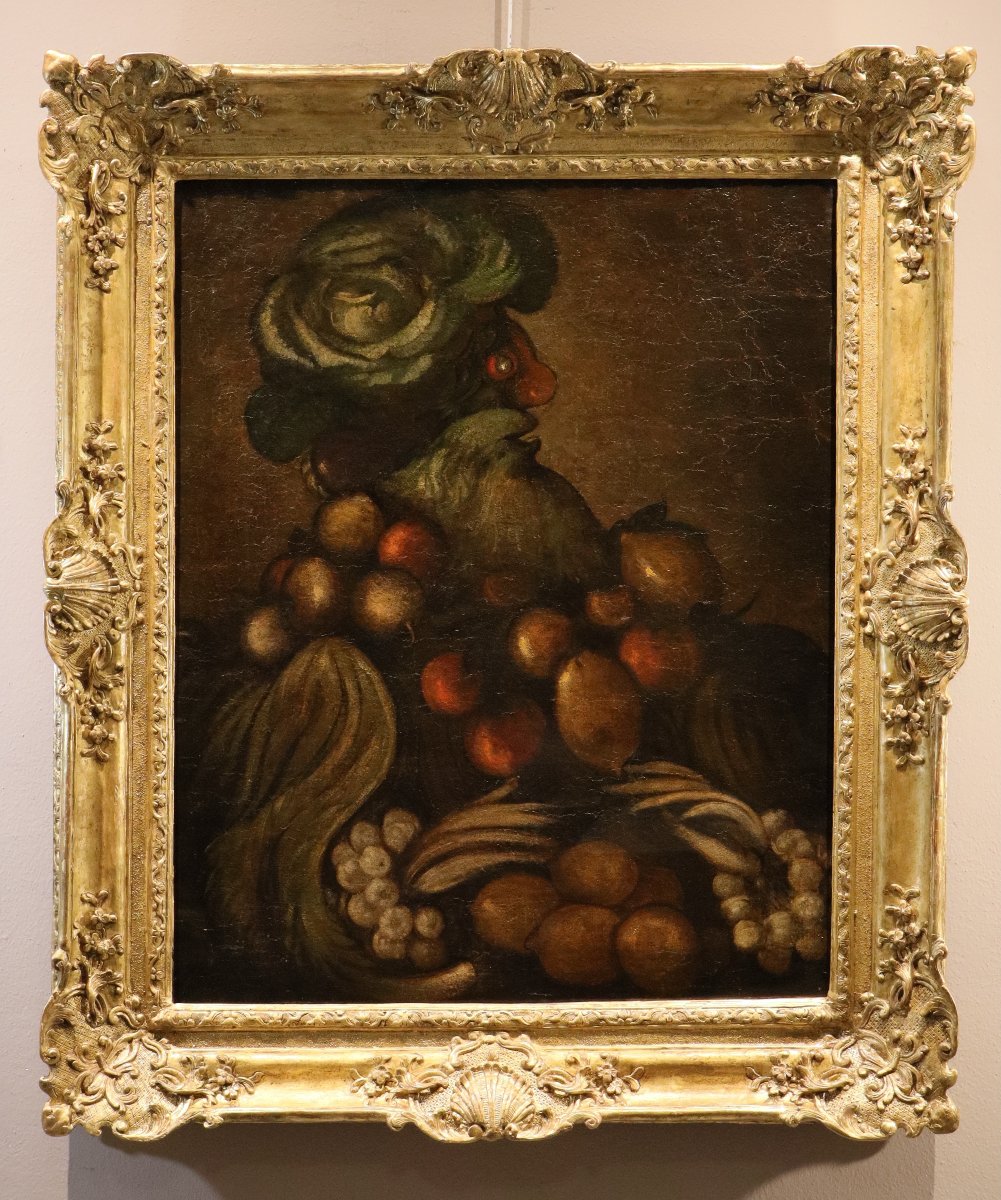
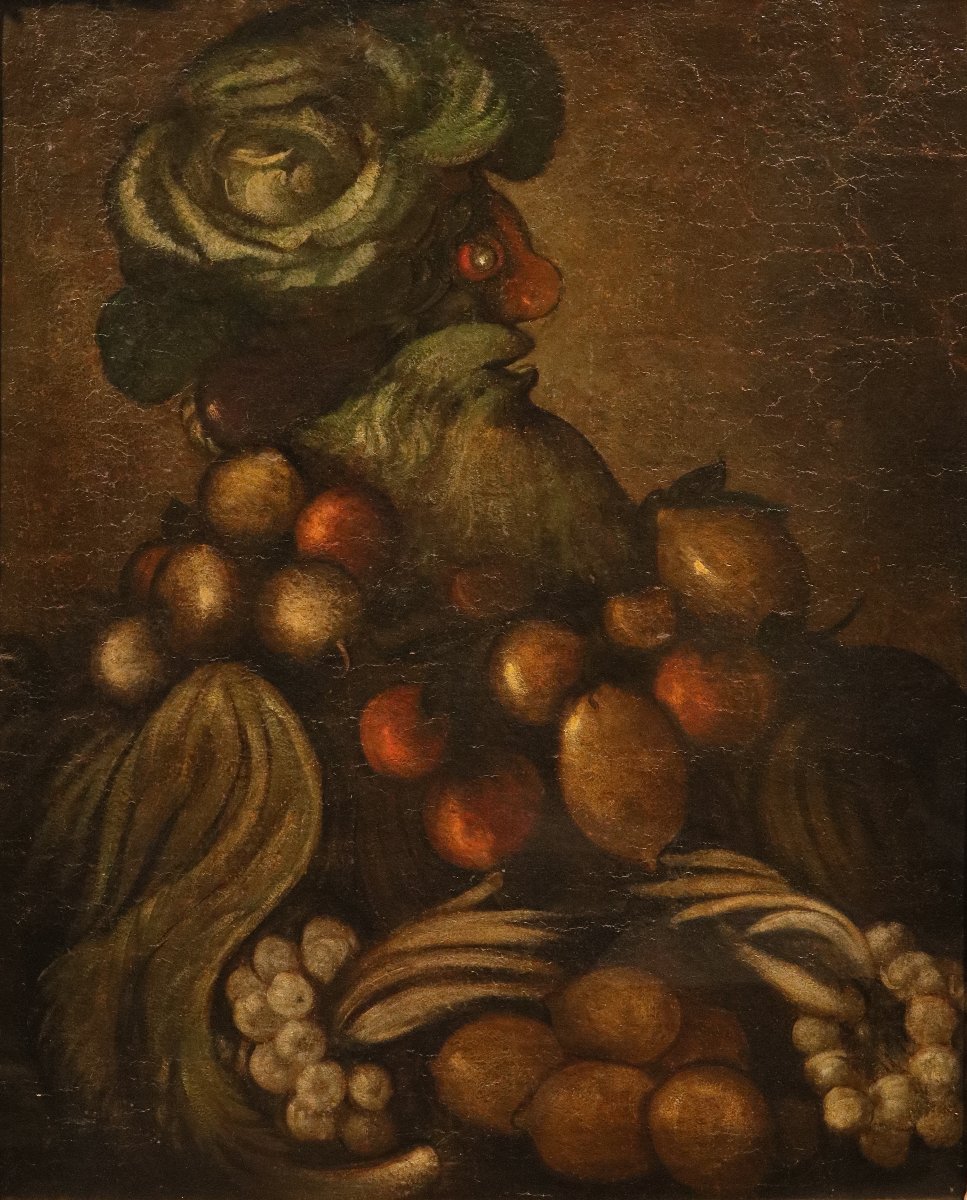
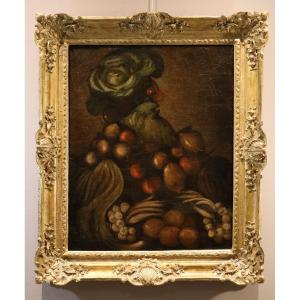
Anthropomorphic Allegory of Winter
Oil on canvas
96 x 75 cm.
In an important antique frame (with flaws) 118 x 101 cm.
TO VIEW THE FULL DETAILS OF THIS PAINTING, CLICK ON THE FOLLOWING - LINK -
The intriguing painting we are pleased to present to you, depicting a personification of Winter, is derived from the famous surrealist iconographic prototypes conceived around 1560–70 by the eclectic Milanese painter Giuseppe Arcimboldi (Milan 1526–1593) and draws on a series of still lifes depicting the Seasons.
After leaving Milan for the court in Vienna, Giuseppe Arcimboldi became the official painter to Emperor Maximilian II of Habsburg, for whom he created a series of paintings that were nothing short of brilliant, executed using an innovative technique that would inspire imitation and reinterpretation for decades to come.
In particular, he created a distinct artistic genre that plays on optical illusions and anthropomorphic composition, crafting true portraits in which he skillfully combines plant elements, fruits, and vegetables typical of each season.
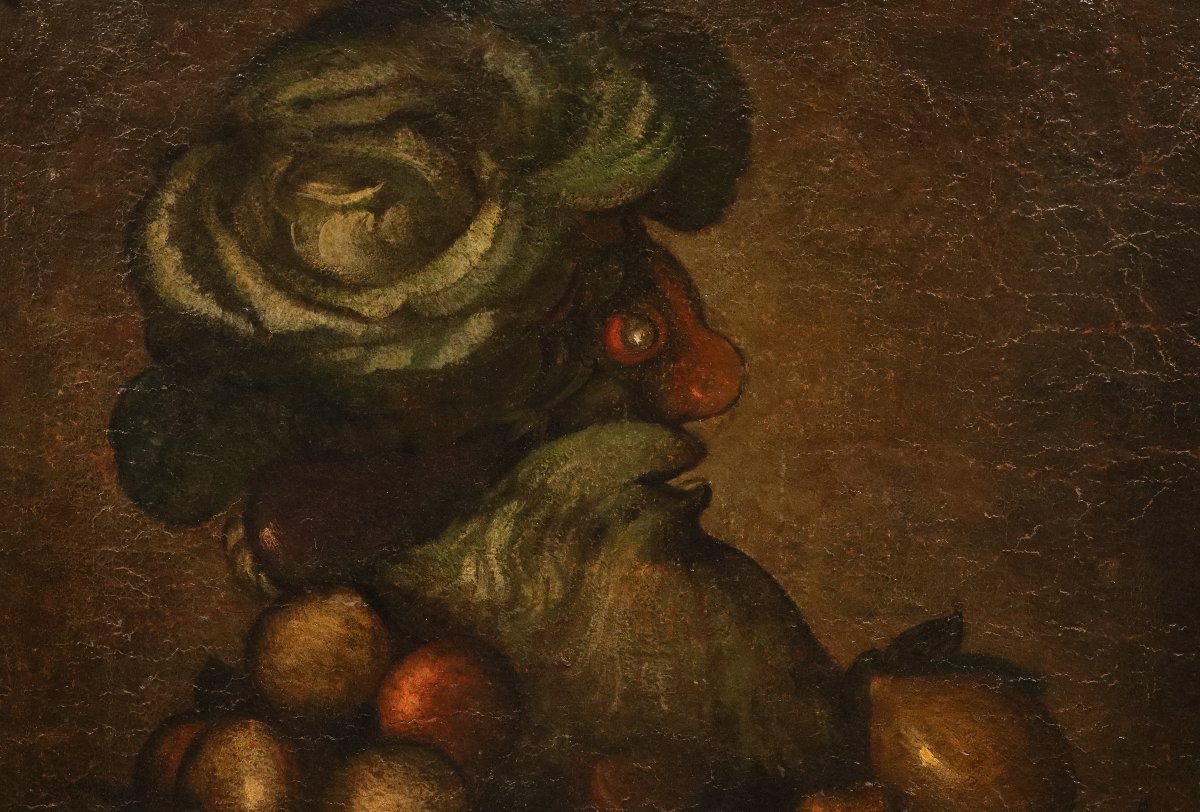
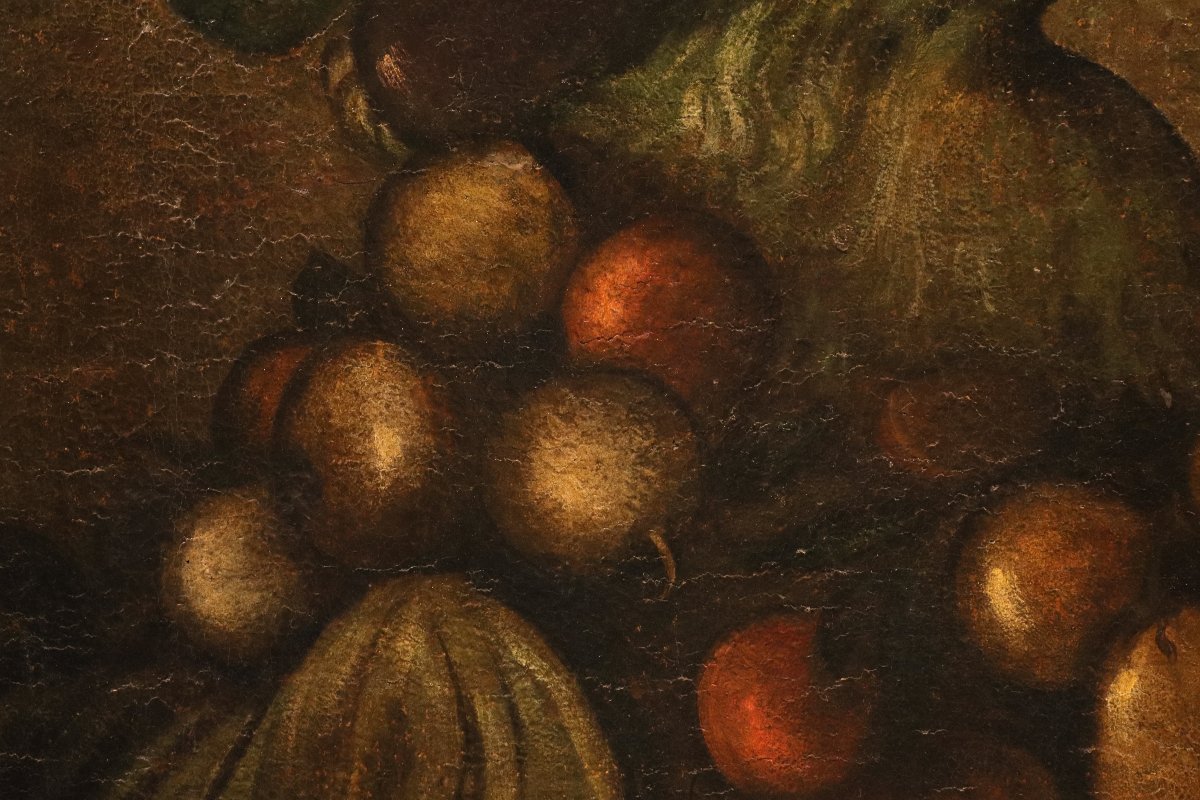
Upon closely observing these works, one cannot help but be captivated by Arcimboldo’s extraordinary inventiveness: in this case, the winter figure is recreated entirely by combining elements typical of the cold season, such as oranges, citrons, garlic, cardoons, cabbage, onions, endive, leeks, and turnips.
According to iconological interpretation, these works were to be understood as celebratory “imperial allegories,” whose symbolic purpose was to represent the Habsburg dynasty’s dominion not only over rival families but over all of creation, including the many resources of Mother Nature.
At the same time, this rich and erudite symbolism of the anthropomorphic heads, in addition to glorifying Habsburg power, appealed to the court’s Mannerist taste for the rare, the curious, and everything that could arouse wonder among the art collectors of the time.
The anthropomorphic depictions of the Seasons conceived by Arcimboldi enjoyed immediate success, as evidenced by the existence of subsequent autograph versions, replicas executed by collaborators, and numerous antique copies, more or less faithful to the originals, which were produced and circulated throughout Europe as early as the end of the sixteenth century.
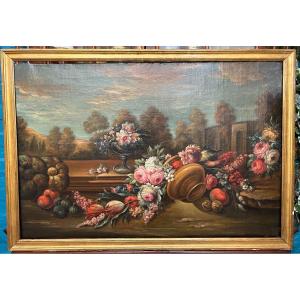
One artist who was strongly influenced by Giuseppe Arcimboldo was Francesco Zucchi (Florence, 1562 – Rome, 1622), an Italian painter known for having disseminated and perpetuated in Rome the style of “composed heads” conceived by Giuseppe Arcimboldo, who, for his part, worked primarily in Vienna and Prague, and as far as Milan. A great many paintings historically cataloged as generic works by “followers of Arcimboldo” have now been reattributed to Francesco Zucchi (Fig. 4).
We can find our prototype in the personification of winter in some works published in the Zeri Photo Library:
Fig. 1 - G. Arcimboldi (follower), Portrait of a Woman and Composition with Fruit and Vegetables, Dorotheum Auction, Vienna, June 10, 1997, no. 124/b
https://catalogo.fondazionezeri.unibo.it/scheda/opera/86956/
Fig. 2 - G. Arcimboldi (in the style of), Composition featuring fruits and vegetables, Private collection
https://catalogo.fondazionezeri.unibo.it/scheda/opera/86961/
Image 3 - G. Arcimboldi, Allegory of Winter, c. 1580–1600, Yale University Art Gallery, New Haven
https://www.meisterdrucke.it/stampe-d-arte/Giuseppe-Arcimboldo/623640/Inverno,-c.1580-1600.html
Image 4 - G. Arcimboldi, Composition with Fruit and Vegetables (Alternate attribution: Francesco Zucchi) Antique Market, Florence
https://catalogo.fondazionezeri.unibo.it/scheda/opera/86984/
ADDITIONAL INFORMATION:
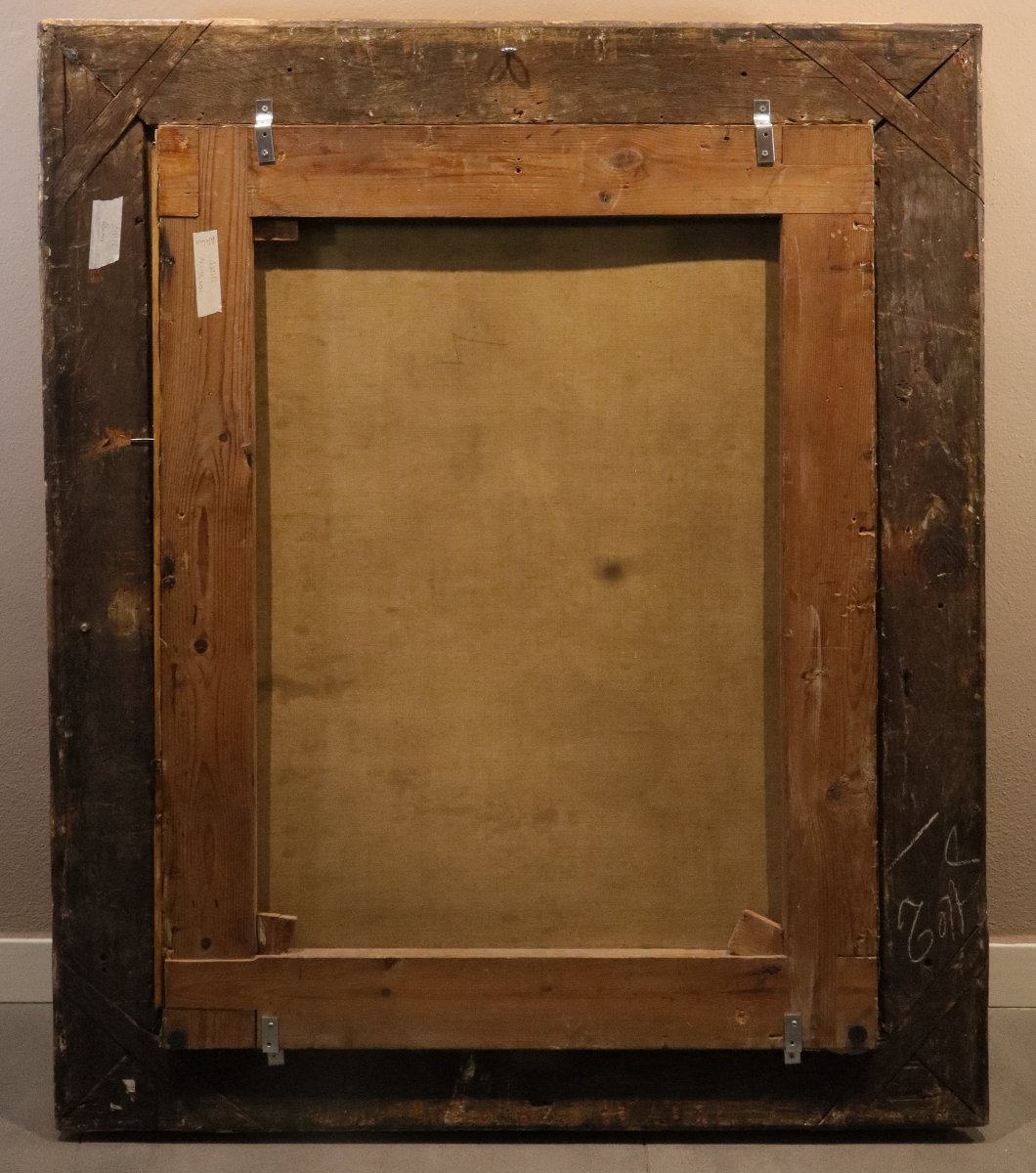
The condition is good, with some restoration and repainting on the surface.
The painting comes with an attractive gilded frame and is accompanied by a certificate of authenticity and a descriptive iconographic sheet.
We handle and arrange the shipping of purchased works, both within Italy and internationally, using professional, insured carriers.
If you would like to view this or other works in person, we would be delighted to welcome you to our new gallery in Riva del Garda, located at Viale Giuseppe Canella 18. We look forward to seeing you!
Please contact us for any information or to schedule a visit; we’ll be happy to assist you.
Follow us on:
https://www.instagram.com/galleriacastelbarco/?hl=it
https://www.facebook.com/galleriacastelbarco/
17th/18th-century follower
Anthropomorphic Allegory of Winter
Oil on canvas
96 x 75 cm.
In an important antique frame (with flaws) 118 x 101 cm.
TO VIEW THE FULL DETAILS OF THIS PAINTING, CLICK ON THE FOLLOWING - LINK -
The intriguing painting we are pleased to present to you, depicting a personification of Winter, is derived from the famous surrealist iconographic prototypes conceived around 1560–70 by the eclectic Milanese painter Giuseppe Arcimboldi (Milan 1526–1593) and draws on a series of still lifes depicting the Seasons.
After leaving Milan for the court in Vienna, Giuseppe Arcimboldi became the official painter to Emperor Maximilian II of Habsburg, for whom he created a series of paintings that were nothing short of brilliant, executed using an innovative technique that would inspire imitation and reinterpretation for decades to come.
In particular, he created a distinct artistic genre that plays on optical illusions and anthropomorphic composition, crafting true portraits in which he skillfully combines plant elements, fruits, and vegetables typical of each season.
Upon closely observing these works, one cannot help but be captivated by Arcimboldo’s extraordinary inventiveness: in this case, the winter figure is recreated entirely by combining elements typical of the cold season, such as oranges, citrons, garlic, cardoons, cabbage, onions, endive, leeks, and turnips.
According to iconological interpretation, these works were to be understood as celebratory “imperial allegories,” whose symbolic purpose was to represent the Habsburg dynasty’s dominion not only over rival families but over all of creation, including the many resources of Mother Nature.
At the same time, this rich and erudite symbolism of the anthropomorphic heads, in addition to glorifying Habsburg power, appealed to the court’s Mannerist taste for the rare, the curious, and everything that could arouse wonder among the art collectors of the time.
The anthropomorphic depictions of the Seasons conceived by Arcimboldi enjoyed immediate success, as evidenced by the existence of subsequent autograph versions, replicas executed by collaborators, and numerous antique copies, more or less faithful to the originals, which were produced and circulated throughout Europe as early as the end of the sixteenth century.
One artist who was strongly influenced by Giuseppe Arcimboldo was Francesco Zucchi (Florence, 1562 – Rome, 1622), an Italian painter known for having disseminated and perpetuated in Rome the style of “composed heads” conceived by Giuseppe Arcimboldo, who, for his part, worked primarily in Vienna and Prague, and as far as Milan. A great many paintings historically cataloged as generic works by “followers of Arcimboldo” have now been reattributed to Francesco Zucchi (Fig. 4).
We can find our prototype in the personification of winter in some works published in the Zeri Photo Library:
Fig. 1 - G. Arcimboldi (follower), Portrait of a Woman and Composition with Fruit and Vegetables, Dorotheum Auction, Vienna, June 10, 1997, no. 124/b
https://catalogo.fondazionezeri.unibo.it/scheda/opera/86956/
Fig. 2 - G. Arcimboldi (in the style of), Composition featuring fruits and vegetables, Private collection
https://catalogo.fondazionezeri.unibo.it/scheda/opera/86961/
Image 3 - G. Arcimboldi, Allegory of Winter, c. 1580–1600, Yale University Art Gallery, New Haven
https://www.meisterdrucke.it/stampe-d-arte/Giuseppe-Arcimboldo/623640/Inverno,-c.1580-1600.html
Image 4 - G. Arcimboldi, Composition with Fruit and Vegetables (Alternate attribution: Francesco Zucchi) Antique Market, Florence
https://catalogo.fondazionezeri.unibo.it/scheda/opera/86984/
ADDITIONAL INFORMATION:
The condition is good, with some restoration and repainting on the surface.
The painting comes with an attractive gilded frame and is accompanied by a certificate of authenticity and a descriptive iconographic sheet.
We handle and arrange the shipping of purchased works, both within Italy and internationally, using professional, insured carriers.
If you would like to view this or other works in person, we would be delighted to welcome you to our new gallery in Riva del Garda, located at Viale Giuseppe Canella 18. We look forward to seeing you!
Please contact us for any information or to schedule a visit; we’ll be happy to assist you.
Follow us on:
https://www.instagram.com/galleriacastelbarco/?hl=it
https://www.facebook.com/galleriacastelbarco/
11 000 €
Period: 17th century
Style: Louis 16th, Directory
Condition: Excellent condition
Material: Oil painting
Width: encadré 75 cm.
Height: encadré 96 cm.
Reference (ID): 1797738
Availability: In stock
Print