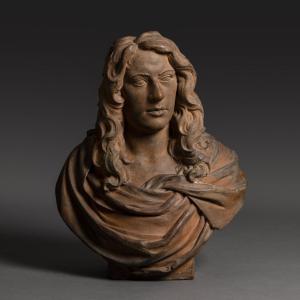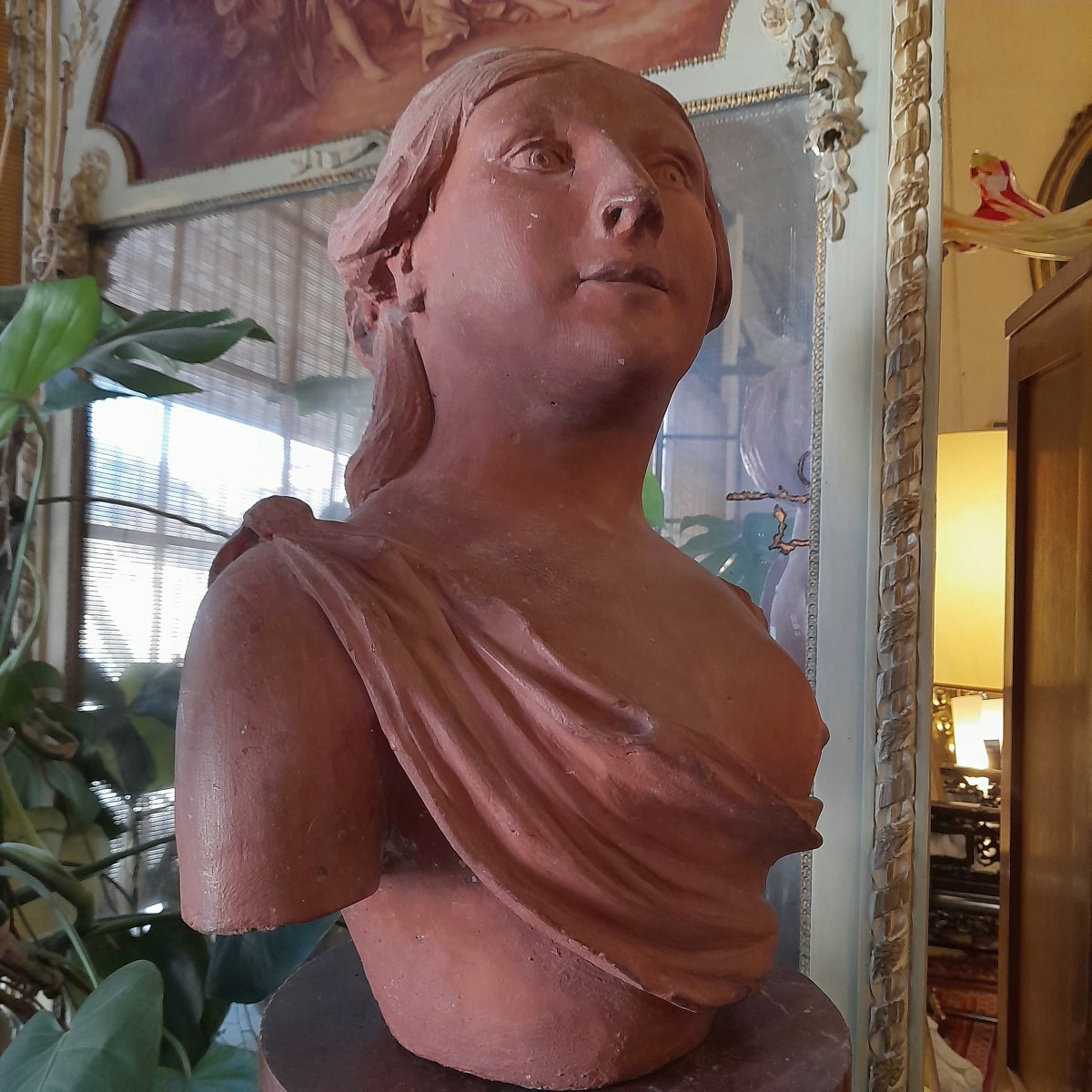
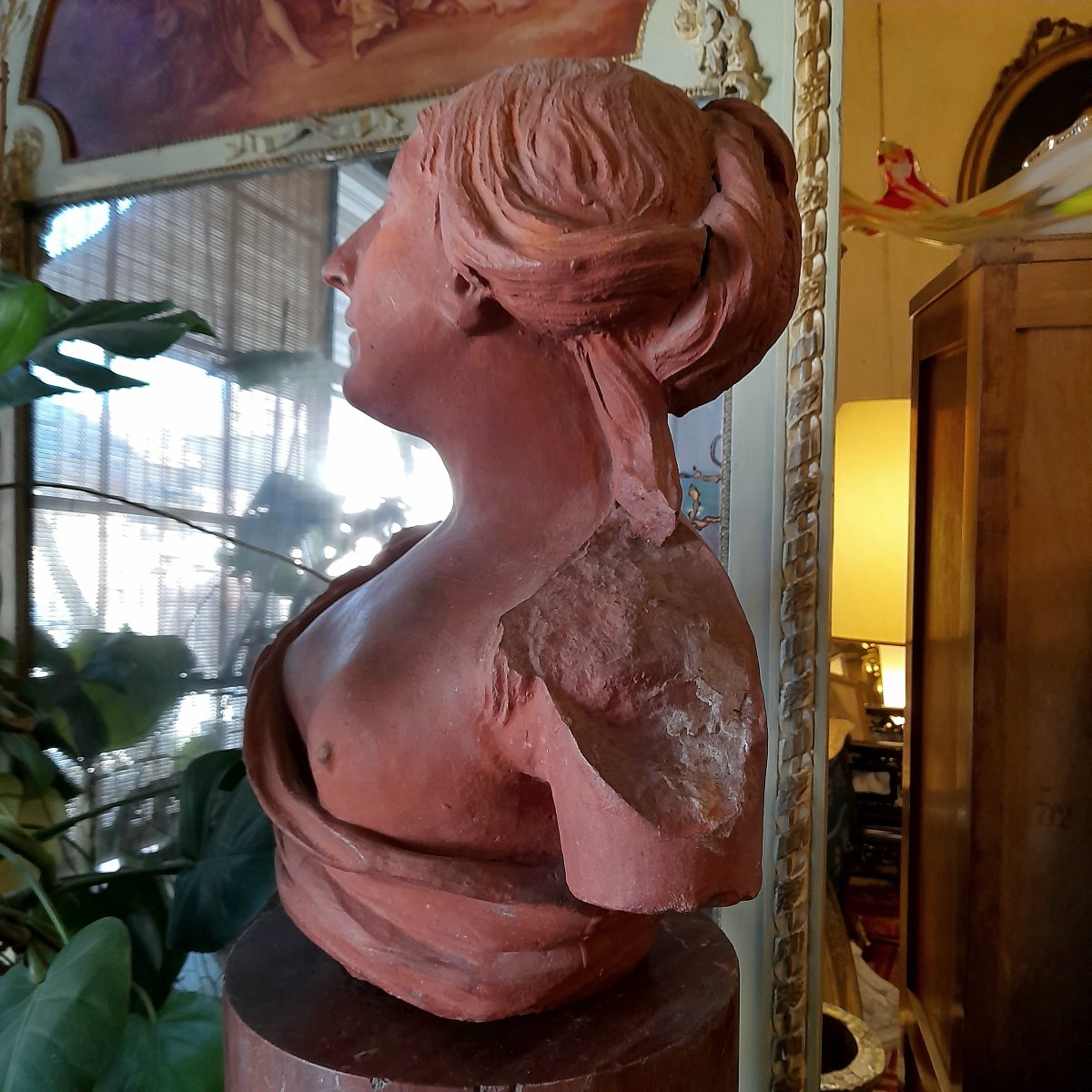
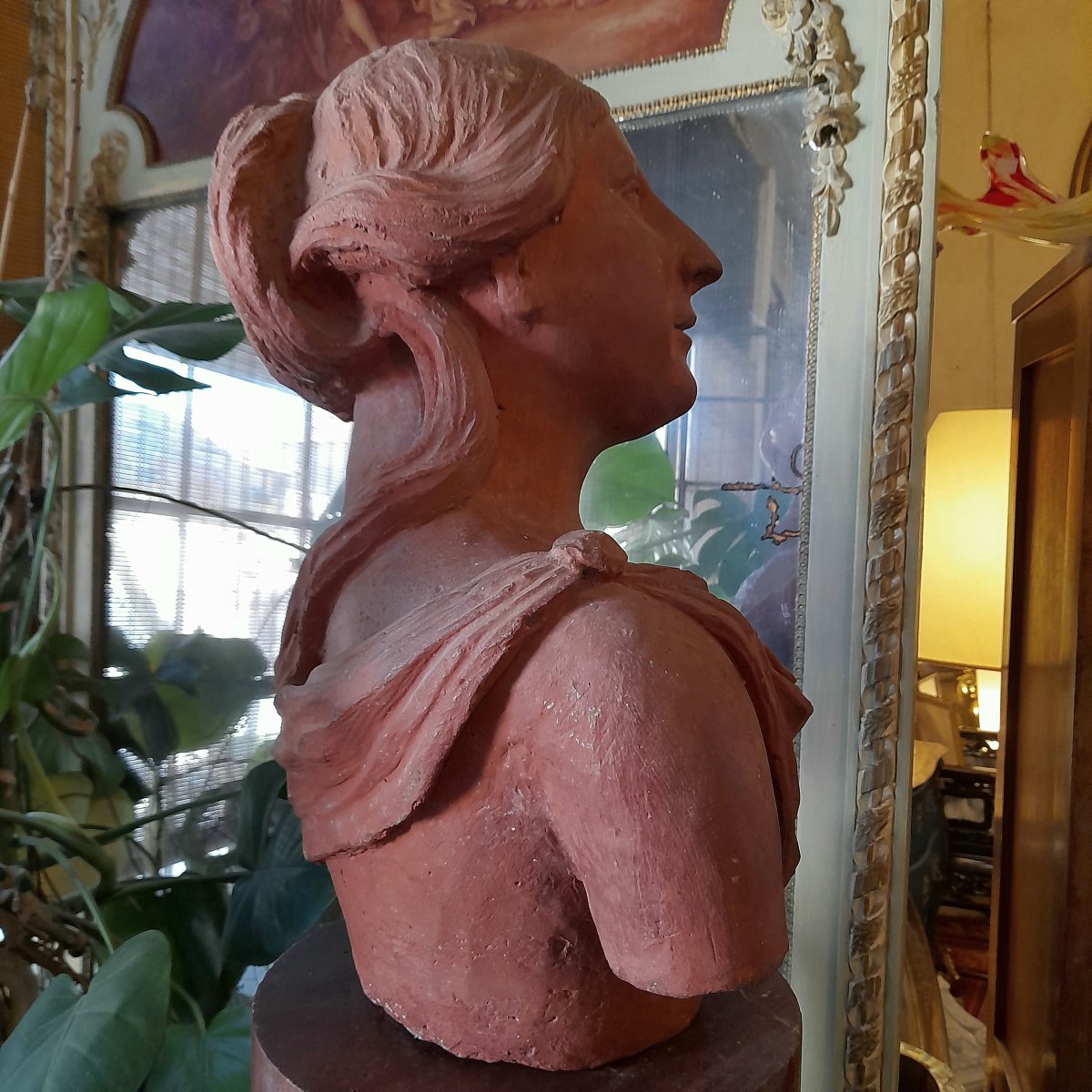
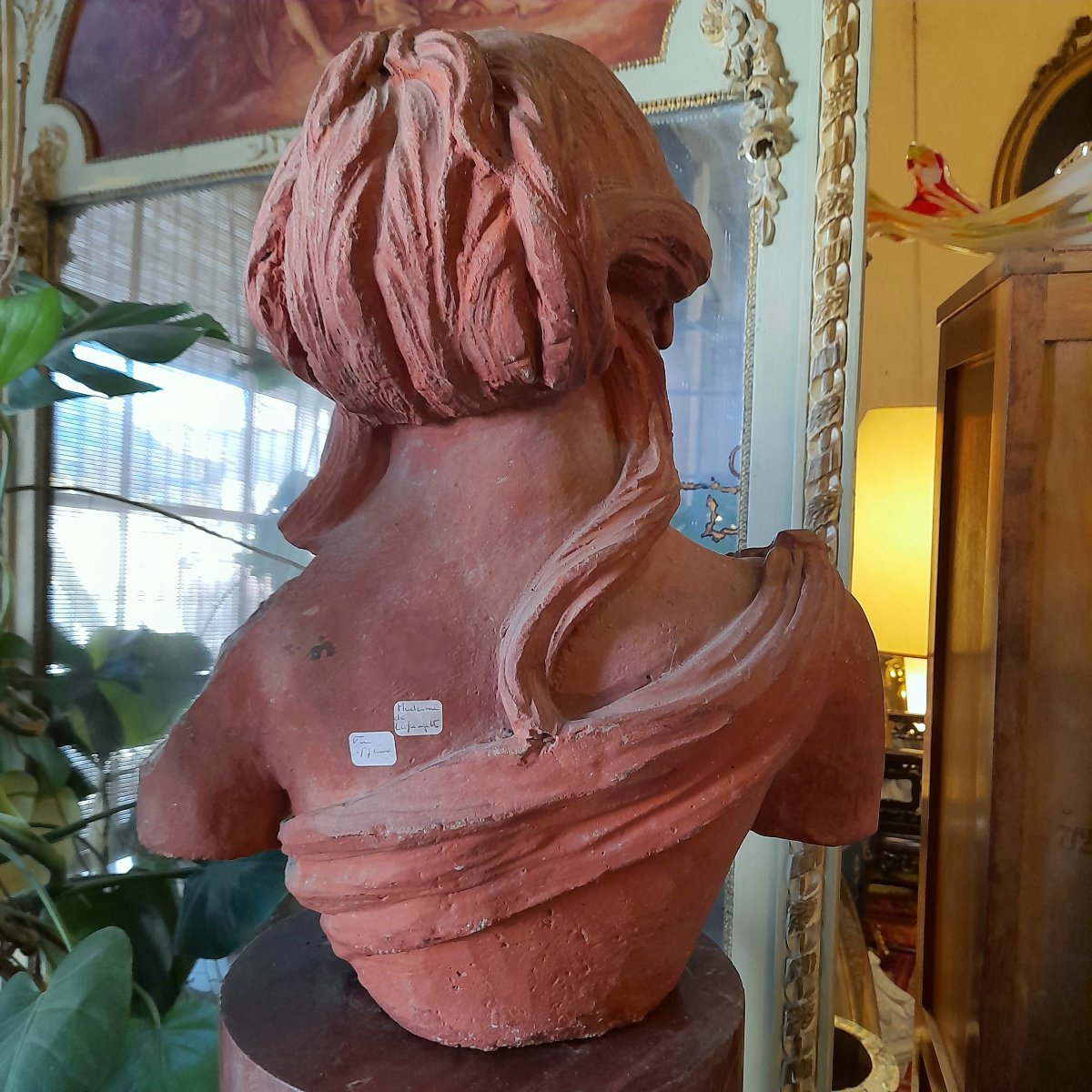
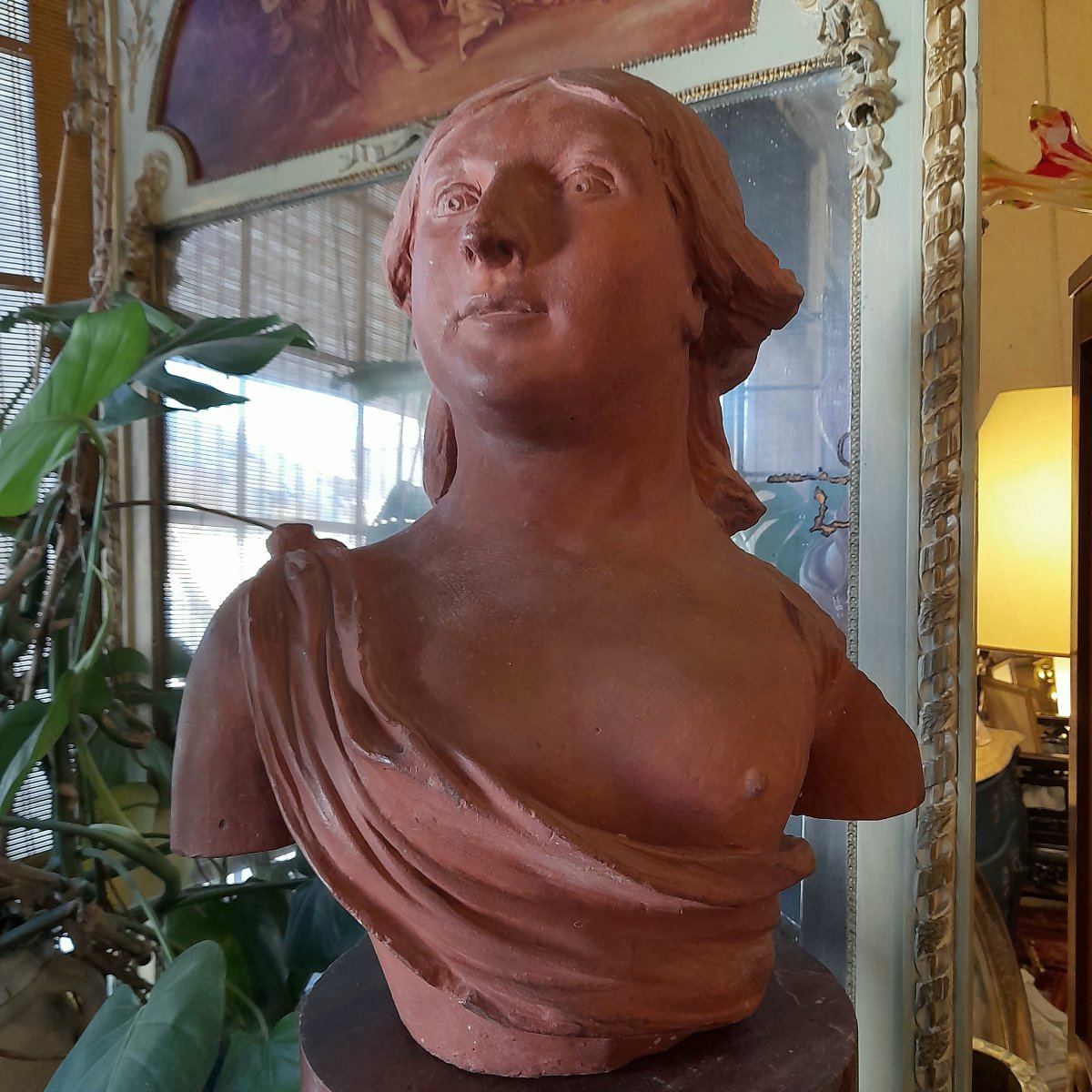


Bust Of Madame De Lafayette, Late 17th To Early 18th Century.
Artist: Inconnu
Fine 17th-century terracotta bust
Madame de La Fayette
Marie-Madeleine was born into a wealthy family of the minor nobility that moved within the circle of Cardinal de Richelieu.Her mother, Marie de Péna—the daughter of a physician to Louis XIII—hailed from an ancient Provençal family;one of her ancestors, Hugues de Péna, served in the 13th century as secretary to King Charles I of Naples and was the author of several tragedies, while another, Jean de Péna—who three centuries later produced Greek and Latin editions of Theodosius’s *Sphaerics*—taught mathematics at the Collège de France.Marie de Péna was in the service of Duchess Marie-Madeleine de Vignerot du Pont-de-Courlay (Lady of Comballet and later Duchess of Aiguillon), Richelieu’s niece[2].
Marie-Madeleine’s father, Marc Pioche—who sought to obscure his bourgeois origins by adopting the name "Aymar de La Vergne"[3]—was a royal squire and a gentleman in the retinue of the Richelieu household; in September 1632, the Cardinal entrusted him with the military education of his godson, Jean Armand de Maillé (the eldest son of Marquis Urbain de Maillé-Brézé)[4].
When her father died in December 1649, Marie-Madeleine was only fifteen years old.A year later, her mother remarried Renaud-René de Sévigné, an uncle of the Marquise de Sévigné’s husband;the two women—separated in age by eight years—would go on to become "the dearest friends in the world."That same year, the young woman was appointed lady-in-waiting to Queen Anne of Austria and began her literary education under the grammarian Gilles Ménage; he taught her Italian and Latin and introduced her to the fashionable literary salons of Catherine de Rambouillet, the Marquise du Plessis-Bellière, and Madeleine de Scudéry—connections that would lead to her inclusion in Baudeau de Somaize’s *Grand Dictionnaire des précieuses* in 1661, under the pseudonym "Féliciane"[5].
In 1655, at the age of twenty-two, she married François Motier, Count de La Fayette—a nobleman of high standing from Auvergne, brother of the famous Louise de La Fayette (a lady-in-waiting to Anne of Austria) and nephew of François de La Fayette, the Bishop of Limoges.This thirty-eight-year-old widower—who was short of funds and lived a secluded life at his Château de Nades—brought a prestigious name to Mademoiselle Pioche de la Vergne.The couple had two sons.
She accompanied him to his estates in Auvergne and the Bourbonnais while frequently returning to Paris, where she began to gain entry into the high society of the Court.She successfully opened her own literary salon in her lavish private mansion on the Rue de Vaugirard.Their marital happiness appears to have collapsed after a few years of marriage—following the birth of their sons—at which point François de La Fayette became so inconspicuous that he seemed to have literally vanished (it was not until the late 19th century that a document found in the La Trémoille archives revealed that this silent husband had lived until June 26, 1683).
Marie-Madeleine de La Fayette’s acquaintances included Henrietta of England (the future Duchess of Orléans), who asked her to be her biographer[6] and with whom she became close; "Grand Arnauld";and Pierre-Daniel Huet, whose *Traité de l'origine des romans* (Treatise on the Origin of Novels) would be published as a preface to her *Zaïde*.At the very beginning of the Fronde, she was also close to Cardinal de Retz.Other figures in her circle included the poet and novelist Jean Regnault de Segrais and the society writer Gilles Ménage; both men were regulars at Mme de La Fayette’s salon and became invaluable literary advisors to her.
Encouraged by Segrais and Ménage—who acted as true literary advisors—Mme de La Fayette decided to take up writing.Having settled permanently in Paris in 1659, the only work she published under her own name was a short portrait of Mme de Sévigné, which appeared in a collaborative volume titled *Divers portraits*.
In 1662, she published a historical novella, *La Princesse de Montpensier*, under Segrais’s name.From 1655 to 1680, she maintained a close relationship with the Duke of La Rochefoucauld, author of *Réflexions ou sentences et maximes morales* (Reflections or Sentences and Moral Maxims).Their loyal and steadfast friendship prompted Madame de Sévigné—a friend to both—to write, upon the death of the Duke de La Rochefoucauld: "...nothing could compare to the trust and charm of their friendship."La Rochefoucauld introduced Marie-Madeleine de La Fayette to many of the great literary minds of the day, including Racine and Boileau.The first volume of *Zaïde*—a Hispano-Moorish novel published under Segrais’s name but almost certainly written by Madame de La Fayette—appeared in 1669. The second volume was published in 1671. *Zaïde* was frequently reprinted and translated, notably thanks to Huet’s preface.
Marie-Madeleine de La Fayette’s most famous work is *La Princesse de Clèves*, first published by a friend of hers in March
1 200 €
Period: 17th century
Style: Louis 14th, Regency
Condition: En l'etat
Material: Terracotta
Width: 44 cm
Height: 50 cm
Depth: 30 cm
Reference (ID): 1796668
Availability: In stock
Print