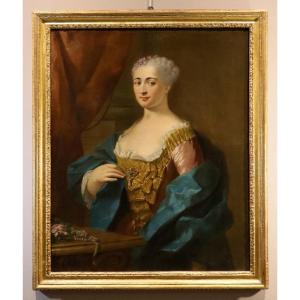


Portrait Of A Noblewoman, Jean-baptiste Van Loo (aix-en-provence, 1684–1745), Circle Of
Jean-Baptiste van Loo (Aix-en-Provence, 1684–1745) circle
Portrait of a Lady
Oil on canvas
93 x 77 cm.
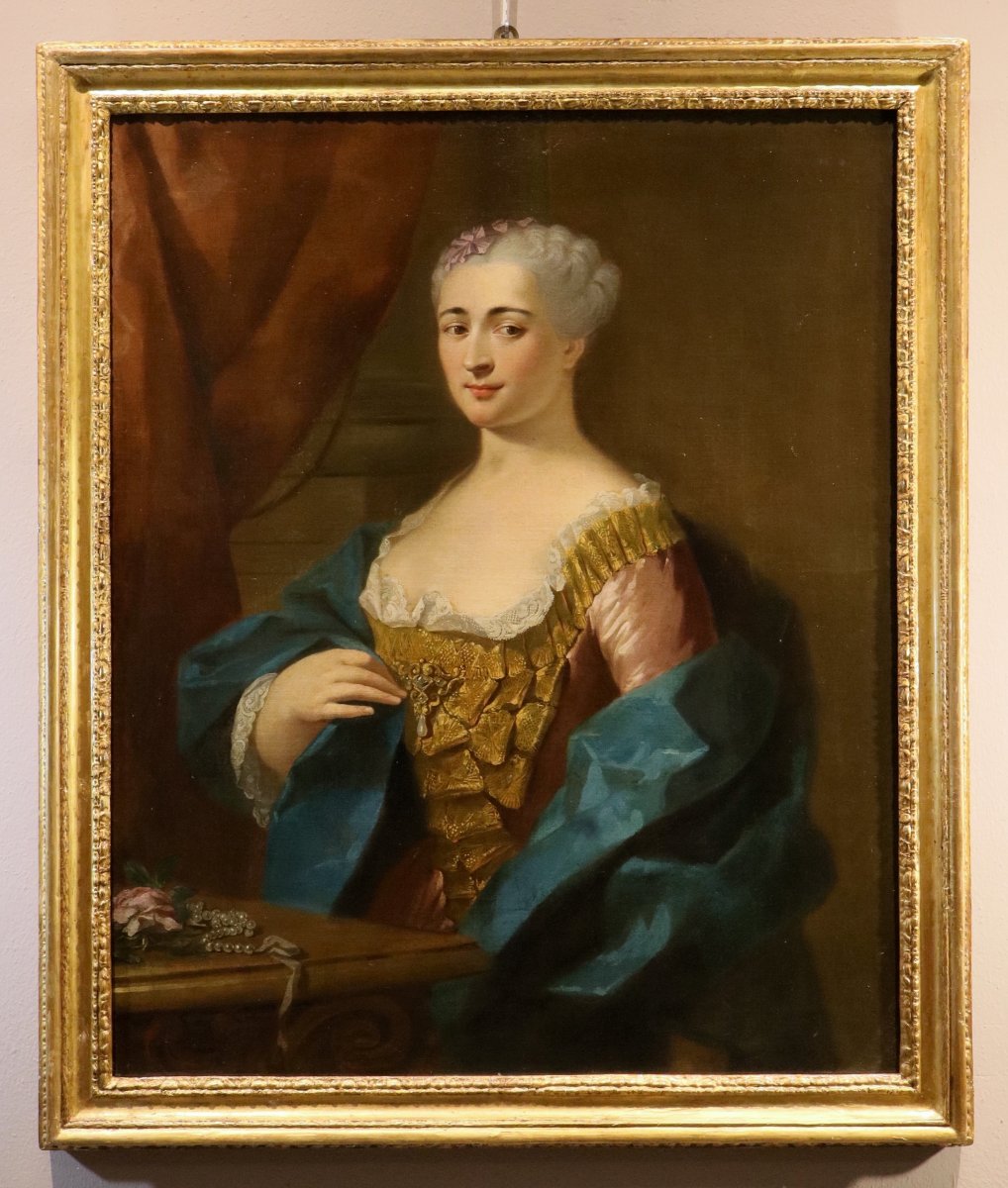
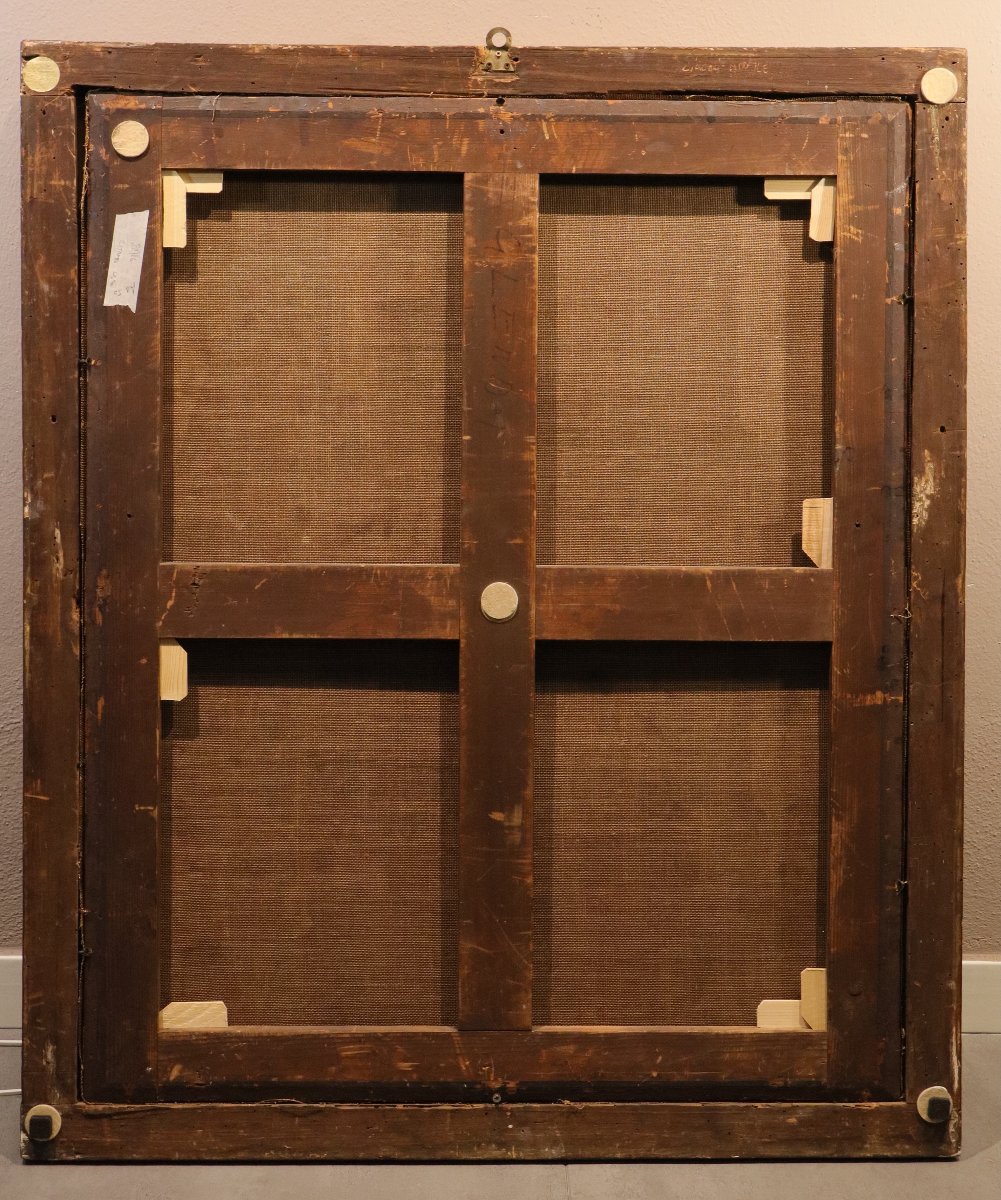
In antique frames (with imperfections) 103 x 87 cm.
Complete details of the painting (CLICK HERE)
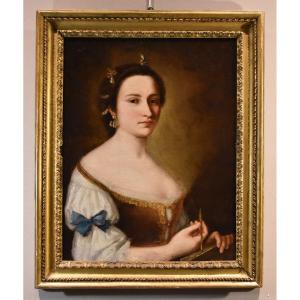
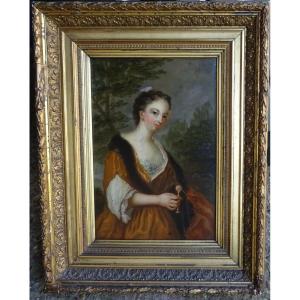
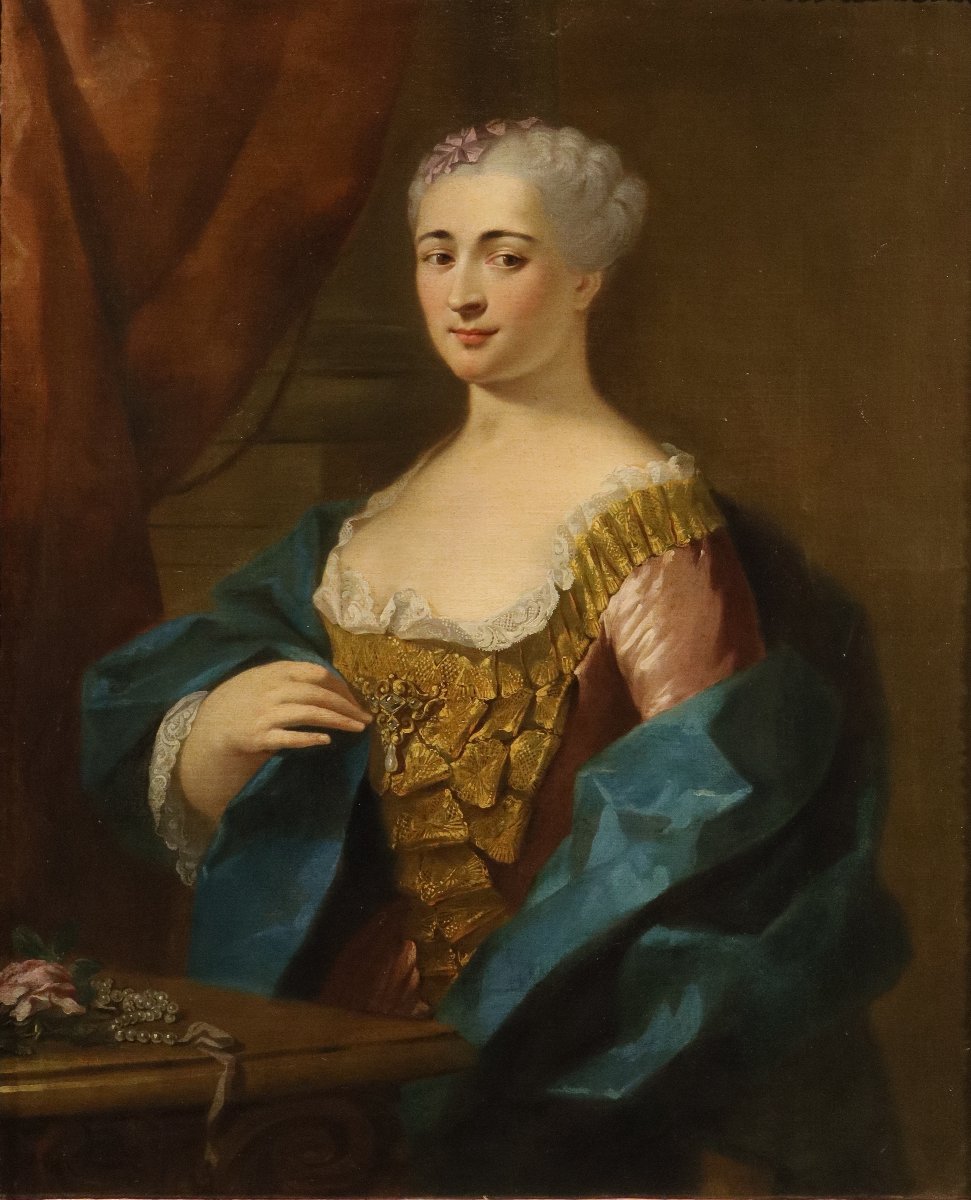
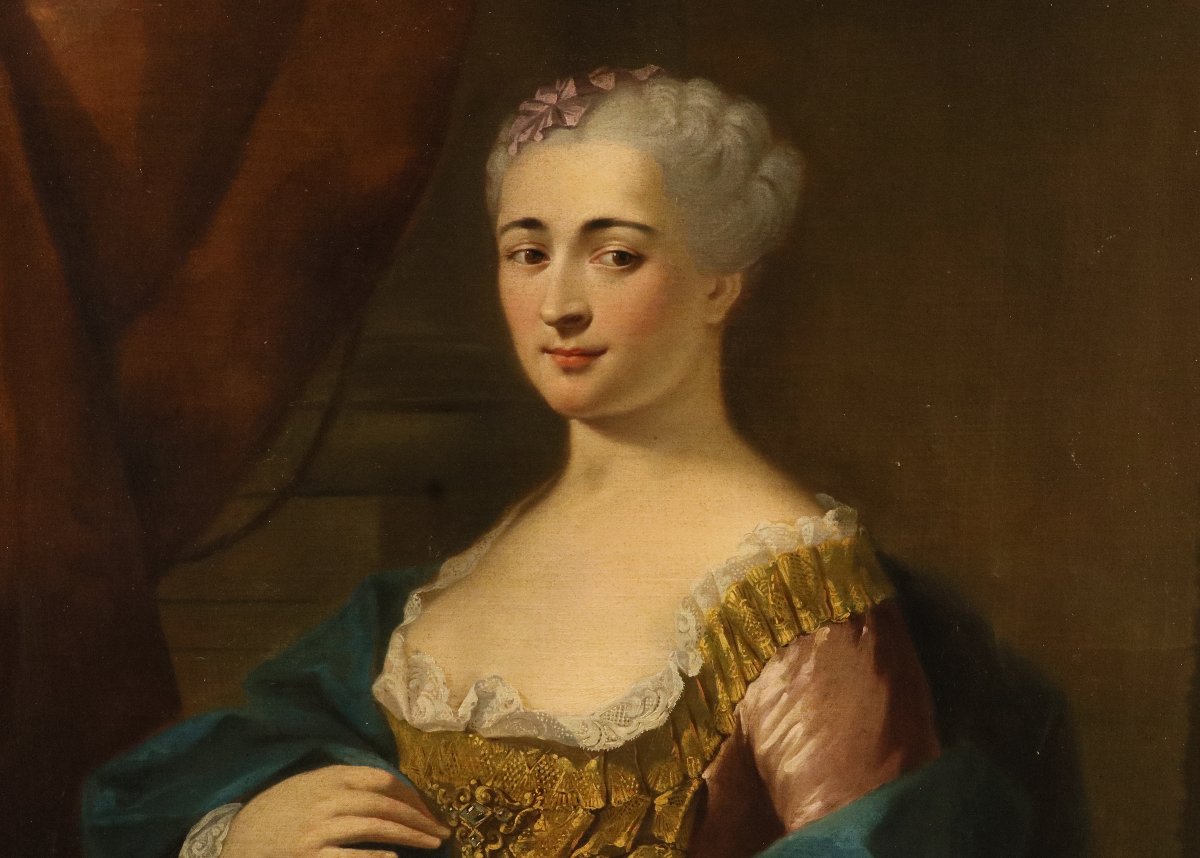
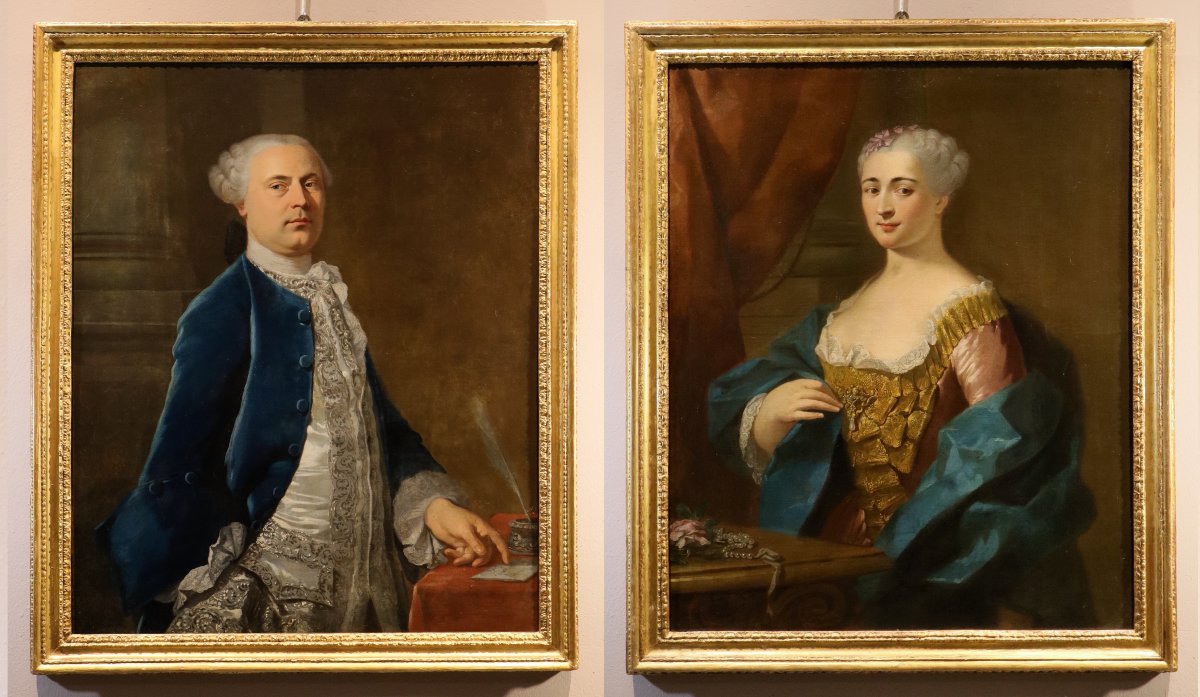
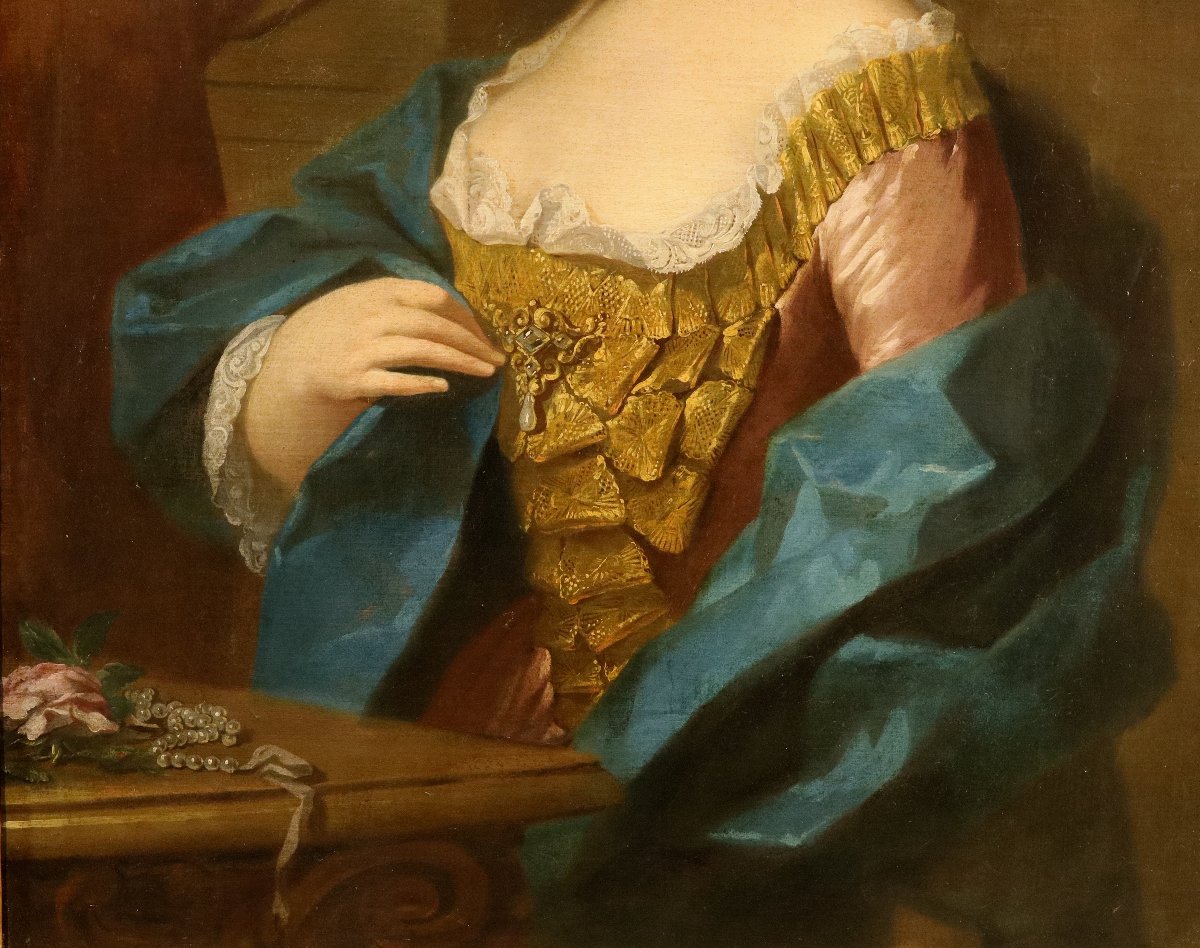
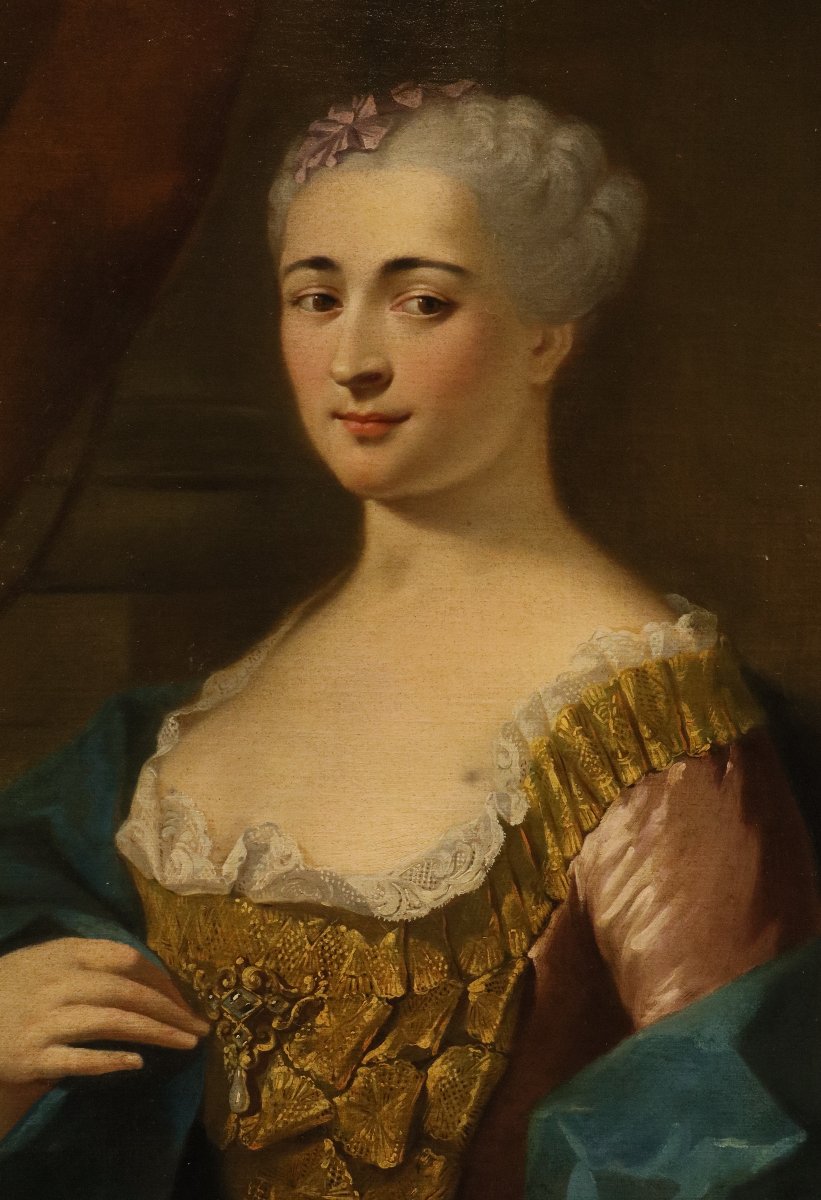
The painting depicts a noblewoman (the corresponding pendant is also available—link -) depicted in a refined and sumptuous pose, typical of 18th-century aristocratic portraiture: she is portrayed in half-length, with her body slightly inclined and her gaze fixed directly on the viewer, conveying an air of confidence befitting her high social status.
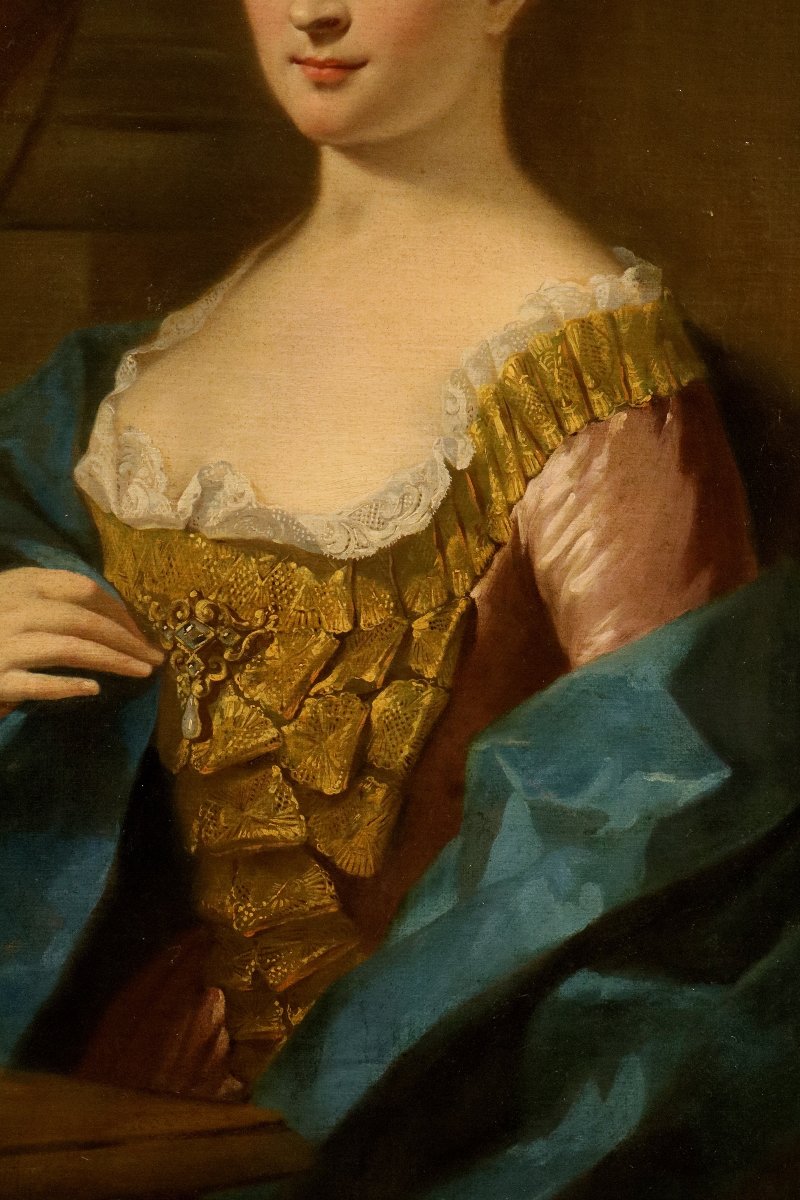
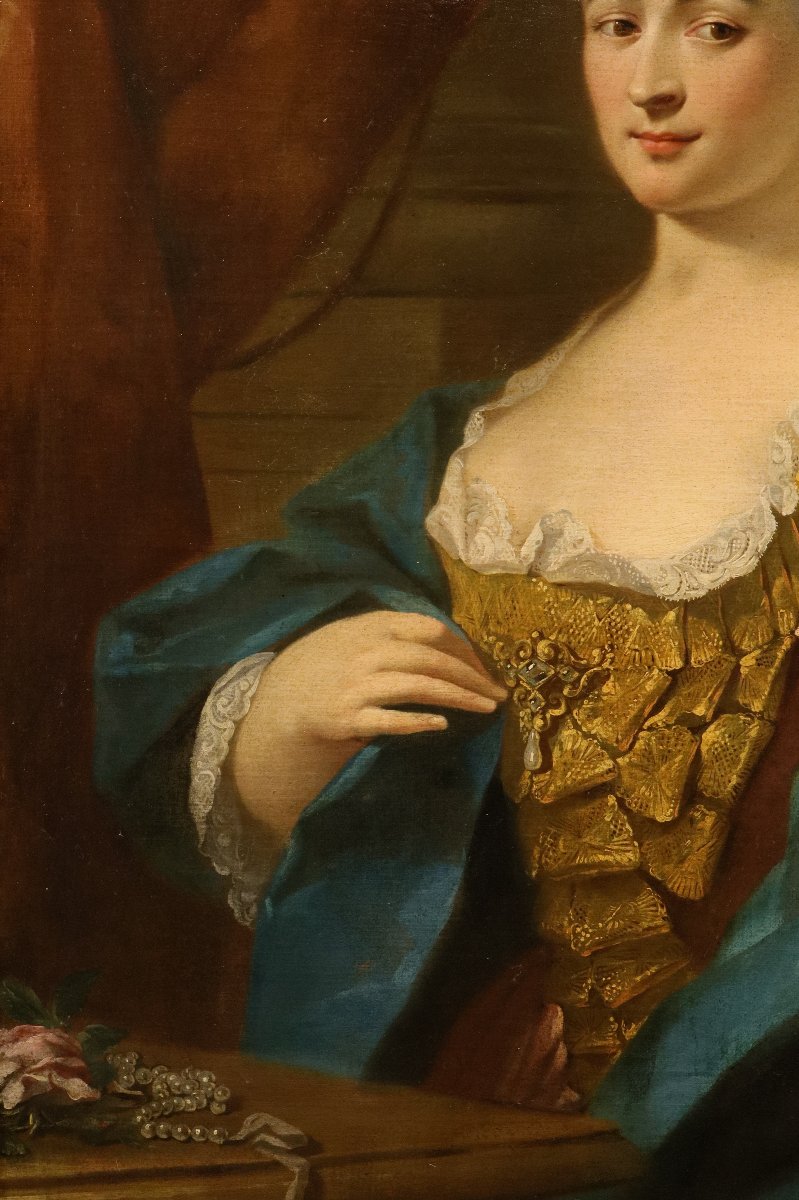
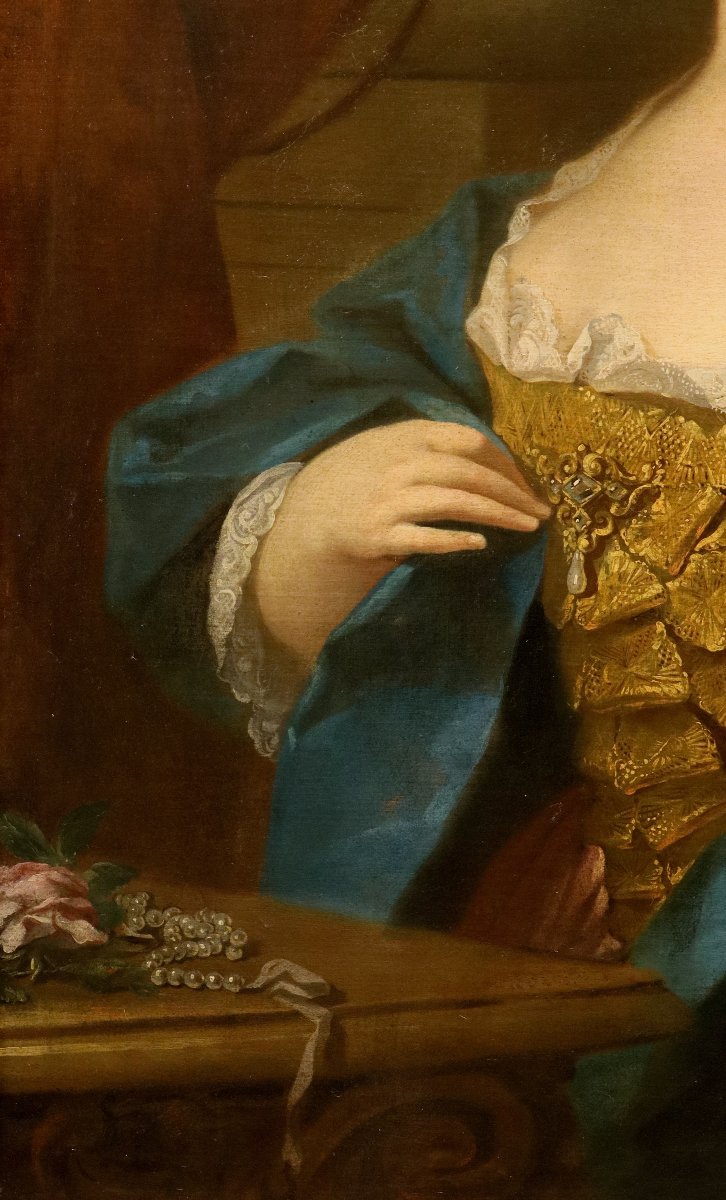
The lady, with a regal bearing, wears a magnificent gown with a wide neckline and a richly decorated golden bodice, embellished with a jeweled brooch featuring pearls at its center, characterized by embroidery and luxurious gold-thread appliqués. Draped over her shoulders is a wide blue silk cloak, whose intense color creates a stark contrast with the delicate pink of the visible sleeve and the white lace at the neckline; the woman holds the cloak with one hand, emphasizing her noble pose.
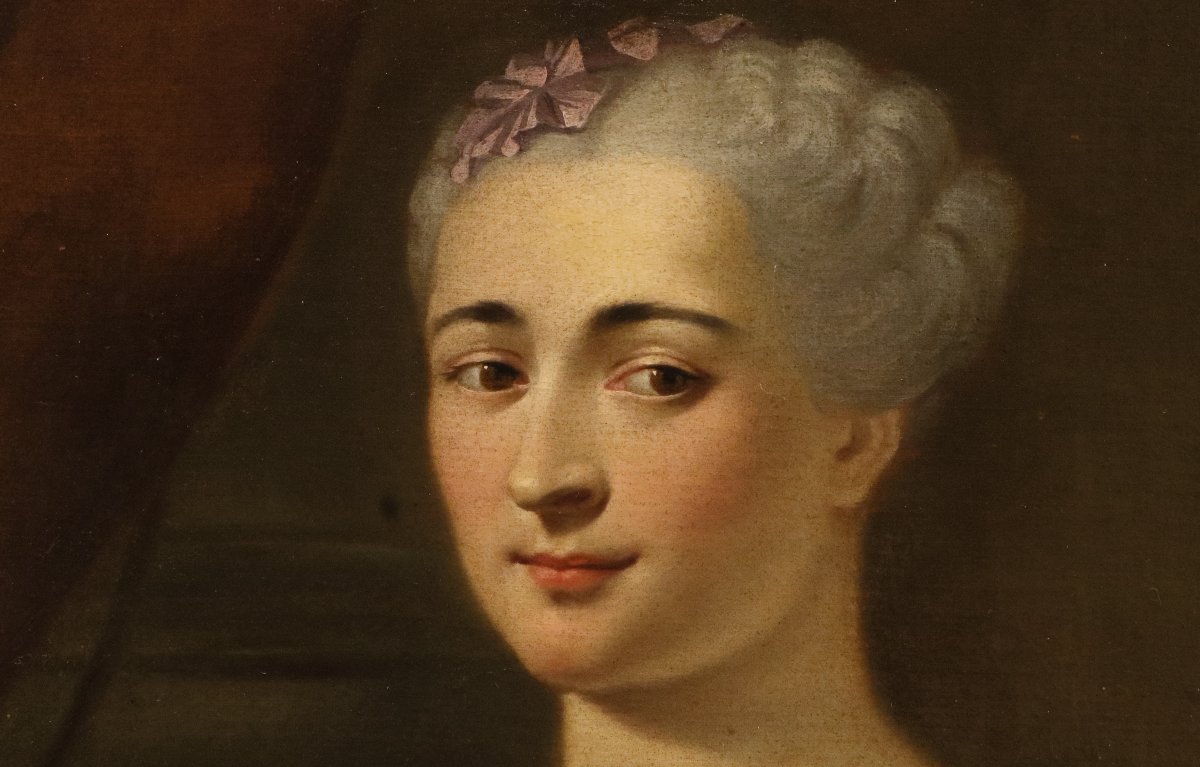
The subject is depicted in a half-length portrait, turned slightly toward the viewer with a serene and composed expression; she poses naturally while gazing intently at the viewer, aware of her rank, in keeping with the pictorial conventions of the time, which required painters to hint at emotions—without making them explicit, and thus vulgar—in order to convey a sentiment.
The scene is set in a noble interior, with a dark drape on the left serving as a theatrical backdrop, highlighting the illuminated figure of the woman, while a pearl necklace rests on the table—an element that further underscores the subject’s elevated status—along with a rose, which in female portraits symbolizes beauty and youth.
The stylistic features and compositional choices in this high-quality portrait hark back to examples of the most refined French portraiture of the early 18th century, celebrated for its ability to capture the aristocratic elegance and sophistication typical of the Rococo period.
In particular, we are inclined to attribute its execution to a skilled portraitist from the circle of Jean-Baptiste van Loo (Aix-en-Provence, 1684 –1745), one of the most celebrated French portraitists of the 18th century: The master’s style is evident in the meticulous attention to detail and in the rendering of the sheen of the fabrics (such as silk moiré) and the naturalness of the complexion—elements that ensured him enormous success at European courts, including the English court.
Belonging to a prestigious dynasty of painters of Dutch origin, his career spanned France, Italy, and England; he was known for immortalizing Europe’s leading monarchs and aristocrats.
The painter headed a prestigious family workshop, active at various European courts such as Turin, Paris, and London,
which involved close family members and talented students to meet the extremely high demand for royal and noble commissions.
The work we are examining here perfectly exemplifies Van Loo’s mastery in combining observational realism with elegant colorism. His works, in fact, achieved extraordinary success thanks to his ability to combine elegance with the psychological likeness of his subjects.
ADDITIONAL INFORMATION:
The work is framed in a beautiful gilded wooden frame and comes with a certificate of authenticity and warranty.
We handle and arrange shipping for purchased works, both within Italy and internationally, using professional, insured carriers. It is also possible to view the painting at our gallery in Riva del Garda; we would be delighted to welcome you and show you our collection of works.
Please feel free to contact us, with no obligation, for any additional information.
Follow us on:
INSTAGRAM https://www.instagram.com/galleriacastelbarco/?hl=it
FACEBOOK https://www.facebook.com/galleriacastelbarco/
Portrait of a Lady
Oil on canvas
93 x 77 cm.
In antique frames (with imperfections) 103 x 87 cm.
Complete details of the painting (CLICK HERE)
The painting depicts a noblewoman (the corresponding pendant is also available—link -) depicted in a refined and sumptuous pose, typical of 18th-century aristocratic portraiture: she is portrayed in half-length, with her body slightly inclined and her gaze fixed directly on the viewer, conveying an air of confidence befitting her high social status.
The lady, with a regal bearing, wears a magnificent gown with a wide neckline and a richly decorated golden bodice, embellished with a jeweled brooch featuring pearls at its center, characterized by embroidery and luxurious gold-thread appliqués. Draped over her shoulders is a wide blue silk cloak, whose intense color creates a stark contrast with the delicate pink of the visible sleeve and the white lace at the neckline; the woman holds the cloak with one hand, emphasizing her noble pose.
The subject is depicted in a half-length portrait, turned slightly toward the viewer with a serene and composed expression; she poses naturally while gazing intently at the viewer, aware of her rank, in keeping with the pictorial conventions of the time, which required painters to hint at emotions—without making them explicit, and thus vulgar—in order to convey a sentiment.
The scene is set in a noble interior, with a dark drape on the left serving as a theatrical backdrop, highlighting the illuminated figure of the woman, while a pearl necklace rests on the table—an element that further underscores the subject’s elevated status—along with a rose, which in female portraits symbolizes beauty and youth.
The stylistic features and compositional choices in this high-quality portrait hark back to examples of the most refined French portraiture of the early 18th century, celebrated for its ability to capture the aristocratic elegance and sophistication typical of the Rococo period.
In particular, we are inclined to attribute its execution to a skilled portraitist from the circle of Jean-Baptiste van Loo (Aix-en-Provence, 1684 –1745), one of the most celebrated French portraitists of the 18th century: The master’s style is evident in the meticulous attention to detail and in the rendering of the sheen of the fabrics (such as silk moiré) and the naturalness of the complexion—elements that ensured him enormous success at European courts, including the English court.
Belonging to a prestigious dynasty of painters of Dutch origin, his career spanned France, Italy, and England; he was known for immortalizing Europe’s leading monarchs and aristocrats.
The painter headed a prestigious family workshop, active at various European courts such as Turin, Paris, and London,
which involved close family members and talented students to meet the extremely high demand for royal and noble commissions.
The work we are examining here perfectly exemplifies Van Loo’s mastery in combining observational realism with elegant colorism. His works, in fact, achieved extraordinary success thanks to his ability to combine elegance with the psychological likeness of his subjects.
ADDITIONAL INFORMATION:
The work is framed in a beautiful gilded wooden frame and comes with a certificate of authenticity and warranty.
We handle and arrange shipping for purchased works, both within Italy and internationally, using professional, insured carriers. It is also possible to view the painting at our gallery in Riva del Garda; we would be delighted to welcome you and show you our collection of works.
Please feel free to contact us, with no obligation, for any additional information.
Follow us on:
INSTAGRAM https://www.instagram.com/galleriacastelbarco/?hl=it
FACEBOOK https://www.facebook.com/galleriacastelbarco/
8 500 €
Period: 18th century
Style: Louis 15th - Transition
Condition: Excellent condition
Material: Oil painting
Width: encadré 87 cm.
Height: encadré 103 cm.
Reference (ID): 1789838
Availability: In stock
Print