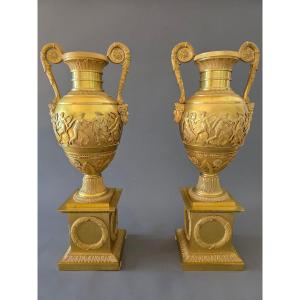


Thomire In Paris, A Monumental Pair Of Signed Vases From The Empire Period.
Artist: Signé Thomire à Paris
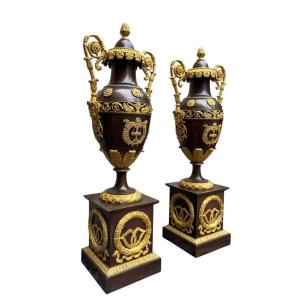
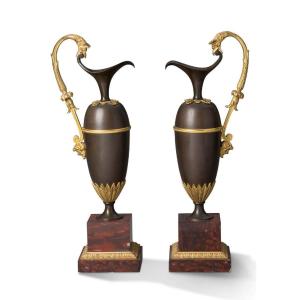
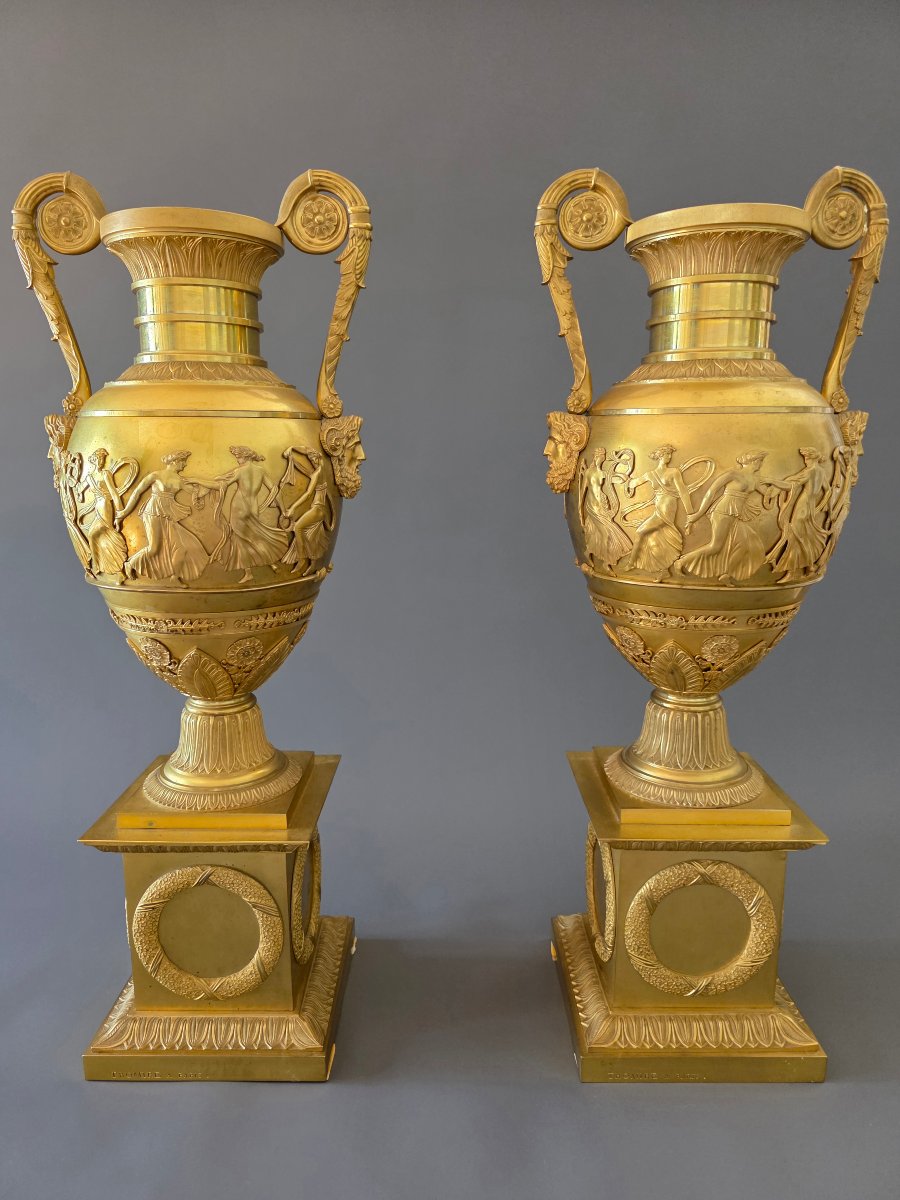
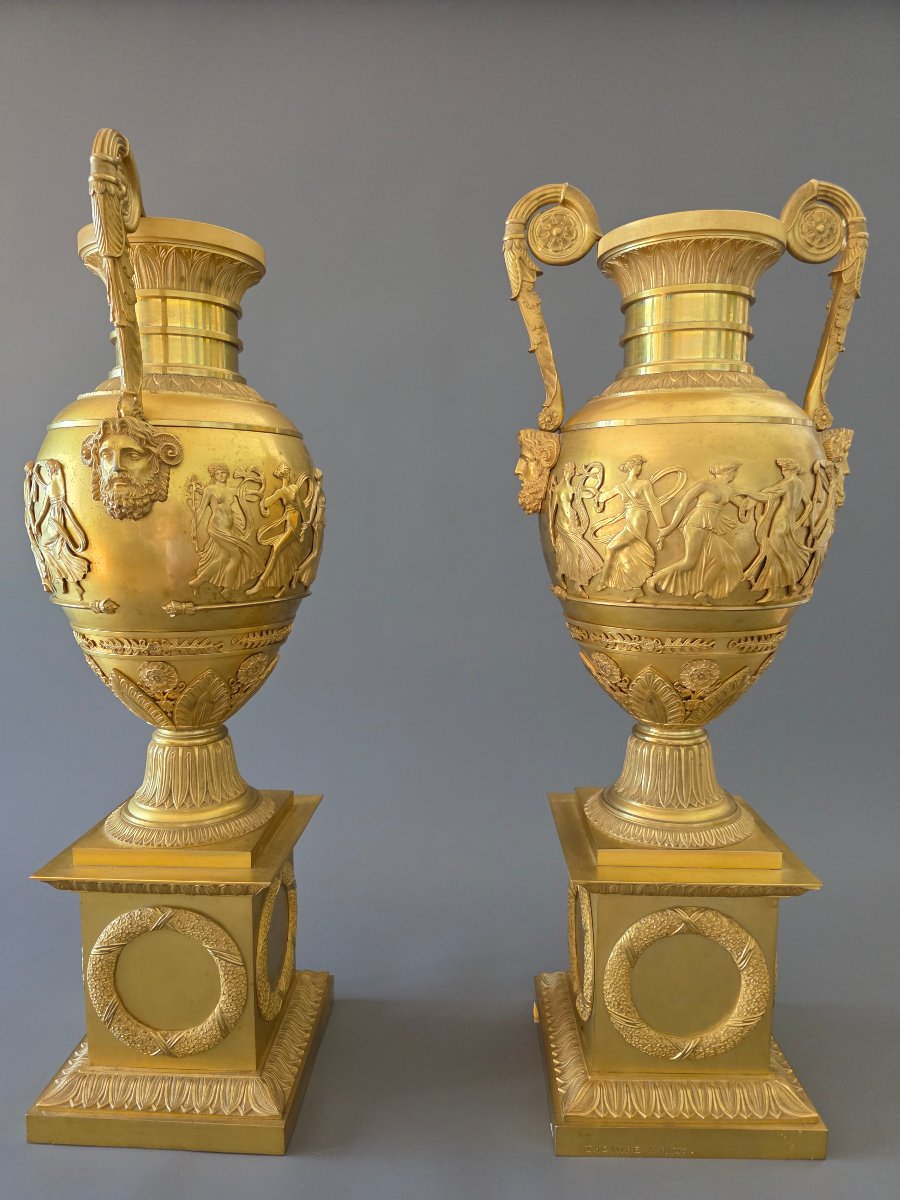
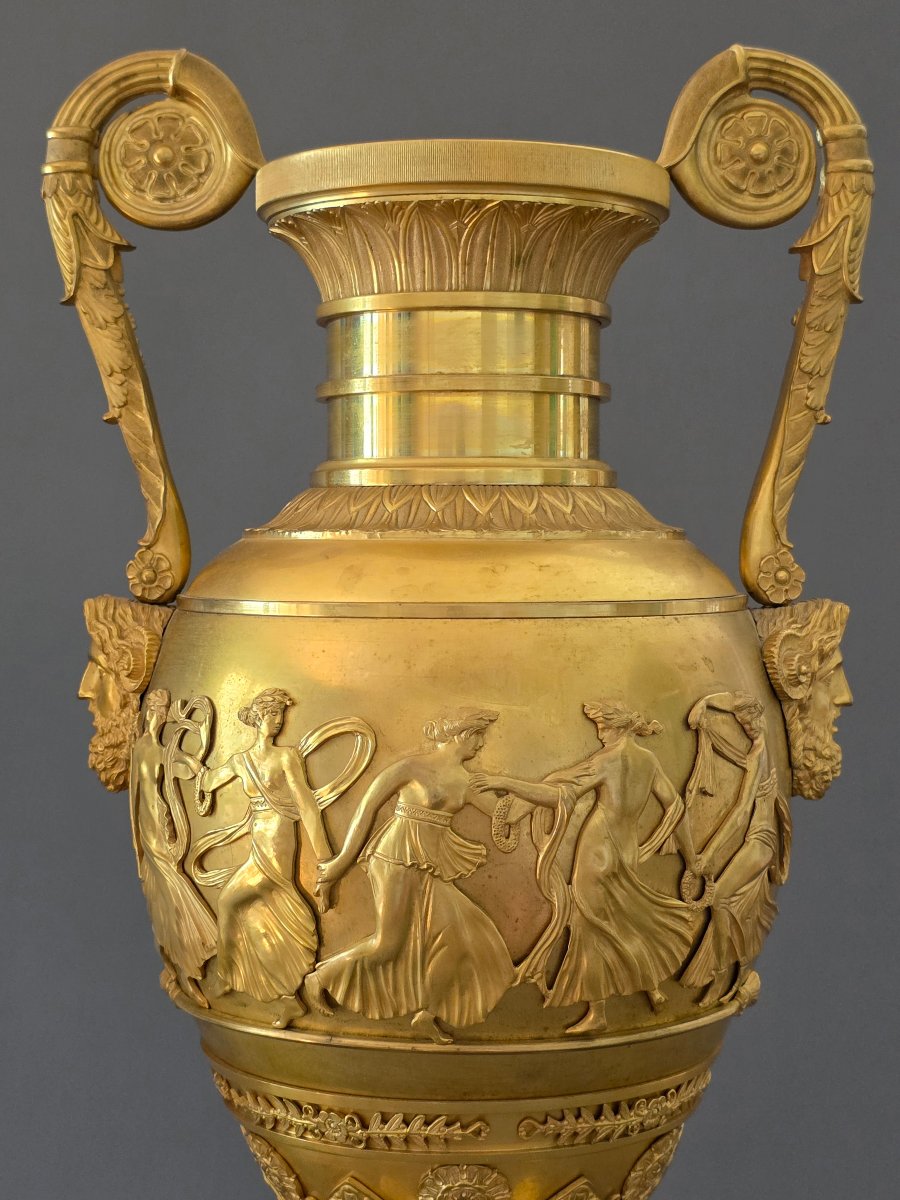
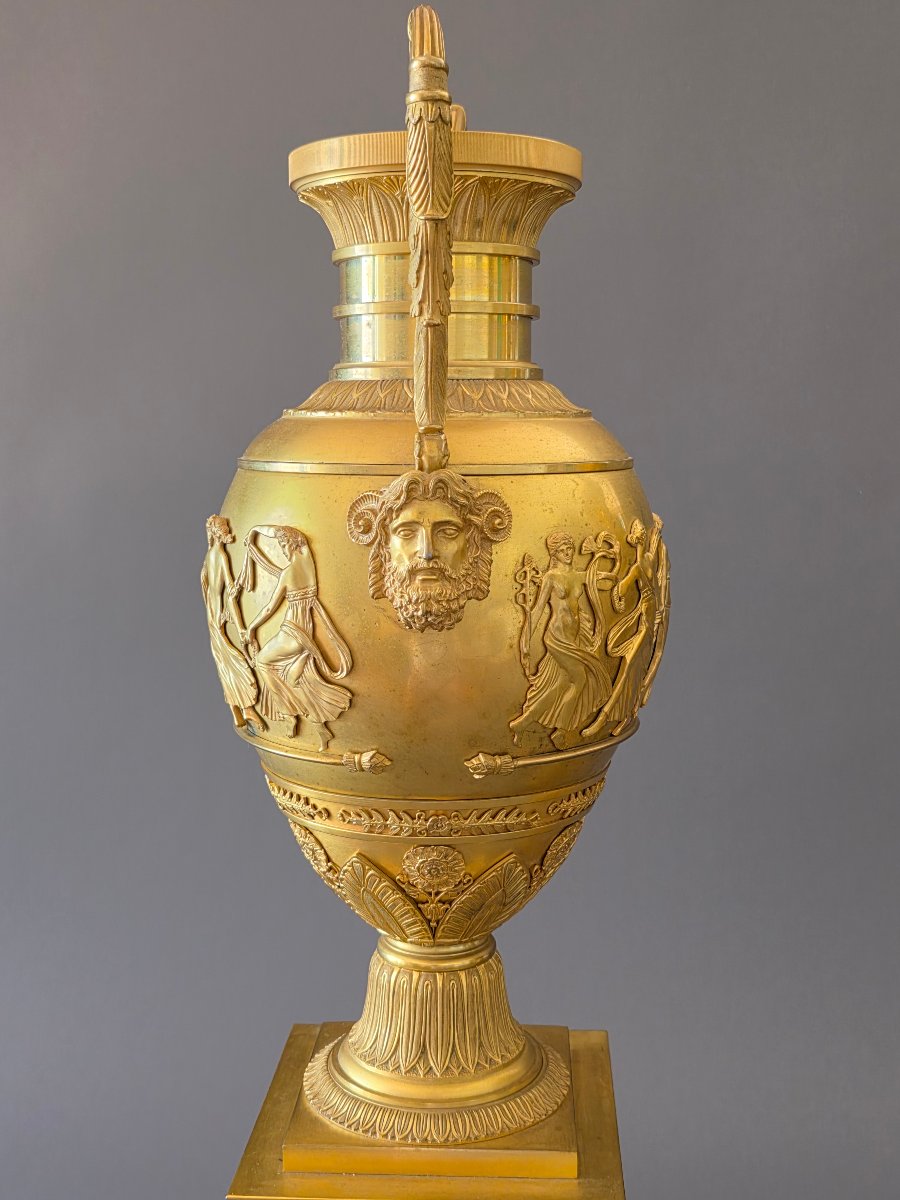
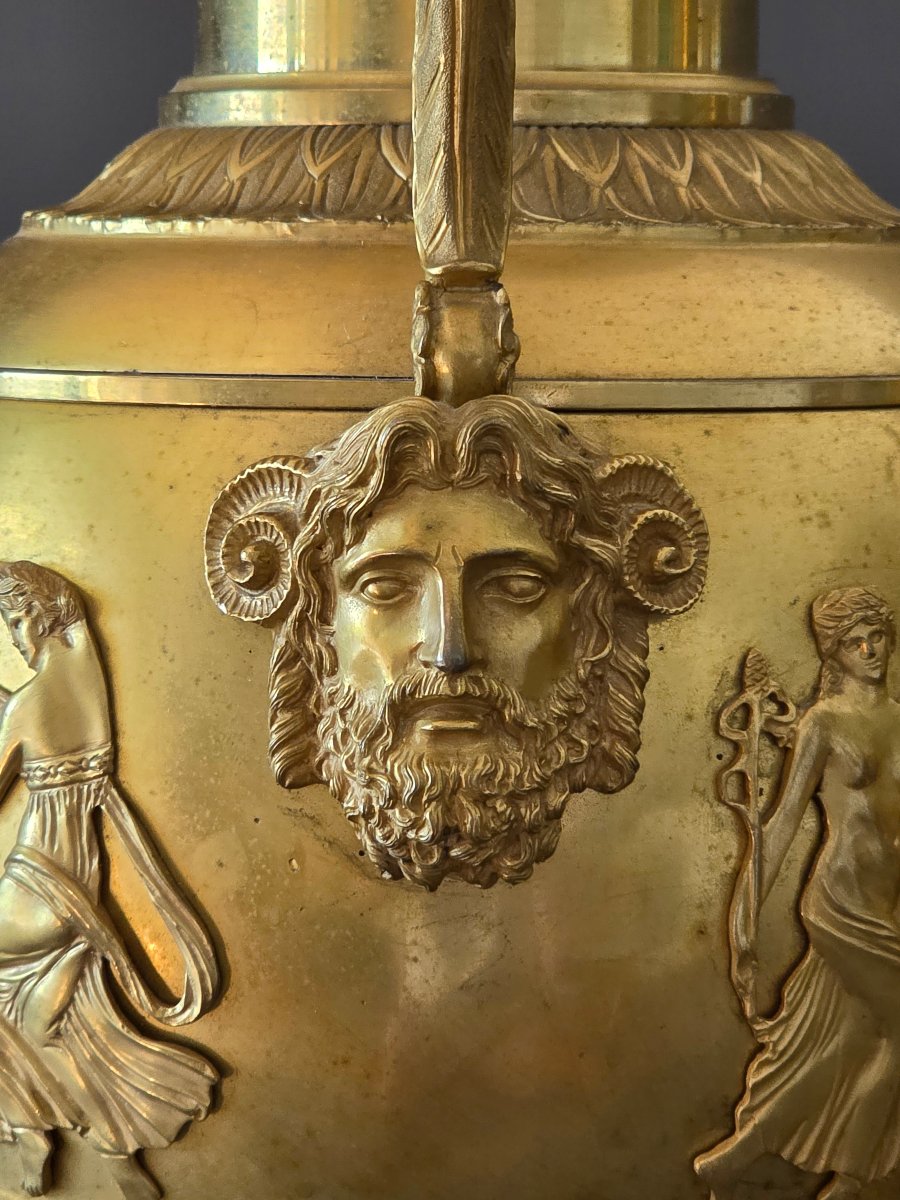
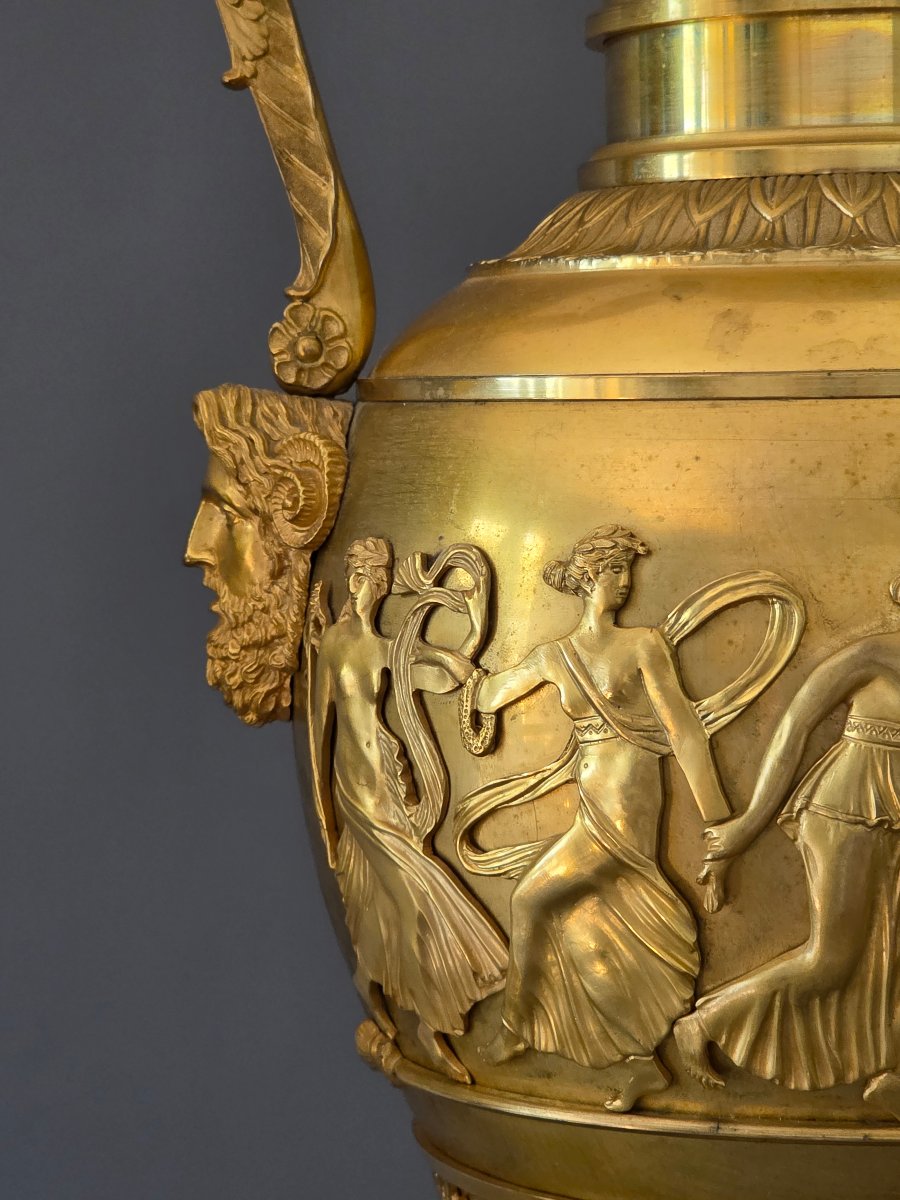
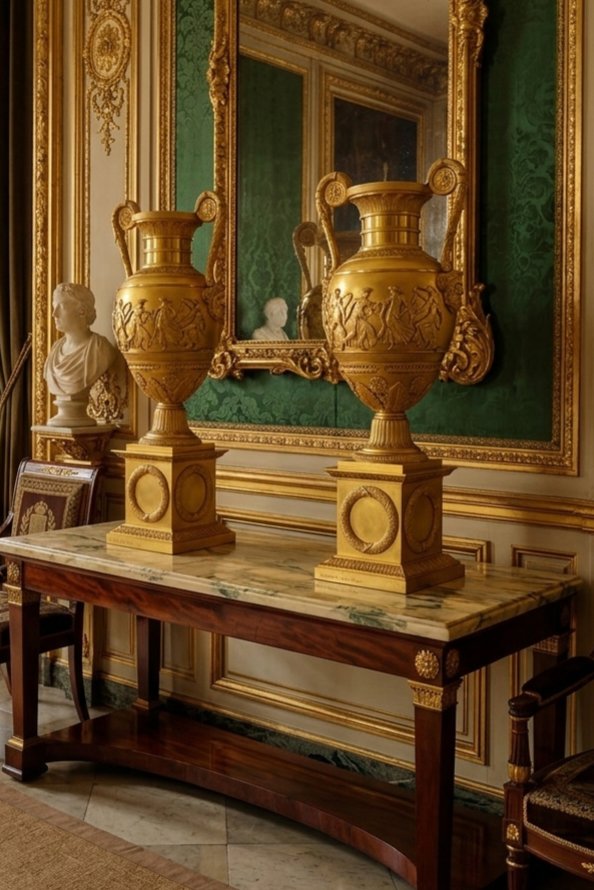
A very large pair of Empire period pyriform (pear-shaped) vases in chased and gilded bronze (ormolu), signed "THOMIRE À PARIS".Each vase opens with a wide flaring neck with a molded lip, adorned with a smooth cove and a double ring. The slightly convex shoulder is entirely burnished with agate, creating a mirror of light that contrasts beautifully with the matte finish of the neck.Powerful console handles rise from the shoulder, curling at the neck into large volutes decorated with floral rosettes. The lower attachments of the handles are shaped as masks of a bearded Silenus, crowned with ivy leaves and clusters of grapes (Dionysian attributes).
The beard of each deity has been meticulously reworked strand by strand using a chasing wheel and graver, offering a striking textural contrast with the smooth skin of the face.
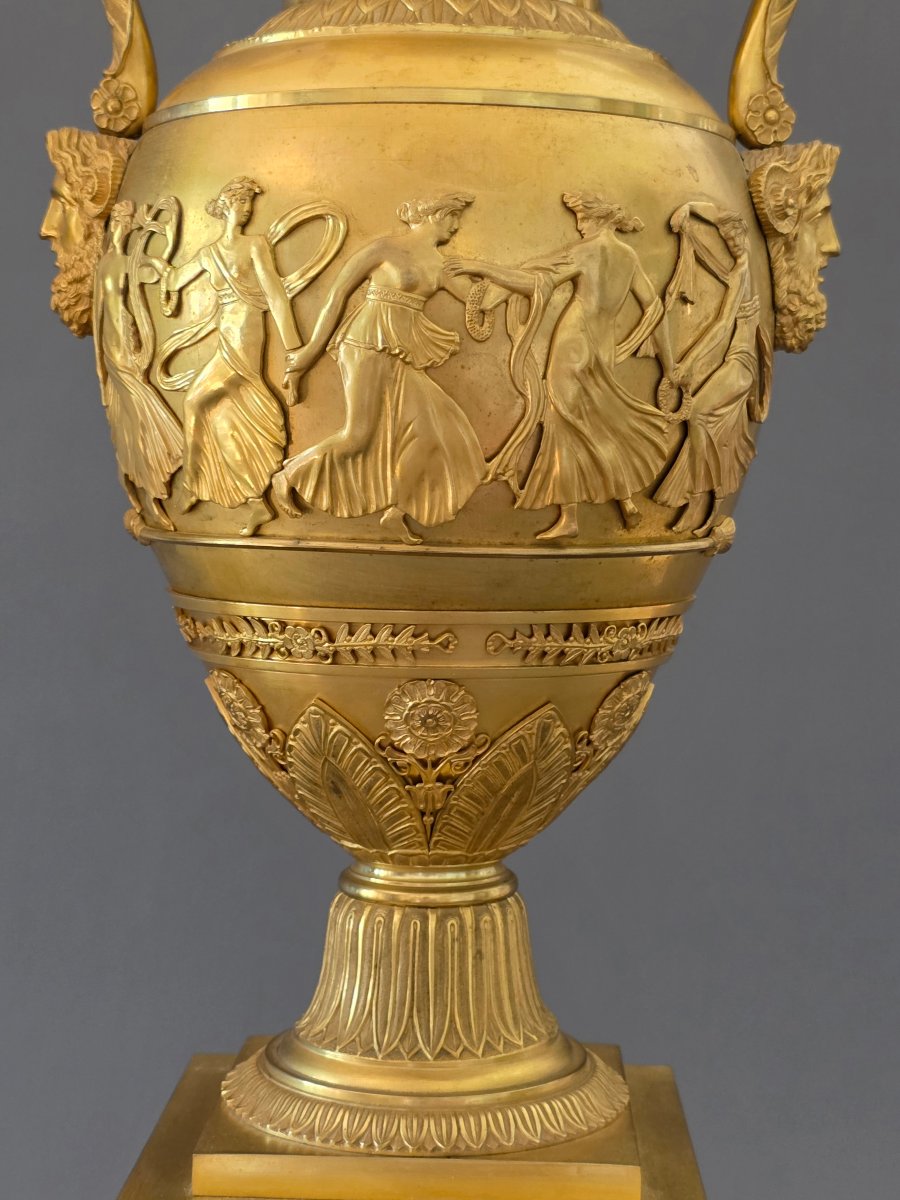
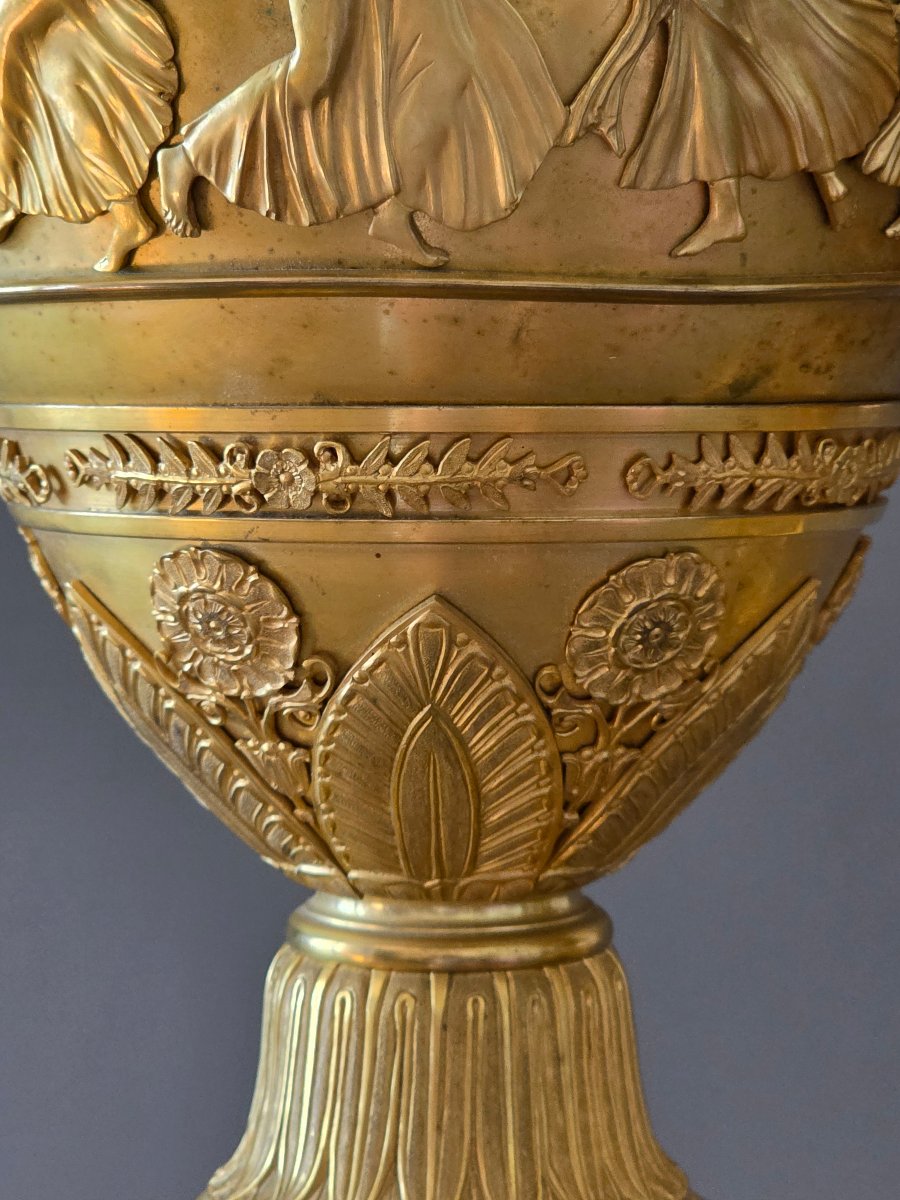
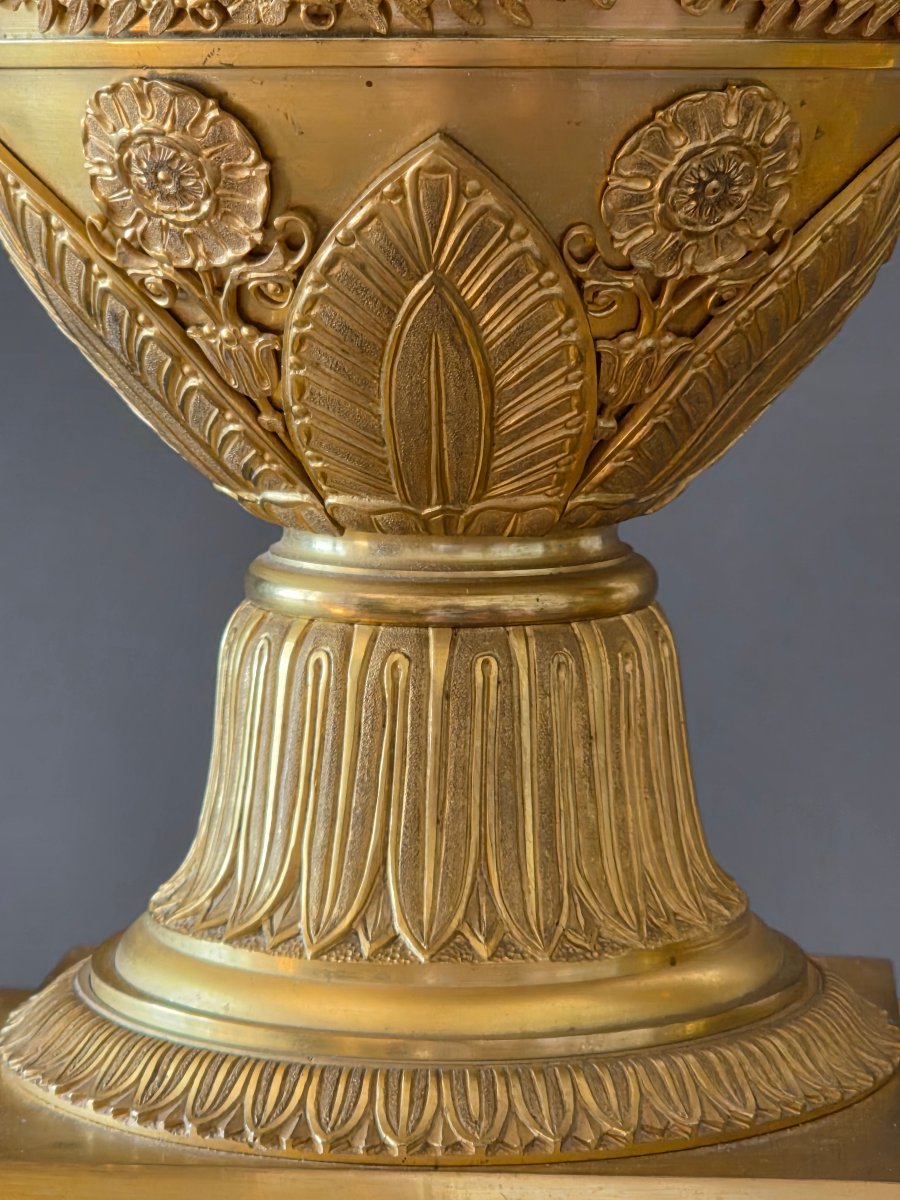
The central frieze features "The Dance of the Bacchantes", a direct reinterpretation of the Borghese Vase—an antique marble crater from the 1st century BC, now housed in the Musée du Louvre, which resided at the Villa Borghese in Rome until its purchase by Napoleon I in 1807 (cf. D. Alcouffe, A. Dion-Tenenbaum and G. Mabille, Les Bronzes d'ameublement du Louvre, Dijon, 2004, No. 138, pp. 276-277). A troupe of five Bacchantes (or nymphs) draped in the antique style hold hands, captured in full choreographic trance.The lower part of the body is highlighted by alternating wide ribbed water leaves and rosettes joined by delicate foliage rinceaux.
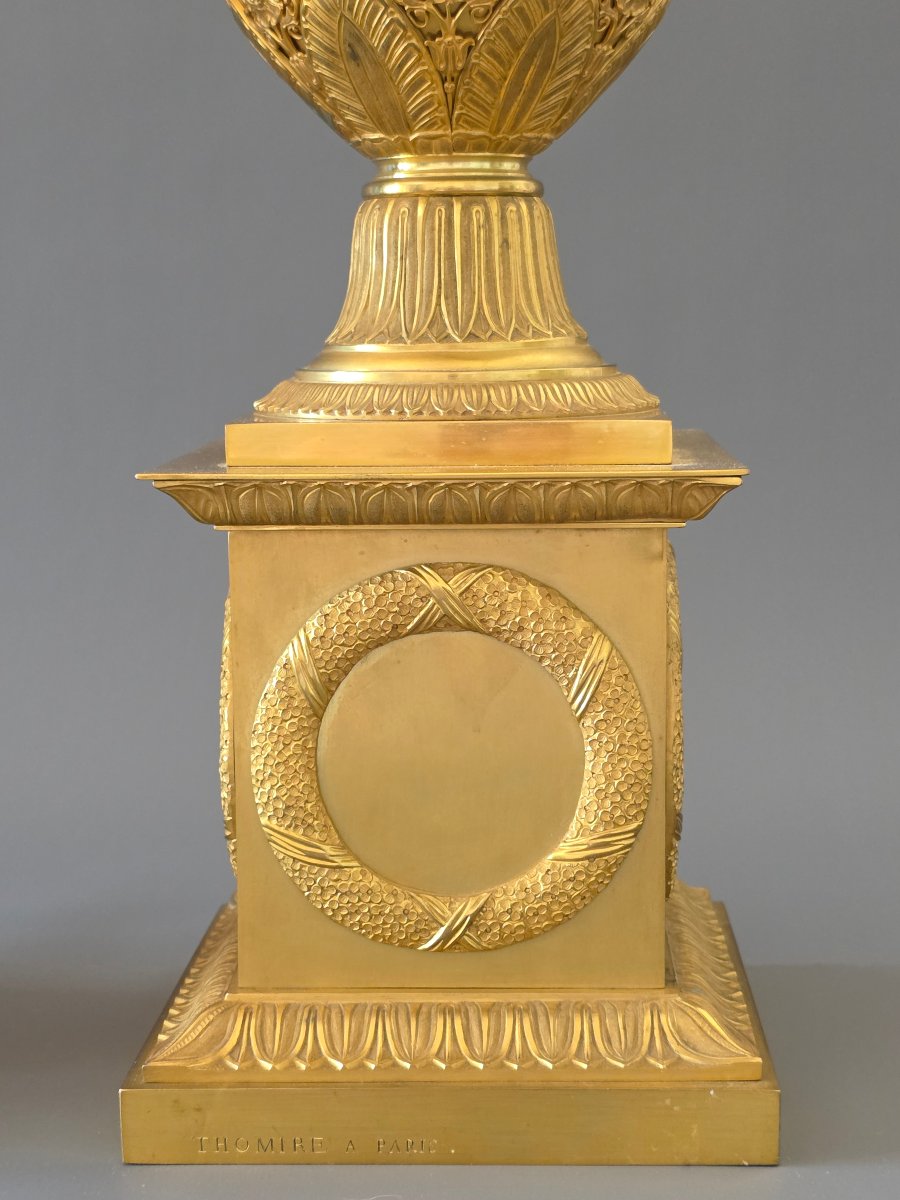
Each vase is supported by a short, entirely gadrooned pedestal, terminating in a ring of water leaves.The entire composition rests on a square pedestal, with all four faces decorated with an applied, imposing ribboned laurel wreath—a symbol of imperial glory and triumph.
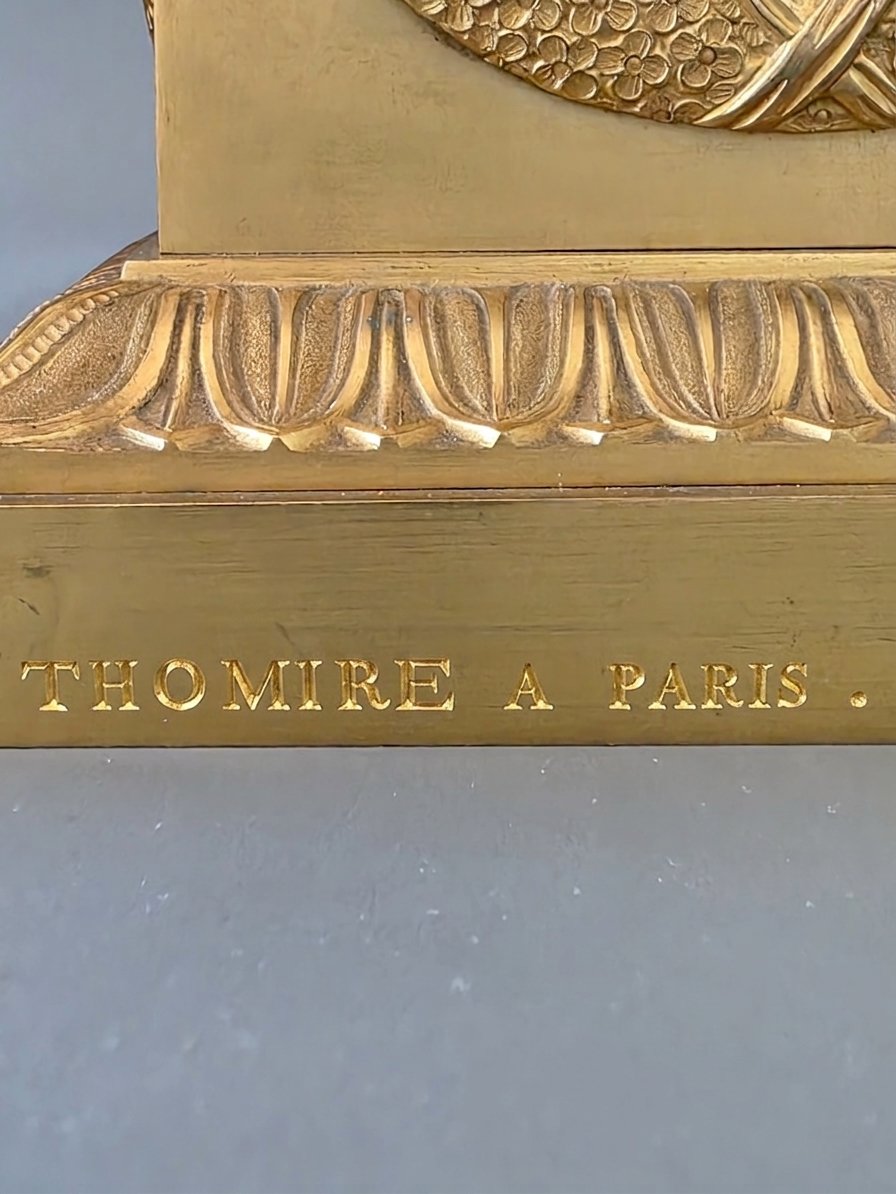
The plinth ends with a double base, the upper section of which is finely chased with a frieze of leaf-and-dart (rais-de-cœur) and overlapping water leaves.
Each of the bases, or counter-plinths, is engraved "THOMIRE À PARIS".These vases feature a rare complexity of assembly. They are not cast in a single piece but are composed of approximately fifteen independent bronze sections.
Pierre-Philippe Thomire (1751–1843), Fondeur-Ciseleur (gilder-chaser) to the Emperor.
Produced between 1805 and 1815, this pair of vases coincides with the golden age of Pierre-Philippe Thomire’s manufactory (located on Rue Boucherat in Paris). Having become official suppliers to the Imperial Court, his workshops employed up to 800 workers at their peak. This specific model of a "Medici vase with a Bacchantes frieze" was among the most prestigious diplomatic gifts commissioned by Napoleon I for European sovereigns or to furnish imperial palaces such as the Tuileries, Saint-Cloud, and Fontainebleau.
With their ovoid bodies, scroll handles ending in volutes, palmettes, and applied decoration of draped figures, our vases are closely inspired by antiquity. They are highly comparable to a pair of vases preserved in the Musée du Louvre (inv. OA 10220), a similar model of which was sold at Christie’s, London, on January 20, 2005, lot 116.
Their shape is inspired by a design by Jean-Baptiste-Claude Odiot for a tea fountain presented at the Exhibition of Year X (1801) and depicted in the goldsmith's portrait painted by Robert Lefèvre in 1822 (Detroit Institute of Arts, inv. 81.692).
A pair of vases of a similar model to ours was sold at De Baeque & Associés in Lyon on March 9, 2019, lot 208. Their decoration, however, differs slightly, one depicting Ganymede and the Eagle and the other Hebe and her cup.
The form of these vases was widely adapted by Thomire, and examples can be found with slight variations in decoration. Notably, a pair of vases forming candelabras was sold at Christie’s, London, on July 7, 2005, lot 405. A similar pair, also signed "Thomire à Paris," is preserved in the Mobilier National under inventory number GML 9808/001.
Pierre-Philippe Thomire (1751–1843)
Born in Paris, Pierre-Philippe Thomire was the son of a chaser. He received an exceptionally high-quality education:He studied under the legendary sculptors Augustin Pajou and Jean-Antoine Houdon at the Académie de Saint-Luc. This artistic background explains the fluidity and anatomical perfection of the Bacchantes seen on the frieze of our vases.He then entered the workshop of Pierre Gouthière, the greatest master bronzier-chaser of the reign of Louis XVI, where he mastered the technique of matte gilding (mercury gilding)—a craft he would elevate to its absolute zenith.
In 1783, following the death of bronzier Jean-Claude Duplessis, Thomire was appointed official bronzier to the Manufacture Royale de Sèvres, tasked with designing the gilt-bronze mounts decorating the most prestigious fine porcelain vases.While the French Revolution ruined many decorative artists due to the disappearance of the nobility, Thomire survived the period by temporarily repurposing his workshops for arms manufacturing.
The true turning point of his artistic and commercial life occurred under the First Empire.
In 1804, he bought out the business of the marchand-mercier Simon Philippe. Partnering with associates, he founded an industrial-scale manufactory on Rue Boucherat in Paris. Very quickly, the company employed up to 800 workers—an unprecedented scale for the era.
In 1806, at the Exposition des Produits de l'Industrie, Thomire won a gold medal. In 1809, he was officially named "Chaser to the Emperor" (Ciseleur de l'Empereur). Napoleon I, eager to use the decorative arts to establish the prestige of his Empire, placed massive orders with Thomire to furnish the imperial palaces (Tuileries, Saint-Cloud, Fontainebleau, Versailles). Among his absolute masterpieces are:
The Cradle of the King of Rome (Napoleon’s son), now preserved in Vienna.
The dressing table presented by the City of Paris to Empress Marie-Louise.
Immense table centerpieces (surtouts de table), candelabras, and monumental Medici vases, whose style perfectly mirrors our pair.
Upon the fall of Napoleon in 1815, Thomire achieved the remarkable feat of retaining the favor of the new regime. His manufactory continued to produce for the Bourbons (Louis XVIII and Charles X) under the name "Thomire et Cie".In 1823, at the age of 72, Pierre-Philippe Thomire officially retired, leaving the company to his sons-in-law and partners. He continued to practice sculpture until his death in 1843.
The House of Thomire permanently closed its doors in 1852, due to shifting fashions and the mass industrialization of bronze casting.
Superb state of preservation, featuring a beautiful, uncleaned original gilding.Signature:
Signed "THOMIRE À PARIS" on each base.
Empire Period.
Dimensions:
Height: 68 cm (approx. 26.8 inches)
Width: 26 cm (approx. 10.2 inches)
Base: 19 cm x 19 cm (approx. 7.5 x 7.5 inches)
We manage both domestic shipping within France and international delivery for you. Shipping arrangements depend on your location. Please contact us to obtain a shipping quote and to arrange delivery.
We take exceptional care to ensure that all purchases are packed and protected with the utmost security.
As only a curated selection of our furniture and art objects is listed on Proantic, we invite you to follow our Instagram account to see all our latest arrivals beautifully staged: @monantiquaire
Discover our complete collection of furniture and art objects
on our website:
MON ANTIQUAIRE
We look forward to your visit,
Géraldine Buisson & Manuel Keepfer
The beard of each deity has been meticulously reworked strand by strand using a chasing wheel and graver, offering a striking textural contrast with the smooth skin of the face.
The central frieze features "The Dance of the Bacchantes", a direct reinterpretation of the Borghese Vase—an antique marble crater from the 1st century BC, now housed in the Musée du Louvre, which resided at the Villa Borghese in Rome until its purchase by Napoleon I in 1807 (cf. D. Alcouffe, A. Dion-Tenenbaum and G. Mabille, Les Bronzes d'ameublement du Louvre, Dijon, 2004, No. 138, pp. 276-277). A troupe of five Bacchantes (or nymphs) draped in the antique style hold hands, captured in full choreographic trance.The lower part of the body is highlighted by alternating wide ribbed water leaves and rosettes joined by delicate foliage rinceaux.
Each vase is supported by a short, entirely gadrooned pedestal, terminating in a ring of water leaves.The entire composition rests on a square pedestal, with all four faces decorated with an applied, imposing ribboned laurel wreath—a symbol of imperial glory and triumph.
The plinth ends with a double base, the upper section of which is finely chased with a frieze of leaf-and-dart (rais-de-cœur) and overlapping water leaves.
Each of the bases, or counter-plinths, is engraved "THOMIRE À PARIS".These vases feature a rare complexity of assembly. They are not cast in a single piece but are composed of approximately fifteen independent bronze sections.
Pierre-Philippe Thomire (1751–1843), Fondeur-Ciseleur (gilder-chaser) to the Emperor.
Produced between 1805 and 1815, this pair of vases coincides with the golden age of Pierre-Philippe Thomire’s manufactory (located on Rue Boucherat in Paris). Having become official suppliers to the Imperial Court, his workshops employed up to 800 workers at their peak. This specific model of a "Medici vase with a Bacchantes frieze" was among the most prestigious diplomatic gifts commissioned by Napoleon I for European sovereigns or to furnish imperial palaces such as the Tuileries, Saint-Cloud, and Fontainebleau.
With their ovoid bodies, scroll handles ending in volutes, palmettes, and applied decoration of draped figures, our vases are closely inspired by antiquity. They are highly comparable to a pair of vases preserved in the Musée du Louvre (inv. OA 10220), a similar model of which was sold at Christie’s, London, on January 20, 2005, lot 116.
Their shape is inspired by a design by Jean-Baptiste-Claude Odiot for a tea fountain presented at the Exhibition of Year X (1801) and depicted in the goldsmith's portrait painted by Robert Lefèvre in 1822 (Detroit Institute of Arts, inv. 81.692).
A pair of vases of a similar model to ours was sold at De Baeque & Associés in Lyon on March 9, 2019, lot 208. Their decoration, however, differs slightly, one depicting Ganymede and the Eagle and the other Hebe and her cup.
The form of these vases was widely adapted by Thomire, and examples can be found with slight variations in decoration. Notably, a pair of vases forming candelabras was sold at Christie’s, London, on July 7, 2005, lot 405. A similar pair, also signed "Thomire à Paris," is preserved in the Mobilier National under inventory number GML 9808/001.
Pierre-Philippe Thomire (1751–1843)
Born in Paris, Pierre-Philippe Thomire was the son of a chaser. He received an exceptionally high-quality education:He studied under the legendary sculptors Augustin Pajou and Jean-Antoine Houdon at the Académie de Saint-Luc. This artistic background explains the fluidity and anatomical perfection of the Bacchantes seen on the frieze of our vases.He then entered the workshop of Pierre Gouthière, the greatest master bronzier-chaser of the reign of Louis XVI, where he mastered the technique of matte gilding (mercury gilding)—a craft he would elevate to its absolute zenith.
In 1783, following the death of bronzier Jean-Claude Duplessis, Thomire was appointed official bronzier to the Manufacture Royale de Sèvres, tasked with designing the gilt-bronze mounts decorating the most prestigious fine porcelain vases.While the French Revolution ruined many decorative artists due to the disappearance of the nobility, Thomire survived the period by temporarily repurposing his workshops for arms manufacturing.
The true turning point of his artistic and commercial life occurred under the First Empire.
In 1804, he bought out the business of the marchand-mercier Simon Philippe. Partnering with associates, he founded an industrial-scale manufactory on Rue Boucherat in Paris. Very quickly, the company employed up to 800 workers—an unprecedented scale for the era.
In 1806, at the Exposition des Produits de l'Industrie, Thomire won a gold medal. In 1809, he was officially named "Chaser to the Emperor" (Ciseleur de l'Empereur). Napoleon I, eager to use the decorative arts to establish the prestige of his Empire, placed massive orders with Thomire to furnish the imperial palaces (Tuileries, Saint-Cloud, Fontainebleau, Versailles). Among his absolute masterpieces are:
The Cradle of the King of Rome (Napoleon’s son), now preserved in Vienna.
The dressing table presented by the City of Paris to Empress Marie-Louise.
Immense table centerpieces (surtouts de table), candelabras, and monumental Medici vases, whose style perfectly mirrors our pair.
Upon the fall of Napoleon in 1815, Thomire achieved the remarkable feat of retaining the favor of the new regime. His manufactory continued to produce for the Bourbons (Louis XVIII and Charles X) under the name "Thomire et Cie".In 1823, at the age of 72, Pierre-Philippe Thomire officially retired, leaving the company to his sons-in-law and partners. He continued to practice sculpture until his death in 1843.
The House of Thomire permanently closed its doors in 1852, due to shifting fashions and the mass industrialization of bronze casting.
Superb state of preservation, featuring a beautiful, uncleaned original gilding.Signature:
Signed "THOMIRE À PARIS" on each base.
Empire Period.
Dimensions:
Height: 68 cm (approx. 26.8 inches)
Width: 26 cm (approx. 10.2 inches)
Base: 19 cm x 19 cm (approx. 7.5 x 7.5 inches)
We manage both domestic shipping within France and international delivery for you. Shipping arrangements depend on your location. Please contact us to obtain a shipping quote and to arrange delivery.
We take exceptional care to ensure that all purchases are packed and protected with the utmost security.
As only a curated selection of our furniture and art objects is listed on Proantic, we invite you to follow our Instagram account to see all our latest arrivals beautifully staged: @monantiquaire
Discover our complete collection of furniture and art objects
on our website:
MON ANTIQUAIRE
We look forward to your visit,
Géraldine Buisson & Manuel Keepfer
48 000 €
Period: 19th century
Style: Consulat, Empire
Condition: Excellent condition
Material: Bronze
Width: 26 cm
Height: 68 cm
Reference (ID): 1777322
Availability: In stock
Print