




Louis XVI Transformation Table Attributed To François-antoine Canabas Dit Gengenbach.
Artist: Attribué à Canabas F. A. Dit Gengenbach
An exceptional multi-functional table, serving as a reading table, writing desk, and dressing table, made during the last quarter of the 18th century in the most refined style of Louis XVI's reign. This transformable table is attributed to François-Antoine Canabas, known as Gengenbach. The original 1997 purchase invoice is available. Secure and convenient international shipping.
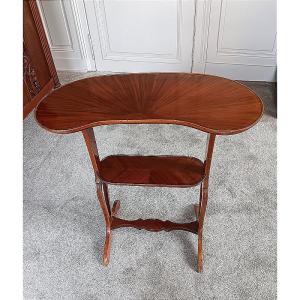
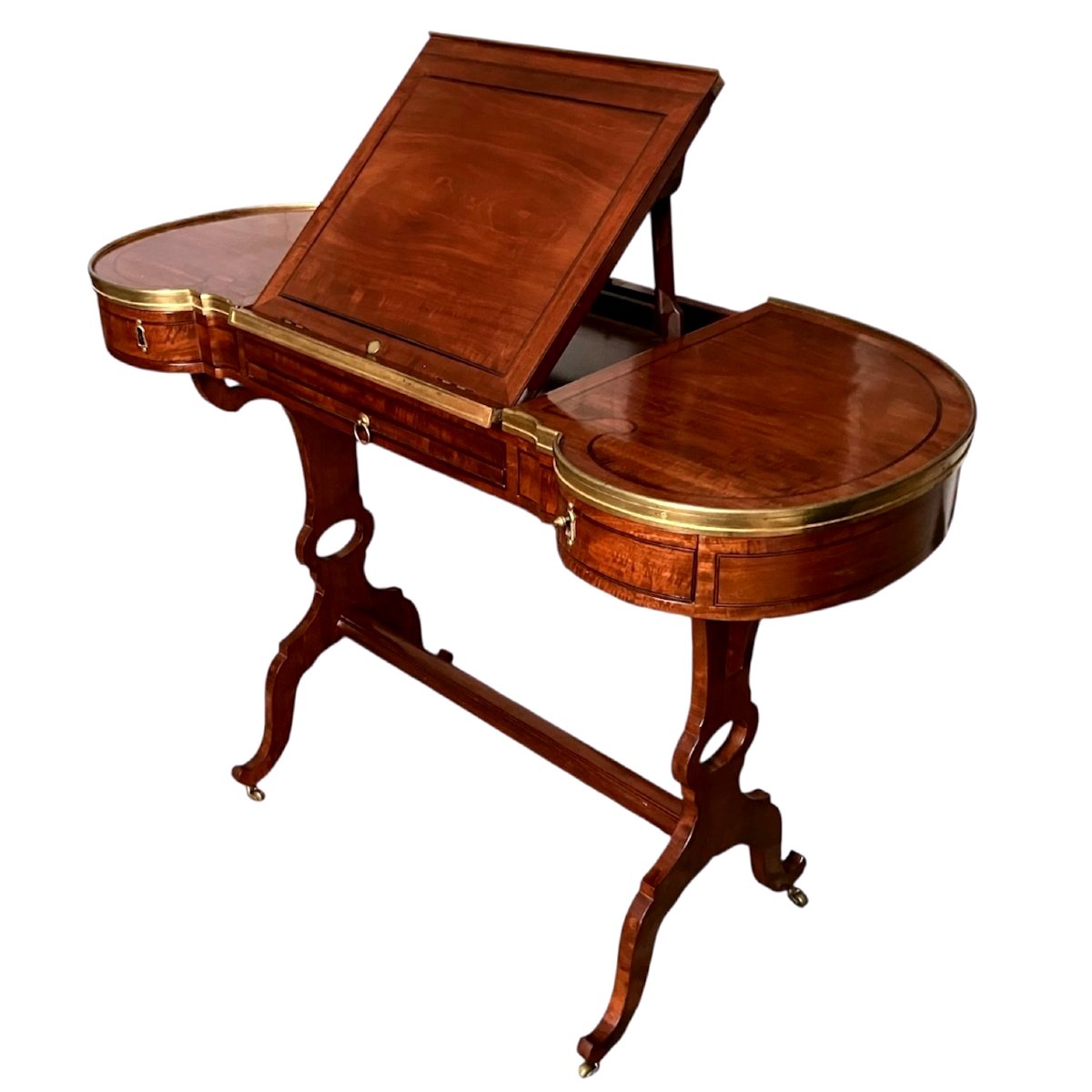
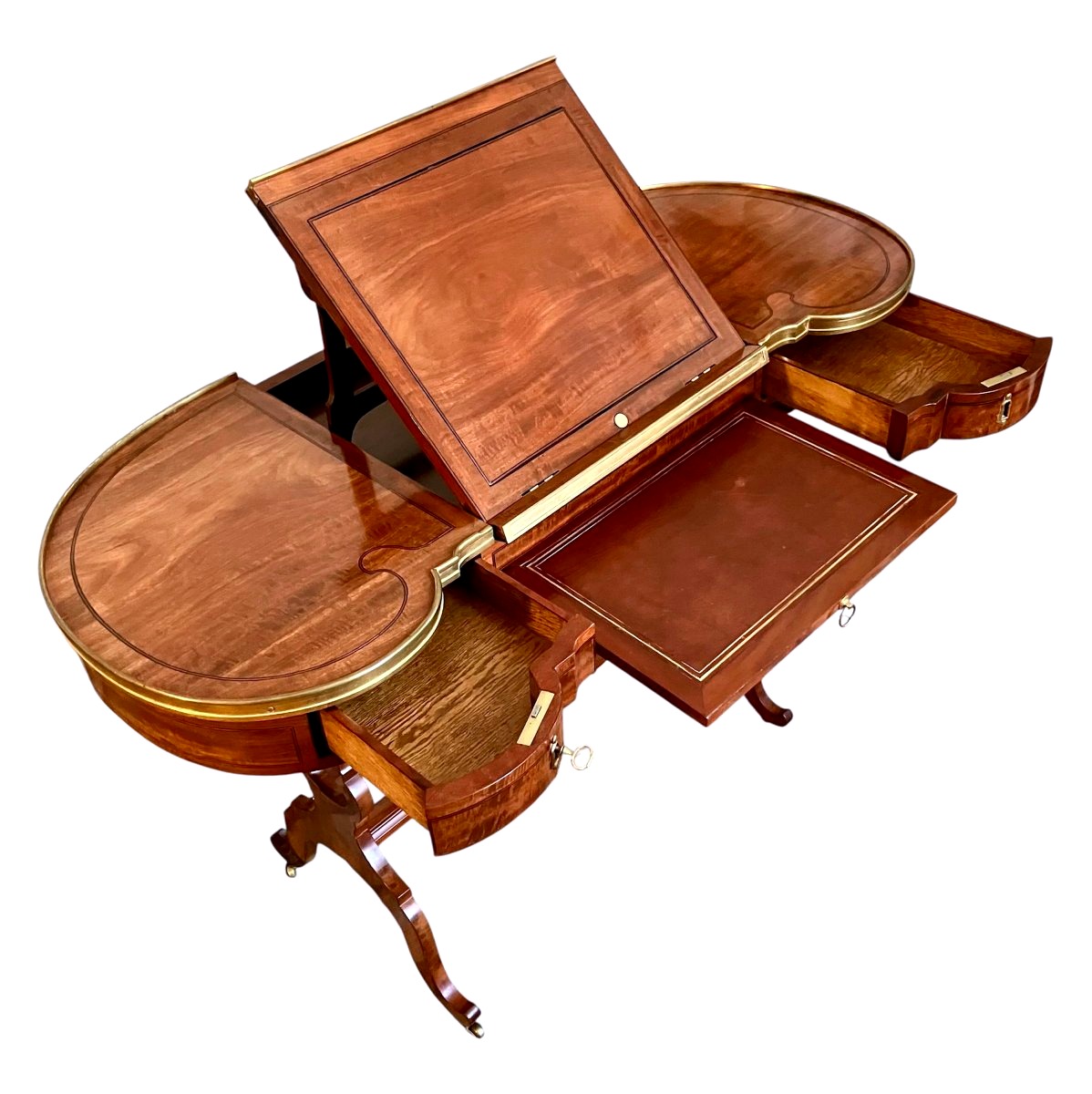
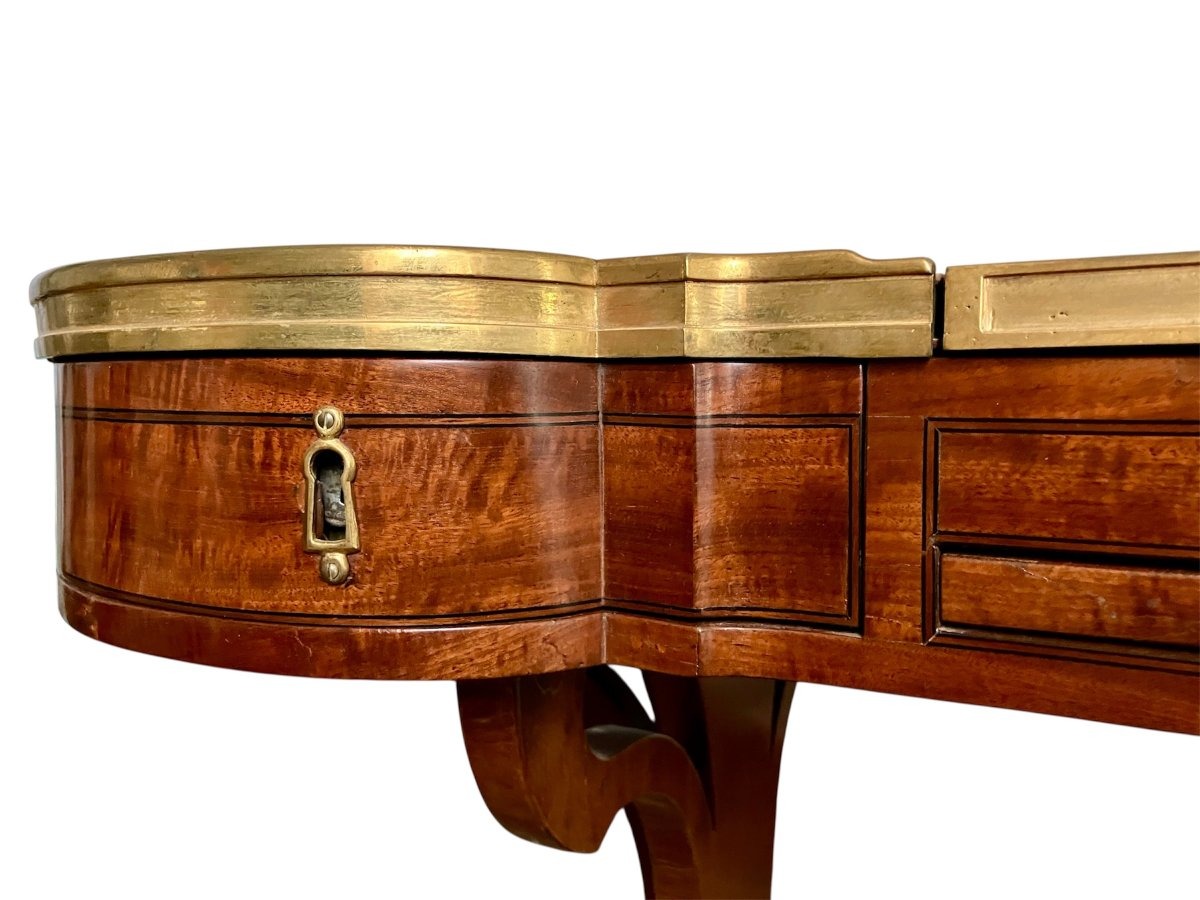
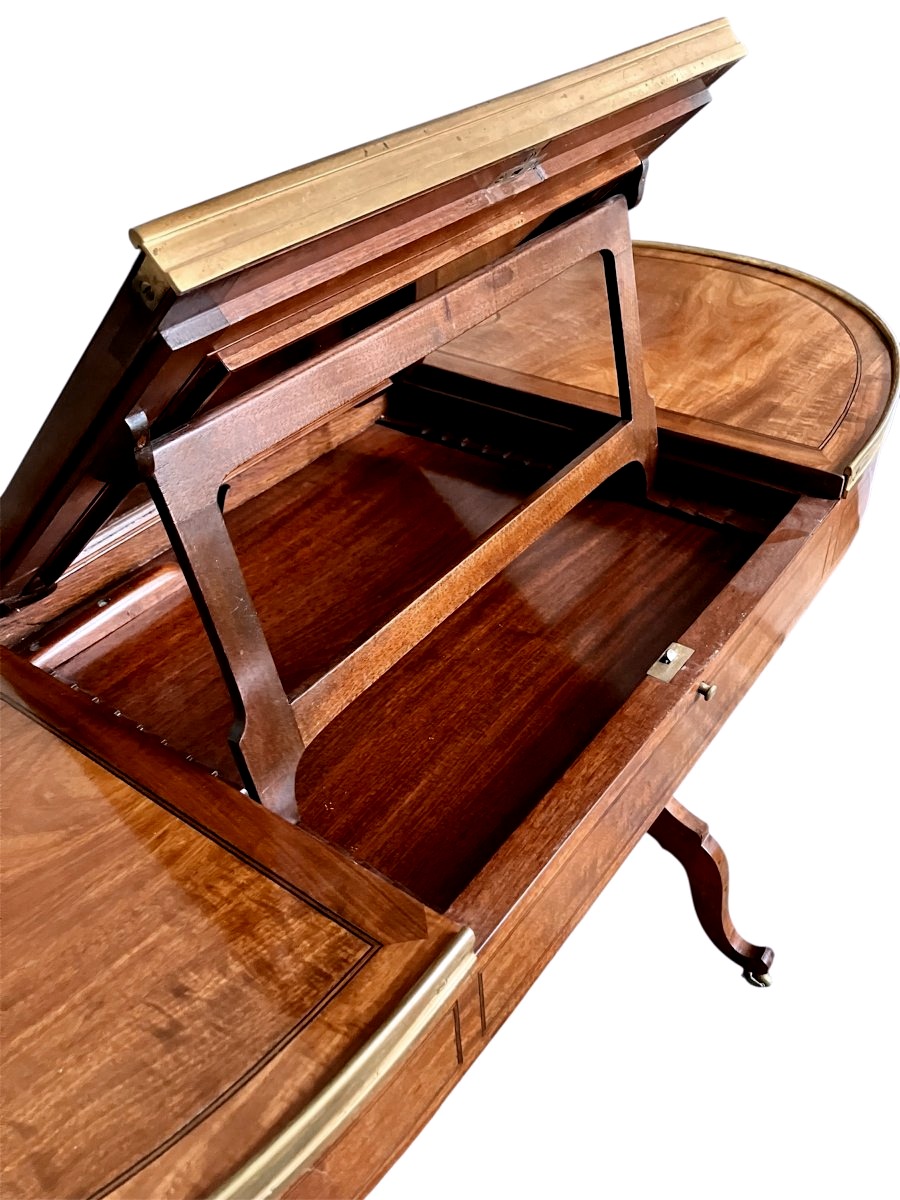
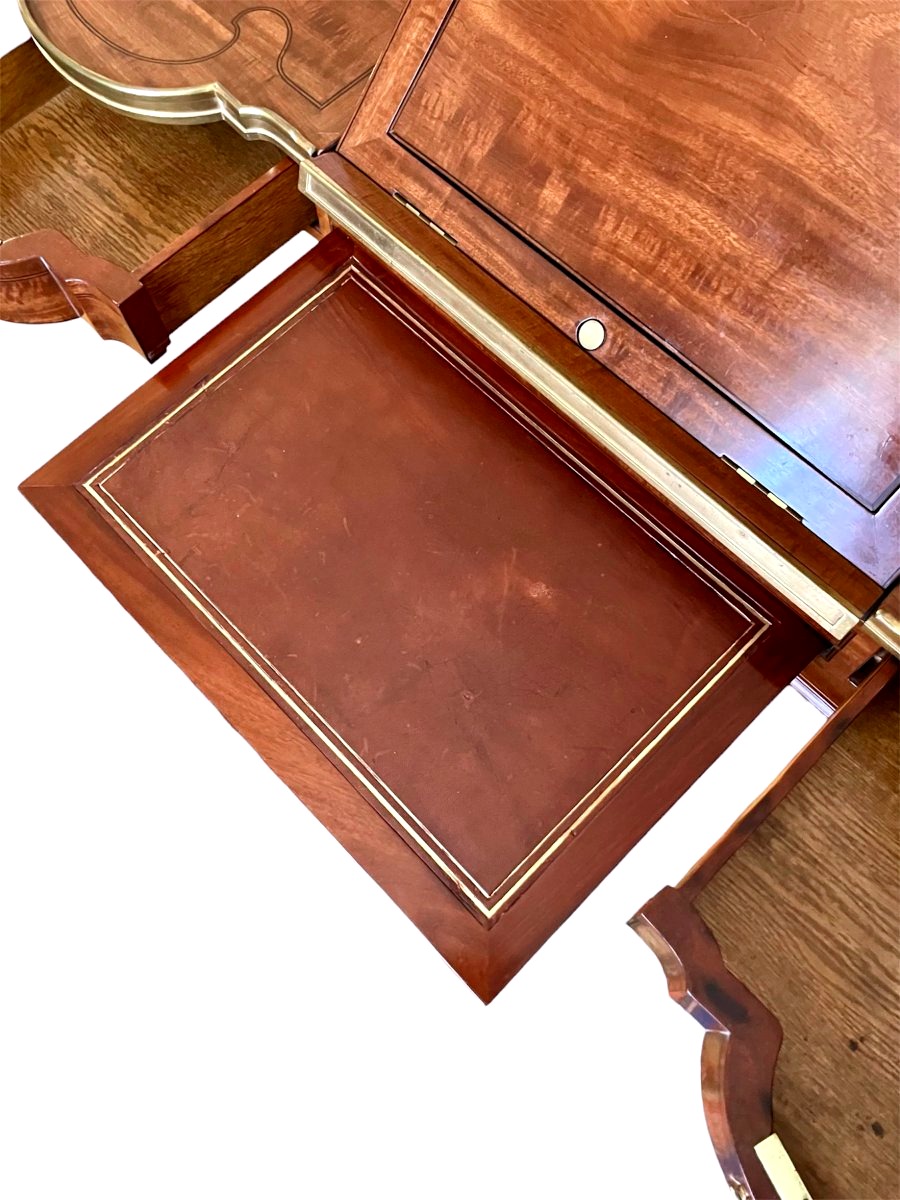
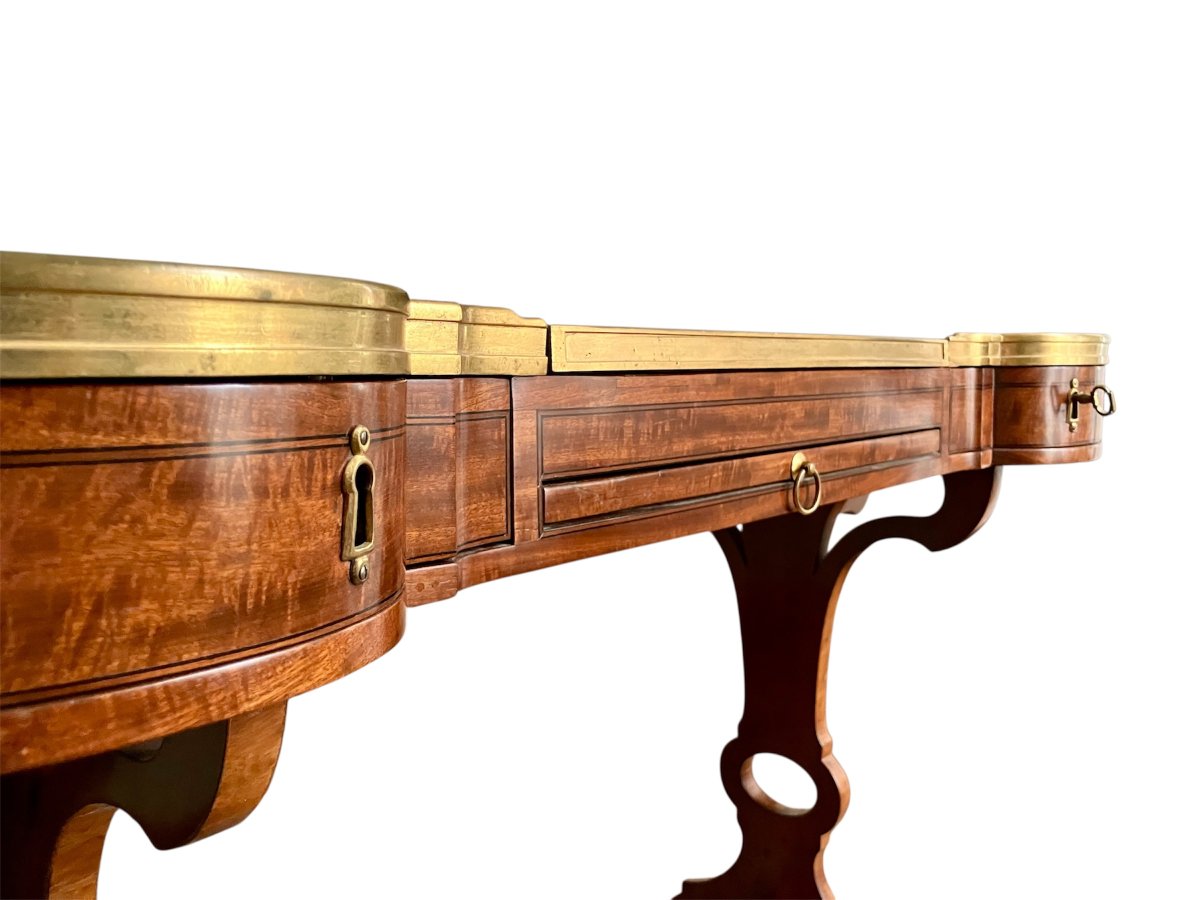
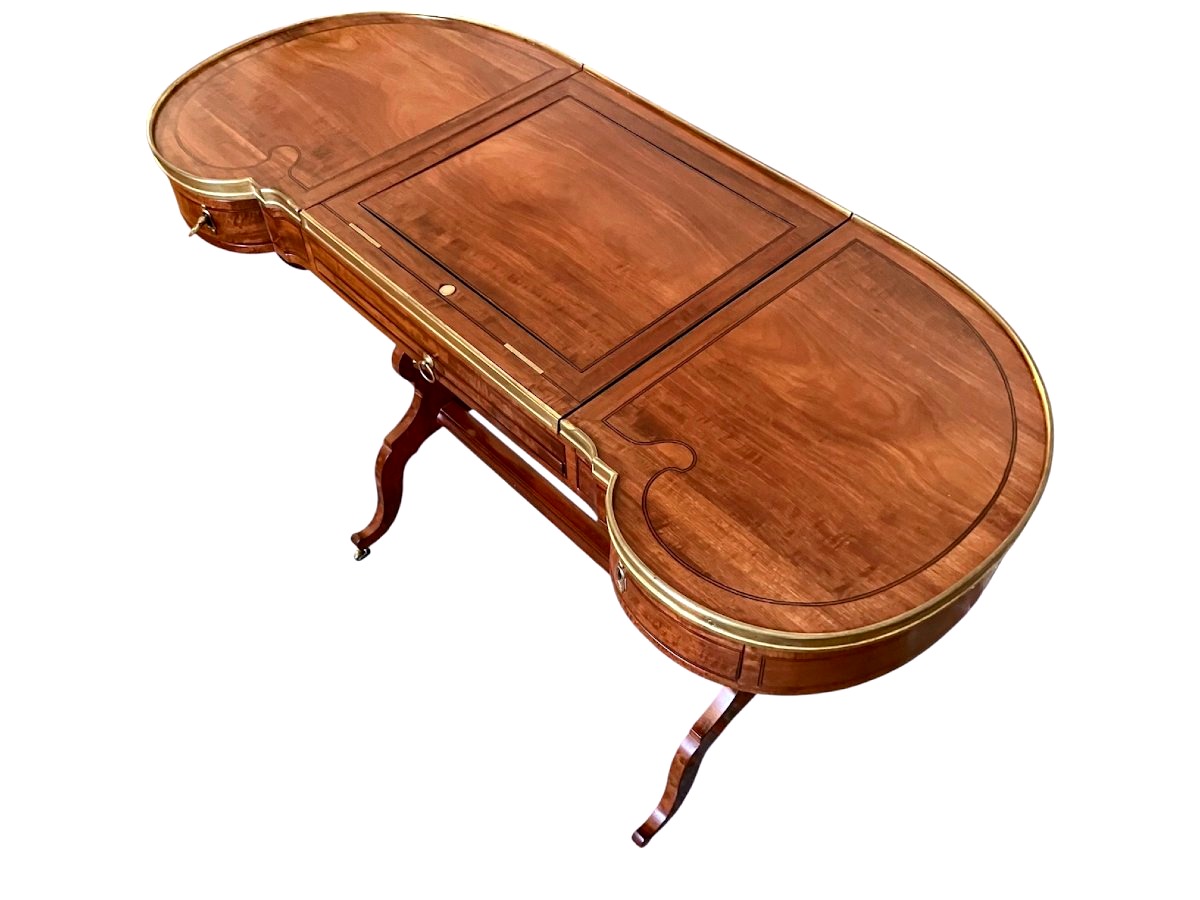
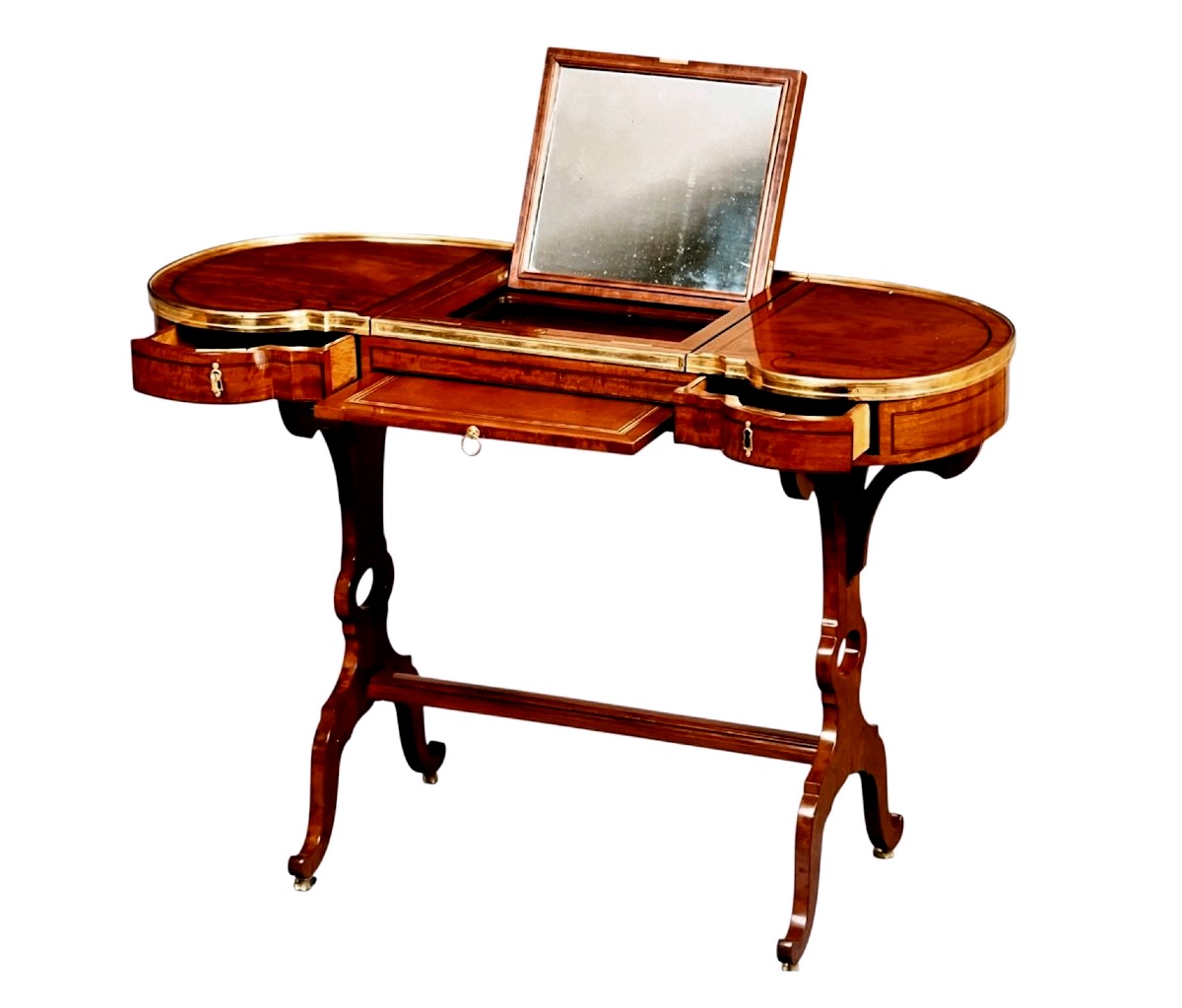
Kidney-shaped, it is crafted from solid mahogany and carefully selected mahogany veneer, displaying a warm patina and remarkable cabinet making. The framework is made of mahogany, oak, and fir. The central top reveals an ingenious convertible mechanism: it opens into a reading desk with several adjustable angles, while a tilting mirror, retained from the original design, allows it to be used as a dressing table. A pull-out slide on the front reveals a writing surface featuring a leather-clad inset with double gilt-tooled borders, attesting to the versatile purpose of this piece of occasional furniture.
The composition is completed by two curved side drawers, harmoniously following the contours of the apron and each locking with a key. The whole rests on a base with openwork brackets, characteristic of quality Parisian productions of the late 18th century, joined by a stretcher and finished with four period brass casters. The frames and moldings are highlighted with elegant gilt brass ornamentation, emphasizing the neoclassical restraint of the composition.
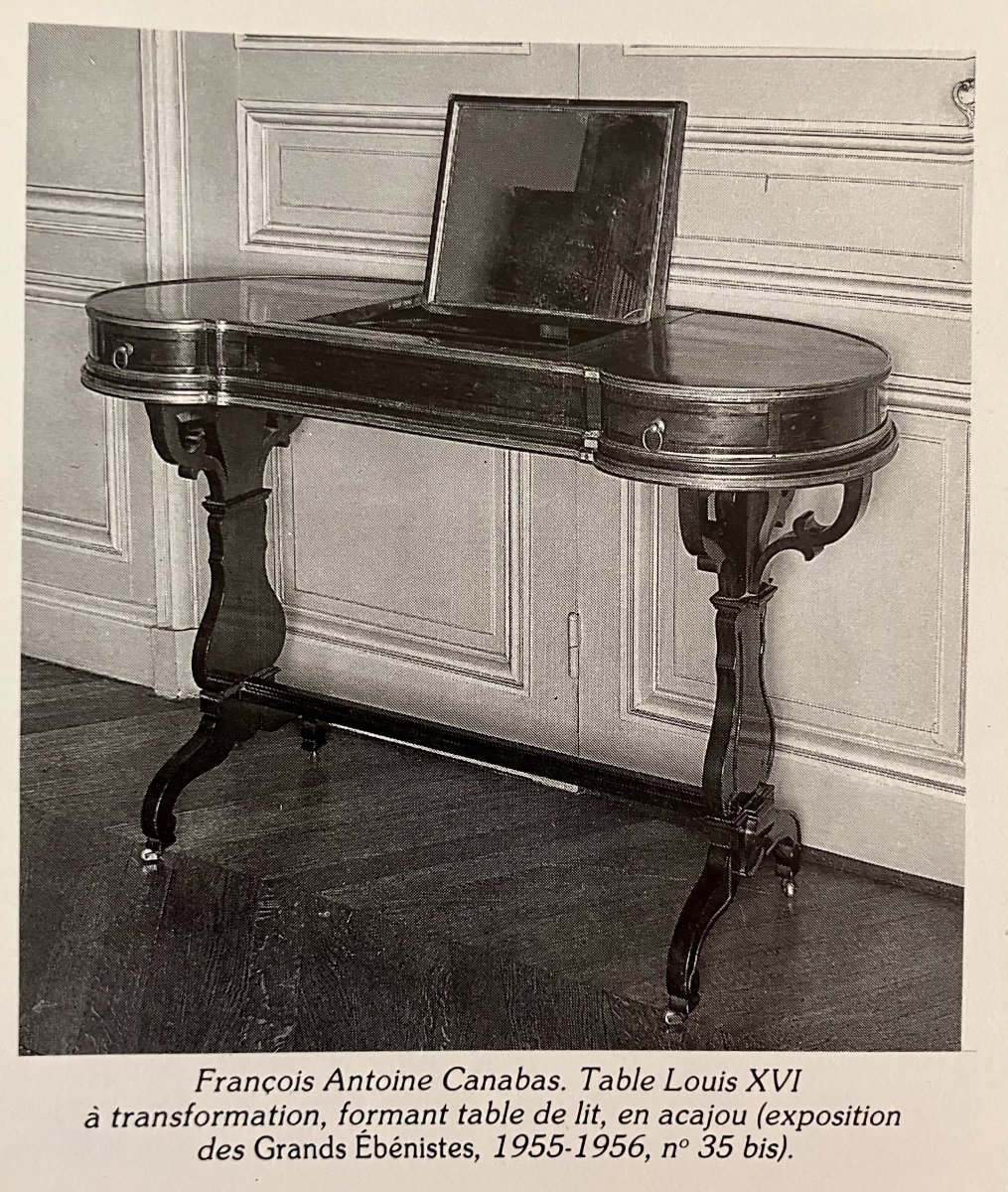
In its design, quality of execution, and the sophistication of its mechanisms, this table can be compared to the creations of François-Antoine Canabas, known as Gengenbach (1735-1803), who became a master cabinetmaker on March 24, 1779. A particularly relevant comparison can be made with a model reproduced on page 144 of the Dictionary of Cabinetmakers and Joiners of the 18th Century, with which it shares the general design, form, and several structural features.
The piece shows signs of age and restoration, respectful of its authenticity, and is currently in very good overall condition. Several accompanying documents and a certificate of authenticity complete this set.
Provenance: Château des Deux-Sèvres.
Dimensions: Height: 76 cm. Width: 108 cm. Depth: 41 cm.
This rare convertible table perfectly illustrates the pursuit of functionality and elegance that characterizes Parisian furniture of the late 18th century. Its multifunctional nature, combined with the quality of its craftsmanship and its convincing resemblance to the work of François-Antoine Canabas, makes it a particularly sought-after piece for collectors of Louis XVI furniture.
François-Antoine Canabas, known as Gengenbach: heir to a dynasty of cabinetmakers in the Faubourg Saint-Antoine. The figure of François-Antoine Gengenbach, known as Canabas, is part of an important line of Parisian cabinetmakers of the 18th century. Having received his master cabinetmaker's certificate on March 24, 1779, he belonged to the family workshop founded by his uncle, the renowned Joseph Gengenbach, known as Canabas (1715-1797), one of the most inventive Parisian furniture makers during the reigns of Louis XV and Louis XVI.
A cabinet maker trained in the Canabas workshop.
Unlike Joseph Canabas, whose career is extensively documented, François-Antoine remains relatively unknown today. However, archives and studies devoted to 18th century furniture show that he was trained within the family workshop in the Faubourg Saint-Antoine, the nerve center of Parisian cabinetmaking. His apprenticeship took place in a particularly favorable environment, marked by the technical mastery, mechanical innovation, and constant pursuit of functional elegance that characterized the Canabas family's production.
After becoming a master craftsman in 1779, François-Antoine continued the workshop's tradition, developing a production primarily focused on small luxury mahogany furniture intended for an aristocratic and bourgeois clientele sensitive to novelty and domestic comfort.
The legacy of Joseph Canabas.
To understand François-Antoine's work, it is necessary to consider that of his uncle, Joseph Gengenbach, known as Canabas. Originally from a family likely established between Alsace and Baden, Joseph settled in Paris in the 1740s and worked for prestigious merchants and cabinetmakers such as Pierre Migeon and Jean-François Oeben before becoming a master craftsman in 1766.
His work is distinguished by several key characteristics: the preferred use of solid or veneered mahogany, then considered a modern and refined material; a deliberately understated ornamentation, favoring the quality of the wood over an abundance of bronze; A remarkable precision of execution; the creation of ingenious furniture designed to meet new domestic needs.
Canabas was notably one of the pioneers of transformable furniture: reading tables, music stands, dumbwaiters, coolers, and a medicine cabinet. Mobile side tables and other furniture designed for use without the constant assistance of servants. This modern approach to furniture design had a lasting influence on Parisian production at the end of the 18th century.
The work of François-Antoine: continuity and specialization.
François-Antoine Canabas seems to have adopted this approach with remarkable fidelity. The few pieces of furniture identified today under his name demonstrate a predilection for mechanical tables, reading tables, work tables, and pieces with multiple transformations. As with Joseph, mahogany is the dominant material, enhanced by lines of great purity inherited from Louis XVI Neoclassicism.
His work thus appears as a direct continuation of the Canabas tradition: cabinetmaking where technical virtuosity remains discreet, concealed behind an apparent formal simplicity. The mechanisms, often complex, are integrated with great intelligence into compositions of measured elegance.
Specialists now believe that several pieces of furniture historically attributed to Joseph Canabas could in fact be the work of François-Antoine, given the striking similarities in their respective styles. This similarity explains the difficulties in attribution encountered in earlier studies.
The transformable table in the work of François-Antoine Canabas. The table presented here is a particularly representative example of this style. Its design combines several functions, reading table, writing desk, and dressing table, in a single piece of furniture, reflecting the pursuit of versatility that characterizes the creations of the Canabas workshop.
The kidney shape, the choice of mahogany, the extreme simplicity of the ornamentation, the integrated mechanisms, as well as the use of a retractable mirror and a tilting writing surface, fully correspond to the aesthetic and technical concerns developed in François-Antoine Canabas's circle during the 1780s and 1790s.
Conclusion:
François-Antoine Canabas, known as Gengenbach, appears today as one of the most interesting representatives of the second generation of cabinetmakers in the Faubourg Saint-Antoine. A direct heir to the aesthetics and know-how developed by Joseph Canabas, he contributed to perpetuating a cabinetmaking tradition based on functional elegance, perfect execution, and discreet innovation. Although his work remains insufficiently studied, the pieces attributed to him reveal a craftsman of the highest caliber, perfectly attuned to the evolving tastes of Louis XVI and particularly remarkable in the complex art of transformable furniture.
Kidney-shaped, it is crafted from solid mahogany and carefully selected mahogany veneer, displaying a warm patina and remarkable cabinet making. The framework is made of mahogany, oak, and fir. The central top reveals an ingenious convertible mechanism: it opens into a reading desk with several adjustable angles, while a tilting mirror, retained from the original design, allows it to be used as a dressing table. A pull-out slide on the front reveals a writing surface featuring a leather-clad inset with double gilt-tooled borders, attesting to the versatile purpose of this piece of occasional furniture.
The composition is completed by two curved side drawers, harmoniously following the contours of the apron and each locking with a key. The whole rests on a base with openwork brackets, characteristic of quality Parisian productions of the late 18th century, joined by a stretcher and finished with four period brass casters. The frames and moldings are highlighted with elegant gilt brass ornamentation, emphasizing the neoclassical restraint of the composition.
In its design, quality of execution, and the sophistication of its mechanisms, this table can be compared to the creations of François-Antoine Canabas, known as Gengenbach (1735-1803), who became a master cabinetmaker on March 24, 1779. A particularly relevant comparison can be made with a model reproduced on page 144 of the Dictionary of Cabinetmakers and Joiners of the 18th Century, with which it shares the general design, form, and several structural features.
The piece shows signs of age and restoration, respectful of its authenticity, and is currently in very good overall condition. Several accompanying documents and a certificate of authenticity complete this set.
Provenance: Château des Deux-Sèvres.
Dimensions: Height: 76 cm. Width: 108 cm. Depth: 41 cm.
This rare convertible table perfectly illustrates the pursuit of functionality and elegance that characterizes Parisian furniture of the late 18th century. Its multifunctional nature, combined with the quality of its craftsmanship and its convincing resemblance to the work of François-Antoine Canabas, makes it a particularly sought-after piece for collectors of Louis XVI furniture.
François-Antoine Canabas, known as Gengenbach: heir to a dynasty of cabinetmakers in the Faubourg Saint-Antoine. The figure of François-Antoine Gengenbach, known as Canabas, is part of an important line of Parisian cabinetmakers of the 18th century. Having received his master cabinetmaker's certificate on March 24, 1779, he belonged to the family workshop founded by his uncle, the renowned Joseph Gengenbach, known as Canabas (1715-1797), one of the most inventive Parisian furniture makers during the reigns of Louis XV and Louis XVI.
A cabinet maker trained in the Canabas workshop.
Unlike Joseph Canabas, whose career is extensively documented, François-Antoine remains relatively unknown today. However, archives and studies devoted to 18th century furniture show that he was trained within the family workshop in the Faubourg Saint-Antoine, the nerve center of Parisian cabinetmaking. His apprenticeship took place in a particularly favorable environment, marked by the technical mastery, mechanical innovation, and constant pursuit of functional elegance that characterized the Canabas family's production.
After becoming a master craftsman in 1779, François-Antoine continued the workshop's tradition, developing a production primarily focused on small luxury mahogany furniture intended for an aristocratic and bourgeois clientele sensitive to novelty and domestic comfort.
The legacy of Joseph Canabas.
To understand François-Antoine's work, it is necessary to consider that of his uncle, Joseph Gengenbach, known as Canabas. Originally from a family likely established between Alsace and Baden, Joseph settled in Paris in the 1740s and worked for prestigious merchants and cabinetmakers such as Pierre Migeon and Jean-François Oeben before becoming a master craftsman in 1766.
His work is distinguished by several key characteristics: the preferred use of solid or veneered mahogany, then considered a modern and refined material; a deliberately understated ornamentation, favoring the quality of the wood over an abundance of bronze; A remarkable precision of execution; the creation of ingenious furniture designed to meet new domestic needs.
Canabas was notably one of the pioneers of transformable furniture: reading tables, music stands, dumbwaiters, coolers, and a medicine cabinet. Mobile side tables and other furniture designed for use without the constant assistance of servants. This modern approach to furniture design had a lasting influence on Parisian production at the end of the 18th century.
The work of François-Antoine: continuity and specialization.
François-Antoine Canabas seems to have adopted this approach with remarkable fidelity. The few pieces of furniture identified today under his name demonstrate a predilection for mechanical tables, reading tables, work tables, and pieces with multiple transformations. As with Joseph, mahogany is the dominant material, enhanced by lines of great purity inherited from Louis XVI Neoclassicism.
His work thus appears as a direct continuation of the Canabas tradition: cabinetmaking where technical virtuosity remains discreet, concealed behind an apparent formal simplicity. The mechanisms, often complex, are integrated with great intelligence into compositions of measured elegance.
Specialists now believe that several pieces of furniture historically attributed to Joseph Canabas could in fact be the work of François-Antoine, given the striking similarities in their respective styles. This similarity explains the difficulties in attribution encountered in earlier studies.
The transformable table in the work of François-Antoine Canabas. The table presented here is a particularly representative example of this style. Its design combines several functions, reading table, writing desk, and dressing table, in a single piece of furniture, reflecting the pursuit of versatility that characterizes the creations of the Canabas workshop.
The kidney shape, the choice of mahogany, the extreme simplicity of the ornamentation, the integrated mechanisms, as well as the use of a retractable mirror and a tilting writing surface, fully correspond to the aesthetic and technical concerns developed in François-Antoine Canabas's circle during the 1780s and 1790s.
Conclusion:
François-Antoine Canabas, known as Gengenbach, appears today as one of the most interesting representatives of the second generation of cabinetmakers in the Faubourg Saint-Antoine. A direct heir to the aesthetics and know-how developed by Joseph Canabas, he contributed to perpetuating a cabinetmaking tradition based on functional elegance, perfect execution, and discreet innovation. Although his work remains insufficiently studied, the pieces attributed to him reveal a craftsman of the highest caliber, perfectly attuned to the evolving tastes of Louis XVI and particularly remarkable in the complex art of transformable furniture.
22 000 €
Period: 18th century
Style: Louis 16th, Directory
Condition: Excellent condition
Material: Mahogany
Width: 108
Height: 76
Depth: 41
Reference (ID): 1770443
Availability: In stock
Print