
Louis XVI Flat Desk Stamped Jean Caumont (1736-1800)
Artist: Jean Caumont (1736-1800)
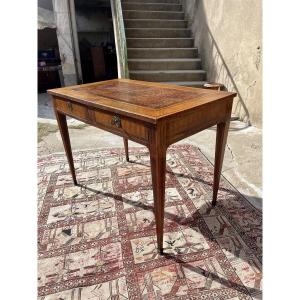
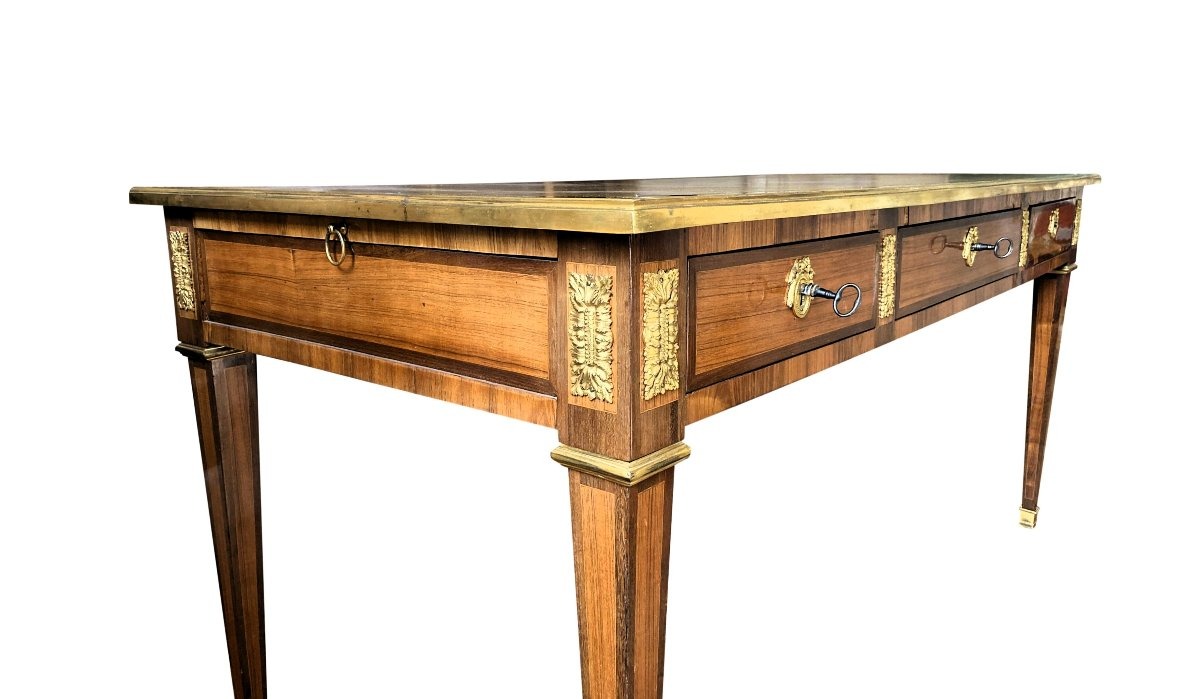
This large Louis XVI period flat desk, made around 1780 and stamped J. CAUMONT, testifies to the refined production of Parisian workshops at the end of the 18th century. Its rigorous composition, inspired by Neoclassical taste, is fully in keeping with the Louis XVI aesthetic while retaining a restrained elegance characteristic of Jean Caumont's work. Very good overall condition. Dimensions: height 79 cm width 77 cm length 160 cm.
Photos coming soon.
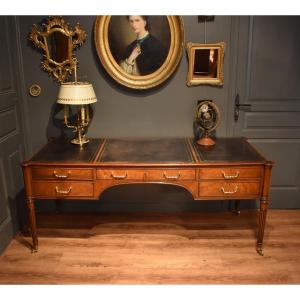
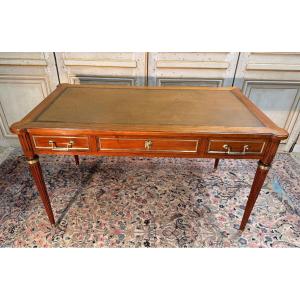
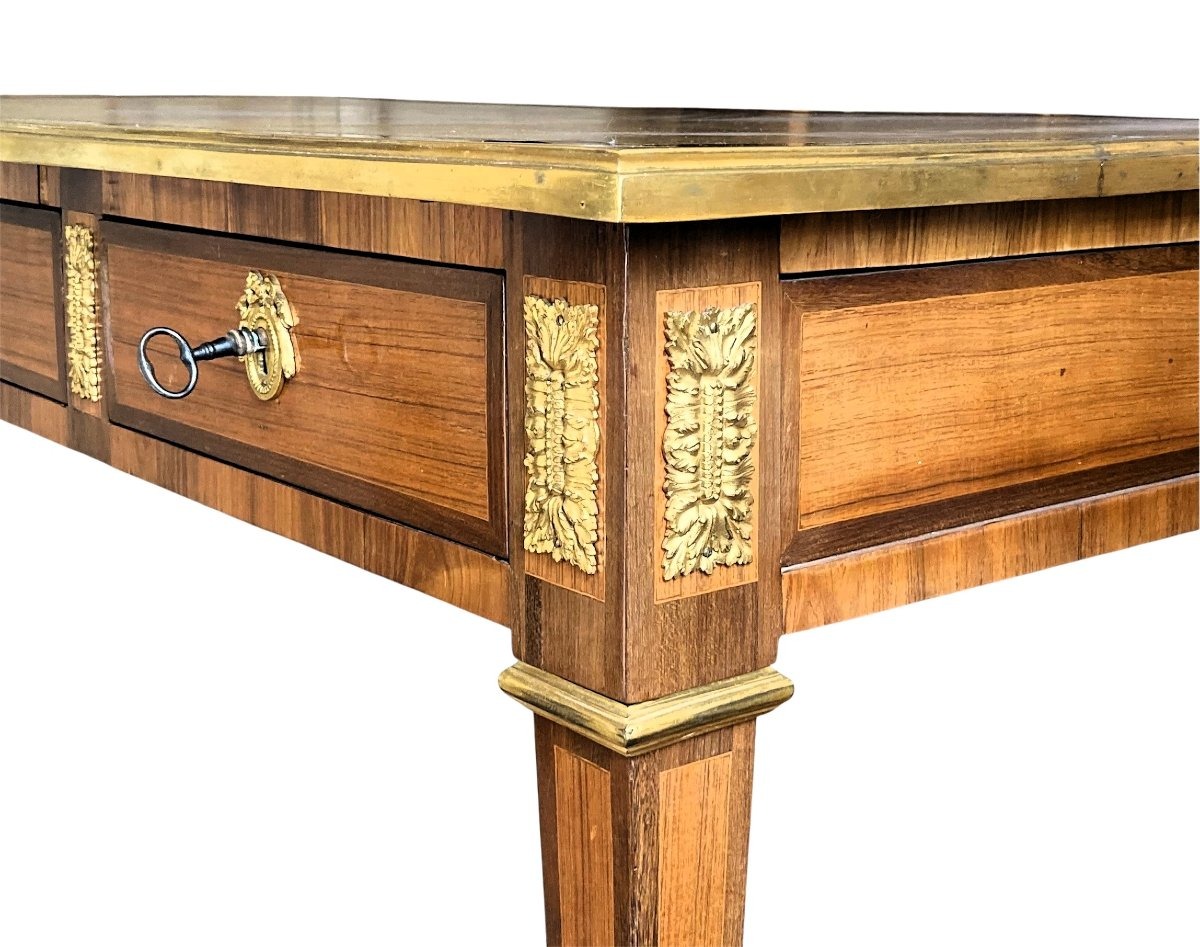
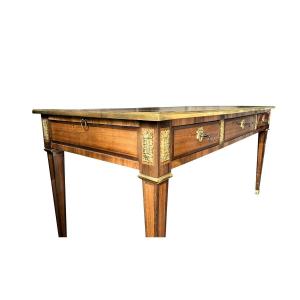
The desk features a rectangular top surrounded by a brass gallery, resting on four tapered legs with a square cross-section. The frieze opens with three drawers, and the fronts are veneered in mahogany and satinwood with carefully selected grain.
The uprights are highlighted by rich ornamentation of chased and gilded bronze decorated with acanthus leaves, while the keyhole escutcheons and drawer pulls on the two side shelves contribute to the overall discreet ornamentation.
The fineness of the frames, the quality of the veneers, the light brown leather blotter, and the balanced proportions reveal first-rate cabinetmaking. The use of gilt bronze mounts, the geometric simplicity of the lines, and the pursuit of perfect symmetry reflect the gradual abandonment of the ornate forms of the Louis XV style in favor of the classical vocabulary that dominated during the reign of Louis XVI.
Jean Caumont (1736-1800)
Jean Caumont was born in 1736 and received his master craftsman's certificate in Paris on December 14, 1774. He established his workshop and store on Rue Traversière, in a district then very active in the furniture trade. A renowned figure in Parisian cabinetmaking, he developed a prolific output during the final decades of the Ancien Régime and continued his work until around 1795, when his son Claude-Emmanuel succeeded him. He actively participated in the French Revolution and also served as a justice of the peace at the commercial court.
Jean Caumont's work falls primarily between the Transitional and Louis XVI styles. His production is distinguished by the exceptional quality of its mahogany and satinwood veneers, its architecturally restrained compositions, the measured yet refined use of gilt bronze, elegant marquetry sometimes depicting flowers, landscapes, branches, or musical instruments, and a constant pursuit of balance and refined proportions.
While he produced various roll-top desks, bouillotte tables, pedestal tables, and occasional furniture, Jean Caumont is particularly renowned for his commodes and secretaries, considered the most accomplished pieces of his work. These pieces are sought after for their understated elegance, their perfect technical mastery, and their quality of execution.
His works are now held in several public collections. A commode by his hand is notably listed in the Carnavalet Museum in Paris, while the Mobilier National (National Furniture Collection) also holds pieces attributed to his workshop.
Jean Caumont belongs to that generation of cabinetmakers who bridged the gap between the last vestiges of Rococo style and the triumph of French Neoclassicism. Without seeking the spectacular effects of some of his contemporaries, he favored purity of line, the nobility of materials, and remarkable craftsmanship. His furniture thus embodies one of the most refined aspects of Parisian furniture under Louis XVI, where decorative richness always remained subordinate to the overall harmony of the composition. Very good condition. Certificate of authenticity. International shipping available.
Photos coming soon.
The desk features a rectangular top surrounded by a brass gallery, resting on four tapered legs with a square cross-section. The frieze opens with three drawers, and the fronts are veneered in mahogany and satinwood with carefully selected grain.
The uprights are highlighted by rich ornamentation of chased and gilded bronze decorated with acanthus leaves, while the keyhole escutcheons and drawer pulls on the two side shelves contribute to the overall discreet ornamentation.
The fineness of the frames, the quality of the veneers, the light brown leather blotter, and the balanced proportions reveal first-rate cabinetmaking. The use of gilt bronze mounts, the geometric simplicity of the lines, and the pursuit of perfect symmetry reflect the gradual abandonment of the ornate forms of the Louis XV style in favor of the classical vocabulary that dominated during the reign of Louis XVI.
Jean Caumont (1736-1800)
Jean Caumont was born in 1736 and received his master craftsman's certificate in Paris on December 14, 1774. He established his workshop and store on Rue Traversière, in a district then very active in the furniture trade. A renowned figure in Parisian cabinetmaking, he developed a prolific output during the final decades of the Ancien Régime and continued his work until around 1795, when his son Claude-Emmanuel succeeded him. He actively participated in the French Revolution and also served as a justice of the peace at the commercial court.
Jean Caumont's work falls primarily between the Transitional and Louis XVI styles. His production is distinguished by the exceptional quality of its mahogany and satinwood veneers, its architecturally restrained compositions, the measured yet refined use of gilt bronze, elegant marquetry sometimes depicting flowers, landscapes, branches, or musical instruments, and a constant pursuit of balance and refined proportions.
While he produced various roll-top desks, bouillotte tables, pedestal tables, and occasional furniture, Jean Caumont is particularly renowned for his commodes and secretaries, considered the most accomplished pieces of his work. These pieces are sought after for their understated elegance, their perfect technical mastery, and their quality of execution.
His works are now held in several public collections. A commode by his hand is notably listed in the Carnavalet Museum in Paris, while the Mobilier National (National Furniture Collection) also holds pieces attributed to his workshop.
Jean Caumont belongs to that generation of cabinetmakers who bridged the gap between the last vestiges of Rococo style and the triumph of French Neoclassicism. Without seeking the spectacular effects of some of his contemporaries, he favored purity of line, the nobility of materials, and remarkable craftsmanship. His furniture thus embodies one of the most refined aspects of Parisian furniture under Louis XVI, where decorative richness always remained subordinate to the overall harmony of the composition. Very good condition. Certificate of authenticity. International shipping available.
24 000 €
Period: 18th century
Style: Louis 16th, Directory
Condition: Excellent condition
Material: Mahogany
Length: 160
Width: 77
Height: 79
Reference (ID): 1772398
Availability: In stock
Print