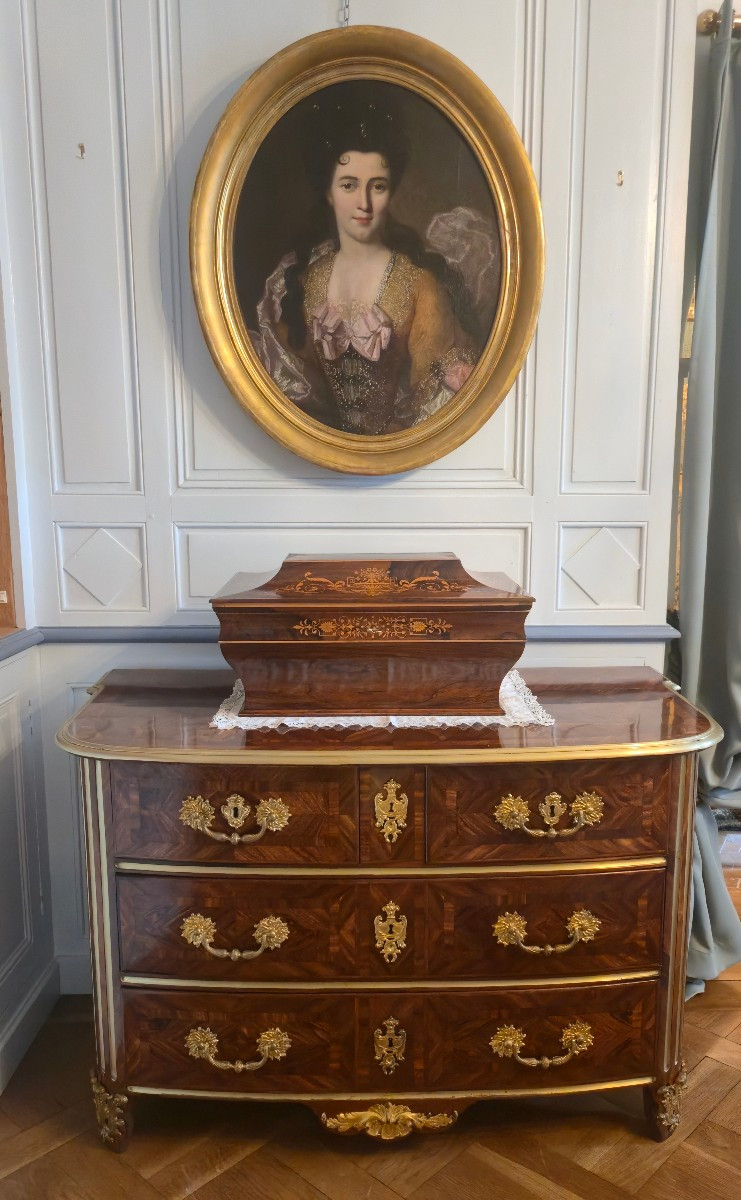
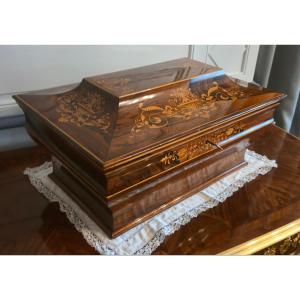


Large Sarcophagus-shaped Case In Rosewood And Holly Marquetry Restoration Period.
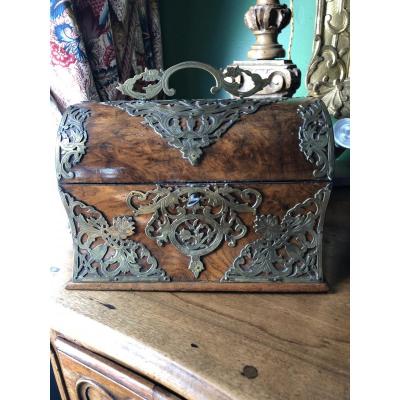
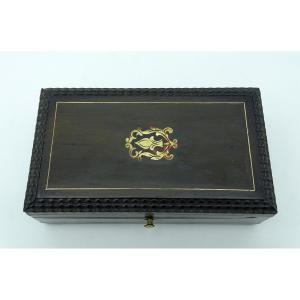
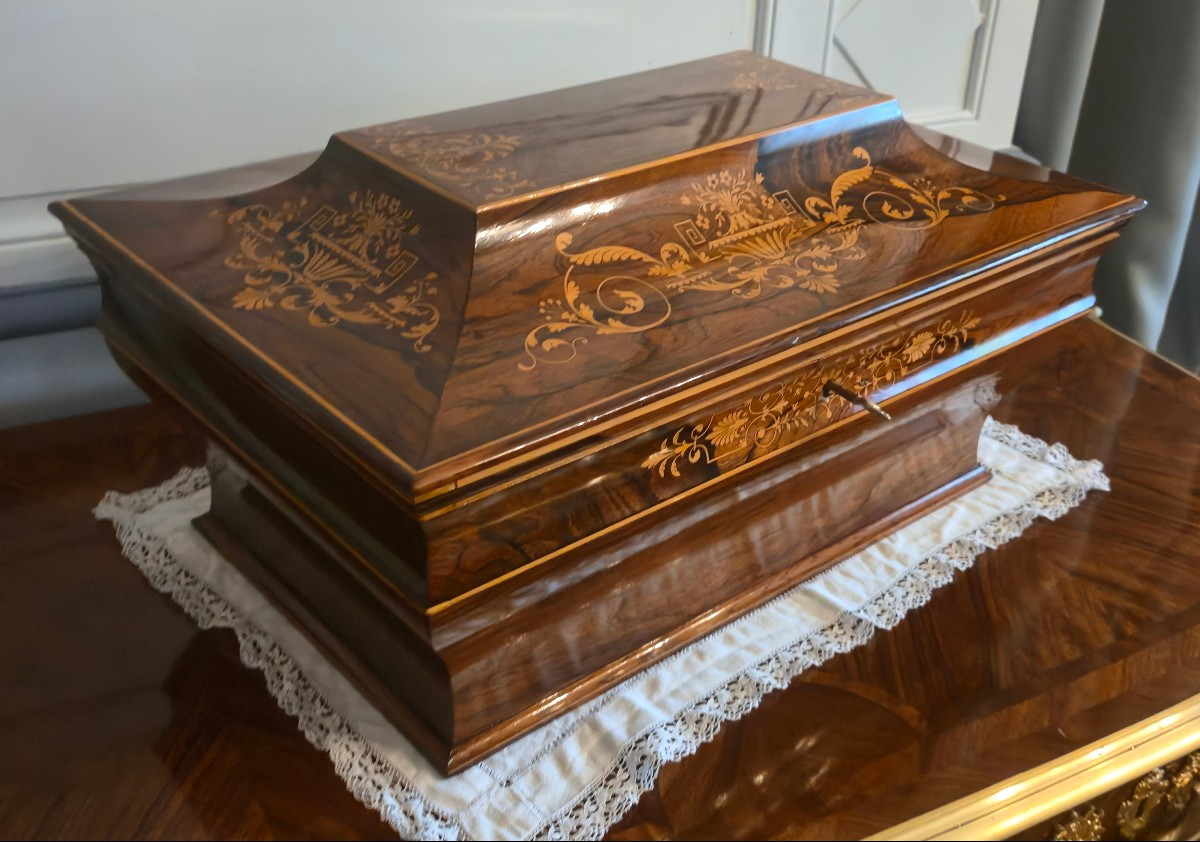
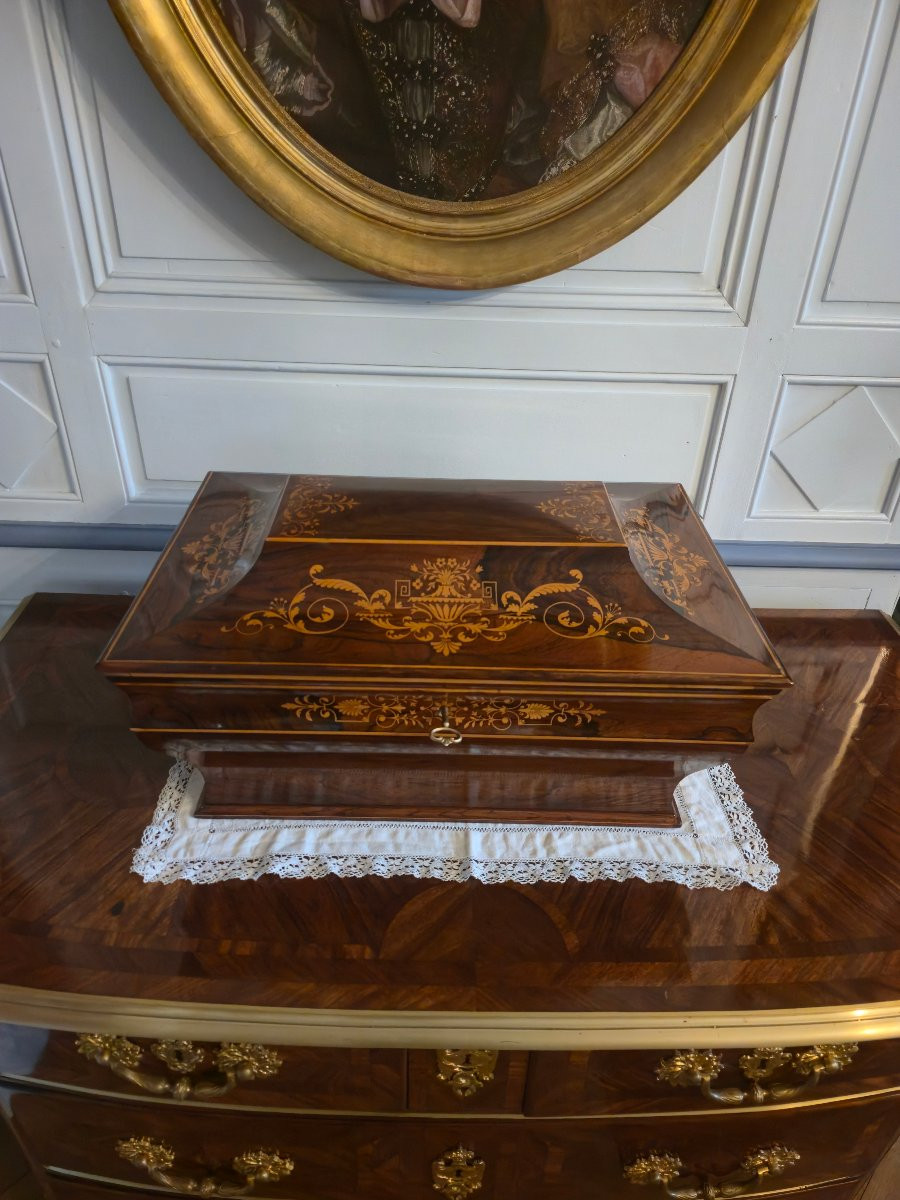
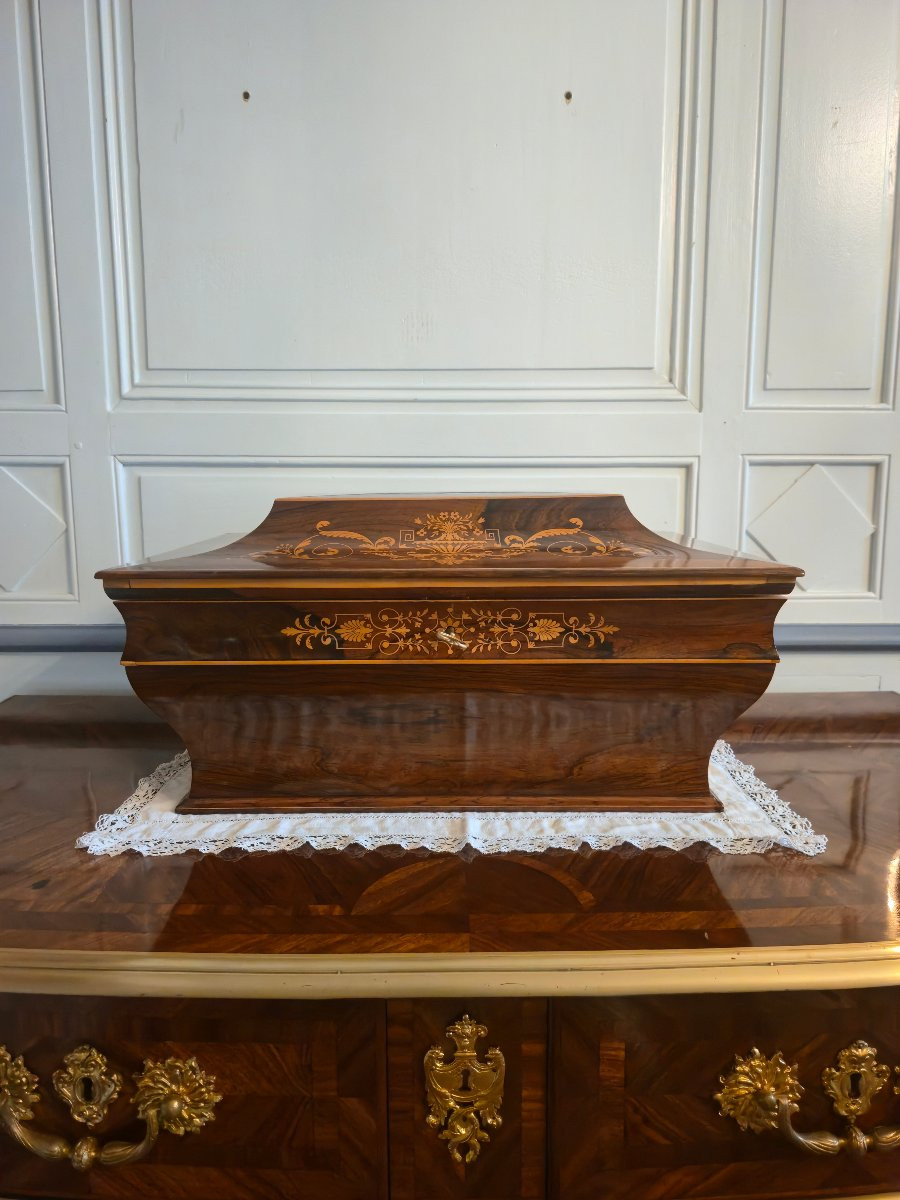
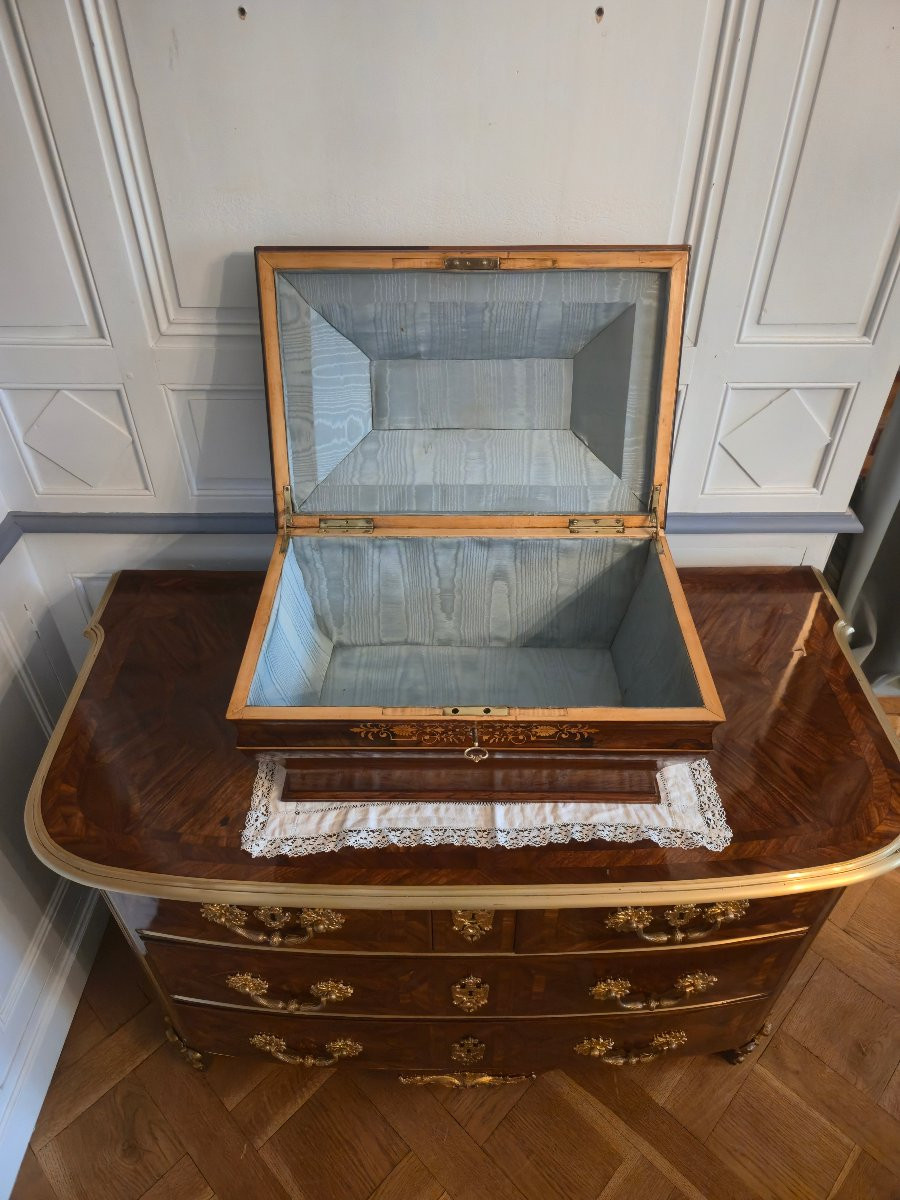
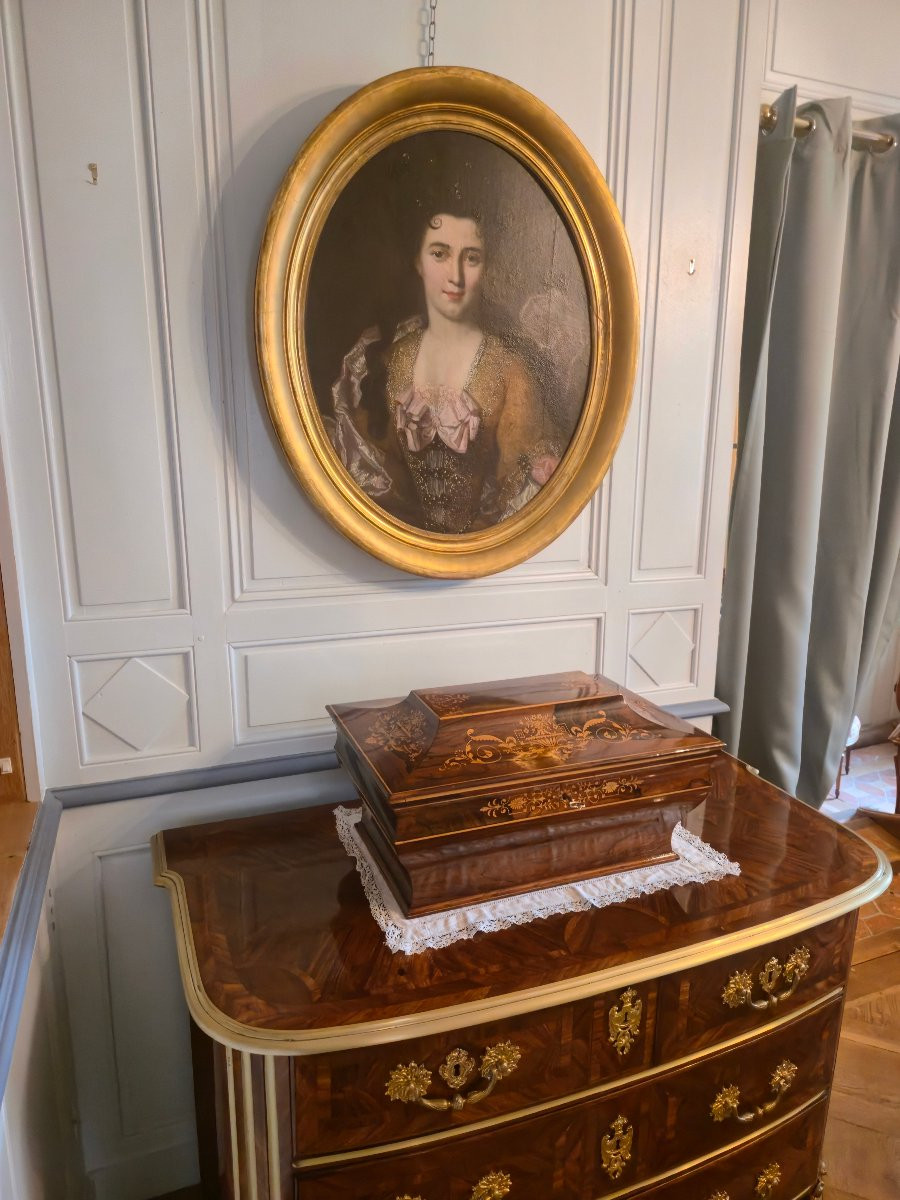
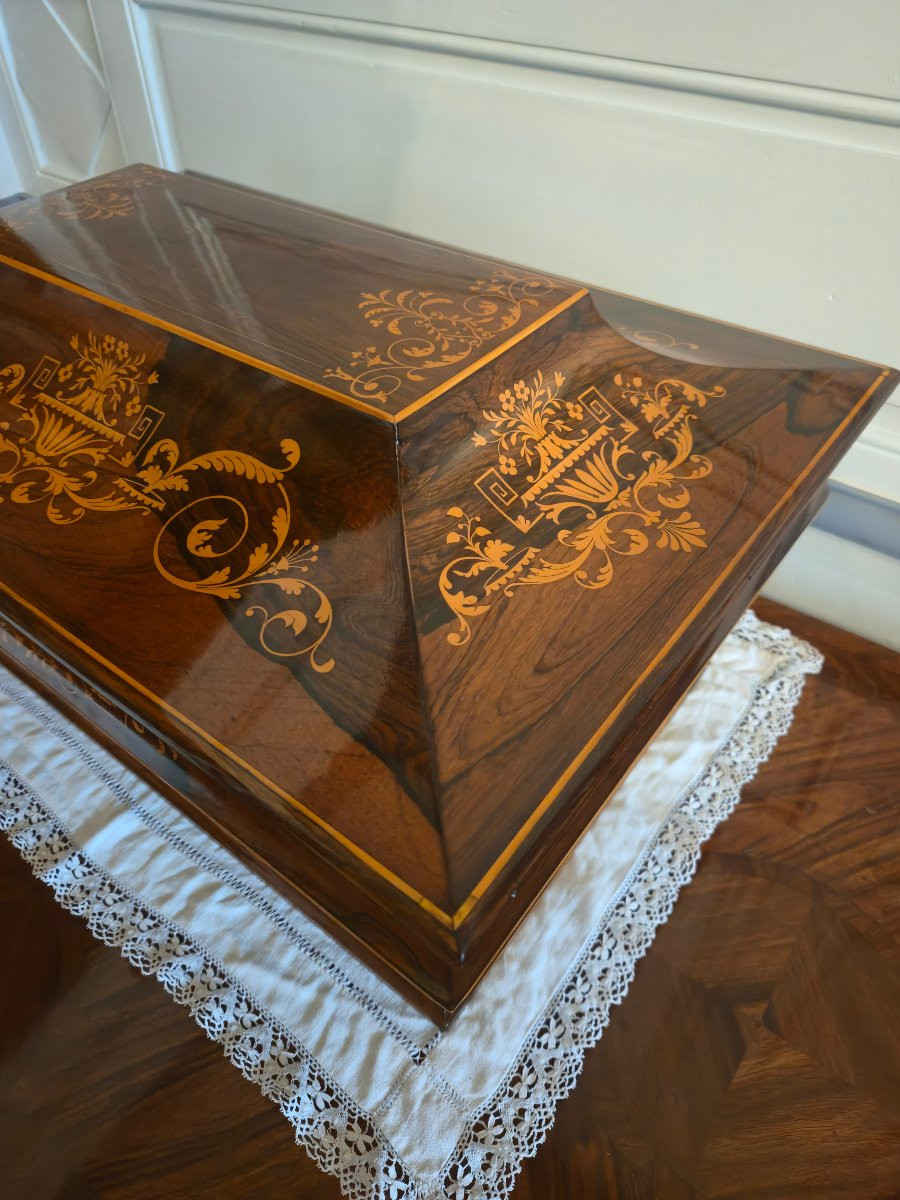
An important sarcophagus-shaped case in rosewood veneer, richly inlaid with holly on a light wood frame, opening with an architectural lid revealing a vast interior entirely sheathed in blue-gray moire.
This remarkable chest belongs fully to that singular period known as the Restoration, between the survival of Empire vocabulary and the emergence of a more intimate, poetic and romantic sensibility in French decorative arts.
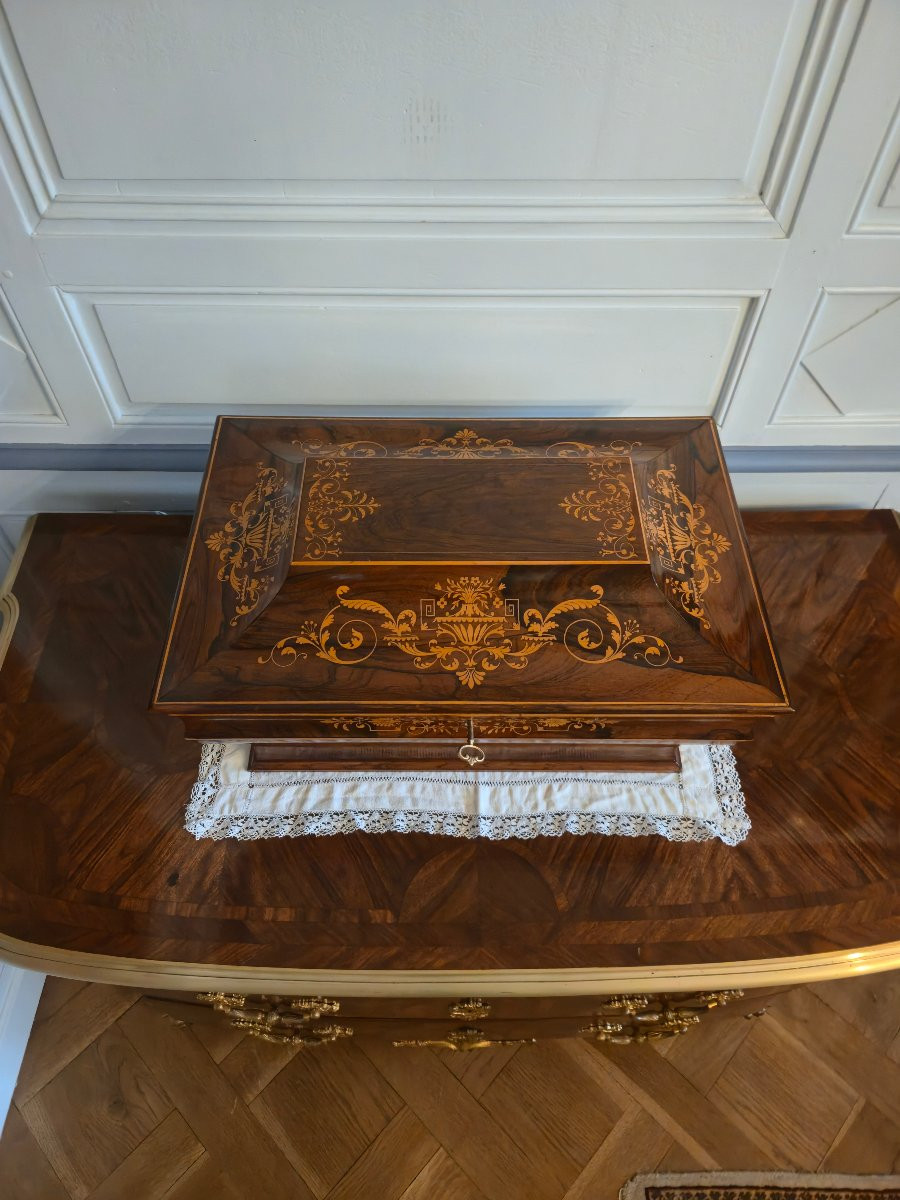
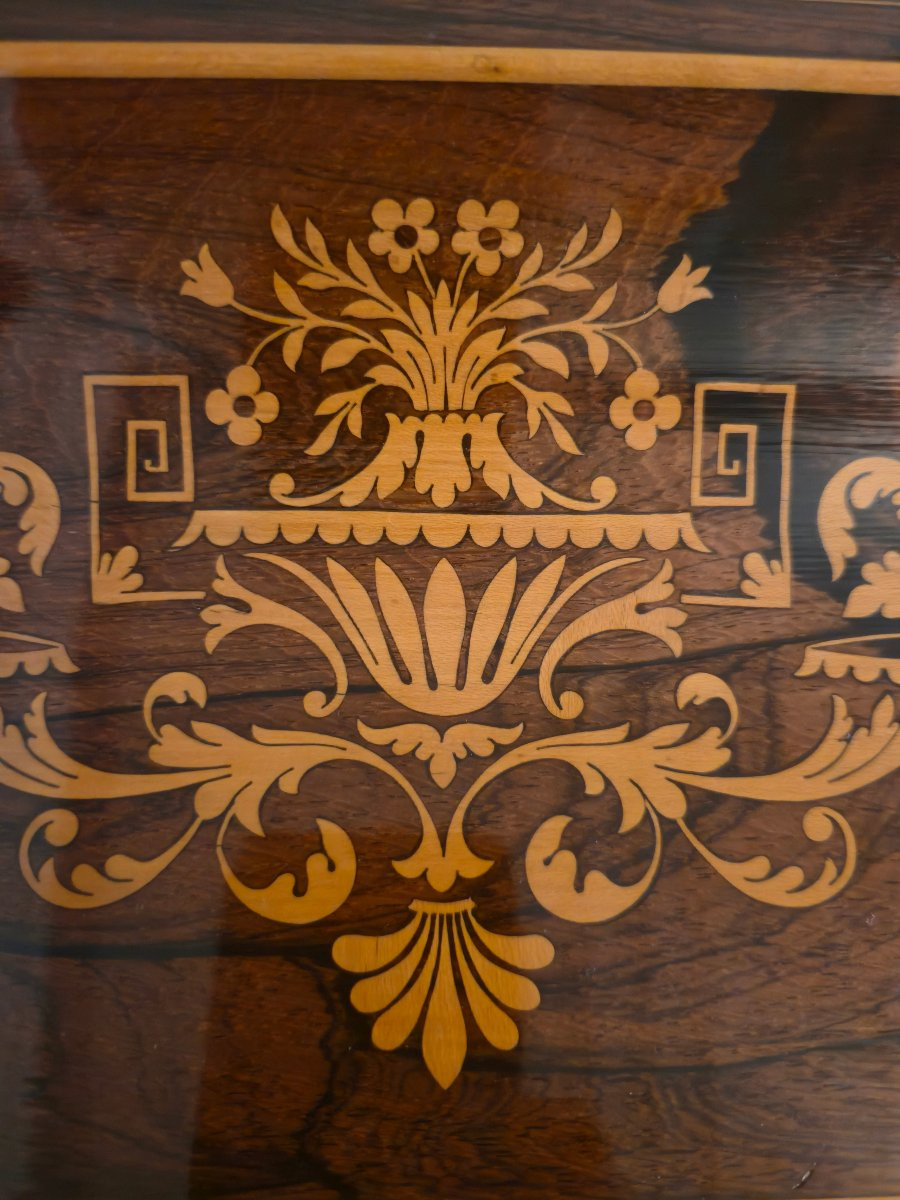
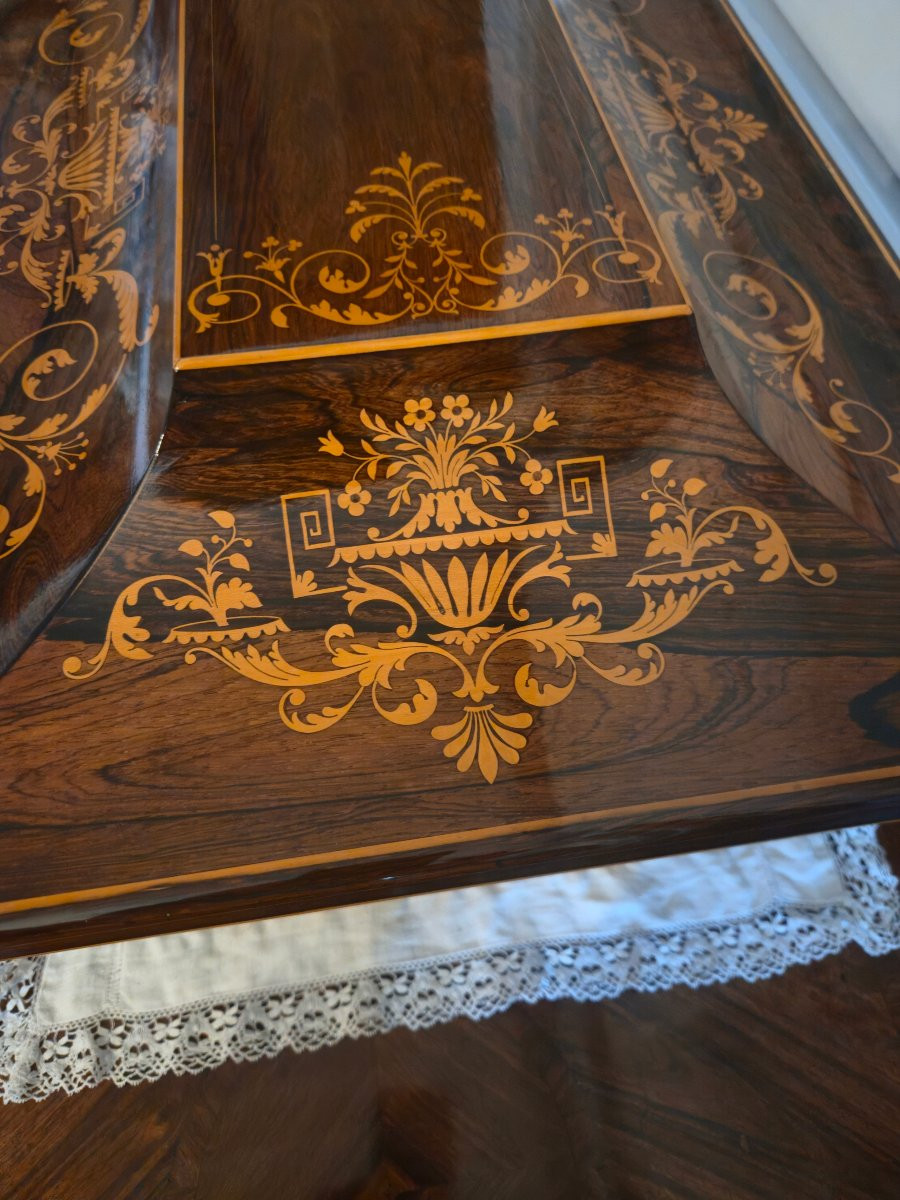
The inlaid decoration bears witness to great intellectual and decorative finesse. At first glance, the eye perceives an elegant composition of scrolls, arabesques and symmetrical motifs running across the sloping sides of the lid and the front. But close observation gradually reveals a more sophisticated reading of the decoration: the scrolls actually depict stylized horns of plenty, while in the center appear antique-style vases whose handles are suggested by small geometric Greek shapes.
This deliberate ambiguity of design is particularly refined. Shapes are never described literally; they are suggested by the organization of foliage and lines, in an almost calligraphic spirit. The palmettes, omnipresent in the decor, are themselves transformed and softened: at times close to the imperial vocabulary inherited from Antiquity, at other times almost vegetal or floral, they participate in this Restoration aesthetic where the great motifs of neoclassicism survive in a lighter, more evocative form.
The contrast between the deep-veined rosewood and the light holly marquetry plays a full part in this decorative quest. The precious wood is not masked by intrusive ornamentation: it remains visible, alive and vibrant under the pad varnish. The decoration is never ostentatious; it suggests rather than imposes.
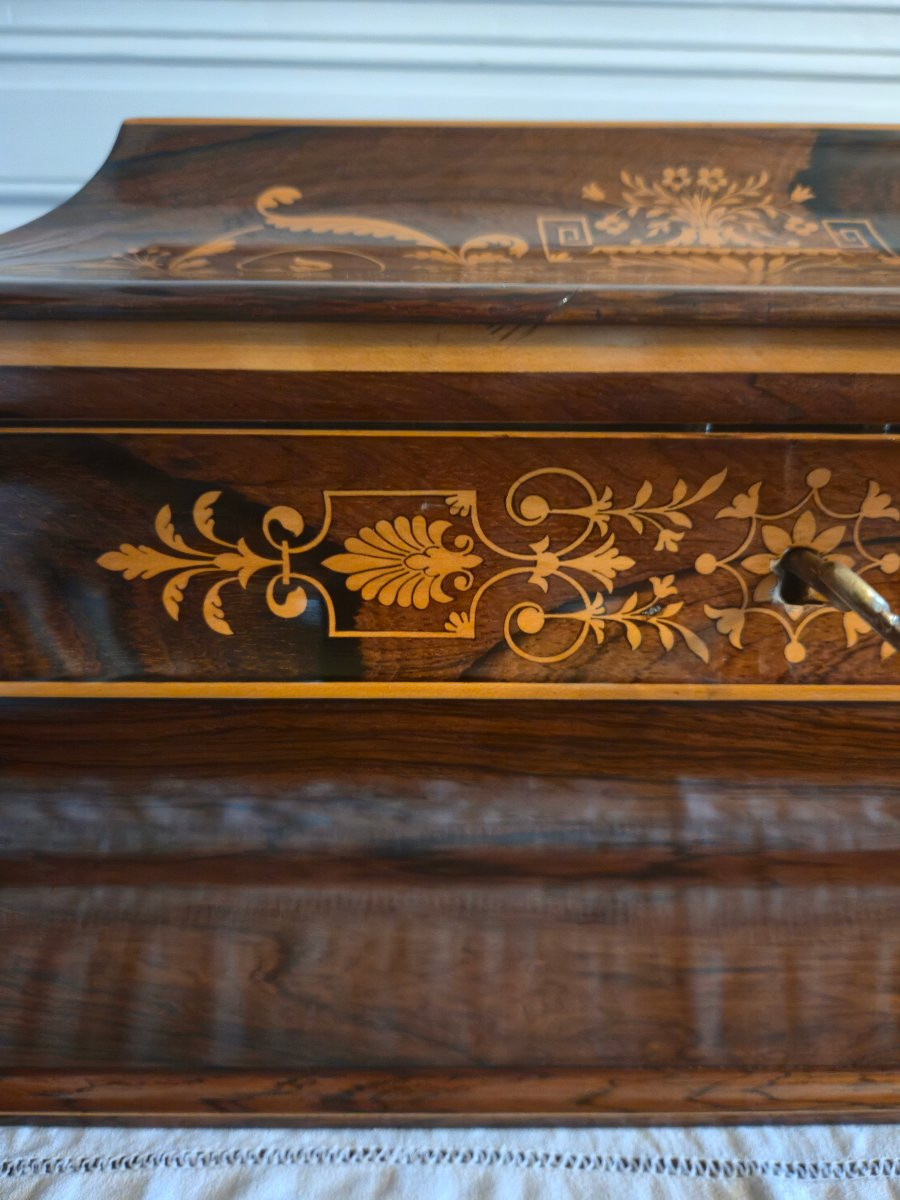
This decorative restraint is particularly representative of the spirit of the Restoration. After the splendors of the Empire and the political upheavals of the early 19th century, luxury became more interior and subtle. Bronzes gradually disappeared in favor of essences and inlays. Here, even the lock escutcheon is simply evoked by marquetry, recalling in stylized form the memory of the great imperial ornamental bronzes without ever seeking their monumentality.
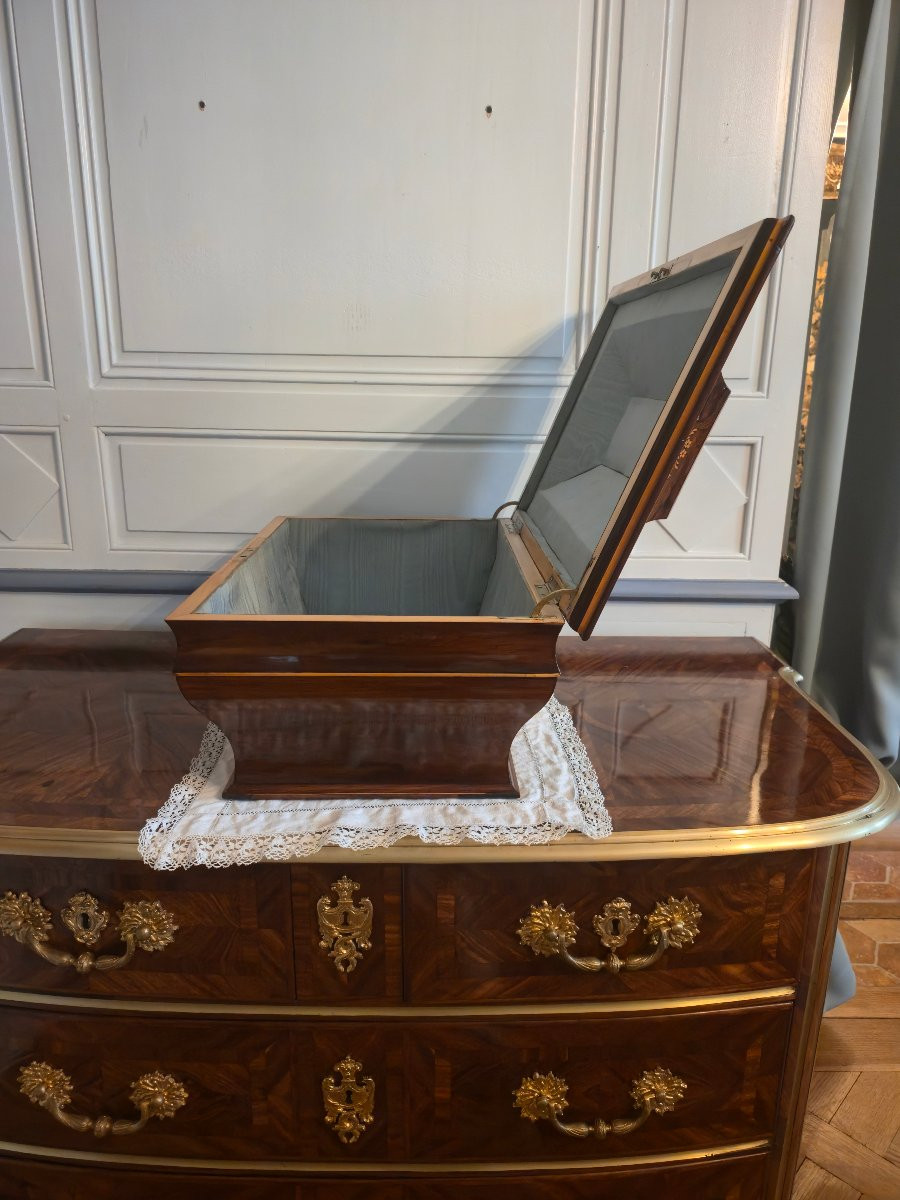
The architectural lid, composed of sloping sides surrounding a raised central part, gives the whole an almost monumental silhouette despite its relatively contained dimensions. This carefully thought-out construction still recalls certain architectural rhythms of the Empire style, but softened by the supple lines and arabesques of the Charles X period.
The interior is entirely sheathed in a superb, probably original, blue-gray moire, whose luminous undulations respond to the movements of the veneer and exterior marquetry. This satin-finish fabric, with its shimmering reflections, is particularly representative of the refined harmonies of the Restoration period. The sloping sides of the cover and the geometric tension of the fabric almost evoke the world of textile hangings and pavilions dear to the decorative imagination of the early 19th century. Here again, nothing is literal: the box works by suggestion and evocation.
This type of large chest could hold precious fabrics, shawls, feminine accessories, refined linen or important papers. It was fully in keeping with the new culture of bourgeois and aristocratic intimacy that developed under the Restoration, where refinement no longer lay in spectacular display, but in the subtlety of materials, the quality of design and the intelligence of decoration.
The hinges and compasses are original. The lock, replaced in the 19th century, works with its key. The set is in very good condition, with a few old restorations and discreet signs of use.
Dimensions:
Height: 28 cm
Width: 60 cm
Depth: 40 cm
Bibliography and stylistic context:
- Musée des Arts Décoratifs, Paris, pages devoted to the Restoration and Charles X style
- Gazette Drouot, "C comme Charles X, le style d'une époque"
- Studies on the decorative arts of the Restoration and the revival of marquetry under Charles X.
This remarkable chest belongs fully to that singular period known as the Restoration, between the survival of Empire vocabulary and the emergence of a more intimate, poetic and romantic sensibility in French decorative arts.
The inlaid decoration bears witness to great intellectual and decorative finesse. At first glance, the eye perceives an elegant composition of scrolls, arabesques and symmetrical motifs running across the sloping sides of the lid and the front. But close observation gradually reveals a more sophisticated reading of the decoration: the scrolls actually depict stylized horns of plenty, while in the center appear antique-style vases whose handles are suggested by small geometric Greek shapes.
This deliberate ambiguity of design is particularly refined. Shapes are never described literally; they are suggested by the organization of foliage and lines, in an almost calligraphic spirit. The palmettes, omnipresent in the decor, are themselves transformed and softened: at times close to the imperial vocabulary inherited from Antiquity, at other times almost vegetal or floral, they participate in this Restoration aesthetic where the great motifs of neoclassicism survive in a lighter, more evocative form.
The contrast between the deep-veined rosewood and the light holly marquetry plays a full part in this decorative quest. The precious wood is not masked by intrusive ornamentation: it remains visible, alive and vibrant under the pad varnish. The decoration is never ostentatious; it suggests rather than imposes.
This decorative restraint is particularly representative of the spirit of the Restoration. After the splendors of the Empire and the political upheavals of the early 19th century, luxury became more interior and subtle. Bronzes gradually disappeared in favor of essences and inlays. Here, even the lock escutcheon is simply evoked by marquetry, recalling in stylized form the memory of the great imperial ornamental bronzes without ever seeking their monumentality.
The architectural lid, composed of sloping sides surrounding a raised central part, gives the whole an almost monumental silhouette despite its relatively contained dimensions. This carefully thought-out construction still recalls certain architectural rhythms of the Empire style, but softened by the supple lines and arabesques of the Charles X period.
The interior is entirely sheathed in a superb, probably original, blue-gray moire, whose luminous undulations respond to the movements of the veneer and exterior marquetry. This satin-finish fabric, with its shimmering reflections, is particularly representative of the refined harmonies of the Restoration period. The sloping sides of the cover and the geometric tension of the fabric almost evoke the world of textile hangings and pavilions dear to the decorative imagination of the early 19th century. Here again, nothing is literal: the box works by suggestion and evocation.
This type of large chest could hold precious fabrics, shawls, feminine accessories, refined linen or important papers. It was fully in keeping with the new culture of bourgeois and aristocratic intimacy that developed under the Restoration, where refinement no longer lay in spectacular display, but in the subtlety of materials, the quality of design and the intelligence of decoration.
The hinges and compasses are original. The lock, replaced in the 19th century, works with its key. The set is in very good condition, with a few old restorations and discreet signs of use.
Dimensions:
Height: 28 cm
Width: 60 cm
Depth: 40 cm
Bibliography and stylistic context:
- Musée des Arts Décoratifs, Paris, pages devoted to the Restoration and Charles X style
- Gazette Drouot, "C comme Charles X, le style d'une époque"
- Studies on the decorative arts of the Restoration and the revival of marquetry under Charles X.
1 400 €
Period: 19th century
Style: Louis Philippe, Charles 10th
Condition: Good condition
Material: Wood marquetry
Reference (ID): 1763202
Availability: In stock
Print