






Ancient Khmer Empire, Angkorian Period, 12th–13th Century, Bronze Statuette Of Prajnaparamita
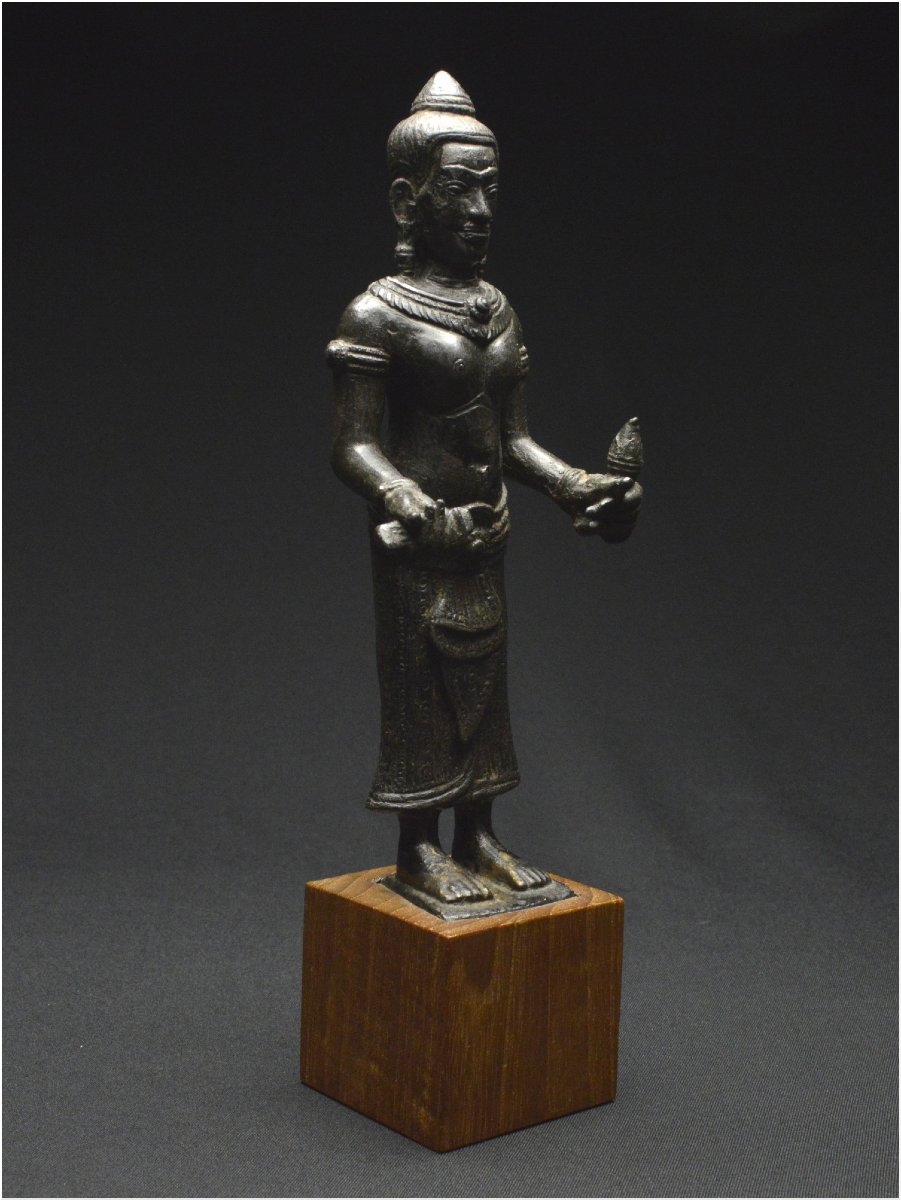
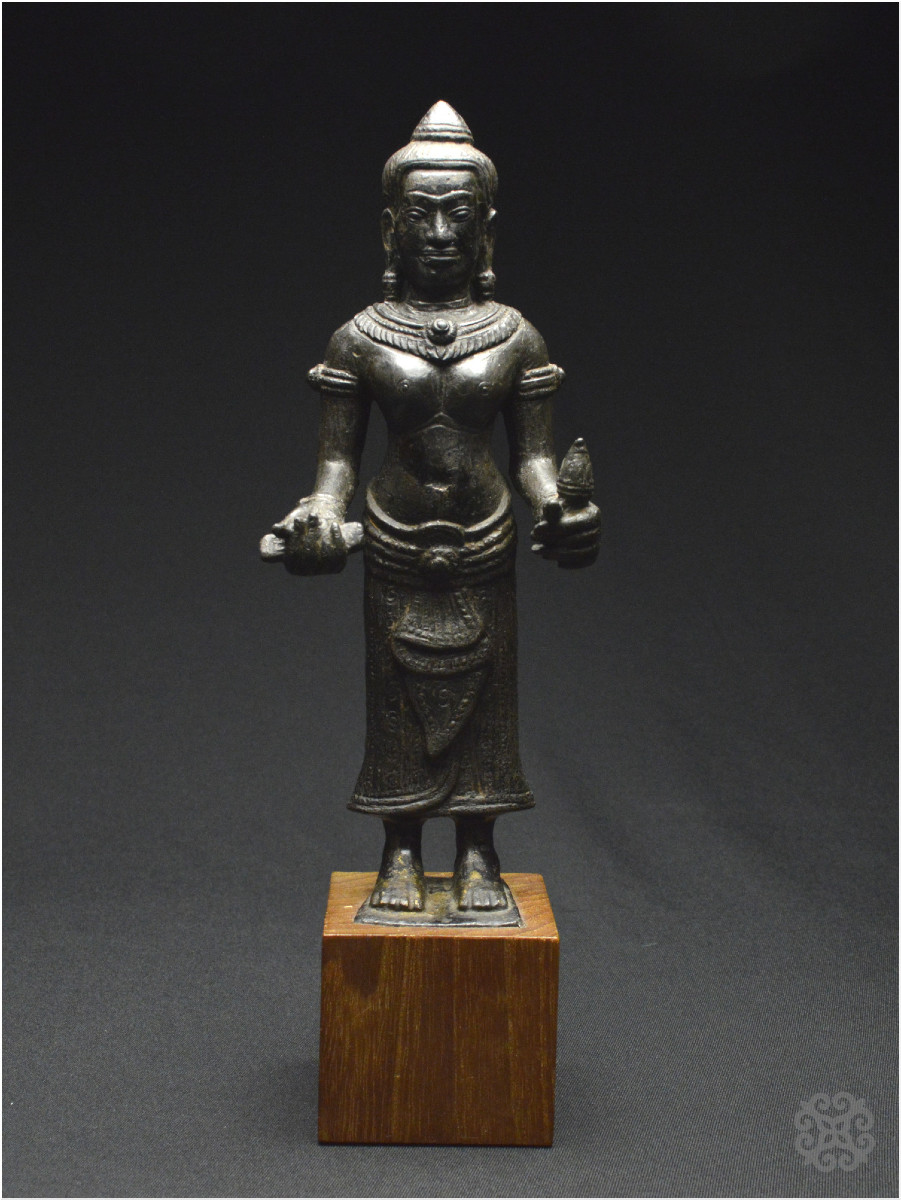
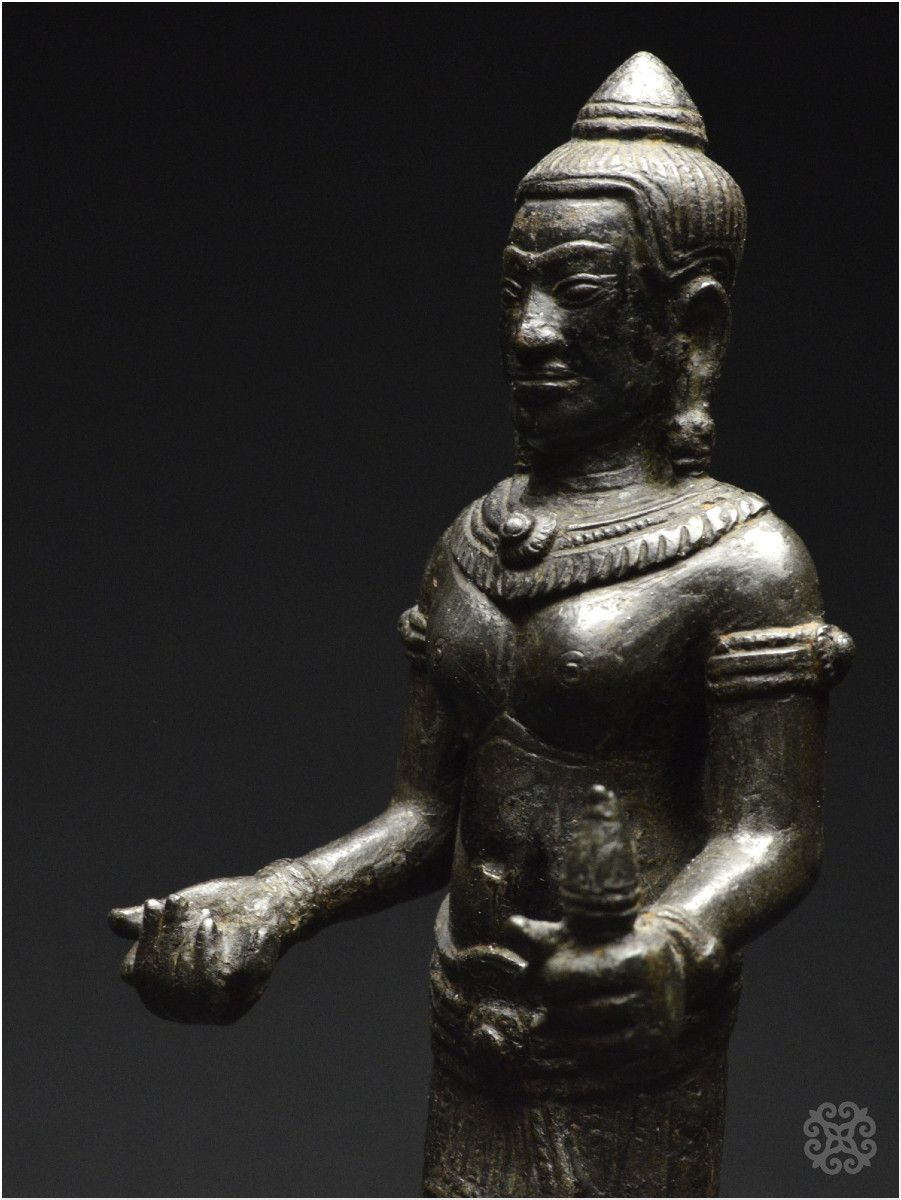
Representation of the deity Prajnaparamita in dark patinated bronze
Ancient Khmer Empire, Angkorian period
Lopburi style, 12th–13th century
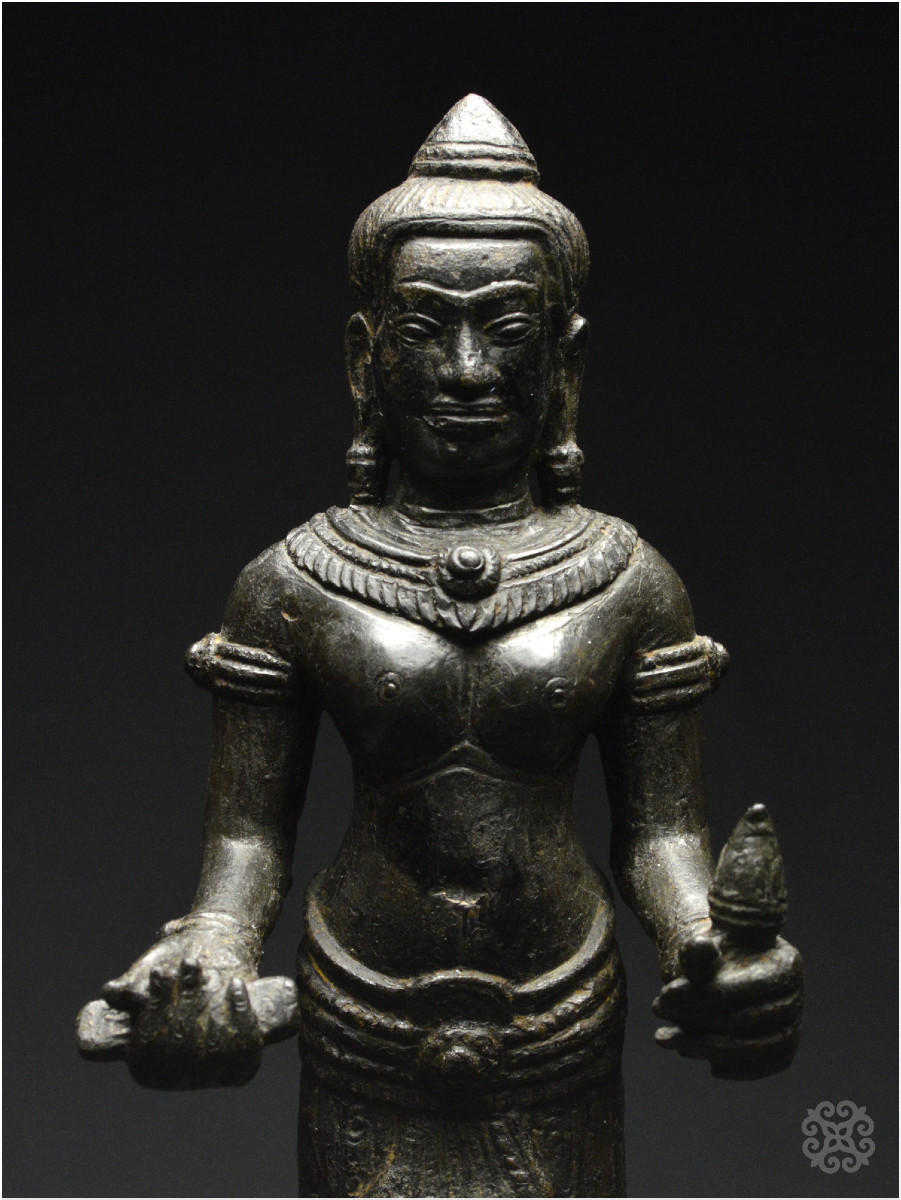
The deity is represented in a hieratic posture, standing in samapada, with the arms detached from the body and holding her classical attributes: a lotus bud in the left hand, while the right hand grasps the Sutra of the Perfection of Wisdom. She is adorned with numerous jewels: cabochon-decorated bracelets on the arms and wrists, necklaces with finely worked pendants, as well as a large floral pectoral pendant.
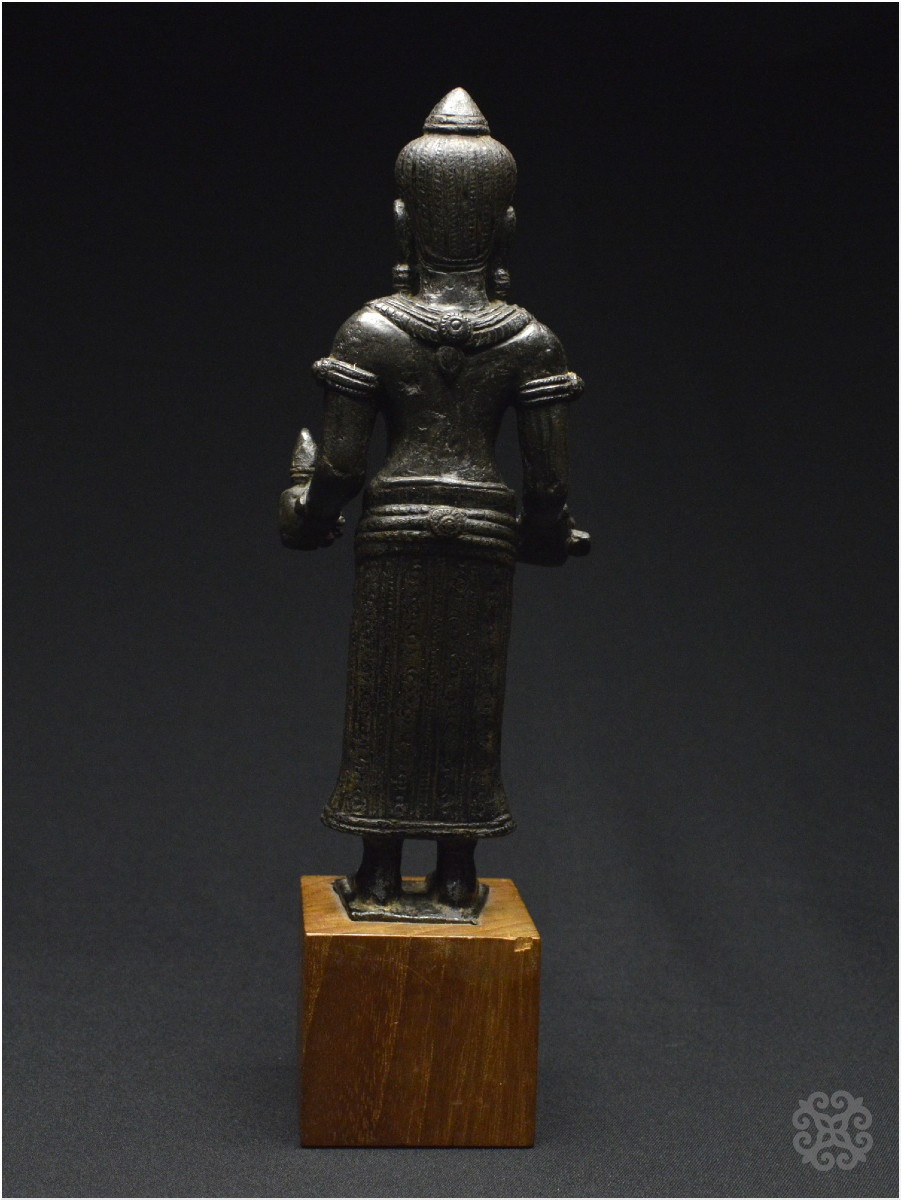
She is depicted bare-chested, with broad hips covered by a large sampot, slightly flaring toward the lower part and decorated with bands of floral motifs. The garment is secured by a belt whose fastening knot takes the form of a corolla and features a wide pleated panel in the shape of a fishtail, characteristic of Angkorian Khmer art.
The face is characterized by fine slightly raised eyebrows meeting at the base of the nose and overhanging two large lenticular eyes. The slender and flattened nose surmounts a mouth with full lips suggesting a fixed smile, while the chin is marked by a slight dimple. The upper forehead is framed by a fine line encircling the entire hairstyle, composed of vertical braids gathered into a high truncated conical chignon encircled by a tiara. The ears are adorned with large pendants resting on the shoulders.
Our statuette of Prajnaparamita represents the abstract personification of the Prajnaparamita-sutra, a fundamental text of Mahayana Buddhism, embodying the transcendent and perfect wisdom that enables one to attain Enlightenment by transcending the illusion of the phenomenal world.
Our representation belongs to a particular context in which King Jayavarman VII (1182–c. 1219/1220) established Mahayana Buddhism as the dominant religion of the Khmer Empire, marking a profound religious and cultural transformation in Angkor at the end of the 12th century. Thus, in the Khmer world from the 7th century onward, the first images of Avalokiteśvara appeared, establishing the preeminence of Mahayana, or Great Vehicle Buddhism, over the Buddhism of the Elders, the latter gradually fading from religious life until the 13th century.
It was during the 10th century, under the reigns of Rajendravarman II and his son Jayavarman V, that the goddess appeared within a still largely Hindu context, where she remained a secondary deity integrated into triadic compositions alongside Avalokitesvara / Lokesvara or Vajrapani and the Buddha. It was under the reign of Jayavarman VII that she was elevated to the rank of major deity of Great Vehicle Buddhism, within a conception in which wisdom (Prajnaparamita) and compassion (Lokesvara) structured royal religious ideology.
The Lopburi style, associated with the eponymous city (ancient Lavapura) located in central present-day Thailand, developed during the Angkorian era between the 11th and early 13th century within the framework of the Khmer Empire’s expansion into central Thailand. During the Angkor Wat period, the region was fully integrated into the Khmer political and cultural sphere, notably under Suryavarman II, which encouraged the diffusion of Angkorian architectural and iconographic models. In the 12th century, under Jayavarman VII, this influence reached its height with the flourishing of Mahayana Buddhist art and the Bayon style. Lopburi productions subsequently adopted the principal characteristics of Khmer art: hieratic figures, volumetric treatment of the body, and refined drapery.
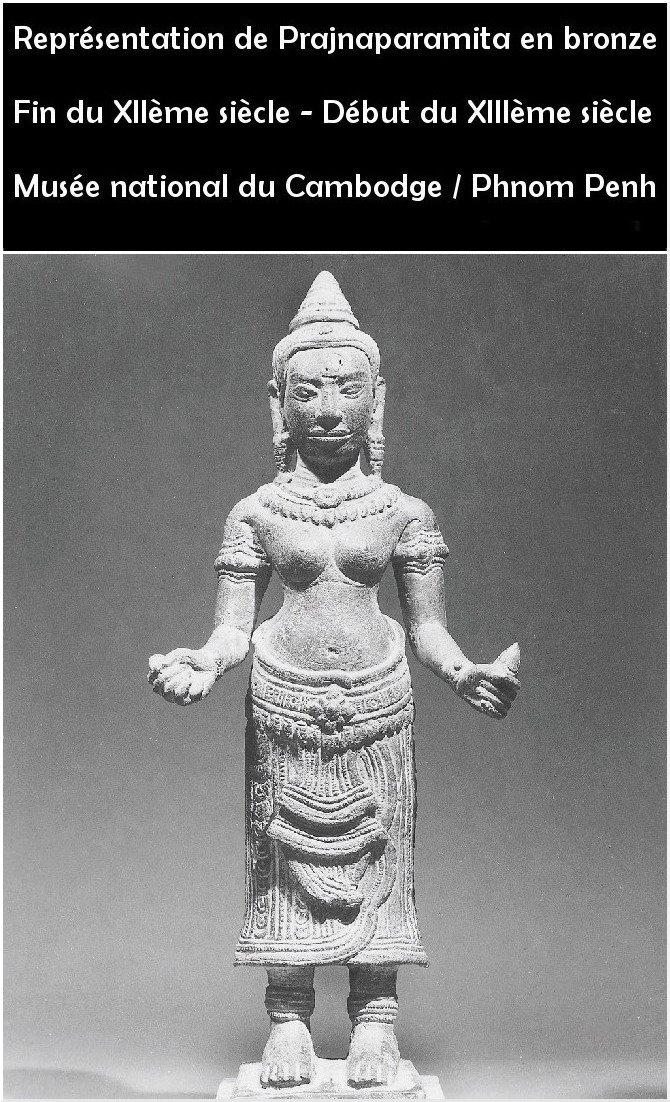
For a Prajnaparamita statuette comparable to ours, see the final illustration depicting the deity preserved in the archives of the National Museum of Cambodia.
Dark patinated bronze
Wear consistent with age and use
18.5 × 7.3 cm excluding base
Former New York private collection, acquired before 1970
Contact us: culturesetcivilisations@orange.fr
Period: Before 16th century
Style: Asian art
Condition: Excellent condition
Material: Bronze
Width: 7.3 cm hors socle
Height: 18.5 cm hors socle
Reference (ID): 1758226
Availability: In stock