

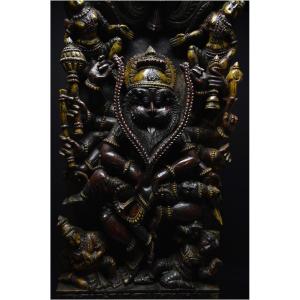


India, Late 19th - Early 20th Century, Large Polychrome Wooden Panel Depicting Narasimha
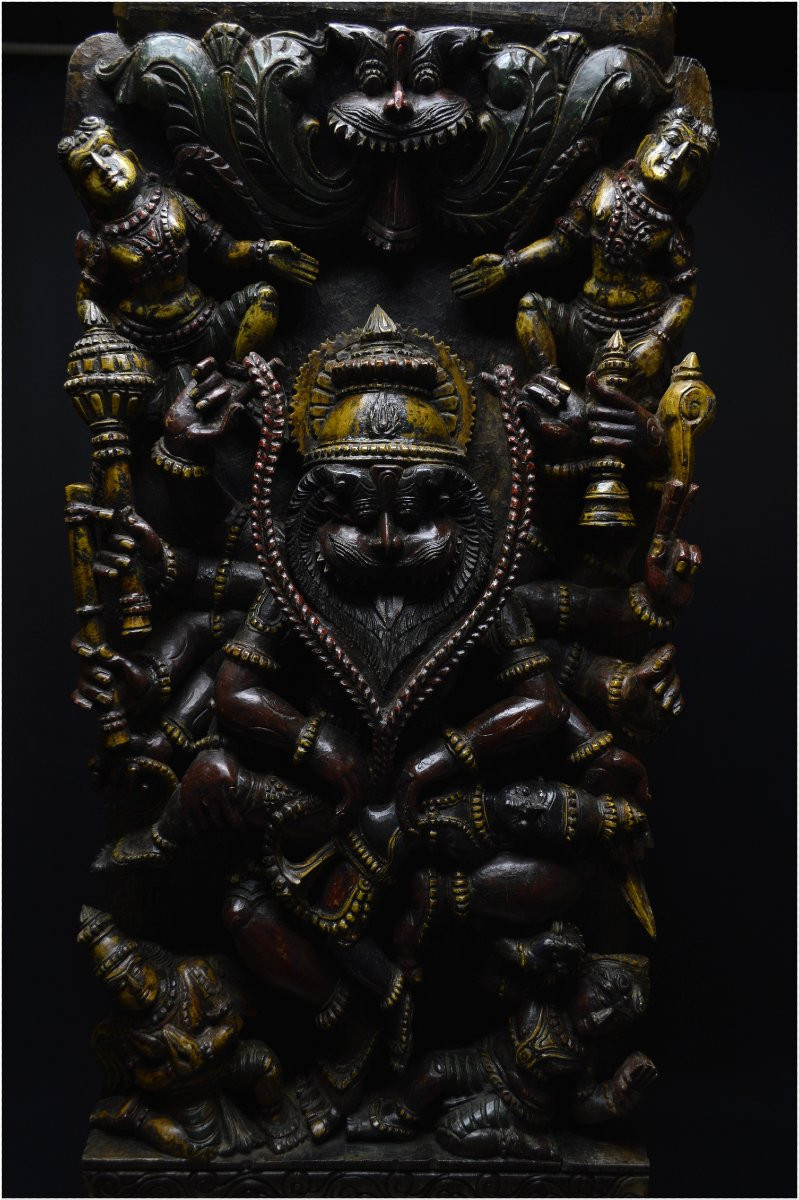
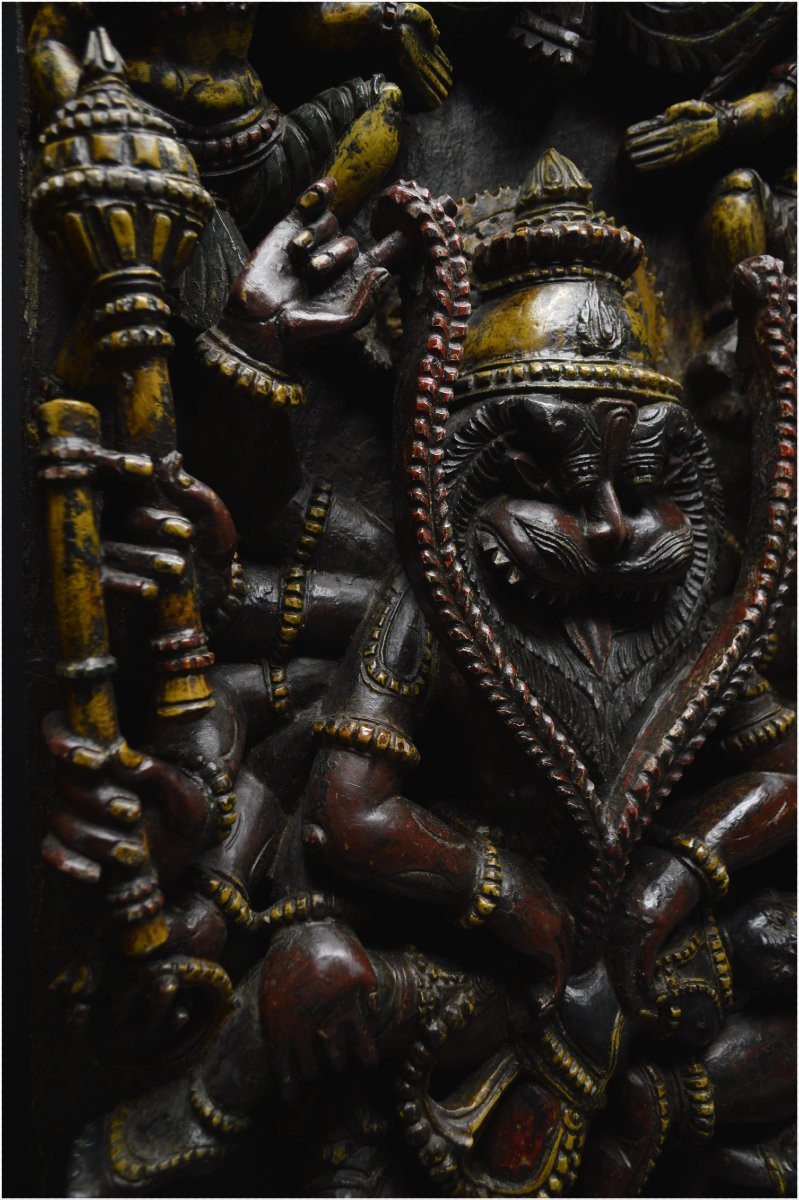
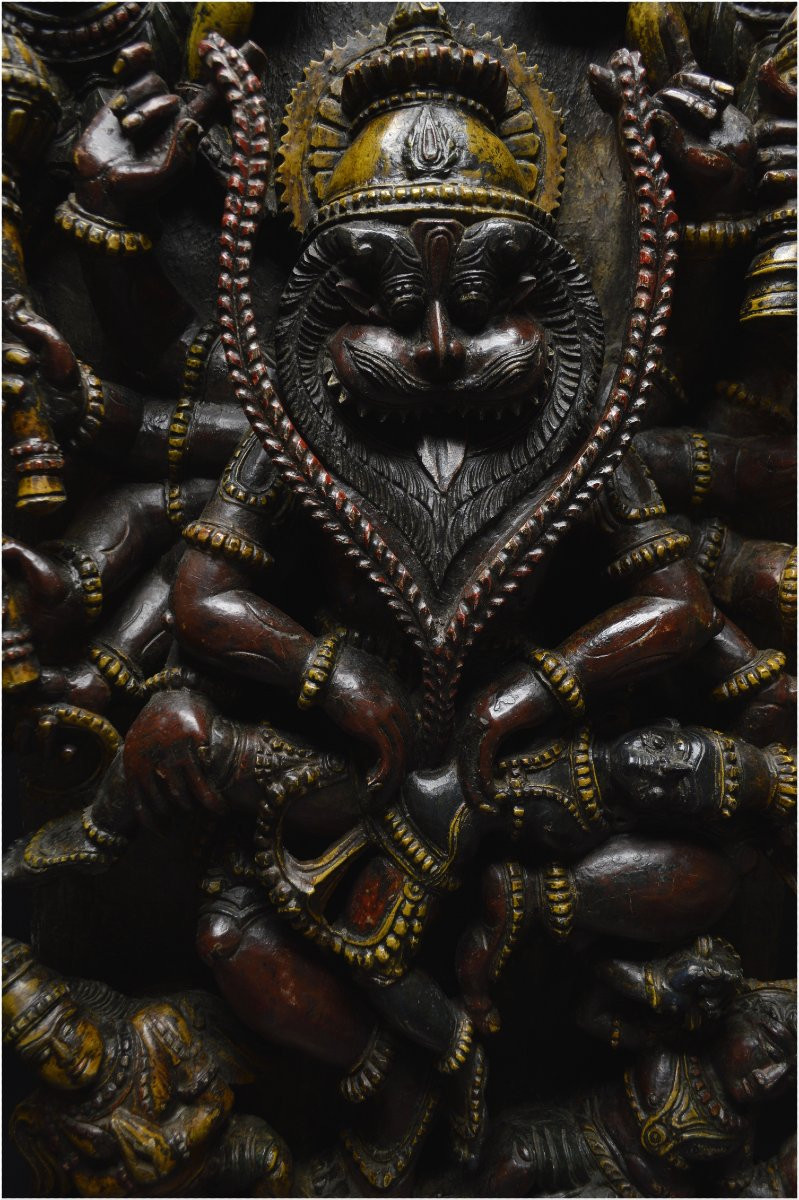
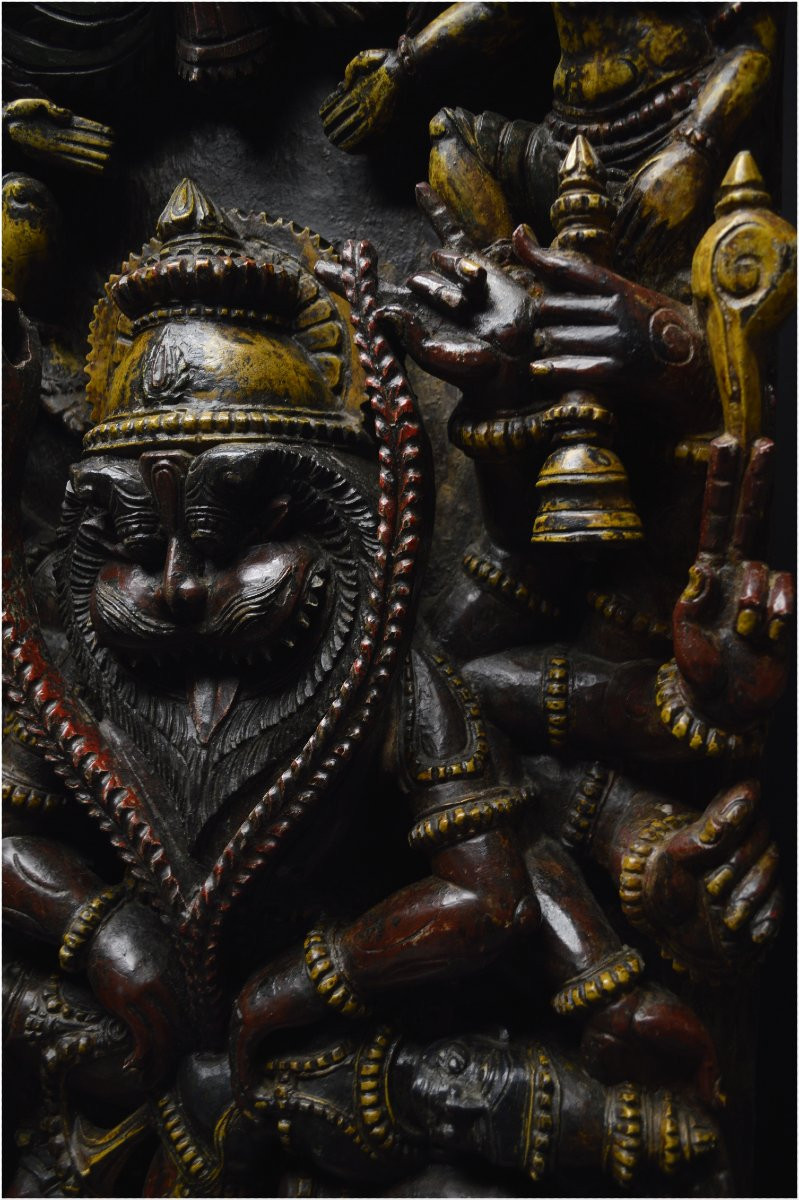
Large polychrome wooden panel depicting Narasimha, one of the ten avatars of Vishnu
Southern India, State of Tamil Nadu
Late 19th – Early 20th century
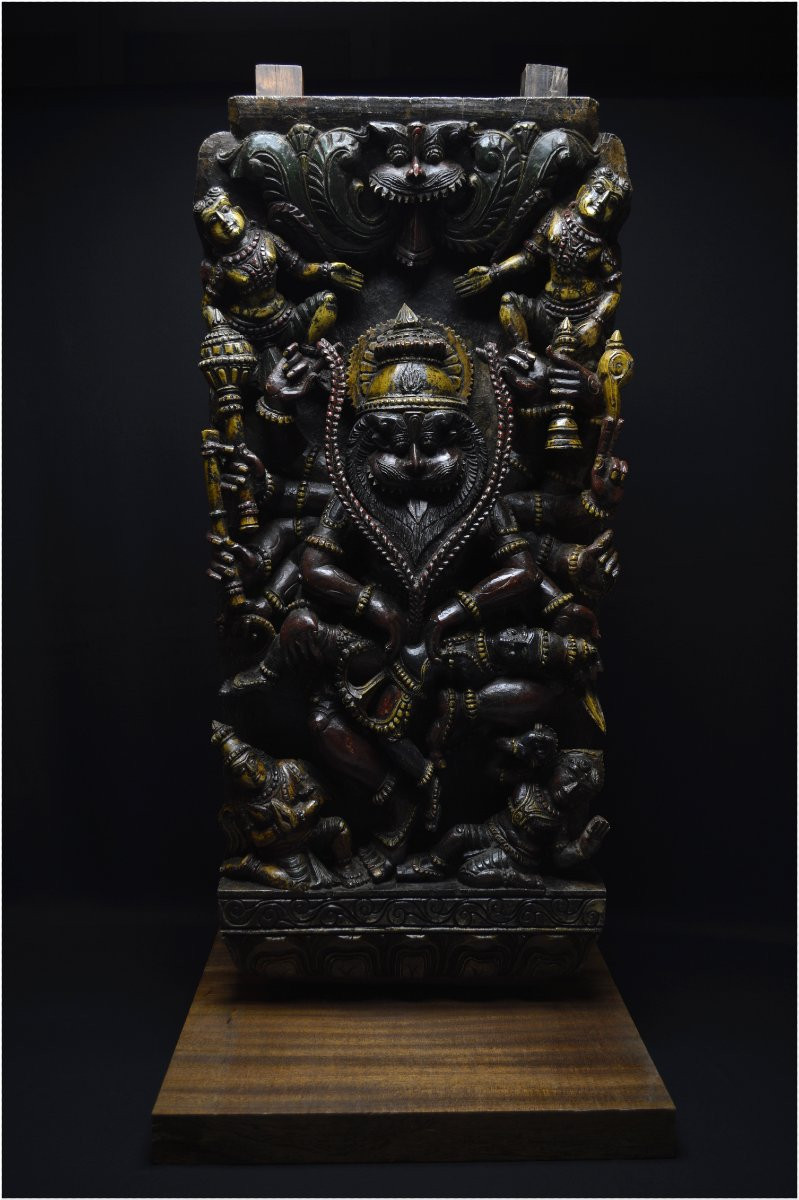
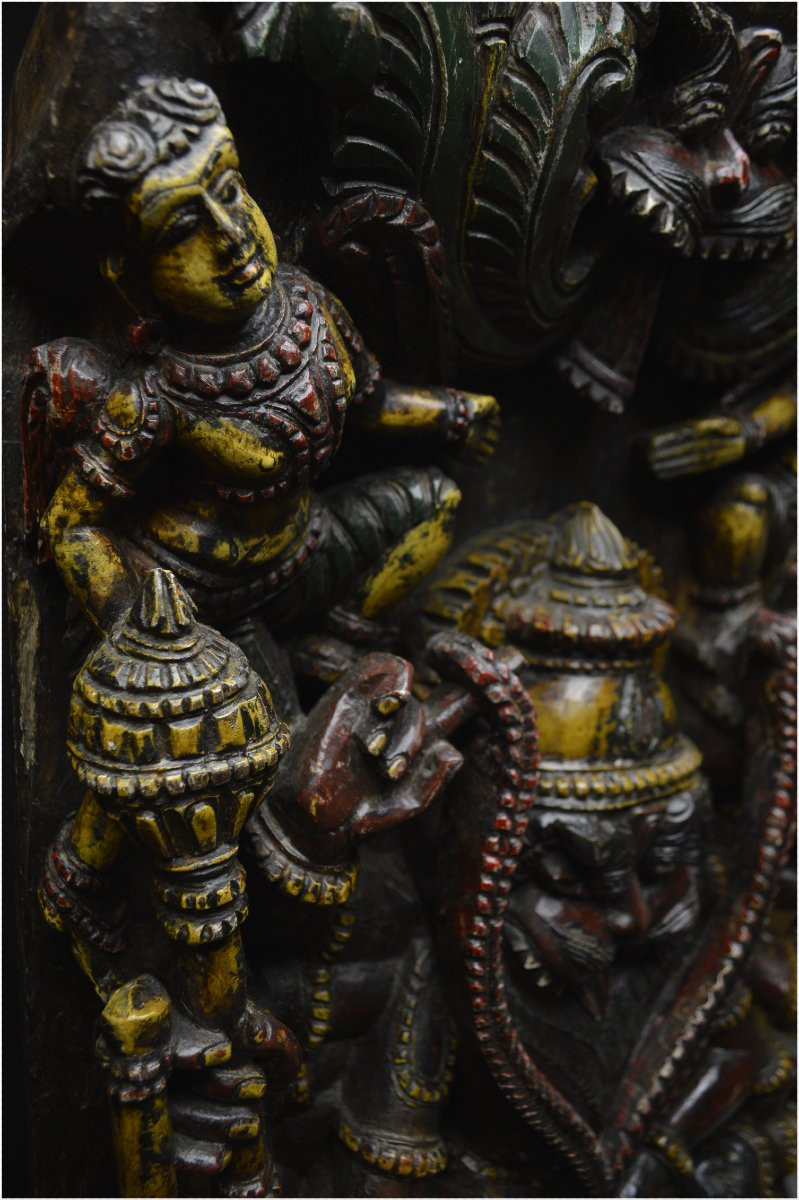
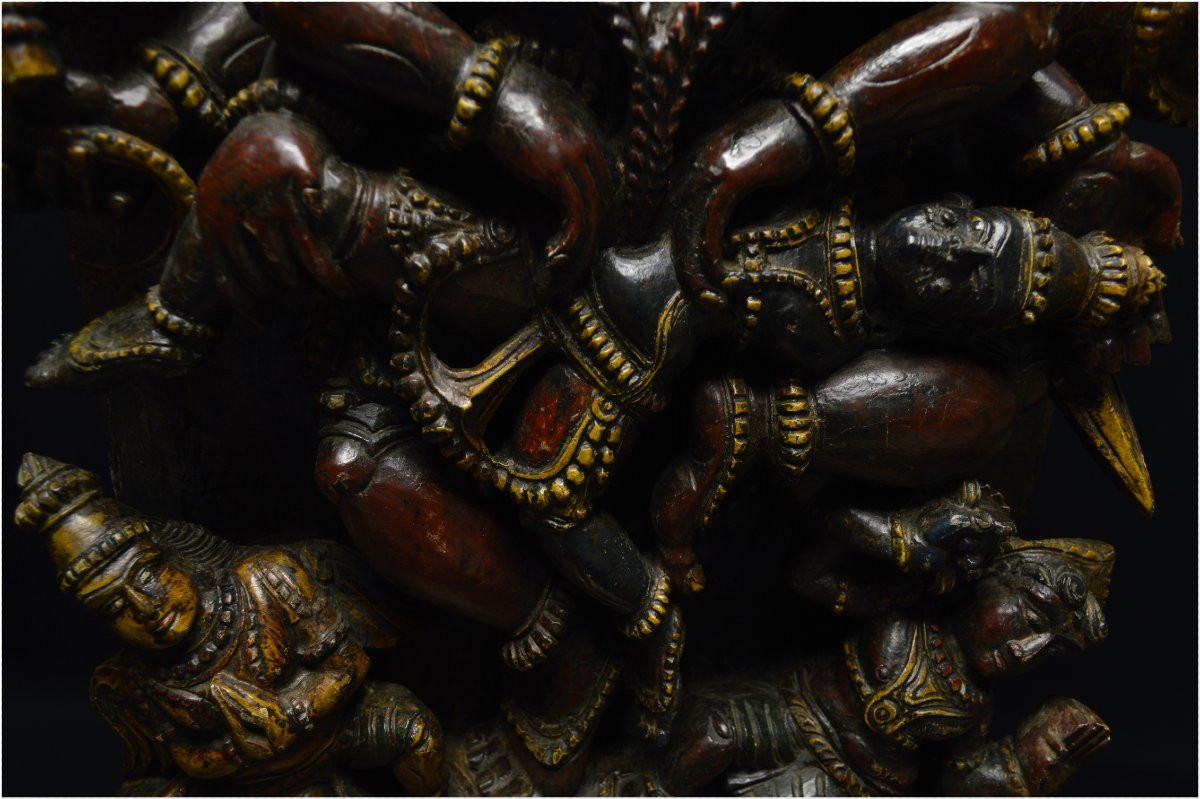
Vishnu is depicted in his avatar as Narasimha, half-man, half-lion, standing in the athibhanga posture, with his right leg bent and his left leg drawn up. He is depicted with twelve arms holding his traditional attributes: the bell (gantha), the mace (gada), the conch shell (panchajanya), the sceptre (danda) and the discus (chakra). Depicted here in his ferocious form (Ugra Narasimha), he embodies divine wrath against the demon-king Hiranyakashipu, whom he overpowers and disembowels. The two upper arms tear into and plunge into the demon’s belly, whilst two other arms brandish his entrails like a garland. He is adorned with numerous ornaments on his arms, wrists and ankles.
His head is crowned with a tall, richly crafted kiritamukuta adorned with the tilkat symbol, set against a halo of radiant light (prabhamandala), a symbol of his divine omnipotence. His face expresses a paroxysmal, almost frenzied rage: eyes wide open, fangs bared and mane bristling, embodying the fury, the uncontrollable force of Narasimha, whom even the gods fear. The defeated Hiranyakashipu is depicted lying on his back, held horizontally across Narasimha’s thighs. His face remains impassive as he still clutches his sword and circular shield, reminders of the battle he was about to wage.
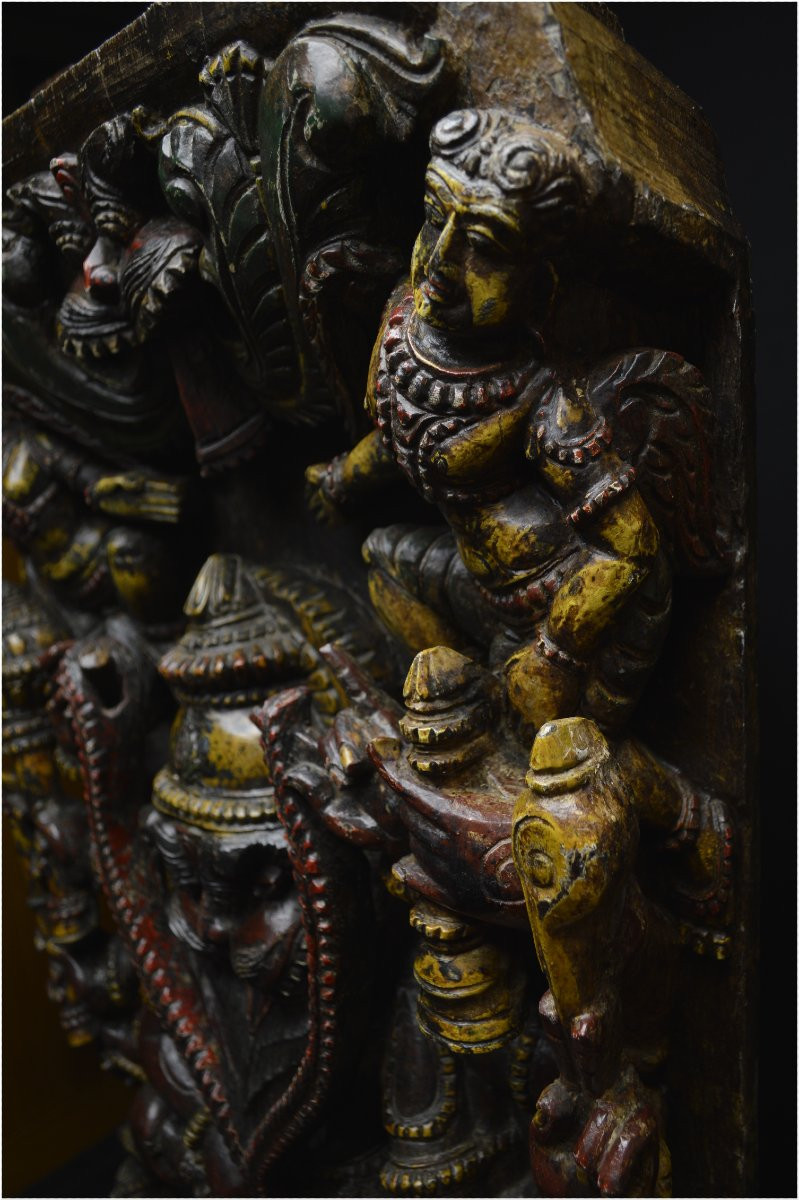
The upper register is dominated by a fearsome-looking head of Kirtimukha, intended to ward off evil forces: its mouth is wide open, from which stylised scrollwork emerges, its eyes bulging, teeth bared and tongue protruding. At each end, two vidyadharis, winged celestial nymphs, gracefully frame the scene.
At the base of the composition, on the left, a winged figure kneels in a devotional posture, hands joined in anjalimudra, representing Garuda, the faithful and devoted mount of Vishnu. On the right, a devotee of the demon stands back, frightened and paralysed, witnessing the terrible scene in which his master is literally disembowelled before his eyes. The whole rests on a frieze decorated with ripples surmounting stylised lotus petals.
The scene of Narasimha disembowelling Hiranyakashipu falls under the Bibhatsa Rasa, where disgust and violence are integrated into a codified artistic form.
The term rasa is a central concept in Indian aesthetics, denoting the emotional flavour or experience felt by the viewer when encountering a work of art (theatre, dance, sculpture, poetry). Bibhatsa, one of the nine rasas of classical aesthetic theory, corresponds to the feeling of aversion or repulsion. It plays a central role in the viewer’s emotional experience and illustrates the capacity of Indian art to transform the odious and repulsive into an aesthetic experience, turning the confrontation with discomfort into a source of beauty and spiritual depth.
Our piece depicts an iconic scene from Hindu mythology. It shows Vishnu in his fearsome form as Narasimha, slaying Hiranyakashipu. After the death of his brother Hiranyaksha, who was defeated by Varaha (one of Vishnu’s avatars), Hiranyakashipu harbours a deep hatred for the god. Through intense asceticism, he obtains near-invulnerability from Brahma: he cannot be killed by a man or an animal, nor by a god or a demon, neither by day nor by night, neither indoors nor outdoors, neither on earth nor in the heavens, nor by any weapon. Empowered by this, he transgresses dharma, overturns the cosmic order, imposes the worship of himself, and persecutes the devotees of Vishnu. The demon attempts on several occasions to kill his son Prahlada, a fervent devotee of the god, but the boy survives these murder attempts thanks to divine protection. Vishnu then intervenes in the form of Narasimha, a hybrid being half-man, half-lion, who thwarts Brahma’s blessing: he seizes the demon on a threshold at twilight, holds him on his lap and kills him with his claws, without breaking the conditions of Brahma’s blessing.
Our carved panel depicting Narasimha follows the tradition of Tamil Nadu’s processional chariot decorations, known as ther. These monumental wooden chariots are used during major religious festivals to carry the image of the deity out of the temple, thereby allowing the faithful to come into direct contact with it through darshan (the vision of the divine). The carved panels that adorn them, such as this one, depict immediately recognisable and highly symbolic mythological scenes, serving as a medium for devotion whilst conveying sacred narratives. They play a vital role in bringing the divine into the public space, transforming the chariot into a veritable mobile temple and making the procession a central moment in religious and community life.
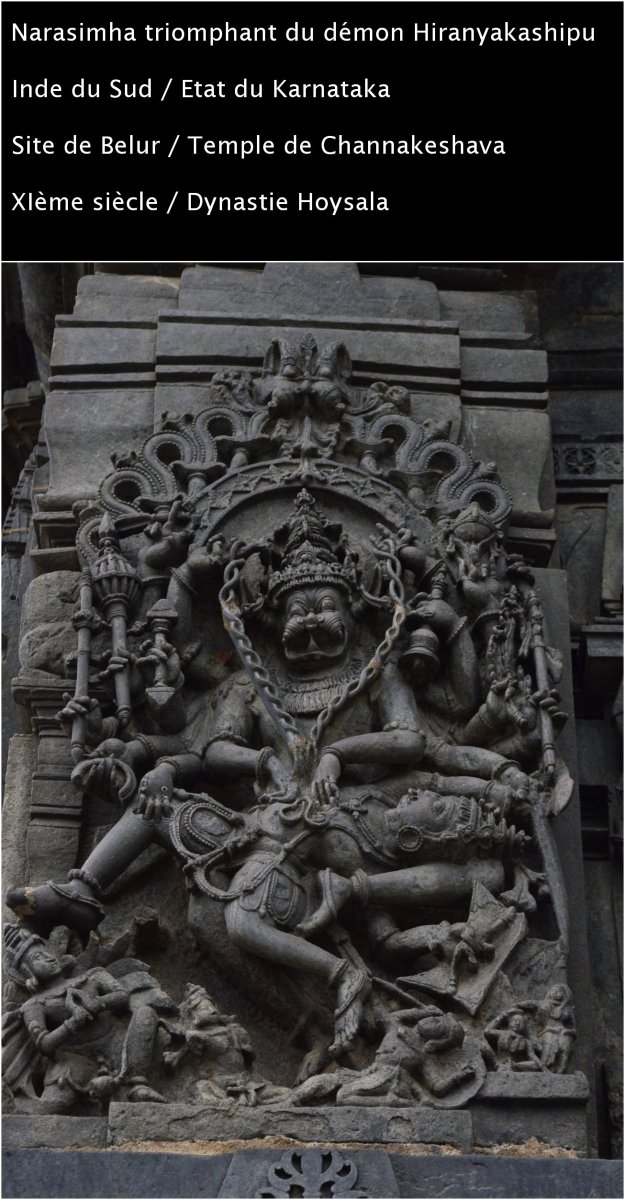
The last image depicts Narasimha slaying the demon Hiranyakashipu.
ChannakeshavaTemple, Belur site in the state of Karnataka, South India.
Hoysala Dynasty, 11th century
Polychrome wood
93.3 cm x 44.5 cm excluding tenon and plinth
Surface wear, otherwise in very good overall condition
From a private French collection
Contact us:culturesetcivilisations@orange.fr
Period: 19th century
Style: Asian art
Condition: Excellent condition
Material: Solid wood
Width: 44.5 cm hors socle
Diameter: 93.3 cm hors socle
Reference (ID): 1731648
Availability: In stock