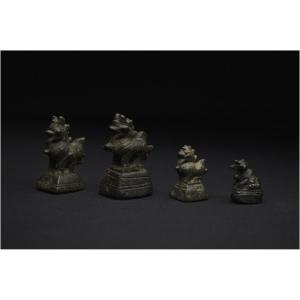
Burma, 18th-19th Century, Set Of Ten Bird-shaped Opium Weights, Bronze With Brown Patina
Set of ten bird-shaped opium weights
Burma
18th-19th century
These small bronze objects, commonly called opium weights, actually belong to a weighing system used in Burma from the 16th to the 19th centuries. Before the introduction of industrial weights by the British colonial administration, much of local trade relied on weighing rather than currency. These weights were used to measure high-value goods such as silver, gold, precious stones, and sometimes also opium, hence the modern name. Burmese artisans fashioned these weights in the form of animals or mythical creatures. Among the most common representations is the hinta, a mythical bird related to the sacred goose, which occupies a central place in the Burmese imagination.
A symbol of purity, wisdom, and prosperity, it is closely associated with royal power, justice, and cosmic balance. Its adoption as a form for weights conferred moral and political legitimacy upon the object, guaranteeing the fairness of transactions and the authority of the state or sovereign who controlled its use.
Produced for over three centuries, these weights gradually disappeared in the 19th century when British authorities imposed standardized iron models, putting an end to a tradition where economic functionality, religious beliefs, and symbolic aesthetics intertwined.
Bronze with a brown patina
From 1.6 x 1 cm to 6.8 x 5.2 cm
Signs of wear
Private collection
Contact us: culturesetcivilisations@orange.fr
499 €
Period: 19th century
Style: Asian art
Condition: Good condition
Material: Bronze
Width: voir descriptif
Height: voir descriptif
Reference (ID): 1675352
Availability: In stock
Print