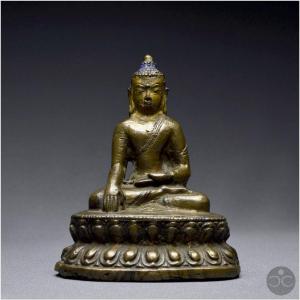
Laos, 19th Century, Representation Of The Maravijaya Buddha, Bronze With Brown Patina
Representation of the Buddha Maravijaya
Laos
19th century
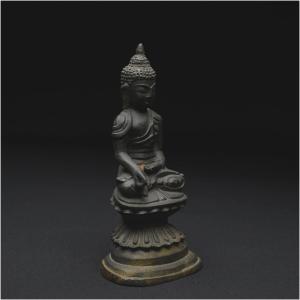
The Buddha is depicted seated on a bnase in the sattvaparyanka position, his right leg resting on his left, his right hand placed on his knee in the bumisparsha mudra with fingers pointing towards the ground, and his left hand resting in his lap, palm facing upward. His body has broad shoulders and a chest filled with the breath of meditation. The enlightened one is clothed in the sangathi and the uttarasangha, worn close to the body, leaving the right shoulder bare. A fold of the cloth draped over the left shoulder extends towards the navel. The face, marked by profound inner reflection, is characterized by large, lenticular eyes with half-closed eyelids, surmounted by pronounced brow ridges.
A long, aquiline nose, shaped like an eagle's beak, sits above a mouth with thin lips that hint at a slight smile. The neck displays the classic folds of beauty. The skull is covered with a multitude of small bumps bordered by a thin line and surmounted at its summit by the ushnisha, from which springs a rasmi in the shape of a lotus bud. The pointed ears, with their long lobes stretched by the weight of the ornaments the Buddha once wore in his worldly life, are curled outwards.
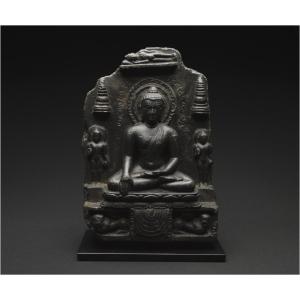
This representation of our Buddha is among the classic images of Buddhist statuary and refers to a particular episode in the life of the Awakened One. As he was nearing Enlightenment under the Bodhi tree, Mara, the god of perpetually unfulfilled desires, sought to distract the Blessed One and claimed the throne of Enlightenment for himself. Faced with Mara's repeated assaults, the Buddha remains impassive and, through this symbolic gesture, calls upon the Earth to witness his will to attain complete Enlightenment.
Bronze with brown patina
21.6 x 13.6 cm
Signs of wear
Private collection
Contact us: culturesetcivilisations@orange.fr
349 €
Period: 19th century
Style: Asian art
Condition: Good condition
Width: 13.6 cm
Height: 21.6 cm
Reference (ID): 1667106
Availability: In stock
Print